Exploring Taizhou: 'Sea Plain, Millennium Ancient City' - A Travel Photography Guide (Ultra-Complete Tips on Eating, Accommodation, and Transportation)
Taizhou, an ancient cultural city with a history of five thousand years,
has been known since ancient times as 'a vital water and land thoroughfare, a key strategic point.'
Taizhou, a city surrounded by dual waters without war,
takes its name from the meaning 'national peace and people's safety.'
Taizhou, a plain water city rooted in the sea,
is famously called 'Hailing.'
Taizhou, a romantic city that enjoys a slow-paced life,
indulges in the comfortable lifestyle of 'skin wraps water in the morning, water wraps skin in the evening.'
It is said that over 700 years ago, Marco Polo visited Taizhou and praised it, saying, 'This city is not very big, but there are many worldly pleasures,' a happiness that continues to this day, making it a romantic city with an extremely high happiness index.
The row upon row of concrete forests have awakened humanity's renewed recognition of nature.
Having spent too long in the steel forest of the city, accustomed to the bustling roads, and tired of the crowded masses,
why not come here for a mental release?
Escape the city and go to Lizhong Water Forest to experience a real-life fairy tale forest. As the weather gradually cools, go to Bishui Dongluo to enjoy the warmth under the sun. When night falls, go to Fengcheng River to enjoy the night view, listen to an opera, and savor the comfortable life in the water city. In the morning, taste Taizhou's most distinctive morning tea and baked cakes. Visit Mei Garden to explore the past and present of Mei Lanfang. Go to Qiao Garden, the first garden in Huai Zuo, to appreciate China's long history. Check out Taizhou's landmark, Wanghai Tower, to see the vastness of the sky. Visit the Salt and Tax Museum to learn about Taizhou's salt tax culture. Explore the exquisite beauty of Taizhou's Carved Flower Tower. Let's spend these few days getting a glimpse of Taizhou's essence.
So with that anticipation in my heart, I came to this water city, this romantic sea plain—Taizhou.
DAY 1: Xinghua: Lizhong Water Forest — Bishui Dongluo Homestay — Night Tour of Fengcheng River [Stay] Daohe Scholar Family.
DAY 2: Taizhou Morning Tea — Taizhou Old Street Grass Oven Baked Cake — Mei Garden — Qiao Garden — Wanghai Tower — Salt and Tax Museum — Carved Flower Tower Scenic Area [Stay] Daohe Scholar Family.
DAY 3: Daohe Ancient Street — Qintong Ancient Town — Qin Lake
Today's first stop is the long-awaited Xinghua · Lizhong Water Forest, where 'there is water in the forest, fish in the water, and birds in the forest,' forming a unique water town landscape.
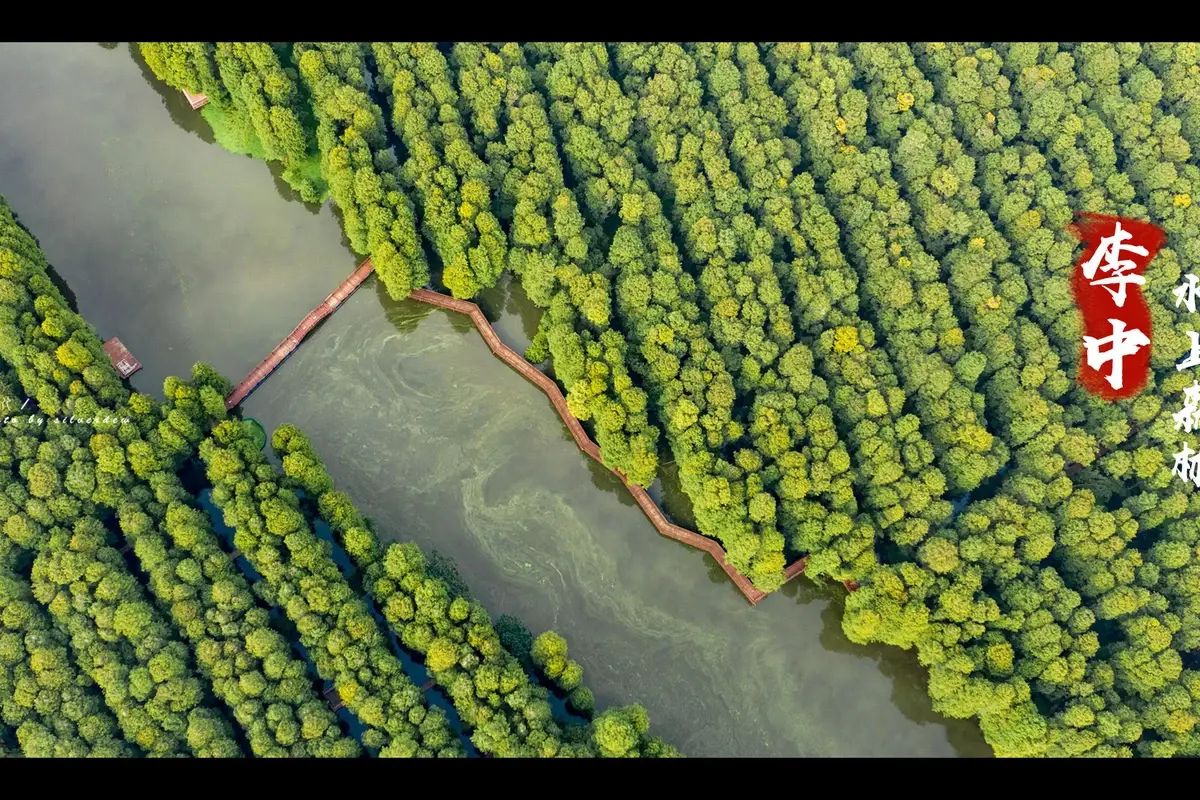
Lizhong Water Forest is known as the 'Little Jiuzhaigou of Jiangsu.' With endless green forests and the fragrance of herbs, it is a huge 'natural oxygen bar.' There are rows of pond cypresses growing on the clear water surface, with roots submerged underwater, dotted with duckweed on the water and fish swimming in it.
Upon entering Lizhong Water Forest, the first thing you see is the mysterious forest water lane. The crisscrossing waterways divide the 'raised fields' into a chessboard. Around the Qingming Festival, these 'raised fields' are covered with golden rapeseed flowers, forming a vast 'sea of flowers' on the water, stretching as far as the eye can see, like an ocean of flowers.
Walking along the forest path in the water, sunlight filters through the leaves, casting a gentle light on you. Take a deep breath of the fresh air, close your eyes, and listen to the birds and flowers. It's like the Wizard of Oz in a fairy tale world, or Alice's Wonderland.
This is like a magical forest castle, where everything is clothed in green. The bushes are graceful yet tall and straight, as if endowed with life.
After passing through the forest, the next stop is the Misty Wonderland. The water forest is far from the noise of the city, with negative oxygen ion levels tens of times higher than in the city. The 'Misty Wonderland' is in the core area of the scenic spot. When the thin mist rises and swirls in the forest, it feels like falling into a fairyland. The air is filled with a refreshing herbal fragrance. Gently tiptoe and feel the true comfort brought by nature.
Next is the highlight of the day: rafting in the forest. Sitting on a bamboo raft, following the river, and drifting into the forest, it feels like becoming one with the forest, becoming the most beautiful scenery here, like 'raft going through the forest, people traveling in a painting.'
We sat on the raft, moving forward slowly. Looking up, there was a sliver of sunlight; looking down into the water, there was a line of sky. On both sides of the water lane, the pond cypresses were like huge green umbrellas, forming a green fairy tale world.
We faced the light, letting the sunlight fall on our faces as it pleased. The bamboo raft glided gently on the water, a breeze brushed our faces, and there was a faint fragrance passing by.
The beams of light sweeping through the forest were ever-changing, adding a touch of mystery to the forest, like a bizarre magical planet landing here, with changing light and shadow performing a myth of stars and moon.
Roaming in the forest, I discovered a mysterious kind of root. The pond cypresses growing along the river, to facilitate breathing, have strange-shaped roots protruding from the water. Here we call them 'air roots.' These air roots come in various forms, some like immortals, some like figures, some like animals—all in different poses, lifelike.
Location: Near Shunsheng Bridge, Xingsha Highway, Qiansi Town, Xinghua City, Taizhou City, Jiangsu Province
Ticket price: 45 yuan for adults
Bamboo raft floating: 40 yuan per person
Opening hours: 8:30-17:00
Location: East of Shunchuan Road, Qiansi Town, Xinghua City, Taizhou City
After visiting Lizhong Water Forest Park, the sunlight was already covering the earth, so we decided to go to Bishui Dongluo to enjoy the sunset.
In the golden autumn, Dongluo Village exudes a pastoral atmosphere. The houses are neatly arranged, the fields are crisscrossed, and the folk customs are simple. It is embraced by Xiaguan River and Daxi River.
Continuing forward, we found a spot perfect for photos. Against the setting sun, a small bridge and flowing water appeared, with reed-covered lakes adding a touch of romance.
The entire village is dominated by blue bricks and small tiles, presenting a poetic scene of Jiangnan. There is also a Dongluo Grand Hall converted from an old temple.
It's only 6 kilometers from Lizhong Forest Park. After finishing the Lizhong itinerary, you can also stay here. The homestay is elegantly furnished, with spacious and bright rooms, perfect for friends on vacation, truly experiencing a leisurely rural life.
Behind the homestay is a large pond. Opening the balcony door, you can fully enjoy the sunset here—absolutely great.
Boating on the water, listening to a melodious opera, feeling the relaxation and cleansing of the soul brought by this ancient city, and experiencing the charm and allure of the water city!
Leaning on Fengcheng River, with water as the vein and people as the soul, a rare urban water charm appears in Taizhou, highlighting its long historical context.
Taizhou is a city of water. Water is Taizhou's characteristic and soul. The Fengcheng River, which nurtures generations of Taizhou people, surrounds the city with a thousand acres of water, making it one of the few well-preserved millennium-old ancient city rivers in Jiangsu Province. Boating on the river, I fully appreciated the historical weight of 'the state was established in the Southern Tang.'
Wanghai Tower at night has a unique charm, standing here like a guardian god, protecting the people's peace and well-being.
Our boat moved slowly on the water. Although autumn had set in, our fiery enthusiasm for this place could not be stopped. On the boat, we heard a ditty from not far away, lingering in our ears. A stage built on the water was extremely romantic.
An excellent antique homestay. Stepping inside felt like entering an ancient scholarly family. Just as its name suggests, the homestay was renovated from an old house, so the overall style is very charming.
This homestay was amazing, exceeding our expectations. The structure of the house was like a maze, with rooms of antique charm coming into view.
Walking here felt like traveling back to that era, with red lanterns hanging high and a pavilion in the courtyard for rest. If you have time, you might have a romantic encounter here.
The room was spacious and bright. I suddenly noticed a small pavilion in the room. In the afternoon, having a cup of tea here was great.
I really liked the pillows in the room; they were super comfortable, allowing me to have a good sleep.
Next to Daohe Scholar Family is Daohe Ancient Street. The first thing you see upon entering the ancient street is a stream that divides the street in two, with rows of antique, finely crafted old houses arranged in an orderly manner.
This Daocheng is not the historical Daocheng. Daohe is actually located outside the north gate of ancient Taizhou, facing the city river across the west dam to the south, and connecting to the Lixia River and Yanchang River in the north. It is the meeting point of the Yangtze River system and the Huai River system. In the second year of Yongle of the Ming Dynasty, after the opening of the Tai-Dong River from Dongtai to Taizhou, salt boats from the Huainan saltworks were moored here. Salt was carried by laborers over the dam into the city river and then transported westward along the Yunyan River. During the Republic of China period, there were hundreds of 'Lu Chen' shops on both sides of the river dealing in grain, and boats loaded with rice from the Lixia River were moored there. Hence the name Daohe (Rice River).
Speaking of Taizhou's cuisine, the first thing that might come to mind is the scenes from 'A Bite of China.' Let's go and taste them one by one. To sample Taizhou's specialty dishes, we deliberately got up early and went to the time-honored Guyue Tower to try authentic Taizhou morning tea.
How can you come to Taizhou and miss its special morning tea? Taizhou morning tea is traditionally summarized as 'one tea, three dim sum, one noodle.' 'One tea' means a cup of tea and a serving of hot dry shredded tofu, with one serving of hot dry shredded tofu called a 'tea head'; 'three dim sum' means three famous Taizhou breakfast items: buns, steamed dumplings, and shaomai; 'one noodle' means fish soup noodles, which is also the meaning of 'skin wraps water in the morning.'
This place is extremely popular. When we arrived in the morning, it was already full. I especially loved their crab roe buns and fish soup noodles—superb.
Da Zhu Gan Si (braised dry shredded tofu) is a dish known both at home and abroad. It is a must-eat dish whenever you come to Taizhou. Taizhou's dry shredded tofu is divided into two types: boiled dry shredded tofu and hot dry shredded tofu. The dry shredded tofu here is made from dried bean curd cut into shreds. Generally, the shredded tofu is cooked with shredded ham, shredded bamboo shoots, shredded mushrooms, shredded black fungus, etc. In high-end restaurants, shark's fin or bird's nest shreds are added. Cooked together into a soup, the taste is superb.
Besides Huangqiao Baked Cake, the grass oven baked cake on Taizhou Old Street is also very tasty, especially the freshly baked cake, which is crispy and delicious, leaving a lingering fragrance in the mouth.
Speaking of Mei Lanfang, he was world-famous at the time. His artistic achievements had long transcended national boundaries, ranking him with the world's art masters Stanislavsky (Soviet) and Brecht (Germany), collectively known as the three major performance systems.
Mei Lanfang's ancestral home is Taizhou. This Mei Garden was built especially on the 90th anniversary of his birth, named Mei Lanfang Park, later shortened to Mei Garden.
Mei Garden is located on the east outskirts of Taizhou city, on a beautiful legendary hill called Fenghuang Dun, surrounded by water and embraced by forests, suitable for the characteristics of Chinese garden architecture.
Entering Mei Garden, follow the stone path, face the sun, feel the breeze, sit in a corner of the pavilion, and quietly appreciate Mei Lanfang's artistic life.
Mei Lanfang Park has 'four wonders' worth seeing. The Mei Pavilion is the first wonder; the second is the large half-length white marble statue of Mei Lanfang, which stands in the middle of the pool outside the exhibition hall. The large white marble artistic image of Mei Lanfang playing Yang Taizhen in 'The Story of Taizhen' is the third wonder; the fourth is a huge stone tablet inscribed with a poem by Zhao Puchu composed during his visit to Taizhou.
The exhibition hall displays a large number of photos and artifacts from the master's lifetime. Mei Lanfang's representative Peking Opera works include 'The Drunken Beauty' and 'Farewell My Concubine'; Kunqu works include 'Si Fan' and 'The Wandering Dream in the Garden.' Each work has become a timeless masterpiece.
Address: No. 90 Yingchun East Road, East Suburb, Taizhou City, Jiangsu Province
Ticket price: 15 yuan
Opening hours: 8:00-17:30
Recommended play time: 2 hours
Suitable season: All year round
Transportation: Take bus 7, 10, 19, 22, or 36 to Yingchun East Road 90.
Qiao Garden is an ancient residence in Taizhou, Jiangsu. It is located in the old city of Taizhou, Jiangsu Province, bordering Hailing North Road (formerly Bazigiao Straight Street) to the west and Bazigiao East Street to the south.
Due to various reasons, part of the garden was destroyed, leaving only this portion. Although the existing garden is not large, it is cleverly conceived and has a long history, earning the title 'First Garden of Huai Zuo.'
Stepping into the garden feels like traveling back to the Wanli period of the Ming Dynasty. The garden is filled with green trees.
It is one of the oldest existing gardens in northern Jiangsu. Over the past four hundred years, it has changed owners many times, experiencing ups and downs. After hundreds of years of time, through vicissitudes, from prosperity to decline, from hustle and bustle to weathering the years, this garden that has seen all the world's changes still stands strong after more than 400 years, as if guarding every dynasty's people here.
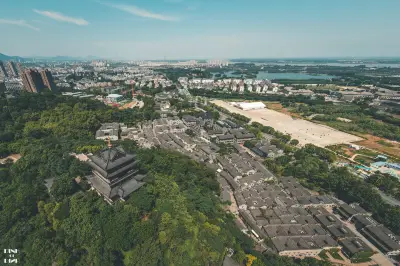
Wanghai Tower is a landmark of Taizhou. First built in the second year of Shaoding of the Southern Song Dynasty (1229), it has a history of over 700 years. Wanghai Tower has a magical characteristic: it was repeatedly destroyed and rebuilt, mostly destroyed by war and rebuilt during prosperous times.
It is said that during the Kangxi period, when it was rebuilt, it started with heavy rain and thunder, then cleared to a clear sky with cranes flying. The people were amazed and considered it an auspicious sign, so they placed increasing importance on the tower. The most recent destruction was in the early years of the Anti-Japanese War, also due to war. It is said that the fate of this tower symbolizes the rise and fall of the Chinese nation. Therefore, since the country is prosperous and Taizhou's industries are flourishing, how could Wanghai Tower not be rebuilt? So it was rebuilt in 2006 to bless the well-being of Taizhou's people.
How can you come to Taizhou without visiting Wanghai Tower? Upon entering Wanghai Tower Park, a path shaded by dense bamboo groves comes into view, as if stepping into a bamboo forest.
Continuing forward, a tall building can be vaguely seen standing here. This is Wanghai Tower. Taizhou Wanghai Tower Park covers an area of about 100 mu. The main attractions in the park are Wanghai Tower and the city wall ruins.
Wanghai Tower is located in the southeast corner of the park. The tower is over 30 meters high, built in the architectural style of the Song Dynasty. It has three outer ring corridors. The main colors are chestnut brown and gray, simple and elegant.
Location: Inside Fengcheng River Scenic Area, Hailing District, Taizhou City, Jiangsu Province
Opening hours: 8:00-17:00
Ticket price: 40 yuan
Recommended play time: 1-2 hours
Suitable season: All year round
1. Bus 301 can reach Fengcheng River Scenic Area, where Wanghai Tower is located.
2. Take bus 1, 9, 10, or 22 in Taizhou city and get off at Wanghai Tower. From the railway station, take bus 1.
Free ticket policy: Seniors aged 60 (local) or 70 (non-local) or above with a senior citizen card get free entry; active military personnel, tour guides, people with disabilities, impoverished households, and low-income households with valid certificates (documents) get free entry; children aged 6 (inclusive) or below, or under 1.4 meters (inclusive) get free entry.
Discount policy: Minors aged 6 (exclusive) to 18 (inclusive), full-time undergraduate students and below with a valid student ID get half-price tickets.
Taizhou is an ancient historical and cultural city that flourished because of salt and thrived because of taxes. The Salt and Tax Museum is located by the ancient city river of Taizhou, on the site of the historical Taiba Supervision Office. Known for its 'wealth of red millet and salt profits,' it is one of the important birthplaces of China's salt tax culture.
The Salt and Tax Museum narrates the origin of China's taxation and related history. China is an ancient civilization with a history of 5,000 years and a long-term self-sufficient agricultural society. Before the Tang Dynasty, the main national tax came from land tax. After the 'An Lushan Rebellion,' salt tax revenue rose to equal land tax. History records 'of the world's taxes, salt profits accounted for half.'
During the 1,200 years from the mid-Tang to the end of the Qing Dynasty, the salt tax from the Lianghuai region became the main source of salt tax revenue for successive dynasties. History records 'of the world's salt taxes, Lianghuai accounted for half.'
Among Lianghuai's salt tax revenue, Taizhou's salt tax accounted for half of Lianghuai's salt tax, hence 'of Lianghuai's salt tax, Taizhou accounts for half.'
Many know of the Carved Flower Tower in Suzhou's Dongshan, but few know that there is also a Carved Flower Tower in Taizhou. For many years, it remained hidden like a secluded beauty. One in the south, one in the north, like sisters.
The Carved Flower Tower is located in the southwest of Taizhou's Gaogang District, covering a total area of 88,000 square meters. The area, Chaiwu Ancient Town, has a profound history, is well-known, has many historical relics, and a concentration of traditional-style buildings.
This tower was built during the Qianlong period. The wood carvings, brick carvings, and stone carvings in the garden are exquisite, all classic works of carving art at the time, and it has the reputation of 'First Tower of Jiangzuo.'
The exquisite wood carvings 'Good Luck as Vast as the Eastern Sea' and 'Rhinoceros Gazing at the Moon,' the vivid brick carvings 'Lion Playing Ball' and 'Zither, Chess, Calligraphy, Painting,' and the profound stone carvings 'Five Blessings at the Door' and 'Five Blessings Symbols for Longevity' are all classic works of carving art, full of charm and emotion.
Entering the Carved Flower Tower feels like traveling back to the Qing Dynasty. The various carvings on the buildings are lifelike. Everywhere you go, you want to stop and savor the charm of these carvings. In this fast-paced society, occasionally being able to slow down is also a happy thing.
Thus, step by step, we pause and look, still not satisfied. The afterglow of the sunset shines through the rocks behind the pavilion, emitting a sparkling light. The sunlight falls on the carvings of the pavilion, as if endowing them with life, making them dynamic.
Besides the carvings, the garden scenery is also charming. It is a standard Suzhou-style garden architecture, showing that every brick and tile is crafted with care.
Qintong Ancient Town has a history of at least a thousand years. It is said that people lived here 5,000 years ago. Located in Qintong Town, Jiangyan District, Taizhou City, Jiangsu Province, the town is surrounded by water on all sides, with a river running through it. It is known as 'Zhouzhuang of Central Jiangsu.' The thousands of camellia trees in its temple are famous far and wide. During the Xia, Shang, and Spring and Autumn periods, the area had lush vegetation, with 'thousands of herds' of elk, and farmers 'farmed without plowing.'
Qintong Ancient Town is not yet fully commercialized and is well-preserved, with a large number of Ming and Qing architectural complexes such as Xiaoyi Lake Lane and Baxian Bridge Lane. There are many snack shops along the street, such as Huangqiao baked cakes and Jiangyan crisp cakes, all with excellent taste and reasonable prices.
The former residence of academicians has five rows of halls, with the entrance hall, hallway, main hall, back study, fire alley, and secret room well-preserved. The courtyard is full of beautiful flowers and ancient trees. A tree-lined path starts your visit to this ancient town.
The former residence of academicians, with five rows of halls, is a representative ancient residential building in the Lixia River area of central Jiangsu. Entering the residence, you see white walls and black tiles, slowly flowing pond water, architectural gray sculptures, and elegant brick carvings with profound meanings. The old-style houses exude more charm here.
Entering the courtyard, you find a place called the Sedan Chair Hall. As the name implies, it was the hall for parking sedan chairs in the mansions of officials and gentry in the old days. This shows how well the ancient residential architecture culture is preserved here.
Continuing forward is the Camellia Courtyard, also known as 'Flower Shadow and Clear Gao,' one of the eight ancient scenic spots of Qin Lake. The ancient camellia tree in the courtyard was planted in the late Song Dynasty, over 800 years ago. It has endured severe cold and heat, remaining green all year round, standing proudly in this land of three waters.
Around Qingming Festival, it blooms with thousands of flowers, a magnificent sight. It has formed 'sister flowers' and 'reunion trees' with the ancient camellia in Lijiang, Yunnan, and the grass mountain red camellia in Yangming Mountain, Taiwan. It is known as the 'king of artificially cultivated camellias in the world.'
Walking the paths that ancient people walked a thousand years ago, seeing the scenery they once admired, my mind occasionally flashes with the prosperity of this place a thousand years ago. One camellia flower after another blooms, delicate yet simple and elegant.
Passing through the gates here, I noticed that the gates are very distinctive. The top has two pointed corners, like cat ears, and the door below is like a cat's mouth. Every time I pass through a gate, it feels like entering a cat's den.
Before finishing Qintong Ancient Town, in the afternoon, we headed to Qinhu National Wetland Park, known as the 'Pearl of the Water Towns,' located in Jiangyan District, Taizhou City, Jiangsu Province. With 'water, wetland, and ecology' as its connotation, Qin Lake nurtures a natural landscape of quiet lakes, strange forests, exotic animals, and rich folk customs.
Qin Lake, also known as Magpie Lake, is the largest lake in the wetland park. Since nine main rivers converge into the lake from all directions, it forms a peculiar scene of 'nine dragons paying homage.' Taizhou Qinhu National Wetland Park covers a total area of 26 square kilometers, with lakes, rivers, etc., accounting for about 37% of the total area.
Qin Lake is called 'Magpie Lake' because of a beautiful legend. It is said that during the reign of Emperor Xuanzong of Tang, on a Mid-Autumn Festival night, Zhang Guolao used magic to send the emperor to the Moon Palace. After a dreamlike visit to the Guanghan Palace, the emperor was about to return when the divine dragon protecting him suddenly fell ill. A magpie fairy brought fairy grass to heal the dragon. In gratitude, the dragon roared, soared into the sky, and with his tail created a vast lake—this is Qin Lake.
According to records, the Qin Lake area is the homeland of the elk. The most elk fossils have been unearthed here, and they are the most typical in the country. Moreover, the only complete elk fossil specimen in China, treasured in Taizhou Museum, was unearthed here.
However, due to natural ecological changes and other reasons, the wild elk population became extinct a thousand years ago. It was not until the 1980s that these national treasure animals, stranded overseas, returned to their homeland from Britain, beginning to thrive again by the Qin Lake where their ancestors lived.
There is also the China Qinhu National Wetland Science Museum, which is super suitable for bringing children to visit and learn.
How can you miss the highlight here: a boat ride in the wetland? After putting on life jackets, we prepared to board. This boat ride was slightly different from our previous ones. Normally, a boatman rows the boat, but in Qin Lake, it is a boatwoman who rows.
On the boat, listening to the boatwoman's ditty, feeling the breeze from the water surface, and hearing the birds in the forest, with fish occasionally swimming in the water.
The islands in the lake are also beautiful, scattered like stars, with lush reeds. Sails flutter during the day, and fishing lights dot the water at night.
Location: Jiangyan District, Taizhou City, Jiangsu Province, at the junction of Taizhou and Dongtai cities
Recommended play time: 3 hours
Qin Lake ticket information:
Qin Lake: standard price 100 yuan
Qintong Ancient Town: standard price 40 yuan
Combined ticket (Qin Lake + Ecological Park + Qintong Ancient Town): standard price 130 yuan
Combined ticket (Qin Lake + Bridge Garden): standard price 140 yuan
1. Opening hours: 8:30-17:00
2. Ticket collection: Ticket window 2 at the Qin Lake Scenic Area group ticket office
3. Combined tickets are valid for two days. Yunhai Hot Spring is 300 meters from Qin Lake; Ecological Park is 3 km from Qin Lake; Ancient Town is 10 km from Qin Lake.
4. Special groups:
A. Free policy: Children under 1.2 meters, tour guides, tourist bus drivers, journalists on assignment, active military personnel, disabled persons, retired cadres, seniors over 70 in the province (among them, seniors need to buy a 20 yuan transportation boat ticket), (all above must present valid ID for free entry)
B. Discount policy: Children 1.2-1.5 meters, students from Taizhou's three cities and three districts, seniors over 60 in the province, seniors over 70 from other provinces and cities get half-price tickets (all above must present valid ID for half-price)
The three-day, two-night Taizhou trip ends here.
It is an end, and also a beginning.
We continue forward,
looking forward to meeting on the road.
Travelogue Directory: 1. Preface 2. Itinerary 3. 'Lizhong Water Forest': Misty Forest, Nature's Oxygen Bar 4. 'Bishui Dongluo': Enjoy a Slow Life 5. Night Tour of 'Fengcheng River': Boating on the Water, Listening to a Ditty 6. [Stay] Daohe Scholar Family 7. [Eat] Taizhou Morning Tea 8. 'Mei Garden': Visit Mei Lanfang's Past and Present 9. 'Qiao Garden': First Garden of Huai Zuo 10. 'Wanghai Tower': First Tower of Jianghuai 11. 'Salt and Tax Museum': Explore the Birthplace of China's Salt Tax Culture 12. 'Carved Flower Tower': First Tower of Jiangzuo 13. 'Qintong Ancient Town': Explore 'Zhouzhuang of Central Jiangsu' 14. 'Qinhu National Wetland Park': 'Pearl of the Water Towns' 15. 'END' Travel Information Hotel Index Guide Index Air Ticket Index Website Navigation Travel Index Cruise Index Corporate Travel Index Franchise Cooperation Distribution Alliance Partner Links Corporate Gift Card Purchasing Insurance Agency Agent Cooperation Hotel Franchise Destination and Scenic Spot Cooperation More Partnership About Ctrip About Ctrip Ctrip Hotspots Contact Us Careers User Agreement Privacy Policy Business License Security Center Ctrip Content Center Intellectual Property Trip.com Group Algorithm Disclosure