A Low-Key Small City in Jiangsu, Yet One of China's Happiest Cities, Scenic as a Poem or Painting, Rivaling Suzhou's Beauty
At the beginning of last year, 'Jiangsu in Bulk' became a meme, but the term 'bulk' was not invented by netizens; such phrasing has existed for a long time. Because the thirteen prefecture-level cities of Jiangsu Province all have a solid economic foundation, they are both competitive and cooperative with each other, making this term quite accurate for describing Jiangsu.
Recently, I saw the release of the '2020 China's Happiest Cities' list. Among the prefecture-level cities, a low-key city in Jiangsu made the list—Taizhou. Although Taizhou was just separated from Yangzhou in 1997, it shares similarities with Yangzhou in terms of culture, cuisine, and natural scenery, yet it is far less famous than Yangzhou, and rarely appears on travel recommendation lists. Its inclusion on this list surprised me, but also seemed well-deserved.
I was fortunate enough to visit it two years ago. Its deepest impression is captured in the city's promotional slogan: 'Happy Water Paradise, Slow Water City Life.' In this historic cultural city with over 2,000 years of history, wherever you look, clear waters flow gently, and ancient towns, old streets, gardens, and other cultural relics are scattered throughout. It has the typical landscape of a Jiangnan water town, yet with an extra touch of leisurely charm unique to a small city. As the Italian traveler Marco Polo praised after visiting Taizhou, 'This city is not big, but it is full of worldly pleasures.' It is worth diving into and savoring its small beauties.
Everyone knows Suzhou's Zhouzhuang Ancient Town, but few are aware that Taizhou hides Qintong Ancient Town. True to its name, the ancient Yangtze River and Huaihe River converge here before entering the sea, creating a unique landscape where water surrounds the ancient town, earning it the reputation of 'Zhouzhuang of Central Jiangsu.' In my opinion, Qintong Ancient Town is more down-to-earth than Zhouzhuang, combining gentleness with a touch of everyday life. Many courtyards are still inhabited, allowing you to effortlessly blend into the local lifestyle.
Qintong Ancient Town is not large. A vast area of well-preserved Ming and Qing buildings sits alongside local residences. Stepping onto the blue stone paths, famous sites such as the Former Residence of Academicians, the Ancient Camellia Courtyard, Shuiyun Tower, and the Li Clan Ancestral Hall are all within easy reach. There is no need to plan a specific route; just stroll along the old streets and visit them one by one. These buildings are remarkably well-preserved, making this ancient town the one with the most ancient residences in Central Jiangsu.
Besides ancient architecture, Qintong Ancient Town is also famous for its ancient trees. The most notable are the locust tree in the Lüshu Temple and the old tea tree beside the ancient well. The locust tree was transplanted from the Tang Dynasty, giving the temple its name. It remains lush and green all year round, like a giant umbrella protecting the temple. Legend has it that Dong Yong and the Seventh Fairy used this tree as their matchmaker, so now many couples come together, hanging red ribbons on the ancient tree, praying for the divine tree to bless their everlasting love.
Another camellia tree, planted during the Song Dynasty, is the oldest ancient camellia ever discovered in China, renowned as the 'King of Camellias in the World.' I arrived during the season when thousands of camellias were in full bloom, each flower as large as a bowl, a spectacular sight. Beside the tree is a well used for watering the flowers, one of the eight scenic spots of Qin Lake. It is said that on nights when the camellias bloom, one can appreciate the beauty of the flowers reflected in the well. Unfortunately, I was in a hurry and could not personally witness this charming scene.
Although Taizhou's gardens are not as famous as Suzhou's, each one is impressive in its historical background. Mei Garden was once the former residence of Mei Lanfang; Peach Garden is where Kong Shangren wrote 'The Peach Blossom Fan'; Willow Garden houses the Chinese Pinghua and Pingtan Museum. They are known as the 'Three Villages of Opera Culture.' Meanwhile, Qiao Garden, known as the 'First Garden of Huaihe Left,' was originally the residence of Chen Yingfang, a county magistrate of Jinhua during the Ming Dynasty, and is the most exquisite among Taizhou's gardens.
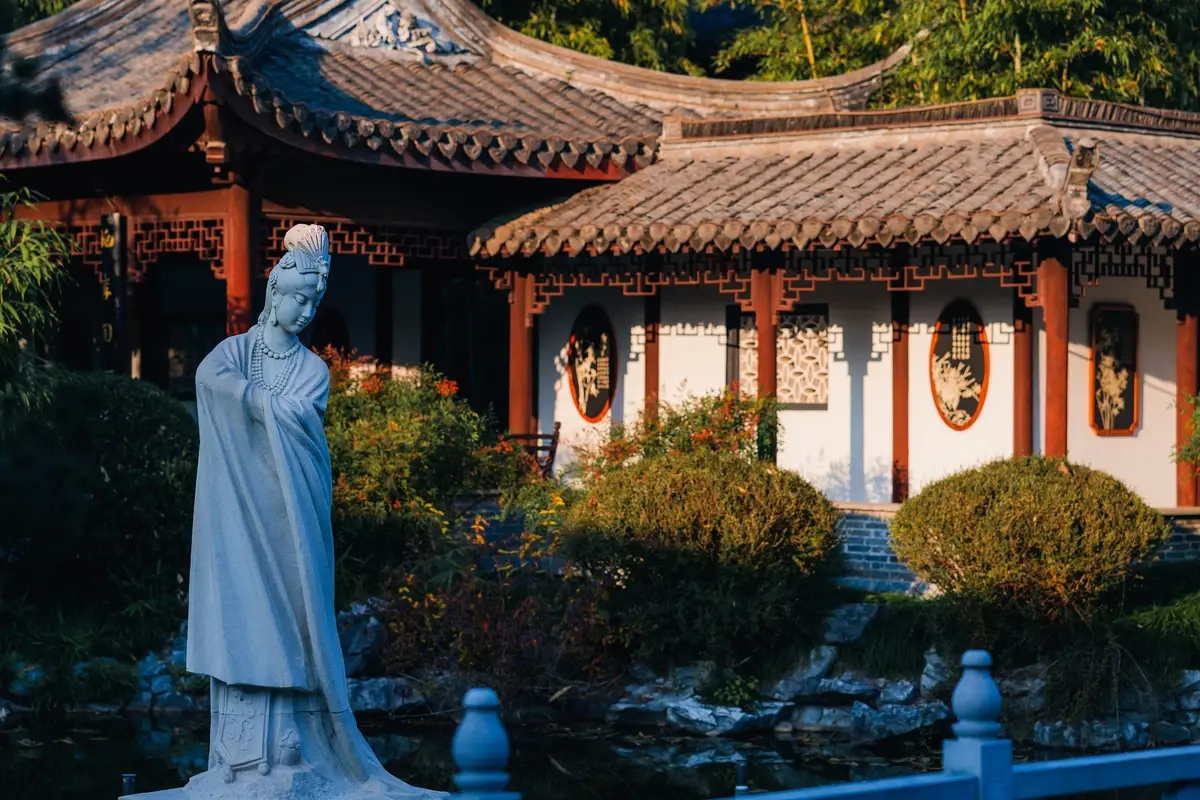
Even if you have visited the Humble Administrator's Garden, you will still be captivated by Qiao Garden's clever design. The layout of the garden is exquisite, with a new scene at every step. Each building stands uniquely, surrounded by lake stones, bamboo, and ancient trees, winding and twisting. Courtyards and residences are always connected by green pavilions; waterfalls, ponds, and swimming fish are everywhere. The garden is both orderly and distinctive, evoking poetic and artistic feelings.
Qiao Garden has a history of over 400 years, during which it changed hands many times. The garden has numerous small scenes, each with its own unique name: Shanxiang Thatched Cottage, Songchui Pavilion, Two-Fen Bamboo House, Jiaoyu Pavilion, Wengui Boat... All exude an air of elegance, reflecting the literary cultivation and meticulous craftsmanship of its owners.
Walking through the garden, you see almost no tourists, allowing you to quietly appreciate the various structures. Qiao Garden is a case of 'small but complete,' and the more you look, the more classical charm it reveals. Moon-gate arches are common in Qiao Garden, one after another, creating a layered view from a distance, like a garden within a garden. Particularly when red maple trees set off the scene, it forms a unique style.
The Fengcheng River is not only the mother river of Taizhou but also one of the few well-preserved ancient city rivers in Jiangsu that has lasted a thousand years. When you visit this water city, how can you not experience the charm of the Fengcheng River?
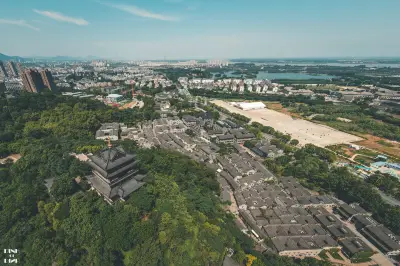
Compared to strolling along the Fengcheng River, boating on the river offers a deeper immersion. Usually, you can depart from the West City River Pier, head north along the river, then east, passing landmark sites such as the Salt Tax Museum, Guandi Temple, Liufang Pavilion, and Wanghai Tower, fully experiencing the profound history of 'the prefecture established during the Southern Tang.' Finally, you can ascend Wanghai Tower and overlook the beautiful scenery of the Fengcheng River's banks from the railing.
At night, the Fengcheng River is resplendent with flowing lights, presenting an antique and elegant scene. Sitting leisurely on a boat, watching the moon and the water under the night sky, is a delightful pastime. You can see performances of 'The Peach Blossom Fan' on the stone boat's bow, catch the majestic reflection of the Gulou Bridge, and gaze up at the imposing Wanghai Tower, all of which make you marvel at the unique charm of this small city.
Some images are sourced from the internet.