In March, Rapeseed Flowers Bloom, Water Nourishes Xinghua, Picturesque and Poetic
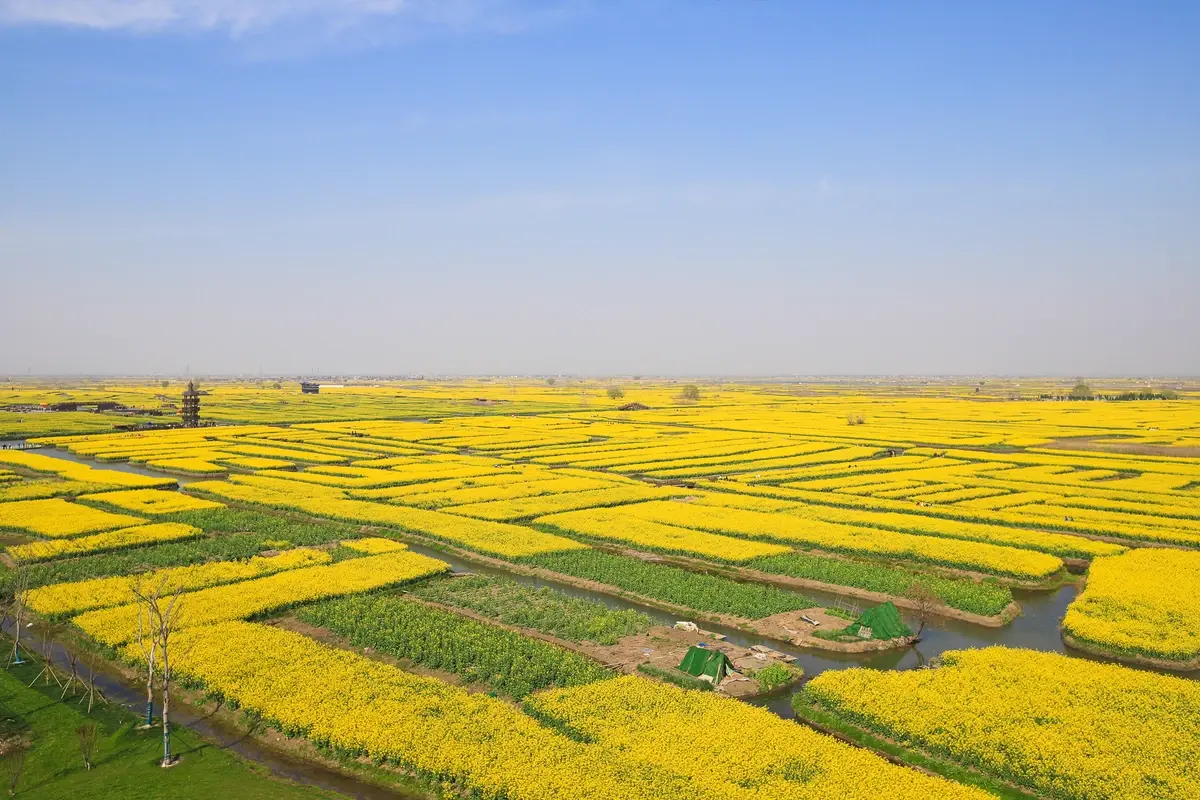
The most beautiful time of the year is March. In the spring of March, everything revives. Entering the Xinghua Qianduo Rapeseed Flower Scenic Area, looking into the distance, what captures the soul is the tens of thousands of mu of duotian rapeseed flowers. The blooming rapeseed flowers are vast and magnificent, like a mighty army or golden snakes dancing. I couldn't help but step into this sea of flowers; the fragrance penetrated my heart, and the golden color covered my eyes. I was like a white cloud falling into the flowers, gradually merging into this golden sea, in the boundless sea of flowers in Xinghua. Blending with nature, it forms a beautiful pastoral ink and oil painting.
Rapeseed flowers grow in the fields. From a distance, they look like a golden beach glistening with seawater; up close, they resemble small golden trumpets. When a breeze blows, the rapeseed flowers dance gracefully, swaying their golden trumpets. The fragrance wafts over, attracting bees and butterflies. Bees gather honey, butterflies dance along—this scenery is absolutely enchanting!
Entering the Xinghua Lizhong Water Forest feels like stepping into a dream world. The vibrant water forest forms a unique water town landscape of 'trees in water, fish in water, birds in the forest.'
In March, the thousands of acres of rapeseed flowers in Xinghua bloom like a poem and a painting.
March is the most beautiful season in Xinghua. One of the world's four major seas of flowers, the Xinghua Qianduo rapeseed flowers fill the garden. I have been to Xinghua before, but never in March during the rapeseed blooming season, so I had never seen the rapeseed flowers here before. I finally saw the Xinghua rapeseed flowers I had been longing for. When I entered Qianduo Rapeseed Flower Scenic Area and stood on the observation deck, looking out at the thousands of acres of blooming rapeseed flowers, a golden sea of rapeseed flowers appeared before my eyes, opening my horizons. I had never seen such a huge sea of rapeseed flowers; the scenery was beautiful and truly stunning.
Looking into the distance, the rapeseed flowers were already blooming luxuriantly, everywhere a golden yellow, like a layer of golden carpet spread on the ground. This was the first time I had seen such a large expanse of rapeseed flowers, and I felt especially happy and excited. Many tourists came to take photos, with laughter echoing in the rapeseed flower sea.
I came down from the observation deck and walked into the sea of rapeseed flowers. Immersed in the golden rapeseed flower sea, I watched the dancing bees gathering honey. Walking among the flowers, I felt as if I were in a golden ocean. I ran, cheered, and felt extremely relaxed.
Looking closer, rapeseed flowers could not be more ordinary. They lack the delicacy of roses; they have only simple four small petals, and the plain golden color is all they have. But when many ordinary small flowers connect, all petals pressed together, each flower leaning on the next, each embracing the other, their faces touching, they form a golden sea of flowers, the dazzling gold seemingly more brilliant than sunlight.
Approaching and carefully observing the rapeseed flowers, I found that each floret has four petals, and the petals are very small. Although a single petal is tiny, so many petals together form a large flower cluster. I gave it a good sniff—only a faint fragrance. These flowers all lifted their heads, as if vying to absorb the spring rain's nourishment, but all in silence.
Lizhong Water Forest Park, like stepping into a dream world.
Entering the Xinghua Lizhong Water Forest feels like stepping into a dream world. What appeared before me were rows upon rows of tall metasequoia trees. In the spring of March, the leaves of the trees had not yet sprouted. Here, there are over 100,000 metasequoia and swamp cypress trees, tall, dense, and vibrant in the water forest, forming a unique water town landscape of 'trees in water, fish in water, birds in the forest.' Walking in the forest, the temperature is much lower than outside, and the air is moist. Coincidentally, it was raining lightly. I took a bamboo raft to drift along the river, passing through one small river after another—very unique. Walking into the misty forest fog felt like entering a fairyland, stirring the imagination.
The forest fog in the scenic area should not be missed. Walking into the misty forest fog feels like stepping into a dream world. Every day, they release water mist in specific time periods. When you come here, don't miss visiting this spot; it's very photogenic. Plus, the purple flowers fill the entire garden. When the mist becomes like smoke, walking inside gives a different dreamy feeling.
Of course, coming here also requires experiencing the bamboo raft. Actually, it's a wooden raft. Sitting on the wooden raft, slowly moving along a green river, as the raft passes slowly, you can see tall trees. Drifting on the river gives a very dreamy feeling, passing through one small river after another—very impressive, as if traveling through a big forest. Every season, taking a boat through the forest offers different scenery. In this season, the new leaves of the metasequoia trees haven't grown yet, so the trees appear relatively bare, but you can see many birds in the trees, including egrets, busy building nests.
After the boat ride, you should head toward Peach Blossom Island to see the peach blossoms. This season, pink peach blossoms are in full bloom, very beautiful. On Peach Blossom Island, every peach tree is covered with beautiful blossoms. Some peach blossoms are in bud, as if ready to burst open at any moment. Others bloom with sweet smiles, like queens dressed in pink or white. Some are still striving to open, unfolding one petal, then two, showing their beauty to the city.
Entering the Xinghua Museum, learn about the city's past and present.
We often say that if you want to understand a city from ancient to modern times, you can visit the Xinghua Museum. At the entrance, you can see a statue of Zheng Banqiao. The first floor displays the development history of Xinghua, the formation of duotian, and the rise of salt boiling. Questions about Xinghua's history and geography can be answered here. On the second floor, the Zheng Banqiao exhibition hall tells the origin of his people-oriented thought and its influence on later generations, featuring many beautiful calligraphy and paintings worth seeing. Another exhibition hall is dedicated to Shi Nai'an, telling the story of his life.
The second-floor exhibition area displays many cultural relics, and you can see the ancient city's appearance. From here, you can learn about the living scenes of Xinghua people in ancient times.
The famous genius Zheng Banqiao at that time; from his statue, you can see he was not very tall, but he was the leading figure of the 'Eight Eccentrics of Yangzhou.' A versatile talent, he was a calligrapher, painter, and writer. He was a very remarkable figure in his time and naturally very famous locally. The entire exhibition area is about him, including later generations' evaluations and praises, worth carefully examining to understand him and the Xinghua of that era.
Next, we passed through a small door beside the museum's main gate to enter the Xinghua County Government Office (Li Garden). The most famous is the Li Garden Boat Hall, which, as the name suggests, is a building shaped like a boat. Hidden behind the Xinghua Museum, Li Garden is a well-preserved private garden in Xinghua, built by a salt merchant from Yangzhou in the Qing Dynasty. The highlight of Li Garden is its core building, the 'Boat Hall.' This small garden is very tranquil, with ancient trees and fragrant flowers, allowing you to fully experience the Jiangnan antique style.
Li Garden connects directly to the Xinghua County Government Office, where the county magistrate of Xinghua in the Qing Dynasty tried cases. Fan Zhongyan also worked here. The two stone lions at the entrance of the government office are ancient artifacts, still standing despite the vicissitudes. Notice the heads of these two stone lions; they are completely different from ordinary ones. You can see that their heads look very much like monkey heads, very interesting.
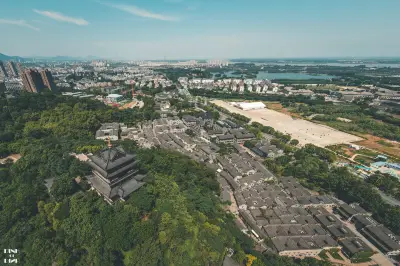
After exiting, we arrived at a building called the Four-Archway Tower, a landmark of Xinghua. Built in the Ming Dynasty, it looks like an eight-eaved pavilion from afar, containing hidden mysteries. As soon as you walk inside and look up, you can't help but exclaim. At the top of the archway, 47 plaques are hung layer upon layer, very spectacular. These plaques were all erected to honor outstanding figures in Xinghua's history, each one telling a story of Xinghua.
Entering the Zheng Banqiao Former Residence Yonglu Garden, an elegant and tranquil garden.
This is the 'elegant room' described in Zheng Banqiao's verse: 'A room may be small, but elegance need not be sparse; flowers need not be many, but fragrance should not be lacking.' It is more like a small courtyard than a former residence. The side rooms serve as studies; from the window, you can see the bamboo shadows swaying in the garden. The garden features pavilions, verandas, and a lotus pond with fragrant flowers, all elegant and tranquil. This is also a must-visit place in Xinghua's old town. If you don't have time to see other places, at least come here. It can be said to be Zheng Banqiao's back garden. Entering through a small door, you will be amazed—this is the real treasure of the former residence. It instantly opens up your view.
Zheng Banqiao was a native of Xinghua, Jiangsu, and the leading figure of the 'Eight Eccentrics of Yangzhou.' The former residence faces south, consisting of eight rooms of Qing Dynasty folk housing with white walls and black tiles, rustling orchids and bamboos, and a quiet courtyard. Inside are displayed a bronze-colored statue of Zheng Banqiao, reproductions of his calligraphy and paintings, and his daily utensils. Small calligraphy and painting exhibitions are held irregularly to promote Zheng Banqiao's artistic achievements. In summer, the lotus leaves in the pond are lush green, but at this time, only still water remains in the pond.
A light rain was falling. Sitting in the pavilion or walking on the path by the pond, one could feel the unique beauty of the garden. The rain grew heavier. We stayed here the longest because it was quiet, far from the city's noise, peaceful and far-reaching.
Entering the hometown of Shi Nai'an, experiencing the past prosperity of Jin Dongmen Old Street.
When the rain lightened, we walked to Jindongmenwai Street. The archway spanning this street was erected in honor of the 'Yuanlao Mansion' owner—Li Chunfang, a top scholar and prime minister of the Ming Dynasty. Next to the archway is a small temple. On both sides of the archway are ordinary houses; through half-open doors, you can glimpse their lives. First, we arrived at a pharmacy called Shangchizhai, a Ming and Qing building facing south, very conspicuous. This is the Shangchizhai Pharmacy, founded during the Kangxi period of the Qing Dynasty.
The front is the pharmacy, dealing in medicinal herbs—authentic and honest; the rear is the workshop, for drying and processing medicines—traditional and refined. The front-shop-back-workshop model, completely in Ming and Qing style architecture, well-preserved. After careful restoration, the old pharmacy once again stands vibrantly before the people of Xinghua.
We entered this deep, quiet old alley to glimpse the locals' living conditions. Limited commercialization has preserved the original market life here. A handmade leather shoe workshop, nostalgic red thermos flasks, bubbling tea eggs—all are filled with a nostalgic retro vibe.
Bishui Dongluo, Dongluo Village covered with rapeseed flowers everywhere.
In March, Dongluo Village exudes a pastoral atmosphere. Neat houses, crisscrossing fields, and simple folk customs. On the country paths, people with smiling faces bustle. Tourists stroll around the village, taking photos everywhere. Here, you can also enjoy leisure fishing, experience characteristic lakeside homestays, and taste fresh seasonal lake delicacies. Dongluo Lake surrounds the village; rapeseed flowers can be seen everywhere, embraced by the lake. The people here live happily, the roads are clean and tidy, with a strong rural pastoral flavor.
Entering the Dongluo Qiu Shi Museum, you can feel that it has transformed into a moderately prosperous life. Relying on the unique natural endowments of the duotian water town, Dongluo Village has transformed into a great tourist destination. Now, the villagers are wealthy and have higher demands for spiritual culture.
Walking in the village, rapeseed flowers bloom everywhere, clean streets, and each household's building looks like a villa. The air is fresh, and fish can be seen swimming in the river. The walls are painted with lotus flowers. A modern rural pastoral style is presented, making tourists want to come again after visiting.
Xinghua morning tea is unique, more flavorful and culturally rich.
Before coming to Xinghua, there might have been a misunderstanding about morning tea. Literally, morning tea means drinking tea in the morning, right? But when I came to Xinghua, I found that morning tea is far more than just tea; it is a series of local specialty foods and a dietary culture. Early in the morning, I went to a hotel for morning tea. As soon as I sat down, fragrant tea was served. First came several small plates: Xinghua sugar ginger, sliced beef, celery mixed with dried tofu, glutinous rice sweet lotus root, red dates, and boiled eggs.
Steaming baskets of crab roe buns arrived—crab roe buns, steamed dumplings, shaomai, and square cakes—four large baskets, which really shocked those with small appetites. The crab roe buns are handmade, with local river crab meat filling. Xinghua river crabs have solid roe, rich flesh, and plenty of oil. Made fresh and steamed, they are extremely delicious. Because the filling is large, the broth seeps into the soft leavened dough, both fragrant and moist. Take a bite, and the crab roe oil spills out. I ate three at once—so delicious!
Taizhou dried tofu shreds are slightly different from traditional dried shreds, emphasizing a smooth texture. After tasting the 'rawness' of the thousand-layer dried shreds, you naturally understand what refreshment means.
In Xinghua, there are three types of dried shreds: traditional Taizhou dried tofu shreds, blanched thousand-layer dried shreds, and braised dried shreds. Celery mixed with dried tofu, fresh and crunchy, is a must-have for morning tea.
The last course of morning tea is Yangchun noodles. Xinghua produces unique medium-gluten flour, making the noodles chewy, paired with chicken and fish broth, and garnished with Xinghua's green scallions and sesame oil. Coming to Xinghua gave me a completely new understanding of morning tea.
Xinghua cuisine should not be missed, a feast on the tongue.
When traveling to Xinghua, the one thing you cannot let down is the food, and the most famous here is the Xinghua hairy crab. But it is only available in autumn. Xinghua xunshao is actually a kind of braised meat; the smoked meat has excellent color and flavor, clean and refreshing, not greasy at all, but rather tender and fragrant with a unique taste. There is also Xinghua mixed small fish, cooked together with crabs, shrimp, eels, softshell turtles, snakehead fish, etc. Lotus root sandwiches are deep-fried, quite tasty. The flavor is good.
Lotus root sandwiches are called 'sha gou' in dialect; in the Weiyang cuisine, they are called 'ou he.' The freshly fried lotus root sandwiches are golden in color, moderately salty, not greasy, crispy, and rich in lotus root flavor. Autumn is the season for new lotus root and the best time to taste lotus root sandwiches. Of course, you cannot miss the fish here; the fish is tender and delicious, with a fresh taste.
Xinghua glutinous rice balls symbolize family reunion and happiness. The balls are the most profound impression of the New Year for Xinghua people. Xinghua's glutinous rice balls are a food made by wrapping fillings in glutinous rice and steaming them. They are round, symbolizing reunion, similar to northern yuanxiao but larger, with a sticky, smooth, soft, and delicious texture.
Staying at Zemuyunju Homestay, experiencing the tranquil pastoral scenery.
For seeing rapeseed flowers in Xinghua, I recommend this homestay. Xinghua Zemuyunju Homestay just opened a year ago, very close to the Water Forest Park and Qianduo Rapeseed Flower Scenic Area. The surrounding scenery is beautiful, the air is fresh, and it is very comfortable. At night, it is very quiet here. Having a delicious breakfast under the gentle morning sunlight is truly wonderful. It's also a great place to sip tea, read a book, and enjoy the lake view.
The homestay is on a small island, surrounded by water, with beautiful scenery. To reach the homestay, you can take a boat to the lobby, adding a fresh feeling to the stay, or cross the bridge and walk. The homestay just opened a year ago. Its design incorporates modern rural elements into the space, blending deep historical culture with modern urban style. There are several room types, with the lake view suites having the most beautiful scenery.
The homestay is very beautiful; having just opened, all facilities are new. The bedding is excellent, very comfortable to sleep on. The homestay has multiple floors. Stepping out onto the balcony, the lake view is fully in sight. At the back on the first floor, there is a small courtyard where you can sit, basking in the sun while enjoying the lakeside scenery. The homestay is surrounded by many rapeseed flowers, visible as soon as you step out.
The interior is a simple modern design. It is very quiet at night; in summer, you can hear the frogs croaking. Opening the balcony door reveals the lakeside. The decoration is relatively new, the bed is comfortable, and the bathroom has strong hot water. However, the temperature here is lower at night, so you need to keep warm.
Transportation guide: Self-driving or taxi is recommended. You can park in the parking lot opposite the homestay and then walk over to the homestay, which is more convenient.
March is the best season to enjoy rapeseed flowers. Xinghua's rapeseed flower duotian are very distinctive. Thousands of acres of rapeseed flowers stretch endlessly, spectacular. Seen from above, each duotian looks like a stroke of Chinese characters written by God on the earth, with a unique charm. Water nourishes Xinghua, picturesque and poetic.