Embrace Spring: A Most Beautiful Encounter with Xinghua
In the warm, sunny March, it's that time for spring excursions again, and this time we're in Xinghua, Jiangsu.
I've been to many places in Jiangsu before, but this is my first time in Xinghua. This small place may be modest in size, but it has plenty of delicious food and fun things to do.
A trip in Xinghua can begin with a morning tea; head to the Qianduo Flower Sea for a date with rapeseed blossoms; explore the museum and old streets to uncover Xinghua’s history and witness the vicissitudes of the past; feel a different charm in the water forest…
This is Xinghua—a city that has produced talented people since ancient times and boasts a rich cultural heritage. Geographically situated between the Yangtze and Huaihe rivers, it's not a typical Jiangnan city, yet it exudes the distinctive atmosphere of a Jiangnan water town. If you come to Xinghua, you'll fall in love with everything here, just like I did.
March spring breezes awaken the city’s ‘golden armor’
Everywhere you look is brilliant yellow; it's that time of year when rapeseed flowers take over your screen. In your free time, gather a few friends and go flower-viewing and spring-outing. When it comes to rapeseed flowers in Jiangsu, everyone immediately thinks of the Qianduo Scenic Area.
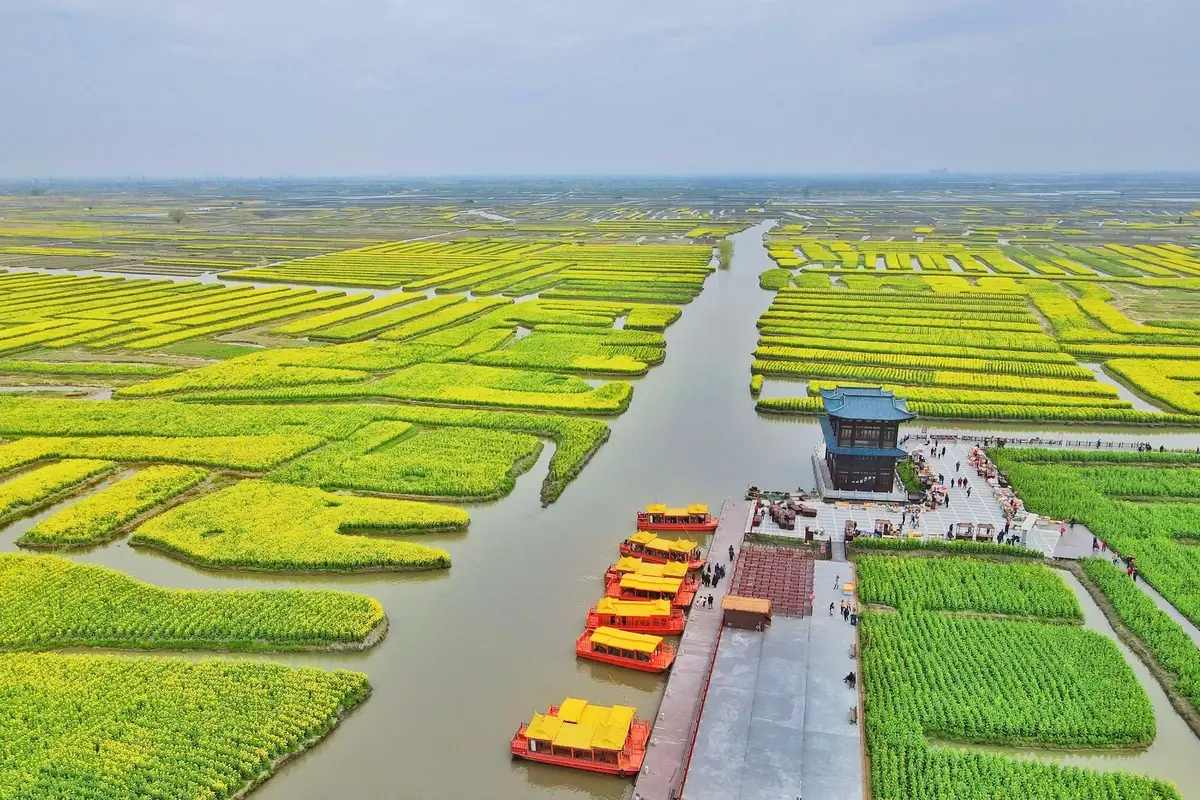
You may have seen many rapeseed flower fields, but a ten-thousand-mu 'duotian' (raised field) rapeseed field is probably a first. This season, the most beautiful rapeseed flowers in Jiangsu are definitely the Qianduo rapeseed flowers in Xinghua. The thousand-island-like duotian landscape is renowned worldwide. It's a one-of-a-kind place, one of the world's four great flower seas.
Legend has it that the Qianduo formation was originally an Eight-Trigrams battle array set up by Yue Fei, the prefect of Taizhou, during his battles against the Jin army. With an average elevation of less than two meters, Xinghua’s farmland was prone to waterlogging. So during dry seasons, locals would dig mud from low-lying areas and pile it onto higher ground, creating small island-like raised fields—duotian. These fields vary in size and shape, unconnected to each other and accessible only by boat.
You can climb the viewing platform to overlook the breathtaking Qianduo Flower Sea. The duotian fields crisscrossed by canals look like islands floating on water, earning it the nickname 'Country of Ten Thousand Islands.' Around the Qingming Festival, when the rapeseed flowers bloom, blue sky, emerald water, and golden islands weave a magnificent picture: 'Rivers have myriad bends and clear waters; every duotian field is covered in yellow flowers.' That’s why it’s hailed as the world’s most beautiful rapeseed flower sea.
Vast patches of rapeseed flowers bloom in the fields, adorning the area with added beauty. Unadorned yet full of vitality, the rapeseed flowers bloom in fields, along riverbanks, and among old houses. Many visitors stroll through the golden flower sea, snapping photos, their smiling faces as bright as the blossoms.
Waterways run through the flower sea. If you're interested, take a boat ride through the golden expanse and admire the beauty from a different angle—you might discover a unique charm and a different kind of experience. If the weather cooperates, you might see the golden sea in mist, a fairy-like haze where the vast splendor appears vaguely, making it easy to get lost in the scene.
Tip: The rapeseed flowers are at their peak around the Qingming Festival.
Address: East end of Dongwang Village, Qianduo Town, Xinghua City, Taizhou, Jiangsu
Getting there: If you're from nearby, driving is recommended; the scenic area has a large parking lot. You can also take a high-speed train to Taizhou Station, then transfer to a bus or car for about one hour to the scenic area. Alternatively, take Xinghua Tourist Bus 1 or 2 to the Rapeseed Flower Scenic Area stop.
Opening hours: 8:00–17:00
Ticket price: 100 yuan per person (including entry and boat ride).
Though Xinghua is a small city, it boasts a profound history and culture. This ancient town with a history of over 2,000 years has produced many historical figures. Zheng Banqiao, the foremost of the Eight Eccentrics of Yangzhou, and Shi Nai’an, author of 'Water Margin,' are both from Xinghua.
Visit the Xinghua City Museum to learn about Xinghua’s past and present.
Xinghua has long been a gathering place of literati and celebrities. To understand the origins of a city, one must know its history. This museum presents the development history of Xinghua.
The Xinghua City Museum, built in 1993, is a three-story pseudo-classic building, forming an 'one body with two wings' layout with Zheng Banqiao’s Former Residence and Liu Xizai’s Former Residence. The Confucian ritual vessels from the Xinghua Confucian Temple, preserved intact through the Ming and Qing dynasties to today, are complete with a full variety and serve as an important historical testimony to ancient Chinese Confucian culture and education.
Zheng Banqiao’s Former Residence Memorial Hall
Zheng Banqiao was a Qing-dynasty painter and calligrapher, a native of Xinghua and a representative of the 'Eight Eccentrics of Yangzhou.' His former residence in Xinghua, Jiangsu, is a relatively niche attraction. The courtyard is small but exquisite and modest. Bamboo groves around the house, with green bamboo reflected in flowing water, create a dance of bamboo shadows. Pavilions, terraces, and waterside halls make the whole environment exceptionally elegant and serene. The garden and architectural style reflect the cultural richness Zheng Banqiao’s home conveys.
Zheng Banqiao’s former residence is just one part of the Zheng Banqiao Memorial Hall. Upon entering the memorial hall, you see three plaques: Zheng Banqiao Memorial Hall, Shi Nai’an Memorial Hall, and Xinghua City Museum. To the right of the entrance is a full-length statue of Zheng Banqiao. Most exhibits display his life, artistic achievements, and original calligraphy and paintings.
The old street is an important part of Xinghua’s historic city, still preserving streets from the Ming and Qing dynasties. It can be divided into two sections: the area near the museum is mainly a commercial street, while Yongjinmen focuses on everyday street life scenes.
Jindongmen Old Street has a long history and rich heritage, dotted with temples, mansions, memorial archways, former residences of celebrities, grand merchant houses, ancient trees, and old wells, forming a multifaceted cultural carrier. It's arguably the best-preserved historical district in the Lixiahe area.
The old street is steeped in culture; strolling along it always brings a deep sense of warmth and reassurance.
Stepping into an old pharmacy on the street is truly evocative, like traveling through time. It’s a microcosm of the old street’s history and full of atmosphere.
In the middle of the square stands a square pavilion with double eaves and upturned corners—the Sipailou. Inside and outside hang 47 plaques honoring the outstanding talents and figures from Xinghua’s history. Most of the plaques are inscribed by renowned contemporary calligraphers and painters, making them artistic treasures.
Outside the East Gate is a Ming-Qing thoroughfare, anciently named ‘Tongtai.’ Since the Qing dynasty, it has been called Dongchengwai Street. Just east is a northward-extending lane called Zhuangyuan Alley, where Li Chunfang, a number one scholar during the Jiajing reign of the Ming dynasty, lived in his early years.
The Xinghua county government office was originally built during the Chunhua period of the Northern Song dynasty. During the Tiansheng period, Fan Zhongyan served in Xinghua and built sea dykes, established schools, and developed the city, putting into practice his lifelong ambition of ‘being the first to worry about the world's troubles and the last to enjoy its comforts.’ In 2009, the Xinghua municipal government relocated and reconstructed the Song-dynasty office using the principle of restoring it to its original state, rebuilding the main gate, watchtower, ceremonial gate, main hall, two side corridors, and the Plum Ridge and Plum Pavilion built by Fan Zhongyan.
After long city life, do you, like me, want to escape the glitz and noise and return to nature? Boating through a forest sea, clouds drifting in the water—this is the biggest charm of Lizhong Water Forest.
Lizhong Water Forest Park is a man-made ecological forest. The park was originally barren riverbanks. In the early 1980s, local officials and residents rationally developed these wastelands into raised grid fields, planting trees like pond cypress and dawn redwood that thrive in water, and intercropping taro, rapeseed, and other cash crops. Today, over 100,000 trees have grown into a tall, dense, vibrant water-borne forest—a natural oxygen bar that offers city dwellers a perfect escape back to nature.
Lizhong Water Forest Park typically combines two ways to explore:
Entering the park, there's a ferry on the left where you can board a bamboo raft.
Drift slowly along the waterways, watching vast stands of pond cypress and dawn redwood rooted in the water, standing tall and reaching into the sky, truly a green forest on water. The forest hosts many bird species—owls, wild ducks, egrets, black cuckoos, grass parrots, magpies—and bird nests are visible in treetops everywhere. Normally there are over 30,000 birds, peaking at over 60,000. You might startle water birds resting on the banks, sending them fluttering into the air, which draws many photography enthusiasts to capture the moment.
On the raft, your ears are filled with crisp, melodious bird calls. Look up and see bird nests of various sizes, watch birds fly by carrying twigs to build nests.
'Water within the forest, fish in the water, birds in the trees' is the hallmark of Lizhong Water Forest. Follow the park’s guide signs to stroll among attractions like Little Jiuzhaigou, Banqiao Plank Path, Rarely Sober Forest, Buyun Bridge, and Forest Water Alleys. Sunlight filters through the leaves; breezes sweep through the forest, carrying the occasional warbling of birds. There are also water stilts you can walk on, giving a feeling of floating on water. In the misty illusion area, purified groundwater is atomized by high-tech devices, shrouding 3,500 square meters of forest in misty ambiance—perfect for taking gorgeous photos.
On Peach Blossom Island, you can also see blooming peach blossoms.
Tips: April, when rapeseed flowers bloom, is the best time to visit both Xinghua and the Water Forest Park. If you want to photograph birds, early morning or dusk is recommended.
Getting there: Driving is recommended; there’s a parking lot with a fee of 10 yuan per time. You can also take Xinghua Tourist Bus 1, Route 201, or Route 201-1 and get off at the Water Forest stop.
Opening hours: 8:30–16:30
Ticket price: 45 yuan per adult.
When in Xinghua, you must experience the morning tea culture. The locals' passion for morning tea is no exaggeration. As soon as day breaks, they head out for breakfast, otherwise you'll face long queues if you go late.
This huge spread can be said to be the most sumptuous breakfast I’ve ever had. A great day starts with a great breakfast. My favorite is the palm-sized crab roe bun—one bite and the rich juices flow out, simply delicious.
Besides morning tea, Xinghua has many other specialty delicacies waiting for you to discover.
How to get to Xinghua: Fly to Nanjing, Yangzhou, or Changzhou, then take a high-speed train to Taizhou Station, and transfer to a car or bus to Xinghua.
We flew to Nanjing, took a high-speed train for just over an hour to Taizhou, then drove about one hour to reach Xinghua.
If you're from nearby areas, driving is quite convenient.
Boutique B&B: Zemu Yunju
The B&B is on a small island, extremely peaceful and tranquil. You can even choose to arrive at the lobby by boat—how interesting is that?
The B&B just recently opened, located in Liuze Village, very close to attractions like Qianduo Rapeseed Flower Scenic Area and the Water Forest Park. In April, Xinghua is awash with rapeseed flowers, and the B&B’s surroundings are no exception. Lakes and mountains set each other off beautifully. Across from the B&B, there’s a large glass-house where I especially enjoyed resting in the afternoon.
The B&B is designed in a New Chinese style, warm and cozy overall. The bedding is of very high quality and extremely comfortable.
Travelogue Contents
1. A Note to Begin
2. Qianduo Flower Sea
3. Xinghua Past and Present
4. Water Forest
5. Xinghua Cuisine
6. Practical Information
Travel Info Hotel Index Guide Index Flight Index Site Map Travel Index Cruise Index Corporate Travel Index Franchise Cooperation Distribution Alliance Friendly Links Corporate Gift Cards Insurance Agent Agent Cooperation Hotel Recruitment Destination & Scenic Spot Cooperation More Franchise Cooperation About Ctrip About Ctrip Ctrip Hot News Contact Us Join Us User Agreement Privacy Policy Business License Security Center Ctrip Content Center Intellectual Property Trip.com Group Algorithm Announcement