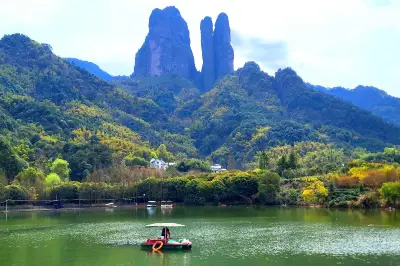
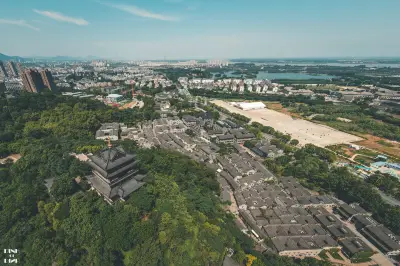
Spring Tour of Xinghua: Encountering Ten Thousand Mu of Flower Sea
Xinghua is located between the Yangtze and Huaihe rivers. It is not only an ancient historical and cultural city but also an emerging tourist city, famous for its 'thousand-island rapeseed flower scenery'. It has 76 cultural heritage protection units at various levels, full of water town charm.
Spring is the season of flowers, especially rapeseed flowers.
Speaking of rapeseed flowers, many might first think of Wuyuan, but in Xinghua, there is also a sea of rapeseed flowers, namely the Qianduo Scenic Area.
Qianduo Scenic Area is located east of Dongwang Village, Ganggu Township, Xinghua City, covering nearly 10,000 mu. Unlike Wuyuan, Qianduo Scenic Area features the famous 'Duotian' (raised fields), which has been recognized by the United Nations Food and Agriculture Organization as a Globally Important Agricultural Heritage System. It is also known as one of the 'Four Great Flower Seas of the World', alongside the lavender fields in Provence, France, the tulip fields in the Netherlands, and the cherry blossom fields in Tokyo, Japan.
'Duotian' refers to a unique agricultural landscape in the Lixiahe region. These fields vary in shape and size, surrounded by water but not connected to each other, resembling islands in the sea, hence the name 'Land of Thousand Islands'.
Once upon a time, this area was a swampy grassland, uninhabited. It was not until the Southern Song Dynasty that the Jin general Wanyan Wuzhu set up camp on the grassland 9 kilometers from Yue Fei's camp. To defend against the Yue family army, he dug a Bagua-shaped trench around his command tent and piled the excavated earth into mounds and embankments as defensive barriers.
However, over time, sediment from the upper reaches of the Yangtze and Huaihe rivers raised the terrain in the west, south, and north, while the central area became a concave basin. The confluence of three rivers raised the water level, turning the trenches into ditches and the mounds into islands surrounded by water. Through the hard work of countless laborers, the Qianduo Scenic Area was born.
Due to the high terrain, good drainage, and fertile soil of the raised fields, they are particularly suitable for growing fruits and vegetables. As early as the 1950s, they earned the reputation of 'Duotian rapeseed, leading the nation'.
But what truly made Qianduo Scenic Area famous is its rapeseed flowers, attracting countless visitors who come with high spirits and leave fully satisfied.
Every March, Qianduo Scenic Area is at its most beautiful. Rapeseed flowers bloom in the wind, creating a golden sea of flowers. The raised fields and waterways interweave, with the fields surrounded by water and the water covered in flowers, creating a magnificent spectacle.
On March 18, the 2021 China Xinghua Qianduo Rapeseed Flower Tourism Festival opened at the Qianduo Scenic Area. Guests from all over the world gathered in the flower sea to witness this annual tourism event.
The highlight of this opening ceremony was the combination of the popular 'cloud tourism' model, holding a 'Dialogue between Rapeseed Flowers and Cherry Blossoms' and a Sino-Japanese 'Global Four Great Flower Seas' online exchange activity. Through a cloud connection, China's Xinghua Qianduo rapeseed flowers and Japan's Yamanashi Prefecture cherry blossoms appeared together on the big screen, creating a splendid chapter.
In addition, Claude Mora, President of the French Cross-Cultural Exchange Association, and Ko Han Ke, President of the Netherlands-China Friendship Association, also sent their blessings. The four great flower seas of the world gathered together for the first time, adding a significant touch to the opening ceremony.
It is worth mentioning that the opening ceremony launched an online cloud flower-viewing platform called 'Four Countries Cloud Flower Viewing, Petals Never Fall'. People can open the mini-program 'One Mobile Phone Tour Xinghua' or scan a QR code to enter an H5 page, allowing them to enjoy the beauty of the four great flower seas without leaving home.
After the opening ceremony, performers took the stage one after another, singing and dancing, bringing a series of wonderful artistic performances that pushed the atmosphere to a climax.
Since we were already at the Qianduo Scenic Area, we couldn't miss the stunning flower sea.
To give visitors the feeling of 'to see a thousand miles further, ascend another story', viewing platforms were built on both sides. Climbing to the top provides an aerial perspective, taking in all the beauty, offering indescribable comfort.
Since the entire scenic area is very large, stepping inside feels like entering a maze, with twists and turns, making it easy to lose direction. However, visitors enjoy wandering around, taking photos and stopping as they please.
At a corner, you'll see a very soft and cute mascot, which is very popular and attracts many people to take photos with it.
As the saying goes, 'All roads lead to Rome', all paths lead to the same place: the boat dock. Because Qianduo Scenic Area features the wonder of water rapeseed flowers, walking and looking around is not enough; taking a boat is the best way to experience it.
Those with leisure time might rent a small boat,穿梭于错综复杂的水道之中, get up close with the rapeseed flower sea, as if stepping into a painting, with scenery everywhere, temporarily leaving behind the troubles of the world and fully enjoying the present moment.
The wind without direction brings the scent of flowers from memory. All colorful dreams revive in an instant, like your old smile, blooming across the mountains and plains.
To deeply understand a place, a museum is undoubtedly the best window.
Xinghua City Museum is a national third-level museum, established in October 1958. It was dissolved and merged into the cultural center in 1961. In 1986, the Xinghua County Zheng Banqiao Memorial Hall was established. In 1991, it was clarified that Xinghua City Museum and Zheng Banqiao Memorial Hall would operate jointly. In 2007, the Xinghua City Shi Nai'an Memorial Hall plaque was added. It is also responsible for the daily management and public opening of cultural attractions such as Li Garden, Zheng Banqiao's Former Residence, and Liu Xizai's Former Residence.
In other words, Xinghua City Museum implements a 'three-in-one' system, with three exhibition halls in the same venue: Xinghua City Museum, Zheng Banqiao Memorial Hall, and Shi Nai'an Memorial Hall.
The current building was built in 1993, imitating Ming and Qing architecture, covering an area of 5,000 square meters, with a building area of 3,289.01 square meters and an exhibition area of 2,180 square meters. It has 2,456 cultural relics in its collection, mainly including pottery, porcelain, bronze, gold, jade, calligraphy and paintings, including 41 national second-level cultural relics and 39 third-level cultural relics.
Because Xinghua is located in the Jiangnan region, the Xinghua City Museum has a distinct Jiangnan garden style, with pavilions, towers, small bridges, flowing water, bamboo groves, and fragrant flowers. In the center, there is a pond with many goldfish, attracting many visitors to stop and watch.
The exhibition area consists of 6 permanent displays and 2 temporary exhibition halls. The permanent exhibition halls are: 'Prodigy of Three Unique Talents – Zheng Banqiao', 'Flowing Waters of Chu – Xinghua Historical Materials Exhibition', 'Shi Nai'an Cultural Relics and Historical Materials Exhibition', 'Xinghua Literature Museum', 'Great Man's Charm and Motherland's Mountains and Rivers – Lv Houmin Photography Art Museum', and 'Xinghua Contemporary Celebrities Achievements Exhibition'. In addition, more than 10 temporary exhibitions are held irregularly each year.
As a local museum, Xinghua City Museum is particularly rich in calligraphy and paintings by the 'Eight Eccentrics of Yangzhou', represented by Zheng Banqiao, and historical celebrities from Xinghua, which form its greatest feature.
Xinghua is not only the hometown of Zheng Banqiao but also of Shi Nai'an. The unearthed artifacts from Shi Nai'an's family tomb are unique to Xinghua City Museum. The 'Epitaph of Shi Tingzuo, the Retired Scholar' is the most important cultural relic for contemporary research on Shi Nai'an and has always attracted attention.
In addition, Xinghua City Museum has also collected works by contemporary calligraphers and painters, mostly praising Zheng Banqiao, worth appreciating carefully.
Xinghua County Office is adjacent to Xinghua City Museum, originally built during the Chunhua period of the Northern Song Dynasty, with a history of over a thousand years.
The most famous magistrate of Xinghua is Fan Zhongyan, who served here during the Tiansheng period of the Northern Song Dynasty. He built sea dikes, established schools, and developed the city, practicing his lofty ideal of 'being the first to worry about the world's troubles and the last to enjoy its pleasures'.
In many people's impressions, Fan Zhongyan was an undisputed great minister of his time, combining the roles of politician, writer, and military strategist. But in fact, he was also an outstanding reformer. In the third year of the Qingli era, deeply distressed by the ills of the court, he submitted the 'Ten Matters for Discussion' to Emperor Renzong of Song, proposing ten reform measures centered on rectifying official governance, such as clarifying rewards and punishments, curbing favoritism, refining the imperial examination system, selecting officials, equalizing public land, promoting agriculture, strengthening military preparedness, reducing corvée, promoting trust, and emphasizing orders. This was historically known as the 'Qingli New Policies'.
Unfortunately, because the new policies infringed on the interests of the aristocratic bureaucracy, they ultimately failed, but they set the stage for the later Wang Anshi Reforms.
In 2009, Xinghua City relocated and rebuilt the Song County Office, following the principle of restoring the old as it was. They restored the main gate, watchtower, ceremonial gate, main hall, side rooms, and the Plum Ridge and Plum Pavilion built by Fan Zhongyan, and specially established the Fan Zhongyan Memorial Hall.
Xinghua County Office is not large; it is also a garden with strong Jiangnan charm, shaded by green trees, simple and elegant.
The entire museum area is divided into four parts: 'Wenzheng Legacy', 'Promoting Education and Building the City', 'Integrity and Serving the People', and 'Jingfan Heritage'. 'Wenzheng Legacy' features a wooden carving of 'Record of Yueyang Tower' as the background, displaying a bronze statue of Fan Zhongyan and a plaque with the words 'Protecting Huaiyang' written by Qing County Magistrate Wei Yuan. 'Promoting Education and Building the City' showcases Fan Zhongyan's achievements in founding the first official school in Xinghua's history – Xinghua School – and building the Canglang Pavilion. 'Integrity and Serving the People' records anecdotes of Fan Zhongyan's attention to people's livelihood, governance, restraint of subordinates, and exemplary behavior. 'Jingfan Heritage' displays historical materials of sixteen capable county magistrates in Xinghua's history, including Huang Wanqing and Chen Pei of the Southern Song Dynasty, Ling Dengying of the Ming Dynasty, and Wei Yuan of the Qing Dynasty.
What interests tourists the most is the 'Qinmin Hall', the place where court was held. In the hall hangs a large plaque with the four characters 'Mingjing Gaoxuan' (Bright Mirror Hanging High). Most people are familiar with this scene from costume dramas.
Although we cannot travel back to ancient times, through these antique scenes, we can imagine the lives of the ancients, as if an invisible bond connects the present and the past.
After leaving Xinghua County Office, not far ahead, you can see the famous Four-Arch Memorial.
The Four-Arch Memorial was called 'Sicuan Fang' in the Ming Dynasty and became the Four-Arch Memorial after the Qing Dynasty. However, there is no exact record of its construction time in any of Xinghua's local chronicles.
The biggest feature of the Four-Arch Memorial is that it has as many as 47 plaques. According to records, there should be 49 plaques in total, including the originally hanging 'Guochao Shengge' and 'Huaihai Renwen' from the early Ming Dynasty, but they were removed during a reconstruction in the third year of the Jiaqing era.
Those who left plaques on the Four-Arch Memorial were all outstanding figures of their time. Except for one old plaque and six reproductions, the remaining 40 were inscribed by 40 contemporary master calligraphers, making the Four-Arch Memorial not only a historical relic but also a treasure of contemporary Chinese calligraphy art.
Golden East Gate is located on the east side of Xinghua's ancient city and is one of the three major historical and cultural districts of Xinghua.
Golden East Gate mainly includes the ancient building complex formed by East Outer City Street and Jiashu Alley. Since the Ming and Qing dynasties, due to prosperous commerce and daily wealth, it was named 'Golden East Gate'.
Golden East Gate is about 496 meters long, covering an area of 15.78 hectares, and still retains a good traditional commercial street appearance. The buildings inside were mostly built from the Ming and Qing dynasties to the Republic of China period. The main street is flanked by two-story buildings combining shops and residences, with shops below and homes above, connected by small alleys leading to riverbanks and main roads.
Because Yangzhou and Taizhou were originally one, the Golden East Gate looks quite similar to Yangzhou's Dongguan Street, giving the illusion of being in Yangzhou.
Speaking of Zheng Banqiao, many may have heard of him. But if asked where Zheng Banqiao's former residence is, many might be stumped.
In fact, Zheng Banqiao's former residence is located at 7-8 Zhengjia Alley, East Outer City, Xinghua City. It faces south, with two courtyards, including three main rooms facing south, a gatehouse, a small study, and a kitchen.
Zheng Banqiao was a leading figure among the 'Eight Eccentrics of Yangzhou', but his residence is not the grand mansion one might imagine; it looks quite ordinary.
Speaking of it, although Zheng Banqiao was a top influencer in the Qing Dynasty, his fate was as troubled as Du Fu's. His family had already declined when he was born, and he lived in poverty from childhood. After his father passed away, life became even more difficult.
As the saying goes, 'Gold will shine eventually'. Zheng Banqiao passed the imperial examination and served as county magistrate twice, but ultimately, due to the darkness of officialdom, he could not realize his ambitions and resigned from office like Tao Yuanming.
Afterwards, Zheng Banqiao made a living by selling his calligraphy and paintings, traveling between Yangzhou and Xinghua, exchanging paintings and poems with like-minded friends.
In other words, although Zheng Banqiao reached the pinnacle of art, he never shed the cloak of poverty and naturally could not afford a grand mansion.
The ancients once said, 'A humble room is virtuous only because I dwell in it.' Zheng Banqiao's former residence is far from 'grand', but it wins with elegance: white walls, black tiles, sparse orchids and bamboos, preserving the original appearance of 'A room need not be large to be elegant; fragrance need not be abundant to be pleasant.'
The entire residence has no 'high-end' furniture, only some basic necessities and reproductions of Zheng Banqiao's paintings. On the altar table in the main hall, there is a bronze statue of Zheng Banqiao.
It is worth mentioning that the Zheng family was a true scholarly family. Zheng Banqiao's main subject in painting and poetry was ink bamboo, which became a symbol of his character: proud, unyielding, humble, and strong. It is a true portrayal of Zheng Banqiao.
Therefore, although Zheng Banqiao's former residence is small, orchids and bamboos are planted everywhere, filling it with a natural fragrance.
In addition, the former residence has a total of 1,181 items in its collection, including 33 pieces of Zheng Banqiao's calligraphy and paintings, 348 works by artists such as Jin Nong, Min Zhen, Zheng Luan, and Liu Xizai, and 833 works by contemporary celebrities commemorating Zheng Banqiao and Shi Nai'an. It is the best place to learn about Zheng Banqiao's life.
Although the former residence is in a busy area, it maintains its tranquility. Strolling leisurely, you can hear your own footsteps, as if cut off from the outside world's noise.
In many people's minds, forests seem to be exclusive to land. But in beautiful Xinghua, there is a magical water forest, the famous Lizhong Water Forest Park.
Lizhong Water Forest Park is located in the northwest of Xinghua City. It was built in the early 1980s when locals, to rationally develop and utilize wasteland resources, turned the barren land into rows of raised fields and planted more than 100,000 pond cypress and swamp cypress trees, with cash crops like taro and rapeseed interplanted. It has now become the largest artificial ecological forest park in Jiangsu Province.
Lizhong Water Forest Park covers an area of 1,550 mu, including 1,050 mu of forest and 500 mu of water surface. The current timber volume is 15,000 cubic meters, increasing at a rate of 12% annually. Rivers crisscross, full of vitality, forming a unique water town landscape of 'forest in water, fish in water, and birds in forest'.
Since Shi Nai'an was a native of Xinghua, Xinghua is also known as the 'Hometown of Water Margin'. The entire water forest park has a distinct 'Water Margin' flavor.
Upon entering the scenic area, you'll see a wide main road called 'Haohan Road', symbolizing the heroic outlaws of Liangshan. Correspondingly, there is the '108 Heroes Forest', with 108 trees symbolizing the 108 heroes of Water Margin.
In addition, there are 'Happy Forest' and 'Wild Interest Forest', both derived from allusions in Water Margin.
Jiangnan and misty rain are like pen and ink, a perfect match. JJ Lin once became famous across China with his song 'Jiangnan', with beautiful lyrics: 'The wind here is sticky, trapping the longing of passersby; the rain here twists into threads, entangling us in the mortal world...'
When we arrived, we happened to encounter a light drizzle. The already lush water forest gained an extra dreamlike filter, like a Land of Oz.
While sunny days are better for photos, rainy days have their own charm. The forest is beautiful, and you can capture very artistic photos.
Especially when the forest mist is turned on, fog is not fog, flowers are not flowers, creating a world beyond the mundane. With a nice umbrella and the right angle, you can capture ethereal, fairy-like photos.
To add fun, the scenic area has not only built over a dozen new attractions like the Wobo Bridge, Qiao Bridge Pavilion, Flavor Tea House, Forest Waterside Pavilion, and Windmill, but also regularly holds wild duck release and cormorant fishing performances, allowing visitors to truly experience the poem by Mei Yaochen of the Northern Song Dynasty: 'Wild ducks sleep by the shore with idle thoughts; old trees in bloom have no ugly branches.'
The scenic area also has a 'Forest Maze', which looks small but is complex and easy to get lost in.
A girl in our group, inspired by a variety show, proposed the 'right-hand rule' – whenever encountering a fork, choose the right path.
Unexpectedly, this trick worked very well. Our group didn't take any detours and completed the maze in one go.
Of course, the most distinctive project is 'bamboo raft drifting'. Visitors transform into 'treasure hunters', riding small bamboo rafts,穿梭于未知的秘境, pursuing hidden beauty.
When the boat reaches a certain spot, you'll see a sign saying 'Best Photo Spot', indicating you've entered the most beautiful area.
Whether it's passing under a bridge, seeing a bird fly across the sky, or a fish surfacing, without this journey, you wouldn't have gained all these beautiful experiences.
This is precisely the meaning of travel: measuring the world with your steps and feeling beauty with your heart.
Birds, rain mist, forests – getting lost in the Jiangnan water town, in a dreamlike season, listening to the voice of blooming flowers.
Jiangsu cuisine is one of the eight traditional cuisines of China, mainly composed of Jinling, Huaiyang, Suxi, and Xuhai local cuisines.
Xinghua belongs to Huaiyang cuisine, which combines the fresh, crisp, and tender characteristics of southern cuisine with the salty, colored, and rich flavors of northern cuisine, forming a sweet-salty moderate, salty with a slight sweetness flavor.
Of course, as a historical and cultural city, Xinghua also has many local specialties, including xunshao (smoked meat), Xinghua fish balls, thousand-layer crispy meat zongzi, Xinghua drunk crab, Xinghua drunk shrimp, Xinghua snails, lotus root sandwiches, spinyfish, mandarin fish, etc. Friends visiting Xinghua must not miss them!
This time we stayed at Xinghua Zemuyunju Homestay, located in the southeast of Hainan Town, Xinghua City, with convenient transportation, close to Qianduo Scenic Area and Lizhong Water Forest Park.
It is said that the design of the homestay was created by a designer who studied in Italy, truly combining Chinese and Western elements, blending rural atmosphere with fashion elements. The use of weaving crafts and dark wood tones gives it a very stylish feel.
The homestay offers various room types: lake-view comfortable king room, romantic pastoral fresh king room, twilight fresh garden view king room, light luxury business elegant twin room, secret drapery exquisite king room, quiet courtyard duplex king room, private luxury high-end suite, etc. I was very lucky to get the best room; opening the window reveals a lake, instantly refreshing the mind.
1. Qianduo Scenic Area
Ticket: 100 RMB.
Opening Hours: 07:00~18:00.
2. Xinghua City Museum
Ticket: Free.
Opening Hours: 08:00~17:00.
3. Xinghua County Office
Ticket: 20 RMB.
Opening Hours: 08:00~17:00.
4. Zheng Banqiao's Former Residence
Ticket: 20 RMB.
Opening Hours: 08:00~17:30.
5. Lizhong Water Forest Park
Ticket: 50 RMB.
Opening Hours: 08:30~17:00.
Travelogue Table of Contents
1. Preface
2. Qianduo Scenic Area
3. Xinghua City Museum
4. Xinghua County Office
5. Golden East Gate
6. Zheng Banqiao's Former Residence
7. Lizhong Water Forest Park
8. Cuisine
9. Accommodation
10. Practical Information
Tourism Information
Hotel Index
Ticket Index
Website Navigation
Travel Index
Cruise Index
Corporate Travel Index
Franchise Cooperation
Affiliate Alliance
Friendship Links
Corporate Gift Card Procurement
Insurance Agency
Agency Cooperation
Hotel Franchise
Destination and Scenic Area Cooperation
More Partnerships
About Ctrip
About Ctrip
Ctrip Hot Topics
Contact Us
Careers
User Agreement
Privacy Policy
Business License
Safety Center
Ctrip Content Center
Intellectual Property
Trip.com Group Algorithm Publicity