Exploring Qintong Ancient Town and Qin Lake to Discover the Unique Charm of Jiangyan, Taizhou
Early in the morning, I arrived at Xichen Village in Jiangyan, Taizhou, to catch a glimpse of the Qintong Boat Festival rehearsal. It took only an hour and a half to drive from Changzhou to Jiangyan, Taizhou. As soon as I got out of the car, a breath of fresh air greeted me. This is a quiet village. The first thing that caught my eye was a bridge with an antique-style pavilion on it, featuring flying eaves and upturned corners. Some elderly people were sitting by the pavilion, basking in the sun – a scene of tranquil contentment.
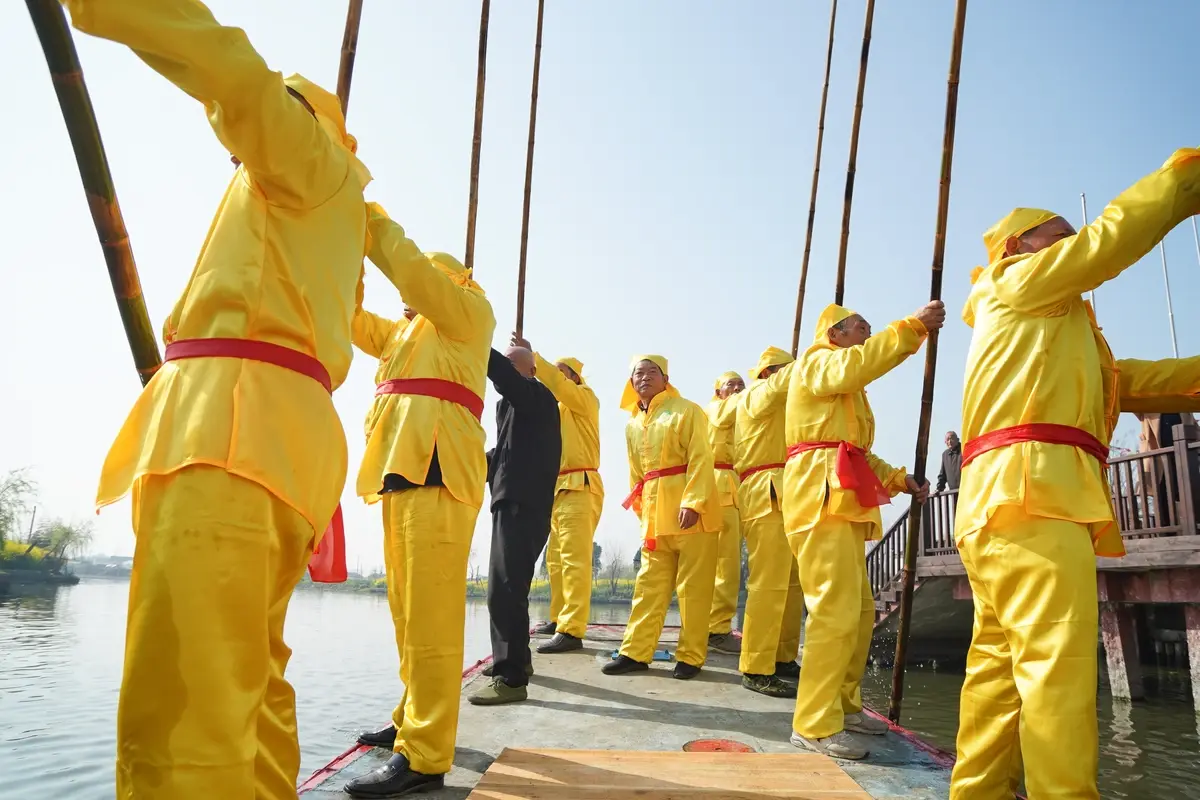
Meanwhile, villagers and their pole boats were already preparing by the riverbank. They wore golden costumes with red sashes, and golden headscarves tied around their heads. Each held a long bamboo pole in hand, ready to work together at the auspicious moment and ride the wind and waves.
This was indeed my first time watching a boat gathering. The Qintong Boat Festival is held once a year, usually on the day after Qingming Festival, on Qin Lake. There are also various decorated boats, creating a grand spectacle with tens of thousands of people. As an important representative of folk culture, it attracts countless visitors from all directions to witness the event.
Back to the rehearsal at Xichen Village. A string of loud firecrackers announced the start of the boat gathering. The pole handlers all geared up, and first, gongs were struck to boost morale and serve as a synchronized signal for everyone.
Once the leader boarded the boat and sounded the first gong, the boat gathering began. The villagers raised their poles and plunged them into the water in unison. Only with the concerted effort of all twenty people could the boat move slowly forward—this is a collective activity that demands unity.
The boat sailed from one dock to another, moving freely on the river. However, what looked easy to us actually required full solidarity. A flag emblazoned with “Qintong” unfurled in the wind over the water—a symbol of the Qintong people’s spirit and a carrier of their beautiful hopes and aspirations for peace and prosperity, a rich life, and longevity and abundance.
It is said that the festival originated over 800 years ago during the Southern Song Dynasty, when Yue Fei’s army fought the Jin soldiers on Qin Lake. Local people rowed boats on Qingming Festival to pay tribute to the fallen soldiers, and over time, this evolved into a water-town tradition. So every Qingming season, thousands of boats and tens of thousands of boatmen gather here, creating a magnificent scene. This custom has been passed down through the ages, and the boat festival has become a cultural festival.
Apparently, the official boat festival involves many procedures: selecting the boats, testing them on the water, then decorating them. The main part is the gathering itself, and the boat race is the most thrilling, with intense gong sounds, crowd cheers, and the pole handlers’ shouts as they chase each other—that’s the grand spectacle, truly awe-inspiring.
Later, I also boarded a boat to experience firsthand how the vessel moves on the river and how the pole handlers work together.
I jumped onto the boat from the dock, wobbling unsteadily. But the pole handlers were long accustomed to the rocking and kept their balance perfectly. They raised their poles and thrust them into the water simultaneously, making sure the direction and depth were consistent—a skill born of long practice.
It’s a tranquil village, with white walls and black tiles. The fields are awash with rapeseed flowers, birds chirp overhead, old people bask by the river, children and small animals enjoy themselves, and busy aunties go about their chores. This is exactly the kind of place that embodies peaceful contentment.
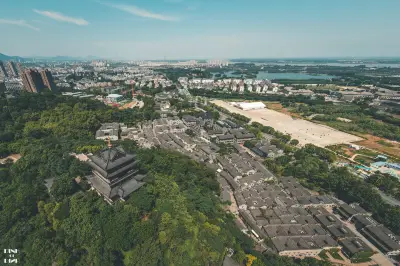
After watching the boat rehearsal, I explored an ancient town called Qintong Ancient Town. Having grown up in the Jiangnan region, ancient towns are nothing new to me, but the ancient towns in northern Jiangsu are somewhat different from those in southern Jiangsu. I can’t pinpoint exactly what it is, but there’s a distinct feeling, a different temperament.
Upon entering through the main gateway, I saw mostly shops selling food and tourist souvenirs—the typical commercialized ancient town look. My heart sank a little, but when I ventured off the beaten path, I discovered a hidden gem.
Qintong is situated on a watery plain. The old lanes are paved with granite slabs that once served as ballast on grain-transport ships and were brought from afar—a scarce resource. In former times, only those with official rank or good reputation could have them laid in their lane. These narrow flagstone paths wind through a distinctive slice of history.
First, I visited the Former Residence of Academicians, built during the Qianlong reign of the Qing Dynasty. It features five courtyards, including the reception hall, passage hall, main hall, rear study, fire lane, and secret rooms, all well preserved. The courtyard is quaint and elegant, with ancient trees and blooming flowers. It is one of the most representative ancient residential buildings in the Lixiahe region of central Jiangsu. There is also the former site of the 'Sanxin Company' founded by the Rong family of Wuxi, once an office of their Qintong operations, and the lodging place of Mr. Rong Zongjing and Mr. Rong Desheng.
The courtyard exudes the style of a Suzhou garden, with a pavilion for resting, a pond full of koi fish, and a large shade tree growing lush and green. The original owner must have been a person of refined taste.
Camellia Courtyard, one of the 'Eight Scenic Spots of Qintong' known as 'Flower Shadows on Clear Gao'. The ancient camellia in the courtyard was planted in the late Song Dynasty, making it over 800 years old. It has withstood harsh winters and scorching summers, remaining evergreen and standing proudly on the land of three waters. Around Qingming Festival, it bursts into tens of thousands of blossoms—a magnificent sight. At most, 30,000 flowers bloom at once. The former president of the International Camellia Society, Mr. Gregory Davis, hailed it as 'the king of artificially cultivated camellias in the world,' earning it a Guinness World Record.
Beside the tree is an ancient watering well, long unused and now dried up.
The people of Qintong have a tradition of morning wine and evening soup, linked to the 'three waters'—where 'long' means longevity. Qintong is a water town; in the old days, its people fished for a living and had to set out early, so drinking wine in the morning helped ward off the cold. As the economy developed, boats merely docked here to load and unload, and dockworkers drank to boost their strength. Today, Qintong locals treat guests with wine: no banquet, ceremony, or joy is without wine. The Ancient Town Distillery showcases this historical tradition.
Lvshu Temple (Green Tree Temple) is home to an ancient pagoda tree that sprouted in the Tang Dynasty, over 1,100 years ago—another venerable elder in the town. It is steeped in many magical legends that bless the local people.
Though the old pagoda tree is still bare, its powerful, gnarled branches suggest that when spring arrives, it will surely burst into lush foliage that blots out the sky.
The temple, built during the Five Dynasties period, is named after the old pagoda tree. The column bases in the main hall are carved with exquisite motifs of dragons, phoenixes, lions, and elephants. Inside, the hall skillfully uses architectural features such as 'golden mountain characters', 'central pillar mountain', and 'beam-crossing mountain', highlighting the distinctive architectural style of water-town temples.
Red ribbons are tied all around the old pagoda tree, bearing the good wishes of the people, praying that the thousand-year-old tree may bless all living beings.
The Family Tradition and Instruction Hall showcases the strict family education of Qintong people. As the saying goes, 'Nothing can be accomplished without norms or standards.' From ancient times to the present, Qintong has produced many outstanding individuals, all because excellent family traditions and ethics have been passed down from generation to generation, ensuring enduring grace and dignity.
At the entrance, you can try the rice cakes from Qinghezhai, a three-generation tea and snack shop. They are sweet, soft, and glutinous without being sticky.
Learning that we wanted them hot, the pastry chef made a whole steamerful right on the spot. Although it looked like the chef whipped up a large batch in just minutes, I knew it was the result of years of practice, enabling them to produce such fluffy, delicious rice cakes.
The chef told me that sifting the rice flour is quite particular and requires special techniques. With a few casual shakes and tosses, he scooped it into molds etched with the Eight Immortals pattern. Qinghezhai, founded in 1932, is a renowned food shop in Qintong Ancient Town and the surrounding Xiahe area.
It only needs steaming for two or three minutes before it’s ready. When the lid is lifted, steam billows out and a fragrant aroma fills the air. It’s best eaten while hot—soft, glutinous, and sweet.
To fully enjoy Qin Lake, it’s best to take a boat. It takes about twenty minutes to go from the departure dock to the wetland park.
This is the official venue for the Qintong Boat Festival on Qin Lake. By then, a thousand boats will converge, with ten thousand poles raised high. The Qintong Boat Festival is celebrated as 'the finest boat festival under heaven' and is hailed as 'a grand spectacle of folk culture and a showcase of water-town charm'.
Cruising on Qin Lake, with a gentle breeze and rippling waves, you feel completely at ease.
When the boat docks, a different scene unfolds: a lake surface as calm as a mirror, with weeping willows swaying. Walking along the wooden boardwalk into the wetland park, you’ll see rivers, harbors, lakes, and inlets dotting the landscape, with cattails, reeds, and green Chinese firs everywhere.
The boardwalks sometimes run straight, sometimes zigzag. Whatever their shape, they lead you into a wonderful paradise where reeds grow thick, aquatic plants flourish, cattails are lush, and the water is so clear you can see fish. Birds roam freely, giving you a long-lost feeling of reconnecting with nature.
I leaned on the boardwalk railing and watched for a long time as the lush water plants swayed in the water and small fish darted in and out among them, leisurely and carefree. I couldn’t help but feel a touch of envy.
According to 'Milu Deer Habitat Survey', the Qin Lake area is the hometown of the Milu deer, and the most fossil specimens have been unearthed here, making it rather typical nationwide. After a century of displacement, these nationally protected animals have finally returned to their dreamt-of homeland. Since then, these wetland spirits have thrived and multiplied in Qin Lake.
These large animals are actually very cute. When they see strangers, they just stand there staring blankly, completely motionless—so adorably goofy.
The Farming Paradise showcases the unique agricultural culture of the Xiahe region. There are diverse crops in the fertile fields, and you can step on a waterwheel or push a stone mill to experience rural pastoral life.
There is also a gourd-themed exhibition area. These gourds of all sizes carry people’s beautiful wishes; the word for gourd sounds like 'fortune', symbolizing blessings and longevity—all things people hope for.
This is also the Qin Lake filming base for the movie 'Xianghe'. Amid vast fields of rapeseed flowers are tucked a few small houses with white walls and black tiles, with a tall willow tree standing at the gate. It inevitably conjures up a picturesque image of idyllic beauty.
The wetlands provide an excellent habitat for birds and animals; it’s truly a paradise for them. Here, far from the confines of cages, they can fly freely without constraint. Black swans, white swans, and wild geese chase and frolic in the waterfowl park, completely at liberty.
Qin Lake Wetland Park has also set aside uninhabited islands for waterfowl and migratory birds to rest. When migratory birds come here to winter, thousands of them gather in the reed bamboo. This is the birds’ endorsement of Qin Lake’s beautiful environment and the best demonstration of harmonious coexistence between humans and nature.
Roadside stalls sell seemingly humble but actually delicious local snacks: fried small fish and shrimp, which must be scrumptious.
There’s also a Fishing Culture Experience Park, Qin Lake Medicinal Botanical Garden, a Crocodile House, and the Lumning River Rafting waiting for you to explore.
Travelogue Directory: 1. Watching the Boat Gathering at Xichen Village 2. Strolling through Qintong Ancient Town 3. Cruising Qin Lake
Travel Information, Hotel Index, Travel Guide Index, Flight Index, Website Navigation, Tourism Index, Cruise Index, Corporate Travel Index, Partnership Opportunities, Distribution Alliance, Friendly Links, Corporate Gift Card Purchases, Insurance Agency, Agent Cooperation, Hotel Partnership, Destination & Scenic Spot Cooperation, More Partnerships
About Ctrip, About Ctrip, Ctrip Hot Topics, Contact Us, Careers, User Agreement, Privacy Policy, Business License, Security Center, Ctrip Content Center, Intellectual Property, Trip.com Group Algorithm Notice