Searching for Wetland Deer, Exploring the World's Boat Festival, Visiting Qintong Ancient Town
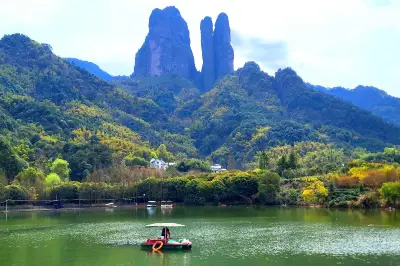
Yes, I was drawn by the title. Have you ever seen such a scene? If you have, maybe only on TV or in various media. But this photo was taken at the Qinhu National Wetland Park in Jiangyan, Taizhou, and I was instantly captivated. Moreover, it was exactly the time of the Qinhu Boat Festival, and I could also explore Qintong Ancient Town. I immediately booked tickets and embarked on a spontaneous trip.
The Boat Festival was also a highlight of this trip. I had heard about the Qintong Boat Festival before, and it was fortunate to witness it in person this time!
It is worth noting that the nearest high-speed rail station to Qinhu National Wetland Park is Jiangyan Station. Jiangyan might be a station still under construction. There is a direct train from Hangzhou, but there is no return train; you need to transfer at Shanghai Hongqiao, or go via Nanjing or somewhere else. Alternatively, you can go to Taizhou, which also has many ancient towns to explore, and then take the high-speed train back. For temperature and weather, you can check the forecast; it is generally similar to Hangzhou and Shanghai. If you want to see the evening light show, it is recommended to bring an extra jacket. Although you watch from a boat, it can still be a bit cool. The train station is about half an hour from the wetland park. Arriving from Hangzhou at Qintong around lunchtime, we grabbed a quick bite and then headed to the wetland park. You could also stay in Qintong Ancient Town, which is relatively close to the wetland park.
Qinhu National Wetland Park
Qinhu National Wetland Park is located in the northeastern suburbs of Taizhou, with vast lake surfaces and crisscrossing waterways. Water plants and reeds are everywhere. You can take a walk on the wooden boardwalk or take a cruise along the channels to enjoy the beautiful wetland scenery. The park is also home to deer, waterfowl, swans, and other animals. It is said that in ancient times, this was the homeland of deer.
Qintong National Wetland Park is located on an isolated island in Qinhu Lake in Jiangyan. Its unique environment has made it a haven for birds.
Our group took a cruise from the dock and headed inward. On the north bank, we could see the tall Three-Faced Medicine Buddha Pagoda, which looked magnificent under the sunlight. The pagoda is 80 meters high, with Buddha images on three sides. We circled the pagoda once, and everyone prayed for peace and safety. During the boat ride, we passed by an uninhabited islet. In the rainy season, it would be submerged, so no one goes there. It has naturally become a resting place for birds, undisturbed by outsiders. The boat's final stop was the China Qinhu Wetland Science Museum. The indoor lighting was dim, and the 360-degree projection made you feel as if you were there. On the walls and ceiling, projections showed the trajectory of Qinhu's ecological development, with various birds and animals vividly displayed. Exiting the museum, there was a winding boardwalk with lakes on both sides. I guessed that some kind of plant was growing there; in summer, there should be lotus flowers. Small water birds were chirping happily in the water, occasionally performing a 'light kung fu water-skimming' act, drawing warm gazes from passersby. Further ahead, we reached a boat dock and a sightseeing station. By then, it was already past 4 PM. Unfortunately, the last boat back was at 5:00 PM. If we went further to the Deer Park, we wouldn't be able to return. So due to time constraints, we didn't complete the wetland deer search. But that's okay; it planted a 'seed' for the next trip to Qintong.
Walking along the circular route, entering from the Wetland Experience Garden and exiting at the Waterfowl Garden, it is about 7.5 kilometers. At first, we saw various wetland plants. Deeper in, there were animals to see and amusement activities. In the Deer Viewing Garden, we could see deer; in the Crocodile Hall, crocodiles. Visitors with children can go to the Adventure Park to try the Brave Path consisting of iron chain bridges and rope net bridges, or pay to ride horses at the racetrack. At the end of the circular route, the Waterfowl Garden had swans and other water birds. Our group strolled around the area and found that it was a great place for photos.
"A Dream to Qinhu" Progressive Water Light Show
After dinner, you can come for a night tour of Qinhu Lake to watch the progressive water light show. You might not understand 'progressive', but since the light show is on the water, it's easy to understand: tourists watch from a boat, hence a progressive water light show. It also circles the Three-Faced Medicine Buddha Pagoda for blessings and peace. The light show starts at the Qinhu Scenic Area dock, connects to Qintong Ancient Town, and features highlights such as 'Nine Dragons Paying Homage', 'Medicine Buddha Pagoda', 'Glazed Zen Charm', 'General's Platform', 'Reading in South Tower', 'New Charm of the Ancient Town', etc., along with water curtain movies, high-altitude wire performances, and fire-breathing. The tour takes about an hour. Finally, at the stage by the dock, about a hundred performers put on a spectacular show. Overall, this night tour of Qinhu is well worth it.
Exploring the World's Boat Festival - Qinhu Boat Festival
Qintong Boat Festival is an ancient traditional folk activity originating from the Song Dynasty. According to legend, righteous people from Shandong, Zhang Rong and Jia Hu, once resisted Jin soldiers in Qintong Village. The local villagers helped bury the fallen soldiers and, every year on the Qingming Festival, they would row bamboo pole boats to race to sweep tombs and pay tribute to the heroes. Over time, this evolved into the custom of holding a boat festival.
The Qintong Boat Festival is mainly distributed in the Lixiahe water region, covering hundreds of square kilometers. Boats are usually divided into five types: pole boats, rowing boats, flower boats, tribute boats, and sedan chair boats. The festival is generally held on the second day of Qingming Festival. It has been officially named the China Qintong Boat Festival by the National Tourism Administration and is a national intangible cultural heritage.
First, there was a performance on stage, and then the boat festival performances began. Each boat had about ten people, and there were probably over a thousand boats, advancing in various formations—a truly spectacular scene. It is said that the boats and crew members participating in the boat festival are selected through competitions in each village. During the performance, there is also a custom of 'sending the first pole,' which symbolizes giving birth to a son, considered very auspicious.
The water boat festival performance began. Six phalanxes of tribute boats appeared in sequence. The first phalanx had the theme 'Inheriting the Past and Present through Boats,' featuring eight tribute boats named 'Praying for Prosperity', 'Riding the Bull', 'Happy Taizhou', 'Strong Industrial District', 'Thriving Tourism District', 'Education-Focused District', 'Rural Revitalization', and 'Centenary of the CPC'. These boats were magnificent, with diverse decorative styles. Some showed the pure and beautiful natural ecology of the water town, while others highlighted the vitality of rural revitalization. Especially the 'Centenary of the CPC' tribute boat: a towering Great Wall spiraled upward, holding up a glittering Party emblem; a giant dragon soared into the sky, symbolizing the historical process of the Chinese people, under the Party's leadership, striving for the great Chinese Dream of national rejuvenation. The mighty ship 'Forging Ahead in a New Era, Embarking on a New Journey' braved the wind and waves amidst resounding drums and music, setting sail.
On the day of the Boat Festival, at least ten thousand people came to watch, which was truly astonishing. Such a boat event could draw such a huge crowd. This visit really opened my eyes. Those who haven't been should definitely come and experience the excitement of the Boat Festival.
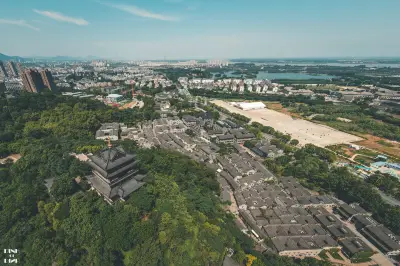
'Do not say that Jiangnan's flowers are like brocade; Qintong's watery kingdom surpasses Jiangnan.' This describes Qintong Ancient Town. Surrounded by water on all sides, the town has a pleasant environment. To the right of the ticket office is the Dongguan Guiyu scenic spot. Dongguan is a Taoist temple built in the Later Jin Dynasty, with many Buddha statues inside. In front of Dongguan is the East Great Lake, with clear water so pure you can see the bottom. Visiting here at sunset to listen to the fishing boats singing in the evening is full of poetic charm. Qintong Ancient Town is not large, entirely surrounded by water. Be sure to visit the places marked with red circles on the map. The old commercial street in the ancient town has many shops, mostly selling local specialties: rice, fish, shrimp, duan crabs, etc., unlike the monotonous souvenirs in other scenic areas. Qinhu fish balls are a local specialty. Qintong also belongs to the Huaiyang cuisine system, with famous snacks. The Qinhu Eight Delicacies Feast is representative of the town, including Qinhu duan crabs, Qinhu green shrimp, Qinhu softshell turtle, Qinhu silver fish, Qinhu sixi (four-treasure), Qinhu snails and shellfish, Qinhu waterfowl, and Qinhu water vegetables. The Qinhu Eight Delicacies Food Festival held in April and May each year is a foodie's festival. Don't miss it when visiting Qintong!
Qintong is famous for its ancient trees. A camellia tree planted in the Song Dynasty, over 800 years old, is a horticultural variety of East China camellia named 'Songzi'. It is a precious old variety and is now a World Cultural Heritage site. It is the oldest, thickest at base, tallest, widest in crown, most flowering, and northernmost artificially planted camellia tree discovered in China, with tens of thousands of blossoms. The Green Tree Chan Temple (Lüshu Chanyuan) is named after an old locust tree. The locust tree became immortal through the temple, with a history of over a thousand years. This is one of the Eight Scenic Spots of Qintong: 'Green Courtyard with Hanging Locusts.' For centuries, people have cared for and revered the old locust tree, hanging red ribbons on it to pray for peace and happiness.
Qintong in Jiangyan is not too far from Hangzhou, Shanghai, or Nanjing, and is reachable by high-speed rail. The distance between scenic spots is also not too great, making it a very comfortable and leisurely trip. If you missed the spring outing, why not take a spontaneous trip? Spend a weekend visiting the deer in the wetland and exploring the ancient trees in the ancient town!