Watery Jiangsu: 3 Days and 2 Nights Exploring Taizhou with Me
In the past two years, it seems fate has tied me to Taizhou—almost a yearly appointment.
Another April arrives, and once again I step into the streets and alleys of Taizhou. The breath of spring grows stronger here: willow branches sprout tender buds, flowers quietly bloom, and the wind becomes gentle, no longer biting cold.
Though Taizhou lies north of the Yangtze River, the city is filled with the scenery of Jiangnan (the region south of the river).
In Taoyuan (Peach Garden), peach blossoms have yet to appear, but lush green fills the eyes; in Mei Garden, traces of Mr. Mei Lanfang may be absent, but the echoes of century-old opera linger.
The old street bustles with people, and the aroma of baked flatbread wafts through the air; the nightscape of Fengcheng River glitters as always; the sculling boats on Qin Lake leisurely cut through the wetland scenery along the riverbanks; and Wanghai Tower still stands watch over the city.
Go to Guyue Tower for morning tea, and head to Qintong Ancient Town to taste lake delicacies.
In Taizhou, as long as you slow down, the beauty reveals itself bit by bit.
At Mei Garden, besides traces of Mei Lanfang, the air is thick with the flavor of Jiangnan.
The peach blossoms haven't opened yet in Taoyuan, but the bustling crowd makes it lively.
Taizhou Old Street is steeped in antiquity, with the fragrance of flatbread from roadside stalls.
A night cruise on Fengcheng River lets you experience the city's night bustle.
The earthly vitality in Qintong Ancient Town.
The greenery in Qintong Ancient Town—spring has arrived.
The view and scenery from Wanghai Tower are truly special.
【About Taizhou】
Taizhou was established as a prefecture during the Southern Tang dynasty, with its name meaning 'peace and prosperity for the nation.' It is a famous historical and cultural city in China, located on the northern bank of the lower reaches of the Yangtze River.
With a history of over 2,100 years, Taizhou was known as Haiyang in the Qin dynasty and Hailing in the Han dynasty. It blends the charms of Wu, Chu, and Yue cultures, gathering the essence of the Jianghuai and coastal areas.
The city holds many stories, bearing witness to countless events.
【Transportation】
Yangzhou Taizhou Airport is 20 km from the city center. It currently operates flights to Guangzhou, Kunming, Harbin, Shenzhen, Chengdu, and other cities, with more routes to be added.
Additionally, Nanjing Lukou International Airport, Shanghai Hongqiao Airport, or Pudong International Airport are all within a 3-hour drive.
There are bullet trains from Nanjing to Taizhou, taking about 1.5 hours with a fare of around ¥60. It's very convenient, though the frequency is not very high—advance booking is recommended on holidays.
Currently, there are also direct bullet trains from Shanghai to Taizhou, making transportation very convenient.
Long-distance buses between Taizhou and nearby cities run frequently, with travel times varying from 3 to 4 hours depending on the route and stops. It is recommended to buy tickets from the South Bus Station, which is closest to the city center.
【Itinerary】
Below is my 3-day, 2-night itinerary for reference:
D1: Nanjing → Taizhou. Visit Taoyuan, Mei Garden, Taizhou Old Street. After dinner, night cruise on Fengcheng River.
D2: Taizhou. Enjoy Taizhou morning tea, visit Qintong Ancient Town, Qin Lake, and Daohe Ancient Block.
D3: Taizhou → Nanjing. Visit Wanghai Tower and Liu Garden.
【D1: Taoyuan, Mei Garden, Taizhou Old Street, Night Cruise on Fengcheng River】
Entering Taoyuan, a sea of green
Taoyuan is located in the Fengcheng River Scenic Area of Taizhou, on the east bank of the southern city river. It is adjacent to Taizhou Old Street on the east, faces Wanghai Tower across the water on the west, and is separated from the Mei Lanfang Memorial Hall by a street on the north.
The signs in the scenic area are very clear. Though the garden is not small, you won't get lost here.
Just go where you want to go.
At the lowest part of the scenic area lies Fengcheng River.
As Taizhou's moat, many attractions in the city are built around it. The scenery on both sides of the river is pleasant, perfect for taking it slow and savoring the moment.
The core scenic spot is the restored Chen Nunnery, built in Ming and Qing architectural styles. The nunnery has three halls, some two stories high, with a small garden on the west side. It is furnished with imitation Ming and Qing furniture, recreating the scene where Qing dynasty playwright Kong Shangren lived in the nunnery while serving in Taizhou for flood control and writing the script for *The Peach Blossom Fan*.
With water, the scenery becomes more lively.
The water surface ripples gently in the occasional breeze. The arched bridges over the water carry strong Jiangnan charm, and the grass and willow shoots are fresh green.
I want to capture the traces of spring with my camera.
The highest point in Taoyuan is this one—if you could go up, the view would surely be wonderful.
The painted boats moored on the water are connected by boardwalks. They make great photo spots.
Inside the painted boats, there is a kung fu tea setup for photos—quaint and elegant. This is clearly a landmark in Taoyuan.
Naturally, I had to take pictures on the boat.
As I walked, I found marks of spring.
These flowers, whose names I don't know, are competing to bloom. During our visit to Taoyuan, we encountered a group of elementary school students on a spring outing, chattering away noisily. It reminded me of my own childhood—simple and happy.
My favorite spot is near the exit: clusters of pink flowers, red lanterns swaying gently in the wind, slowly pushing open the painted window. It suddenly felt like a scene from the lives of ancient people.
Listening to century-old sounds at Mei Garden
Taizhou Mei Lanfang Memorial Hall was built in the 1980s, located on Fenghuang Dun in Taizhou city, surrounded by water on three sides, with green trees and elegant scenery. In 1997, the former Mei Lanfang Historical Materials Exhibition Hall and Mei Lanfang Park were merged into the memorial hall. It underwent comprehensive renovation in October 2007 and reopened in November 2008.
I have always believed that the scenery of Mei Garden is no less than any classical garden. Here there are also rockeries, water, pavilions, and scattered views.
It's comfortable to stroll around here.
I especially like the hollowed window carvings of ancient China. The view through these carvings has a unique beauty—a beauty of shape.
Walking further, the Han white marble statue of Mr. Mei Lanfang sits in the garden.
As a memorial hall for Mei Lanfang, traces of him are everywhere. Mei Lanfang (October 22, 1894 – August 8, 1961) was born in Beijing in the 20th year of Guangxu's reign, with ancestral roots in Taizhou, Jiangsu. He was a master of Peking opera.
Mr. Mei Lanfang is rightly called 'a peerless talent of his generation.'
I had heard stories of Mei Lanfang since school, knowing about his training and rise to become a Peking opera master, so this place feels strangely familiar.
Inside, the white marble statue in the lake depicts Mei Lanfang as Yang Taizhen. Throughout the courtyard, the life of this legendary Peking opera star is recounted.
In Mei Garden, such Jiangnan garden scenes are everywhere. Rockeries of varying heights, winding corridors, pavilions, and white-walled garden gates—all details show us their beauty.
Feel the sun and the scent of grass, experience the unique charm of Jiangnan, and quietly listen to the centuries-old opera sounds.
Hey, here's a short spring letter.
Do you like spring?
I love the cherry blossoms that fill the city in early spring, the humid weather after Grain Rain, and the early-summer taste of late spring.
I love traveling in spring to see the vitality of the world.
Maybe you don't need to do anything—just sit, watch the fish swim freely in the pond, and see the people passing by.
If you have time this spring,
let's go traveling together.
Red and green, flowers and grass—vital yet gentle.
Since this is a memorial hall for a Peking opera master, how could it lack an opera pavilion?
But nowadays, few people sing classical operas in this pavilion.
There are four must-see highlights in Mei Garden, one of which is the Mei Lanfang Memorial Pavilion. On a leisurely day, sit in the pavilion, watch the leaves rustle, and listen to the wind—perhaps the breeze faintly carries the sound of Mei's opera.
With clear water and gentle wind, trust me—you'll like it here.
Strolling on Taizhou Old Street, savoring a Huangqiao Sesame Cake
Taizhou Old Street is located in Hailing District, adjacent to Taoyuan and Mei Garden. With the planning and development of Fengcheng River Scenic Area, it gradually took on its current appearance.
The old street is not very long. On both sides are shops, some with a century of history, each hung with red lanterns, looking very festive.
The ancient street is quaint, with buildings of gray brick, mostly one or two stories. Most shops are restaurants serving Taizhou and Huaiyang cuisine. At mealtimes, the aroma of food fills the air, making people linger.
Many of these shops are century-old establishments. Ancient buildings line the narrow lanes paved with cobblestones, and the courtyard houses in the side alleys. The fragrance of Huangqiao sesame cakes wafts by, and the long cries of vendors at mealtime draw visitors in with this worldly charm.
In Taizhou, there is a saying:
'In the morning, skin wraps water; in the evening, water wraps skin.' This refers to two Taizhou specialties: leisurely morning tea and relaxing foot massages.
A shop with a sign saying 'Skin Wraps Water' is a great place for morning tea.
Because Taizhou once had many waterways, there were many boats, and many customs related to boats. This decorated little boat, with lanterns and festoons, looks very festive.
After dinner, a night cruise on Fengcheng River is a must.
Many say that the night cruise on Fengchong River is the essence of a Taizhou trip, which is why it is called 'Water Paradise, Night Tour City.' So, once here, a night cruise is essential—to see the bright lights along the riverbanks and to experience what nightfall brings.
Take a painted boat under the night sky; the night is dreamily beautiful. Lights illuminate the surrounding buildings. On the boat, sip a cup of clear tea, listen to a passage of opera from the banks, and enjoy the spring evening breeze.
Nighttime can be so beautiful.
Along the cruise route, opera performances take place on the shore. Amid the hazy lights and mist, performers in costume sing, and we drift on the boat.
All this makes us feel as if we have traveled back in time, stepping into the life of an opera.
The boat stops briefly at each stage, just enough time to feel the atmosphere and the nighttime splendor.
【D2: Morning Tea, Qintong Ancient Town, Qin Lake, Daohe Ancient Block】
What wakes up the morning is the fragrant morning tea at Guyue Tower
'In the morning, skin wraps water' is a major feature of Taizhou. Among the best tea houses in Taizhou, Guyue Tower is a must-visit.
It is incredibly popular. For a private room, book in advance; for walk-ins, come early, or you might struggle to get morning tea.
The main hall is packed with people, the noise humming. Usually, whole families come—a pot of tea with various dim sum kick-starts a vibrant morning.
For morning tea, you must have steamed buns, dumplings, and shumai—they are all here! Order according to the number of people. My favorite are the wild vegetable buns and shumai—green-colored, with a light fragrance, delicious.
In fact, Taizhou people have strict customs for morning tea: high-quality Longjing tea, paired with a bowl of blanched dried tofu shreds, a bowl of fish soup noodles, and a steamer of crab roe buns.
Dried tofu shreds are very famous in Taizhou morning tea. Not knowing the exact difference between blanched ones and boiled ones, I ordered both. Personally, I prefer the blanched ones, especially with a bit of vinegar.
Crab roe soup dumplings have rich layers: soft skin, juicy filling, a mixture of crab roe, crab meat, pork, fish, and shrimp—so delicious that many come from afar just to taste them.
Finally, a bowl of fish soup noodles. The noodles soak up the savory fish soup. Eat the noodles, drink the soup—the freshness of the fish, the chewiness of the noodles, plus a hint of pepper at the end—satisfying.
After morning tea, it's time to start the day's itinerary.
The fragrant fish aroma and earthly vitality in Qintong Ancient Town
Qintong Ancient Town is located in Jiangyan District, Taizhou. Surrounded by water, it is a land of fish and rice.
Unlike typical water towns, there are more locals here, and the atmosphere is more daily life.
On both sides of the main street are narrow alleys. These alleys have little commerce, mostly residences. Few tourists come here; it's mostly locals coming and going, chatting in groups.
Unlike the noisy main street, this place seems muted. The alleys are narrow, and the residents know each other well, greeting each other as they pass. We feel somewhat out of place.
How could I not take photos in such alleys? The half-light, half-shadow play is beautiful, and the gray-white brick walls are lovely.
Qintong Ancient Town is close to Qin Lake Wetland Park, so it abounds in fish and shrimp.
This season lacks the seasonal delicacy of Qin Lake pincerless crabs, but that's okay—I can buy some dried small fish to take home.
The goods sold in the ancient town are mostly local specialties. Surrounded by water, this is a typical land of fish and rice, so fish and shrimp are abundant. Locals process them into fish balls, shrimp cakes, and more. Visitors can buy some to take home.
These fish balls are freshly made, rolled large in the oil pan, looking very appetizing.
There are so many types—fish balls, shrimp balls, meat balls. We watch them being made, the aroma overwhelming.
As someone who loves travel and food, how could I miss these delicacies?
I lean in to smell and taste, then buy some to bring home and enjoy slowly.
Only here did I realize that Huangqiao sesame cakes come in many flavors: besides red bean paste, sesame, and pork floss, there are chestnut, salted egg yolk, and even strawberry!! The strawberry one piqued our curiosity—would it be a sweet-and-sour flatbread taste?
Though it's not the season for hairy crabs, small crabs are plentiful. Coated in flour and fried, they are crispy and flavorful, a unique delicacy.
Encountering Qin Lake Wetland again, in this spring
Qin Lake National Wetland Park is located in central Jiangsu, between the Yangtze and Huai rivers. The planned area covers 26 square kilometers. With superior natural resources and diverse biological types, it is home to first-class protected animals such as red-crowned cranes and elk, and second-class protected animals such as whooper swans, white-naped cranes, and silver pheasants.
It is about 9 km from Qintong Ancient Town.
There is also a Qin Lake Ocean World planned here, where you can see many cute marine creatures, and sometimes performances.
Tickets can be purchased jointly with Qin Lake Wetland or separately.
Upon entering Qin Lake, the first stop is a boat ride.
A sightseeing boat carrying several dozen people takes about ten minutes, as the lakeside scenery recedes and the lake opens up. When the boat docks, the real Qin Lake journey begins.
There are water performances on the hour, but we didn't catch them—we could only imagine the scene from descriptions.
After the boat ride, the first attraction is the China Qin Lake Wetland Science Museum. The exhibition hall has two floors and is quite large. Walking through and learning about wetland knowledge helps you enjoy the tour better.
The scenic area is designed for a one-way route; the walking distance is a few kilometers. If you walk the entire area, it takes about 3-4 hours.
Besides walking, you can also take a sculling boat or an electric cart to better appreciate the wetland scenery.
Qin Lake is also called Magpie Lake. Looking from a height, nine main rivers flow into the lake from all directions, naturally forming a 'Nine Dragons Paying Homage to the Throne' landscape.
With its many waterways, the spring scenery is vibrant and beautiful.
In Qin Lake, you can actually see elk. They live here—the ecology is enviable. There are many water birds; with luck, you might see red-crowned cranes.
The wooden boardwalk is flanked by lush greenery. If you crouch down, you are hidden among the plants—perfect for photos, with a hint of summer.
In old times, the most common way for Taizhou people to travel was by boat, mostly these sculling boats, swaying as they move forward.
The sculling boats on Qin Lake allow us to travel through the waterways, giving a better tour. The wooden boats are decorated with blue-and-white print fabrics in Jiangnan style. The boatwomen can sing traditional tunes, accompanying the journey.
Leaning on the bridge, I listen to the women's songs.
The sun is dazzling, so I use a hat to shade my eyes.
Boats one by one break the water's calm, causing ripples.
This season, weeping willows have grown tall and green. Winter ends, spring comes—the most delightful season.
Standing under the tree, at the intersection of tree shadows, letting sunlight filter through leaves onto my face—the light and shadow are beautiful.
Without seeing real swans, I photograph the sculptures as a memento.
These trees growing in the water absorb nutrients and stand tall.
Reflections on the water, green shoots at the treetops, sunlight piercing through, rustling sounds in the wind.
Sitting on the boardwalk, the background blurs.
Daohe Ancient Block—a quiet corner in the city center
Taizhou's Daohe Ancient Block formed at the end of the Yuan and beginning of the Ming dynasties, over 600 years ago. It is the largest complex of Taizhou-style residential buildings. Of course, it has been renovated and rebuilt—the architecture retains its original style, but the overall layout has been greatly improved.
After parking, I stroll slowly along the river. Here, the Daohe and Caohe rivers run north-south. Houses are built along the water; people live by the water.
Though a scenic spot, Daohe Ancient Block is not overly noisy. Unlike the bustling city traffic, the pace of life here is slow.
The river is wide, the water quality decent. People living along the river must feel at ease seeing such scenery every day.
Crossing the bridge ahead, I reach the core area of Daohe.
The scenic area is well planned. Besides the main street, there are many alleys hiding quaint, artistic shops like tea houses and coffee shops—very peaceful.
Gray-white brick walls, traditional Taizhou architecture, wooden doors with large '福' characters, red lanterns at every house—very festive.
This place has become a favorite for photography enthusiasts.
A signboard lists the shops here, many of which look interesting.
I love these mottled tree shadows—they feel full of life.
【D3: Wanghai Tower, Liu Garden】
Climb high for a distant view—Wanghai Tower is a must-see landmark
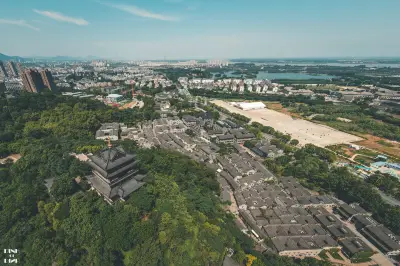
Wanghai Tower is a famous attraction in Taizhou, Jiangsu, and a landmark of the city. Located within the Fengcheng River Scenic Area, it was first built in the second year of Shaoding of the Southern Song dynasty (1229) and is hailed as the 'First Tower of Jianghuai.' It has been destroyed and rebuilt many times, mostly by war and then restored in prosperous times.
The Wanghai Tower we see today is a 4A-level scenic spot, covering 100 mu (about 6.67 hectares). It sits by Fengcheng River, offering a unique view.
Located at the southeast corner of the park, the tower is over 30 meters tall, built in Song dynasty style with a three-story circular corridor. The main colors are chestnut brown and gray, simple and elegant.
You can go up the tower for a distant view, via elevator or stairs. The fourth floor offers a better view and also has exhibition halls.
This is the view from the second floor—the park is lush green, full of spring.
Going higher to the fourth floor, the view expands greatly, reaching far.
The lake has a beautiful color. The pier directly opposite Wanghai Tower offers boat rides on Fengcheng River. Daytime and nighttime boat rides are completely different experiences, both interesting.
From the height, you can see the cityscape of Taizhou. The city has developed well, with many high-rises and commercial districts.
I really like this tree, standing quietly in the park.
Whether looking up at it from below or looking down from Wanghai Tower, it has a unique beauty—not flashy, but striking.
A leisurely and comfortable city park
Liu Garden is located at No. 23 Koutai Road in Taizhou, on the south bank of the eastern city river at Dafeng Bay. It is one of the ancient 'Eight Scenes of Hailing' called 'South Moat Fisherman's Song.' These gardens and scenic spots in Taizhou are not far apart, in the city center, making them convenient to visit.
The street lamps here are beautiful, each bearing the name of a tea house—very artistic and pleasant, full of Jiangnan charm.
I love such paths—winding brick paths, sunlight pouring down, lighting up the leaves. The play of light and shadow stretching infinitely is gorgeous.
In Liu Garden, there is also a Liu Gong Temple to visit.
Outside the garden, a willow embankment surrounds it; inside, willow trees, bamboo, osmanthus, and magnolia intermingle. Winding paths lead to secluded spots, with ancient charm preserved and unique scenery.
This tea house is elegantly located and built with style. In leisure time, invite a few friends to sit here, bask in the spring sun—very comfortable.
Today is the weekend, so many people come here to fish. Fishing requires patience; I always admire their endurance and concentration.
Across the river stands a seven-story pagoda, bright and eye-catching day or night.
Though Liu Garden is not large, as a city park open to the public, it has high vegetation coverage. Whether in early morning or evening, it's a great place for a stroll.
【Time to say 'See you next time'】
Three days and two nights may not be long, but I have taken the time to experience this ancient city with a thousand years of history.
Here lies the gentleness of water-town life, the voice of millennia of cultural fusion,
the steaming morning tea culture, and the relaxing evening entertainment.
I have felt Taizhou's slow-paced life
and enjoyed the city's beautiful scenery.
Spring in Taizhou is unforgettable.