Comparable to Yangzhou, but More Affordable and Down-to-Earth! How to Spend a 3-Day, 2-Night Vacation in Taizhou?
“Happy Water Paradise, Taizhou Welcomes You.”
Over 700 years ago, Marco Polo visited Taizhou and praised it, saying, “This city is not very big, but it is filled with all kinds of earthly happiness.”
This was my first time in Taizhou, and I spent three days and two nights soaking in the slow-paced life of this water city. The overall impression the city left on me was low-key, livable, gentle, and friendly, with an abundance of delicious food—definitely a place worth visiting.
My first impression of Taizhou, compared to Yangzhou just sixty kilometers away, is that it hasn’t been heavily developed for tourism. Yet, it still offers the same classic experience of “morning tea soaking the belly, evening bath soaking the skin.”
As a travel destination, Yangzhou feels more refined, while Taizhou is more off-the-beaten-path, tranquil, affordable, and down-to-earth.
In three days and two nights, I visited Taizhou’s Peach Garden, Plum Garden, Willow Garden, Taizhou Old Street, took a night cruise on the Fengcheng River, saw Wanghai Tower, Daohu Ancient Street, Qintong Ancient Town, Qinhu Wetland Park… I probably ended up knowing Taizhou tourism better than many locals.
Next time I come to Taizhou, I hope to explore more of the local cuisine. This time, since there were few of us, we couldn’t order many dishes, and missed out on a lot of restaurants.
I enjoy wandering at a leisurely pace, so I’ve put together this Taizhou travel guide. Friends who need it can save it for later.
Taizhou, known as Hailing in ancient times, is a prefecture-level city in Jiangsu Province. Bordering the Yangtze River to the south, Yancheng to the north, Nantong to the east, and Yangzhou to the west, it serves as the gateway to central Jiangsu and has been known since ancient times as a “key hub of land and water transport, a strategic pass controlling the region.”
Traveling to Taizhou is very convenient. The high-speed train from Shanghai Station to Taizhou Station takes only two hours. From my hometown Changshu Station to Taizhou Station, it’s just an hour and a half.
I slept in a bit in the morning, set off, and arrived in Taizhou by noon. I grabbed a quick lunch and was ready to start wandering in the afternoon.
“The great artist Mei Lanfang belongs not only to China but, one could say, to the world.”
The renowned Peking Opera master Mr. Mei Lanfang was a native of Taizhou, and Taizhou’s Plum Garden was built in his memory. This compact garden is located in the Hailing District of Taizhou, on the eastern outskirts of the city, atop Phoenix Mound.
After buying an entrance ticket, the first thing I saw in Plum Garden was a statue of Mr. Mei Lanfang. Further on is the Mei Lanfang Memorial Hall.
Strolling through Plum Garden, I learned about Master Mei’s exquisite Peking Opera performance art and appreciated his noble character and patriotic spirit.
Among Master Mei’s representative Peking Opera works are “The Drunken Beauty” and “Farewell My Concubine”; his Kunqu Opera includes “Sifan” and “A Stroll in the Garden, A Dream Interrupted.” Fans of traditional opera can all hum a few lines.
Plum Garden is surrounded by water on three sides, with clusters of trees—the scenery is truly elegant. The garden is planted with many bamboos, but unfortunately, though it’s called Plum Garden, I had missed the season when the plum blossoms were in full bloom.
Pavilions, terraces, winding corridors—gardens like this need to be savored slowly.
In Plum Garden, the “Four Wonders” are the most worth seeing.
The Plum Pavilion is one of the wonders; the second is the large white marble bust of Mei Lanfang; the third wonder is the large white marble sculpture of Mei Lanfang in the role of Yang Taizhen from “The Unofficial Biography of Taizhen,” placed on a pedestal in the outdoor pool outside the exhibition hall; the fourth wonder is a giant stone tablet inscribed with a poem “Treading on Grass” composed by Mr. Zhao Puchu during his visit to Taizhou.
In the afternoon, I sat for a while in the Plum Pavilion, the breeze gently brushing my face.
I thought about how in this world, most people live and die unknown. How many can leave a name for eternity? Better to simply enjoy each day happily.
Travel tips:
Plum Garden entrance fee: 30 yuan
Recommended visit time: 1–2 hours
Peach Garden sits right at the entrance of Taizhou Old Street, facing Wanghai Tower across the water, and only a road away from the Plum Garden I had just visited. It’s part of Taizhou’s Fengcheng River Scenic Area.
Peach Garden is said to have over 3,600 peach trees of 116 different varieties, making it the park with the largest number of ornamental peach blossom varieties in China. The best time to see the blossoms is late March—I could only imagine the scene of peach blossoms in full bloom.
The most striking structure in Peach Garden is the Qingfeng Pavilion, about twenty meters high, built in a three-story, octagonal Song-dynasty style with double eaves.
That day, I ran into many children on a spring outing in Peach Garden. I pretended to be a kid who never grows up, just soaking in the spring vibes.
Travel tips:
Peach Garden entrance fee: 40 yuan
Recommended visit time: 1–2 hours
Taizhou Old Street lies along the Fengcheng River, just outside the Peach Garden scenic area. It’s a Ming-Qing alley paved with granite slabs, with a row of ancient-style buildings featuring blue bricks and black tiles.
Though the architecture is modern reconstruction, it’s a spot every tourist visiting Taizhou ends up visiting.
This is Taizhou’s busiest commercial area, stretching 600 meters.
Compared to its nighttime vibe, the old street feels rather subdued during the day. There’s an ancient opera stage and a Pian Zai Huang Museum to browse.
I especially liked the old street at dusk, when the lights first come on and the sky is a deep blue—the most beautiful time of day.
At the entrance of Taizhou Old Street, there’s a shop called Cai’s Old Store, said to have been featured on “A Bite of China.”
It was only after arriving in Taizhou that I realized Huangqiao sesame cakes come in so many flavors. Besides the traditional plain and scallion oil, there are also crab roe, beef, osmanthus, red bean paste, and more. I bought a pepper-salt one and a “dragon-tiger fight” flavor to try. Warm and fragrant, I ate as I walked and browsed.
Huangqiao sesame cake is an age-old traditional snack, originating from Huangqiao Town in Taixing, a county-level city under Taizhou. Its fame is closely tied to the famous Huangqiao Campaign.
I saw many tourists buying boxes of them to take home—sixteen in a box. Next time, I’d love to visit Huangqiao Town and try the most authentic version there.
Taizhou Old Street is home to many time-honored restaurants, like “Hailingchun,” “Lao Taizhou Taizhou Cuisine,” “Haitangchun,” and others. Pick one and enjoy a leisurely dinner.
“Morning tea soaks the belly, evening bath soaks the skin”—just like Yangzhou, Taizhou has a long-standing and celebrated bathing culture.
On Taizhou Old Street, there’s a “Water-Soaking-Skin Bathhouse.” After dinner and a digestive stroll, you could experience it, but I didn’t dare go in alone.
Travel tips:
Taizhou Old Street entrance fee: free
Taizhou is a city of water; water is its defining feature and soul.
The ancient moat of Taizhou is especially distinctive. It is the mother river that has nourished generations of Taizhou people. A thousand mu of water encircles the city, making it one of the few relatively intact thousand-year-old city moats remaining in Jiangsu Province.
At night you can board a boat and cruise the Fengcheng River. The ticket office for the night cruise is right at the entrance of Taizhou Old Street.
The night cruise route passes Yingchun Bridge, Plum Garden, Liufang Tea House, Guandi Temple, and more.
Floating on the water, you’ll experience a concentrated yet complete display of an urban waterscape rarely seen elsewhere in the country, while feeling the deep thread of Taizhou’s long history.
Or, like the locals, you can simply take a leisurely stroll along the river after dinner. The Fengcheng riverside at dusk is truly pleasant—I only wished I had someone beside me.
Travel tips:
On this day, Peach Garden, Plum Garden, Taizhou Old Street, and the cruise dock are all very close to each other and can be reached on foot; no car needed, which is very convenient.
On the second day, I rented a car and spent the day in Qintong Town, Jiangyan District, Taizhou.
Qintong Ancient Town is a nationally famous historical and cultural town. What I remember most are the streets lined with fish balls, shrimp balls, fish cakes, crab roe lion’s head meatballs, deep-fried Qinhu shrimp, and Huangqiao sesame cakes…
Located at the junction of Nantong, Yancheng, and Taizhou, Qintong Ancient Town isn’t large—you can basically stroll through it in one or two hours. It’s a bit far from the city center, about a 50-minute drive.
Qintong Ancient Town is not far from Qinhu Wetland Park. Since I was passing by, I stopped to look around and had lunch in the ancient town. The most famous local dish is the Qinhu Eight Delicacies Feast.
I heard that the morning tea in Qintong Ancient Town is very distinctive. If you’re willing to get up early, you could consider having brunch here.
All the shops and sights are along one main street. I also bought some fish balls to take home.
I loved the down-to-earth, bustling atmosphere. The aunties frying fish balls were all so kind, letting me taste before buying—the people here are genuinely warm-hearted.
I stood there a long time watching a local auntie fry fish balls. When they first come out of the oil, they’re large, then they gradually shrink. Eat them hot, they’re wonderfully savory.
Crab roe lion’s head meatballs are 10 yuan each, deep-fried to a golden crisp.
Here I also saw Huangqiao sesame cakes with chestnut and strawberry flavors—it seems you really can put anything in these cakes.
Travel tips:
The ancient town itself doesn’t charge an entrance fee, but several spots inside like “Academician’s Former Residence” and “Green Tree Courtyard” require tickets. A combined ticket for Qintong Ancient Town and Qinhu Wetland Park costs 100 yuan.
If you’ve eaten Qinhu shrimp, but haven’t visited Qinhu Lake, come along on this spring outing!
Since ancient times, Qinhu Lake has been a place where people come by boat for fairs. Now, this custom has become intangible cultural heritage, with the annual Boat Festival taking place right after Qingming Festival. Unfortunately, I missed it.
Qinhu National Wetland Park is located in Qintong Town, Jiangyan District, Taizhou, Jiangsu Province. It’s a national 5A-level scenic spot with an excellent ecological environment. Because many elk fossils have been discovered nearby, it’s known as the hometown of the elk.
At the entrance, there’s a Qinhu Ocean World, which requires a separate ticket.
As soon as you enter, you’ll see the golden statue of the Medicine Buddha. Queue up to take a boat to the island—the waters of Qinhu Lake stretch vast and boundless. The lake is famous for its Qinhu shrimp, a specialty of Jiangyan District, Taizhou, and a product protected by China’s national geographical indication.
Along the lakeside, many boat teams were training, with a joyful, festive feel in the air.
After passing through the China Qinhu Wetland Science Museum, I walked along the wooden boardwalks, taking in the wetland scenery—reeds, dawn redwoods, pleasure boats… strolling in the perfect sunshine with a gentle breeze, no noise at all.
You can walk, or you can take a hand-rowed boat, listening to the boatwoman sing a little tune while you soak in the wetland views.
Travel tips:
Qinhu National Wetland Park entrance fee: 80 yuan.
The ticket includes a round-trip shuttle boat, which departs about every half hour and reaches the main scenic area’s Hudong Pier in about 15 minutes.
This is said to be the best morning tea worth eating in Taizhou.
A local foodie told me: “There are quite a few places in Taizhou to enjoy morning tea. Roughly, there’s the Pibaoshui Tea House on Old Street, Huibin Lou at the intersection of Gulou Road and Wuyi Road, and for a more down-to-earth option, Fuman Lou on Yingchun West Road, Yutaihe on Gulou South Road, and also the Taizhou Hotel Food Street.
If it’s your first time in Taizhou, I’d still recommend going to Huibin Lou!”
Last night I hesitated for a long time, wondering whether I should get up and try Taizhou morning tea, to experience the “belly-soaking” ritual. Coming to Taizhou without experiencing morning tea is like not coming at all, right?
So at 7:30 in the morning, I got up early for food’s sake, and went off to have some morning tea. From where I was staying on Renmin East Road, it was just a ten-minute walk.
Taizhou really is a leisurely little city, with morning tea spots everywhere. This highly praised Huibin Lou had a lovely ambiance, and the main hall was packed with diners.
I arrived at 7:40; after 8 a.m., people started lining up, and the queue got really long. If you plan to go, go early—it’s insanely popular.
Tea is free. A large portion of boiled shredded dried tofu with veggies cost 20 yuan. You can also choose blanched shredded dried tofu, which I heard is excellent too.
A bowl of fish soup noodles cost 8 yuan, not fishy at all; you need to add a sprinkle of pepper before eating.
I especially recommend the malantou (Indian aster) shaomai, also called emerald shaomai, which wrap in the fresh, fragrant taste of spring wild greens—refreshing and delicious. A red bean bun was 3 yuan, with very smooth bean paste.
Overall, Huibin Lou is not expensive, very down-to-earth. I spent 54 yuan for myself. Many items start at three pieces per order, so I still ended up with leftovers to take away.
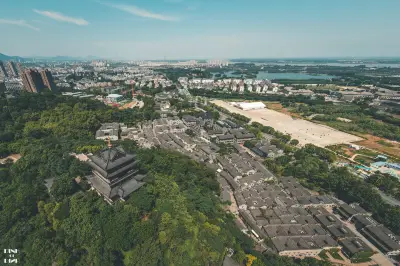
Wanghai Tower is a famous landmark in Taizhou, Jiangsu, and a symbol of the city, known as “The First Tower of Jianghuai.” Over 30 meters tall, it follows a Song-dynasty architectural style.
Since I was in Taizhou, I came to check this must-see spot.
Wanghai Tower was first built in the second year of the Shaoding era of the Southern Song Dynasty. It is said to have been constructed according to the terrain near the ancient city wall. Several hundred years ago, this area was a tidal flat, from which you could gaze out over the sea.
Now the sea has long since receded, but the name “Wanghai” (gazing at the sea) remains. Time has transformed the landscape—Taizhou is no longer what it once was.
I climbed to the fourth floor of Wanghai Tower, leaned on the railing, and looked into the distance. The modern high-rises across the Fengcheng River harmonized so beautifully with the ancient surroundings.
Travel tips:
Wanghai Tower entrance fee: 40 yuan.
Recommended visit time: 1 hour
“Haitangchun on Taizhou Old Street is on the pricier side, and the taste is decent. Zhezheju, Guyuelou, and Pibaoshui are moderately priced. But I recommend the century-old Jinyuelou in Daohu Ancient Street—affordable and tasty.”
For that recommendation, I made a trip to Daohu Ancient Street.
Daohu Ancient Street lies northwest of the North Moat, a block of imitation ancient buildings.
Its main feature is the five alleys that run eastward along the Dao River: First Alley, Second Alley, Third Alley, Fourth Alley, and Fifth Alley. There’s also a China Ancient Well Museum to wander through.
However, the number of shops and open buildings to visit is limited, and it feels rather quiet. The century-old Jinyuelou is right by the river, easy to find.
There are also cafés, bars, tea houses, and even a stinky tofu shop—their stinky tofu is quite unique and delicious.
If you have more time when traveling in Taizhou, there are other gardens like Qiao Garden, Willow Garden, and more. I’ve heard that Qiao Garden is just as good as the gardens in Suzhou. This time I didn’t have enough time, so I’m saving it for the next visit.
Three days and two nights is clearly not enough to truly get to know a city.
This was my first encounter with Taizhou. I really enjoy these less-touristed cities that retain the rhythm of local daily life—worth a visit for the food alone.
Friends who liked this piece can save it. Who knows, you might buy a high-speed train ticket someday and just go!
About the author: Ruoyousuosi CS, a girl from the Jiangnan region, a globetrotter. Click “Follow” above to share travel and life moments with you.