Searching for Hailing's Past and Present in the 600-Year-Old Daohe Ancient Street
Taizhou, the city of peace and prosperity, is also the Phoenix Ancient City mentioned in Marco Polo's travels. Over 700 years ago, Marco Polo came here and said: "This city is not large, but it abounds in every kind of worldly happiness." Taizhou is an ancient city in the Jianghuai region. The Daohe Ancient Street in Taizhou is the most distinctive of the remaining ancient city relics. Daohe is a river that flows with Taizhou's culture; many stories that happened here tell of Taizhou's rise and fall, its prosperity, and depict the simplest life of the Taizhou people. Daohe was the river of life for ancient Taizhou people. In ancient times, the Daohe was a distribution center for agricultural products in the Lixiahe area of Taizhou. The bountiful harvests were transported back and forth on this river; grain shops, oil mills, warehouses, and the like were mostly established along the river, once forming a scene of "small bridges, flowing water, and households." Rice ears scattered on the river, their golden tassels adding some brilliance to the waterway; the busy figures of people on the boats showed their hopes for life...
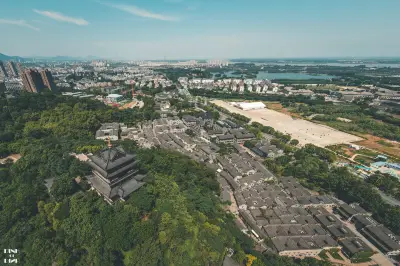
The Daohe Ancient Street in Taizhou is a meticulously restored large-scale nostalgic Ming and Qing dynasty residential complex in an ancient street district.
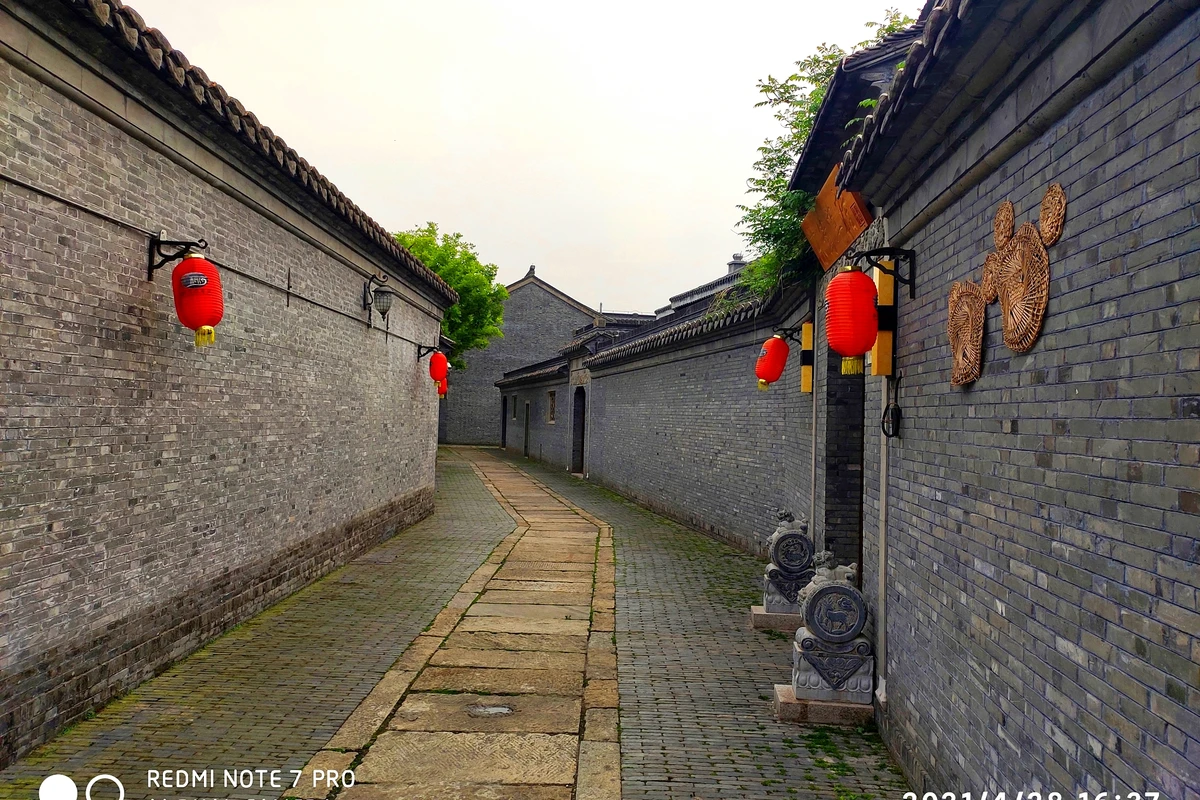
When I look down, I see bluestone slabs of varying sizes and shapes; when I look up, I see grey bricks and black tiles, red lanterns, and orderly ancient houses.
Some Ming and Qing residential houses have signs at the door, indicating which family's heritage they are, telling the historical origin of the house. Because it is an authentic restoration of the historical appearance, visitors can often see different styles. Also, due to the historical inheritance of each household, everyone can see many differences from other houses.
Hidden deep in the alley, the Five Lanes (Wuxiang) Primary School is hard to find without careful searching. This primary school was founded during the reign of Emperor Xuantong of the Qing dynasty. It began as a private school opened by Ye Tong in the Ye Family House in the lane. Later, after several name changes, after the founding of the People's Republic of China, the school was renamed "Five Lanes Primary School."
Stepping onto the age-old stone slab road, slowly passing by one house after another, I clearly feel the vicissitudes of the times and touch the accumulation of culture and history. Starting from one end of the path, I wander around the curves to the other end.
The main part of the ancient street, the Five Lanes, are five parallel lanes that rely on the Daohe to the east, running north-south and arranged east-west. The names of these five lanes are very simple: First Lane, Second Lane, Third Lane, Fourth Lane, and Fifth Lane. Each lane is about a hundred meters long and about four meters wide, with distances between lanes of about thirty to fifty meters. First Lane and Fifth Lane are slightly longer, followed by Second, Third, and Fourth Lanes. The southern ends of each lane are arranged in order, forming an east-west winding path, while the northern ends are connected by small horizontal lanes. The five lanes are neatly arranged, and the layout of the houses is roughly the same. People unfamiliar with the terrain, upon entering the Five Lanes, often get lost wandering around, as if entering an "Eight-Diagram Maze." Hence the local saying in Taizhou: "Enter the Five Lanes, and you'll drink a bewitching soup." This layout is unique in form, and such a street pattern is rarely seen.
It feels that the scale of Ming and Qing residential buildings here is truly unparalleled, and they possess a charm of "one house, one flavor."
"Grey bricks and black tiles, the sentiment of Five Lanes; literary prosperity and water beauty, the charm of Daohe."
For hundreds of years, the atmosphere of smooth access and peaceful living here has imbued the ancient street with an indelible color of its own. The vivid spirit of the Taizhou people is accumulated in the well-proportioned and rich warp and weft of the ancient district.
Taizhou has many rice fields, especially in the Lixiahe area. The "Dao" (rice) in Daohe was one of the main lifelines of Taizhou's economy during the Ming and Qing dynasties. During the Hongwu period of the Ming dynasty, grain shops dealing in grain gradually increased on both sides of the Daohe, reaching their peak in the middle and late Qing dynasty, becoming a well-known distribution center for agricultural products. Oil mills and warehouses were mostly set up along the river.
Here, the historical and cultural accumulation is deep, and the traditional Taizhou-style folk houses have a unique charm! Deep lanes and ancient houses, grey bricks and black tiles, exquisite upturned eaves, small buildings by the water...
On a non-weekend evening, there are few tourists in the streets and lanes. I cherish this rare tranquility and also enjoy the occasional state of being detached from the mundane world.
The term "shijing" (marketplace) originally referred to a place in ancient cities where goods were traded; there was a market only where there was a well, and the well was also the livelihood guarantee for people living in the city. The Daohe Ancient Street contains ancient well groups that have continued for more than 2,000 years from the Han and Tang dynasties through the Song and Yuan to the Ming and Qing dynasties, totaling 17 wells.
These ancient wells have different shapes and features depending on the era. The Han dynasty wells have pottery well rings; the late Tang and Five Dynasties ancient wells have nanmu bottoms, with the lower part laid flat and the upper part brick-built; the Song dynasty wells are made of brick blocks with tenons, laid both horizontally and vertically, with irregular brick shapes forming octagonal wells; the Ming and Qing bluestone ancient wells are made of ordinary small bricks, laid alternately vertically and horizontally.
The China Ancient Well Culture Museum, located on Daohe Ancient Street, is unique in the country. Its treasure piece has a history of 2,000 years. Moreover, finding such a dense group of ancient wells in one place is absolutely unique in the country!
From the oldest Han dynasty pottery well, a turtle shell and undecayed broken grass were unearthed. These ancient wells have witnessed the commercial prosperity of the Daohe from ancient times to the present, and even more so, they have witnessed the long history of the ancient city Taizhou, "a prefecture from the Han and Tang dynasties, a famous district of Huaihai," spanning over 2,000 years.
Taizhou blends the charm of Wu, Chu, and Yue, and gathers the wind of the Jianghuai and the sea. Hundreds of years pass in a fleeting moment, and the Daohe water just flows quietly, carrying a thousand years of cultural heritage, opening up the prosperity of Taizhou, and also flowing into the hearts of every visitor.