Two Days in Taizhou: A Different Slow Life in the Water Town
Prologue: Slow down, feel this water town.
The mighty Yangtze River flows endlessly, and as its vast waves approach the sea, it slows its hurried eastward journey, nourishing with sweet milk the beautiful historic and cultural city—Taizhou.
A city born and raised by water always carries an extra touch of liveliness and charm. Whether it's the Daohe Ancient Street with houses lining the riverbanks, the Fengcheng River glittering under night lights, or the countless moods of Qinhu Lake Wetland Park, it's no exaggeration to say that Taizhou without water would no longer be Taizhou.
From black-tiled white walls to modern chic, from ancient tranquility to bustling fashion, just as Marco Polo put it: this city is not very big, but it holds many earthly pleasures. The city shines with the brilliance of countless literati, so slow down, feel this water town, slow down, and savor the true essence of life.
1. Morning Tea on Old Street, Savoring the Taizhou Essentials
When it comes to Taizhou's morning tea, the one place you must visit is Old Street. On normal days it's quite lively, but for morning tea, I made a point of getting up early. Old Street in the early morning is peaceful, just the way I like it.
Few shops were open yet, but the breakfast stalls already had steam rising, and a tempting aroma drifted over, making my stomach growl. Time to cut to the chase!
"Brew in the morning, bask at night" is the essence of old Taizhou's leisurely life. Among all local food customs, Taizhou alone has preserved the morning tea tradition and rooted it firmly in folk life. Taizhou's morning tea is not just about eating—it's about that gentle, tender feeling.
A morning in Taizhou starts with slow, unhurried bites. At 8:30 we walked into the Guyue Lou restaurant on Old Street, already buzzing with activity. People sat around tables, savouring their food and chatting cheerfully. Locals swear by the "three treasures" of morning tea: blanched shredded dried tofu, fish broth noodles, and crab roe buns.
We ordered tea, shredded tofu, buns, shumai, and more. Soon delicate teapots arrived, each with a different tea—fermented Pu'er, Jinjunmei, and so on.
Taizhou's morning tea is abundant and varied, but the most traditional is "one tea, three snacks, one noodle": a cup of tea, a serving of blanched shredded tofu as a "tea head," three snacks—steamed buns, dumplings, and shumai—and one bowl of fish broth noodles.
The morning tea service comes roughly in five courses: first, tea; second, cold dishes, also called jiaotou; third, blanched shredded tofu; fourth, dim sum; fifth, fish broth noodles.
The plate for eating soup dumplings here is quite special, like a small tray. To eat a soup dumpling, you just bite a small hole at the edge and slowly suck out the soup. The waiter told us that the essence of these soup dumplings is the soup, not the skin.
The fish broth noodles are the final staple, with a fresh, savoury broth and firm, chewy noodles. For a girl, finishing all three treasures of Taizhou definitely qualifies you as a hero—because the portions are really generous.
2. Daohe Ancient Street, Six Centuries of Prosperity on the Water
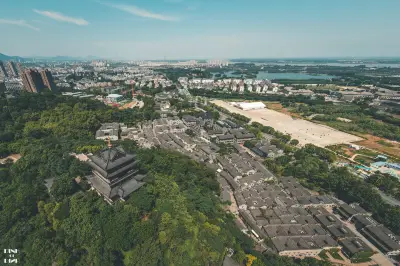
"Five lanes to the west, divided east and west; Daohe and Caohe rivers cross north and south." Built at the end of the Yuan and beginning of the Ming dynasty, the Daohe Ancient Street area is Taizhou's largest ancient architectural complex. After six centuries, it returns to our sight once more.
Renovated in three phases since 2009, the historic and cultural block is well-structured. At first glance, I thought I was in some Jiangnan water town. It's rare to find a place with water and ancient lanes right in the city. Yes, far from the city's neon, yet still under its shelter, washed clean of urban glitter but still playing out its own dazzling scenes.
The ancient street's architecture has the typical charm of a Jiangnan water town. Dwellings line the river, with two residential clusters sharing one waterway, linked by dozens of arched stone bridges.
Flying eaves and tiled roofs still show the old texture; pavilions and towers faintly recall past splendour. The newly opened Daohe Ancient Street blends ancient charm with modern style—it neither loses its rustic heritage nor lacks contemporary flair.
Walking further in, you meet lanes paved with bluestone slabs. To keep the texture of the lanes "authentic," many cultural relics in the area have been protected and properly restored, such as Qing-dynasty wells and the Ming-dynasty Guan Wang Temple.
Strolling in the deep courtyards of old mansions or lingering in the long, elegant lanes, I often felt as if I had crossed centuries. Hundreds of years seem to have passed in a snap, yet the appearance remains unchanged.
On a non-weekend afternoon, the lanes had few visitors, so I could walk slowly and look carefully. Upon meeting an old man playing the erhu, I even sat down to listen to a tune. I cherished this rare peace and enjoyed the occasional state of wandering beyond the dust of the world.
3. Visit the Three Gardens and Discover Opera Culture
1. Mei Garden, the Eternal Farewell My Concubine
Mei Garden, also known as Mei Lanfang Memorial Hall, lies on Yingchun East Road in downtown Taizhou, close to Fengcheng River, Old Street, and Peach Garden.
The famous Peking Opera master Mei Lanfang had his ancestral home in Taizhou. He began studying opera at age eight, at nine became a student of Wu Lingxian learning the qingyi role, and at ten stepped on stage. He devoted his entire life to the art.
I recall reading about him as a child, and later, after studying music and gaining a basic understanding of opera, I admired him even more. The Mei School of Peking Opera that Mei Lanfang innovated is not only the pinnacle of Peking Opera and Chinese opera as a whole, but also ranks among the world's three major performance systems.
In the pool outside the exhibition hall stands a white marble statue, vividly portraying Mr. Mei in the role of Yang Taizhen from The Legend of Taizhen.
Mei Lanfang's life embodied continuous innovation and a relentless pursuit of excellence. He merged creative ideas from many artistic fields into Peking Opera stage performance, bringing singing and performing arts for dan roles to a perfect realm, and making his school profoundly influential. His representative works include Farewell My Concubine, The Drunken Beauty, and Mu Guiying Takes Command.
I had heard before coming that the Mei Lanfang Park has "four wonders" worth seeing. The Mei Pavilion is one; the second is the large white marble bust of Mei Lanfang; the statue of Yang Taizhen is the third; and the fourth is a giant stone tablet inscribed with a poem, "Treading the Grass," by Mr. Zhao Puchu, written during his visit to Taizhou.
The garden is surrounded by water on three sides, shaded by lush trees and with elegant scenery. Even as spring turns to summer, the colours are brilliant, and surprises await around every corner, making you want to press the shutter.
Along the stone path, enter the Mei Lanfang Historical Archives Hall, where you'll find many photos and objects from the master's life, including the costumes and props he used in performances.
The exhibits also include scenes recreated to real life, and through technology, visitors can watch classic arias performed by Mr. Mei again. My personal favourite is Farewell My Concubine.
2. Peach Garden, the Birthplace of "The Peach Blossom Fan"
As is well known, Kong Shangren's The Peach Blossom Fan and Hong Sheng's The Palace of Eternal Life are hailed as the last two peaks of the golden age of Kunqu Opera.
The Peach Blossom Fan revolves around the love story of Li Xiangjun and Hou Chaozong, weaving in numerous characters and presenting a complex cross-section of society. And the place where Kong Shangren wrote The Peach Blossom Fan was Peach Garden.
Peach Garden sits on the east bank of the South City River, adjacent to Taizhou Old Street to the east, facing Wanghai Tower across the water to the west, and just a road away from Mei Lanfang Memorial Hall to the north. Its most beautiful season is when the peach blossoms bloom each year.
The Qing-dynasty playwright Kong Shangren, while serving as an official in Taizhou for water management, rose and then fell from grace, and in his destitute times lodged at the Chen family's nunnery, where he completed The Peach Blossom Fan. This drama borrows the love between Hou Fangyu and Li Xiangjun to express the sorrow of the fallen Southern Ming dynasty, achieving new artistic heights in both conception and script.
It is recorded that The Peach Blossom Fan is called "a panorama of a declining world," with intricate content, numerous characters, and varied scenes. After over ten years of painstaking creation and three revisions, the script was so eagerly copied among nobles and officials that its premiere by the Jindou Troupe caused an immediate sensation.
Small gardens have long been haunts of literati. Walking among the pavilions and terraces, one forgets all worries, filled with pastoral feelings. I imagine Kong Shangren's mood as he lived here writing The Peach Blossom Fan—perhaps he never expected the play would win such high acclaim.
3. Liu Garden, the Hometown of Storytelling Master Liu Jingting
Taizhou is not only the ancestral home of Master Mei Lanfang and the place where Kong Shangren wrote The Peach Blossom Fan, but also the hometown of Liu Jingting, the founder of pingshu storytelling. In 1985, to commemorate the master, Taizhou built Liu Garden, which enjoys a unique geographical advantage and rich historical resources.
Walking into Liu Garden, you can hear birdsong; the garden is imbued with atmosphere. Strolling through it feels like stepping into a dusty history, with different scenes at every turn.
Liu Gong Shrine was built to commemorate Liu Jingting's great life. Inside, you can see his living environment. Once, when Liu Jingting was wandering in exile, he came to Jingting Mountain in Anhui, where he fell drunk beneath the mountain. As he slept, he felt willow branches gently brushing him like a mother's caress. Moved, he declared, "From now on, Liu shall be my surname, and Jingting my given name"—and so the name Liu Jingting was born.
Liu Garden lies on the south bank of the City River, surrounded by weeping willows and reed flowers. The garden is thick with trees, and weeping willows line the river, forming a continuous willow dike inside and out. The deeper you go into the garden, the denser the shade—a perfect place to borrow some quiet leisure.
In April, Liu Garden has few visitors and intoxicating spring breezes. No need to hurry; just sit under the willows, have a cup of tea, enjoy the view, and the day quickly slips away!
4. The Water City at Night: A Night Cruise on Fengcheng River
The Fengcheng River is the moat surrounding Taizhou. "The city lies in the water, the water in the city"—a compound moat that gives Taizhou a rare water-city layout. If the Qinhuai River is the mother river of Nanjing, then the Fengcheng River plays an equally vital role in Taizhou's water system.
During the day, by the Fengcheng River, Wanghai Tower, "the First Tower of the Yangtze-Huai Area," together with the city's distinctive opera culture, highlights Taizhou's profound heritage. The water weaves a network for Taizhou, carrying the entire city.
At Tao Yuen pier on Fengcheng River, you can board a painted pleasure boat and drift quietly along. This experience is even better at night, because when the lights come on, a different world of sparkling brilliance awaits.
Aboard the boat, amidst the sound of oars and dappled light, I watched colourful lights and the reflections of ancient bridges and pavilions in varied shapes. Time seemed to slip back to the past, and in that moment, I felt as if I had entered a dream.
Not far off, the lilting melodies from an antique pleasure boat broke the silence, and the misty light floating in the air came alive. Drifting on the water, listening to a graceful operatic tune, one could hardly tell reality from reflection, then from now.
5. Climb Wanghai Tower, Experience "the First Tower of the Yangtze-Huai"
Standing by the Fengcheng River, the first thing you see is Wanghai Tower, the landmark of Taizhou. First built in the second year of the Shaoding era in the Southern Song dynasty, it is honoured as "the First Tower of the Yangtze-Huai."
To reach Wanghai Tower, you can take a boat or drive directly to the scenic area. Due to time constraints we didn't take the boat, but I highly recommend going by boat and then climbing the tower—it adds to the fun.
The tower has been destroyed and rebuilt time and again, mostly ruined in wars and restored in prosperous times. Legend says that during a rebuilding in the Kangxi period, when work started, heavy rain and thunder struck, then suddenly the sky cleared and cranes circled above. People gazed in amazement, seeing it as an auspicious omen, and grew even more reverent toward the tower.
Its latest destruction was in the early days of the Anti-Japanese War, showing that the tower's fate indeed mirrors the rise and fall of the Chinese nation. Finally in 2006, the Taizhou government decided to rebuild Wanghai Tower. On the eve of New Year's Day 2013, President Hu Jintao returned to his hometown and climbed Wanghai Tower to overlook the city and the moat.
The rebuilt Wanghai Tower follows Song dynasty architectural style, with a three-storey outer corridor, primarily in chestnut-shell and slate-grey tones, simple and elegant. Compared to historical records, the whole structure is taller and more magnificent, with smooth, graceful lines and refined, unearthly expression, harmoniously matching the existing ancient buildings of Taizhou.
6. Qinhu Lake Wetland Park, the Land of the Boat Festival
When you come to Qinhu Lake, you can't miss the Boat Festival. Every year around the Qingming Festival, on the vast lake, gongs and drums sound, bamboo poles rise like a forest, and all manner of decorated boats, dragon boats, and poled boats race forward. The magnificent spectacle, heart-stopping competition, and colourful performances are a grand panorama of folk culture.
I was incredibly lucky—this time I witnessed the boats. Today, the Qintong Boat Festival and Yunnan's Water-Splashing Festival are listed among China's top ten folk festival events. The boat custom, passed down since the Ming dynasty, has become the area's unique folk culture. So it's long been said that "Qintong boats are the best under heaven."
The poled boat formations are the most imposing in the fleet. Leading the charge are the blue and yellow teams, raising poles and churning waves to the sound of booming gongs, sweeping forward like an avalanche, shouting and singing.
The rowers' costumes are golden yellow like rape flowers, representing a hard-working, upward spirit and heralding the arrival of vibrant spring. But Qinhu Lake offers more than just the yearly Boat Festival; it also covers the 5.89 square kilometres of Qinhu Lake National Wetland Park.
Lakes and rivers within the scenic area make up about thirty percent of the park's total area—quite a large proportion. Walking to the dock, I saw the bald cypresses again, their emerald green a symbol of spring's arrival.
The main lake, "Qinhu," covers around 6300 mu (about 420 hectares). It's a living-water lake flowing into the Yangtze, a pearl of Jiangnan where three rivers converge. The water quality at the lake's centre meets national Class II standards. Qinhu Lake nurtures a scenery of secluded, quiet waters and richly pastoral landscapes.
Along a winding wetland boardwalk, you may spot egrets, pheasants, spot-billed ducks, and pond herons skimming the water, occasionally popping up to breathe the moist air. Qintong lies in the Lixiahe water region, where water is everywhere, boats are the way to travel, and even weddings can't do without boats.
After the boardwalk, you can walk or continue your wetland tour by water on a rowing boat or electric boat. The hand-rowed boats are the most distinctive—don't miss them.
Seated in the boat, watching the scenery around us, it felt as if every hue was blended into the dark, gentle lake. I think the beauty of Qinhu Lake is largely a kind of quiet, mysterious presence. The boatman sang a boat song, sweet and lilting. Along the Qinhu shores, weeping willows sway, and when a soft breeze blows, green ripples lightly rise, and willow catkins flutter like clouds and mist.
1. Itinerary
Day 1: Arrive and check in—Visit the Three Gardens—Wanghai Tower—Night cruise on Fengcheng River
Day 2: Old Street morning tea—Daohe Ancient Street—Qinhu Lake Wetland Park
2. Transportation
You can fly to Yangzhou Taizhou Airport or take a train to Taizhou Station or Jiangyan Station, then transfer to Taizhou. You can also take a long-distance bus or drive yourself, depending on your preference. Personally, if you're travelling with family and not too far away, I recommend a self-drive trip.
3. Accommodation
There are many good hotels in Taizhou city. I personally like newer hotels that are clean and hygienic. Compare ratings online before booking. There are plenty of options, so you'll hardly need to book far in advance.