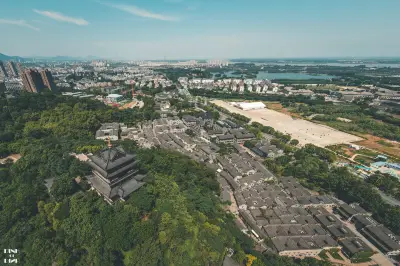
Taizhou's New Cultural Landmark: Former Residence of Wu Tongjia
Every time I come to Taizhou, having morning tea is a must. This time I chose Jinyue Lou on Daohe Ancient Street.
Taizhou morning tea is a folk dietary custom. The people of Taizhou have inherited this tradition, tenaciously rooted in folk culture and integrated into daily life. Through a variety of unique culinary arts, they make Taizhou people's meals flavorful and enjoyable. Taizhou morning tea is not just about eating; it's also about that gentle, warm feeling.
It is said that coming to Taizhou without trying blanched shredded dried tofu is like not coming at all. In Taizhou, there are three must-try snacks: boiled shredded dried tofu, blanched shredded dried tofu, and fish soup noodles. After blanching the shredded dried tofu, it is taken out and topped with shredded ginger, cilantro, dried shrimp, marinated pork, peanuts, etc., then drizzled with soy sauce and sesame oil. When eating, I first push the small mound flat, then spread the shredded tofu thickly on the plate to fully and evenly absorb the sauce. Each bite gives a tender, wobbling sensation. This time I didn't order the fish soup noodles mainly because I couldn't finish it.
Boiled shredded dried tofu is a must-eat every time. For an outsider like me, both blanched and boiled shredded dried tofu really make me 'eat once, crave for three years'!
A crab roe soup dumpling with soft skin and rich broth. Three meals a day: breakfast well, lunch full, dinner light. Since breakfast is the most important meal, people in Taizhou naturally take it seriously: with a satisfying breakfast, your energy is full for the whole day!
At this moment, I am enjoying the leisurely life in Taizhou Water City.
After finishing morning tea, I walked for less than ten minutes to visit the Former Residence of Wu Tongjia. The name of the exhibition hall was personally inscribed by Zhang Huaixi, former Vice Chairman of the National Committee of the Chinese People's Political Consultative Conference.
The Wu Tongjia Memorial Hall was built on the basis of his former residence, located at the east side of Yangqiao Intersection and north side of Nantong Road in the city, connected with Caohe and Daohe. The newly built memorial hall mainly consists of five rooms: the 'Wu Family Model' exhibition hall, Wu Tongjia's medical room, Chinese Classics Hall, Children's Education Hall, and Wu Tongjia's former residence.
The couplet: 'In early years he earned fame in imperial exams, his scholarly fragrance lingers in ancient Anhui; In the reed pond he found it hard to hide, his medical legacy remains in Wuling.' In the 'Wu Family Model' exhibition hall introducing Wu Tongjia's life, this couplet written by humanities scholar Wu Weichun profoundly summarizes Wu Tongjia's achievements. 'Exam fame' refers to passing the imperial exams and gaining official rank, which ancient scholars aspired to. Wu Tongjia passed the highest imperial exam at under 18, the youngest in his cohort, hence 'early years earned fame.' 'Education commissioner' refers to his role as Anhui Provincial Education Commissioner, the pinnacle of his official career, then a third-rank officer. 'Ancient Anhui' refers to Anhui. 'Leopard hide' means to preserve one's integrity and live in seclusion. After the fall of the Qing dynasty, Wu Tongjia rejected Yuan Shikai's offer of official position and secluded himself in the reed pond north of Taizhou. 'Apricot grove' is a metonym for traditional Chinese medicine. 'Wuling' is the ancient name for Taizhou. After a short seclusion, Wu Tongjia returned to the city to heal the sick and serve his hometown people.
Wu Tongjia (1861-1928), courtesy name Dixuan. A native of Taizhou in the late Qing dynasty, his ancestral home was Gaoyou, Jiangsu. In his youth, he was taught by his maternal grandfather Liu Xizai, and adhered to Song Confucianism. In the fifth year of Guangxu (1879), he took the provincial exam, and the chief examiner thought his essays were comparable to three masters. The next year he became a jinshi (metropolitan graduate) and served as a lecturer in the Hanlin Academy. He subsequently served as chief examiner in Shanxi, Henan, Guizhou, Guangdong, and other places. In the thirtieth year of Guangxu, he acted as Anhui Provincial Education Commissioner, then transferred to be a financial commissioner, and soon was formally appointed Education Commissioner. In his later years, he returned to Taizhou, changed his style name to 'Weitang' (Reed Pond), regarded himself as a Qing loyalist, and never again entered government offices. He only spent time with friends composing poetry and drinking, and taught children to read for amusement. Wu Tongjia was upright and strict with himself, modest to the point of pedantry. Even when writing a note, he would use neat regular script, carefully writing each stroke. He was skilled in medicine and would always walk to the patient's home to treat them, doing his utmost without any trouble. He lived a very frugal life; after his death, his family only had shabby clothes and a few books. His poems and writings were never collected and were later lost.
Wu Tongjia's life was deeply influenced by Liu Xizai. After returning to Taizhou in his later years, he still devoted himself to education, spending most of his time establishing schools, teaching students, and cultivating talents.
In the courtyard of the memorial hall, there is a set of bronze statues of Liu Xizai and Wu Tongjia, created by a young sculptor from Suzhou, depicting the vivid scene of Wu Tongjia receiving family education in his childhood.
In 1922, Wu Tongjia participated in the founding of the Chinese Classics Research Society. The society had five directors, all renowned figures: Han Guojun, Wu Tongjia, Liu Xianzeng, Wang Yimou, and Yuan Biao. The society was based in the then county library, and its main duty was to guide members in reading and studying practical knowledge. During the more than five years of its existence, the society trained many talents in Chinese classics for Taizhou. Most of the exhibits now displayed in the Chinese Classics Hall are works by members of the society.
The memorial hall displays a large number of artifacts, pictures, scrolls, and sculptures, providing a true and systematic introduction to Wu Tongjia's life.
After returning to his hometown at the age of 50, Wu Tongjia served his fellow villagers with superb medical skills. The Wu Tongjia Medical Room introduces some of his stories in this regard. There is also a painting of Wu Tongjia diagnosing a patient, created by local renowned painter Ji Feng.
In the exhibition hall, there is a folding fan with writing on both sides, inscribed by Wu Tongjia himself with two poems by Dong Qichang, a calligrapher and painter of the late Ming dynasty. Each rib of the fan is carved from agarwood, making it very precious.
In the center of the exhibition hall is a huge stone seal, carved by the famous seal artist Mr. Wang Kai, using Qingtian stone, one of the four famous sealing stones. This seal is 96 cm high and weighs 200 kg. On its side is inscribed two quatrains by Wu Tongjia. It is the largest seal in various exhibitions in Jiangsu, and can be called 'Jiangsu's First Seal'.
The side inscriptions are two quatrains by Wu Tongjia.
A set of official robes worn by Wu Tongjia when he served as Anhui Provincial Education Commissioner, and a pair of mounting stones for officials of the Qing dynasty, attract attention.
Wu Tongjia embodied three great qualities of ancient literati: being an honest and upright official, teaching and setting an example as a mentor, and practicing medicine to relieve the suffering of the people. A clean-handed, poor scholar, he left a fine reputation. Hanlin Academy lecturer Wu Tongjia deserves our respect.