The Latest 2021 Taizhou Travel Guide!
It has a long history of over 2,100 years, and for thousands of years it has enjoyed favorable weather, peace, and tranquility; it is renowned as 'the place where Confucian culture flourishes, always leading in Huainan,' and has nurtured great artists such as Mei Lanfang, Zheng Banqiao, and Shi Nai'an. It is none other than 'Taizhou,' known as 'Hailing' during the Han Dynasty. It must be said that the name given when it was established as a prefecture in the Southern Tang Dynasty, meaning 'a peaceful and prosperous state,' still suits it very well.
Speaking of Taizhou, even though I have already been there twice, I still feel somewhat unfamiliar, but it is this unfamiliarity that has brought me closer to it. When chatting with friends in the past, we often mentioned this place—its private gardens, its natural scenery, its stories of famous people... As a city with a history of over 2,100 years, it has countless stories worth remembering, and it is even more worthwhile for us to immerse ourselves in them now.
It is precisely these well-preserved private gardens, with their mountains, waters, plants, and trees, that have brought me closer to Taizhou. Although these gardens may not match the grandeur of Suzhou gardens or the fame of Yangzhou gardens, their elegance and uniqueness still linger in my mind, like unforgettable memories.
Simple Itinerary
Day 1: Depart from Nanjing > Qiao Garden (Rishe Garden) > Peach Garden > Mei Garden (Mei Lanfang Park) > Ancient Carved Tower
Day 2: Qinhu National Wetland Park > Qintong Ancient Town > Return to Nanjing
Taizhou boasts a wide variety of cuisine. Here, as in Yangzhou, people enjoy 'skin wrapped in water in the morning and water wrapped in skin in the evening.' A hearty Taizhou morning tea is essential to start a day full of energy. When autumn comes to Taizhou, after the National Day holiday, it is the season for fat river crabs, and you must try the large, plump Qinhu duàn crabs.
There are many snacks, such as Huangqiu sesame seed cake, Caoqiao sesame seed cake, osmanthus cake, and fish balls. Fish balls are also an essential ingredient in many dishes. When eating Taizhou cuisine, you'll notice that locals enjoy soupy dishes. When a table of dishes is served, nearly half are soup dishes. A friend joked that just these soup dishes alone are enough to make you feel full. From large boiled dry shredded tofu to the 'Eight Delicacies of Qinhu,' the cuisine emphasizes the original flavor of ingredients, with a fresh, light taste that is rich but not greasy.
The tradition of Taizhou morning tea consists of 'one tea, three dim sum, and one noodle.' The first things served are a cup of covered tea and a portion of hot dry shredded tofu. 'Fuxiang Tea' combines the color of Kui Zhen tea, the fragrance of pearl orchid, and the taste of Longjing tea. A light sip refreshes you and dispels drowsiness, accompanied by a pinch of smooth, refreshing hot dry shredded tofu, evoking a sense of leisure and elegance.
The 'three dim sum' are steamed buns, steamed dumplings, and shumai. The steaming baskets arrive with a warm, smoky aroma—fragrant like crab roe buns, refreshing like shrimp steamed dumplings, and light like vegetable shumai. Their subtle beauty and lingering charm are the magic of Taizhou morning tea.
The standout of the morning tea, unassuming by name alone, surprises you from the first bite. There is a saying among the people: 'Eating a bowl of fish soup noodles makes you live longer than an old immortal.' The fish soup noodles are not like the soup noodles I know; they have the aroma of fish without any fishy taste. Although I grew up in a coastal city and am not afraid of fishy smells, the fish here are from rivers and lakes, which can carry a bit of muddy earthiness. But the broth of the fish soup noodles has none of that. It is made from crucian carp, eel, and lard, and it is incredibly savory. Besides that, the soup has a strong hint of pepper, and I quite like the aroma of pepper; it is not greasy at all, and before I knew it, I had almost finished the whole bowl of noodles.
996 Boutique Holiday Hotel (Wanda Second Branch)
It was already afternoon when we arrived in Taizhou. We first went to the hotel we had booked to settle in.
Indeed, as they say, an inn is a scene in itself, and a stay is a journey. In a leisurely place like Taizhou, it's best to stay in one hotel for a few days to avoid the hassle of moving around, so you can focus on enjoying the scenery. This time, we stayed at the 996 Boutique Holiday Hotel, and I still recall the feeling of being wordless, sightless, and soundless, settling my body and soul, letting myself be exiled in this tranquil little city. This experience allowed me to enjoy both the beauty of the scenery and such relaxation and comfort.
The hotel is located near Taizhou Wanda, in the city center, close to various attractions, making it very convenient. Before coming, I looked at many hotels online, and this one seemed to offer the best value for money.
When we checked in at the front desk, the staff warmly served us lemonade and coffee. My friend also chatted with them about our itinerary. Since we already had a plan, we took the opportunity to enrich it a bit. The hotel staff were very considerate, taking our heavy luggage and, after the room was ready, escorting us to it. They were very attentive and grateful!
This is the Lakeside Holiday Suite. When you open the curtains, you can see the shimmering lake. It is quite spacious.
The light blue murals paired with the warm beige tones give a very comfortable feeling. The mattress is of moderate firmness and very comfortable. The carpet is soft, clean, and mostly soundproof.
The tea set is also quite stylish.
We also booked another room: a light luxury bathtub room with a king-size bed. When we entered our room, it wasn't too large, but the overall style was elegant and simple, and I instantly fell in love with it.
The bedding had the scent of sunshine, definitely just sun-dried. That's rare.
There were also many books on the bookshelf next to it.
The room was fully equipped. In the bathroom, toiletries were neatly arranged on the vanity—toothbrush, shower cap, cotton swabs, comb, toilet paper, body wash, shampoo, slippers, towels, and bath towels.
This makeup mirror is nice; the warm light gives a natural and soft reflection.
The room also had a large bathtub. The service staff would help fill it with hot water and sprinkle flower petals, so you could enjoy a relaxing bath to wash away the day's fatigue. Ha ha!
There was also a handwritten note from the butler in the room, which was quite interesting.
The hotel also has a swimming pool with a large, very clear pool. Those who love swimming definitely shouldn't miss this clear water.
The hotel's gym and swimming pool are both free for guests.
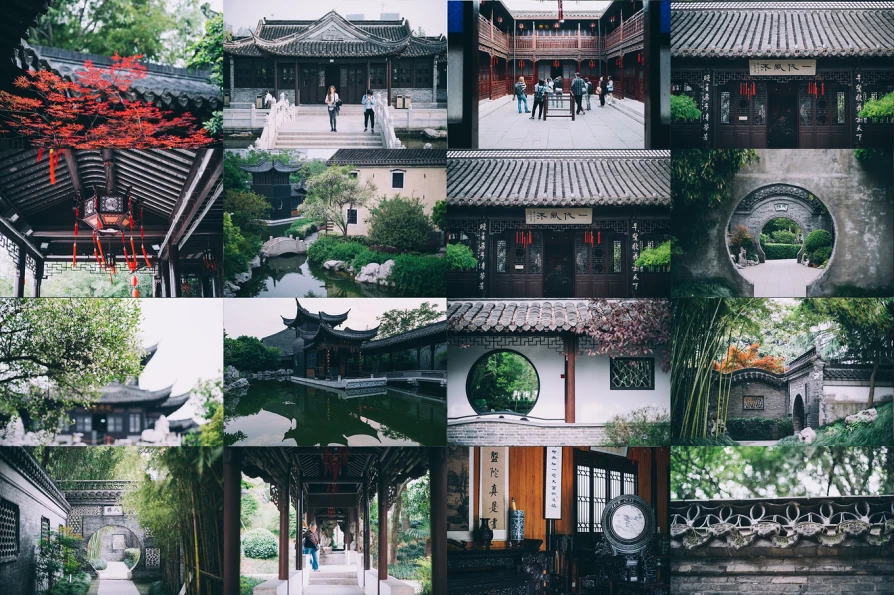
Qiao Garden is small, but it offers a different scene at every step. The architecture is far more fascinating than one might imagine. I suggest spending more time in this garden. Mei Lanfang Park introduces major and minor events in Mei Lanfang's life. If you look carefully, it will take half a day. Peach Garden, due to the season, had already lost its blossoms, and peaches were hanging on the branches. Basically, we just walked through it, but it's by the river, so it's not bad for a walk and a chat.
Qiao Garden, also known as Rishe Garden, is known as 'the best garden in Huainan.' It was originally a private garden, changing owners several times over more than 400 years, experiencing ups and downs. It still exists today, but things have changed.
Every time I visit a garden, standing in front of the gate, I wonder what mood and scenes the original owner experienced when entering and leaving. This time was no exception, out of a sense of reverence.
The garden is full of small scenic spots, most of which have names, such as Shanxiang Thatched Cottage, Shuyu Pavilion, Songchui Pavilion, Gengji Hall, Erfen Bamboo House, Laiqing Pavilion, Jiaoyu Xuan, Wengui Fang—names full of literary atmosphere. This shows Wu Wenxi's profound literary cultivation and his reclusive mindset.
Going deeper, you will see an arched building inscribed with the words 'Enter the Scenic Area,' meaning that passing through this door leads to the garden's most exquisite part. However, I found that even before entering this door, I was already captivated by the beautiful scenery in front of me. The hollowed-out walls and the bricks engraved with characters are so well-preserved. It's truly remarkable.
Peach Garden—the beautiful scenery remains.
At the entrance of Peach Garden, there is a memorial archway with the words 'Old Street.' Old Street is not a real old street, including the Peach Garden we were about to enter; it is a young street that took the local government two years to build. But the paths paved with bluestone are genuinely Ming and Qing Dynasty alleys, about 600 meters long, flanked by buildings with green tiles and white walls. We didn't go inside, and now I think I regret not stepping in to take a look.
Inside Peach Garden, there is the Jizhou Bridge. A stone tablet by the bridge records the story of Zhao Kuangyin of the Song Dynasty taking refuge in Tai and being given a bowl of wheat porridge by a local. After he became emperor, he returned to Taizhou and named the bridge 'Jizhou.' To the north of the bridge is the Fuxiang Pavilion, with four stone tablets inscribed with poems by Su Shi, Su Zhe, and two other 'four sages.' On summer nights, a faint fragrance drifts, allowing one to appreciate the charm of the four sages.
Mei Garden (Mei Lanfang Park)
Speaking of Mei Lanfang, most people probably first think of 'Farewell My Concubine,' one of the classic Mei-style operas performed by the renowned Peking Opera master Mei Lanfang.
This stone bridge is called 'Yinfeng Bridge,' meaning 'building a nest to attract a phoenix.' The water system under the bridge symbolizes the water sleeves in Peking Opera. Goldfish are raised in the water, and when people approach, the fish swarm over.
In the middle of Mei Garden, there is a pool surrounded by imitation white marble railings. In the center of the pool is a white marble statue of Mei Lanfang playing Yang Taizhen in 'The Legend of Taizhen.' The pose is graceful, the expression lifelike, like a lotus emerging from water.
Walking out behind the exhibition hall, you can see a five-cornered pavilion. The roof of the Mei Pavilion resembles five plum blossom petals, and the tip is like a budding plum blossom. The ceiling inside is shaped like plum blossoms, and the floor is inlaid with plum blossom patterns. From the inside out, the entire pavilion looks like a blooming plum blossom.
Jiangzuo First Tower, Ancient Carved Tower
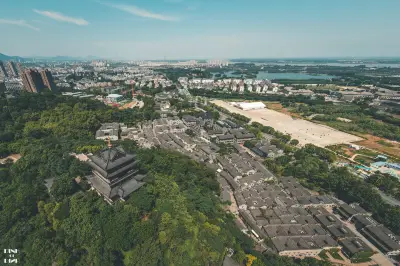
Ancient Carved Tower, also known as the Kou'an Carved Tower, was officially completed in the fourth year of Qianlong's reign in the Qing Dynasty. It is located in Gaogang, on the banks of the Yangtze River in Taizhou, and was built by a timber merchant from Jiangnan named Yao. The building faces east, with double eaves and a hard mountain-style roof. It has two floors, five bays wide, and an impressive appearance. Later, due to poor management, it changed hands to a local wealthy man named Li Songru. Li bought Yao's building and expanded it, not only building a similar rear tower on the west side of the old building but also adding two side towers between the old and new ones, transforming the single tower into a four-sided complex, doubling the area.
The buildings in the garden are imposing, with distinct eaves and corners. It follows the Jiangnan garden layout, with mountains, water, and lush trees. The central building stands on the water like a sailing ship. The couplet reads, 'The stone boat can sail through ancient moons; the wooden raft takes advantage of a river breeze,' symbolizing riding the wind and waves toward a bright future.
We were a bit tired when we left the park and returned to the hotel.
The hotel is very close to Wanda Plaza, just a few minutes' walk. If you have energy left after a day out, it's also very convenient for shopping.
After buying necessities, we returned to the hotel.
The hotel offers a buffet breakfast, which is delicious and quite varied. In the morning, there are various noodles, stir-fries, and the like. Have a hearty breakfast to start the day full of energy!
In the morning, I opened the window to face the lake breeze; in the distance, the lake shimmered, and I quietly enjoyed the leisurely time. I felt I might not even want to go out.
Qinhu National Wetland Park
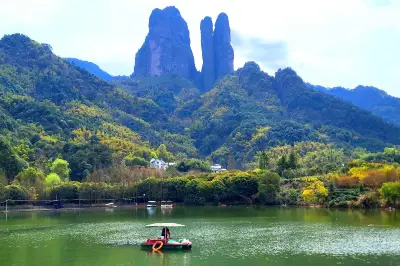
Qinhu National Wetland Park is located in Jiangyan District, Taizhou City, in central Jiangsu. It is a national 5A-level scenic area. Currently, the open area is 7 square kilometers, and it takes about 2 hours to walk through. Along the way, the shrubs are lush, the water is clear, there are many wild animals, and the air is fresh. It's a good choice for a weekend outing. Take a small rowboat, enjoy the scenery on both sides, and clear your mind.
Qinhu Lake, also known as Magpie Lake, is 1.4 kilometers from east to west and 1.5 kilometers from north to south, shaped like a jade pendant, covering an area of about 2.1 square kilometers. Looking down from a height, there are nine main rivers flowing into the lake from all directions, naturally forming a 'Nine Dragons Paying Homage' spectacle.
In addition to the boardwalk, there is also a section of land trail for hiking. The vegetation on both sides is lush, with poplars standing tall. Of course, the air is good. Breathing the fresh air, I had already forgotten the troubles and old memories entangled in my mind, and my mood naturally became relaxed.
Along the way, there is also an option to take a black-canopied boat. As the boat moves, the boatman might improvise a few local folk songs. But make sure to take a boat rowed by an elderly woman, because the elderly men here rarely sing.
You must have heard of the duàn crabs of Qinhu Lake, which are also a famous local specialty. The railing set up here is a test to determine whether a crab qualifies as a Qinhu duàn crab. Crabs that can climb over this railing become duàn crabs and double in price, but whether they climb over or not, they will eventually end up on the plate.
After visiting Qinhu Lake, you must not miss Qintong Ancient Town to its north. Qintong has been near the sea since ancient times, with abundant water and grass. The village on the east bank of the river is still called 'Haibin Village.'
Like other ancient towns, the streets are full of local snacks, such as Huangqiu sesame seed cake, Zhongzhuang drunken crab, hot dry shredded tofu, Qintong fish cake, fried stinky tofu, five-flavor shredded tofu, fish soup noodles, Jiangyan crisp cake, farmer's buckwheat noodle soup, and Chai Xu cicada wing pastry. They are all very authentic, and the locals are very warm and friendly.
Qintong Ancient Town is a famous historical and cultural town in China. It is located in the northeast corner of Jiangyan City, at the junction of Taizhou, Yancheng, and Nantong. It has been said since ancient times that 'a dog's bark can be heard in three counties.' The spiritual aura of Qinhu Lake has nurtured the intelligent and diligent students of Qintong, forming the unique scholarly atmosphere of the ancient town.
Former Residence of Academicians: Qintong is a place blessed with outstanding people. In ancient times, the Liu family produced two top scholars in three imperial examinations. Today, there are five academicians from the two brothers Li Dequn and others. This is an ancient residence built during the Qianlong period of the Qing Dynasty, with a history of over 200 years.
The centuries-old house, after enduring many vicissitudes, contains rich cultural connotations. From Li Chenglin, the top scholar in the Gengzi year of Daoguang, to the current three brothers Li Deren, Li Deyi, and Li Dequn, who are five academicians, they all walked out of the gate of this old house, stepped into the currents of the century, and created brilliant careers.
As I walked slowly, the ancient town is surrounded by water on all sides. Every household lives by the river. The residential buildings are known for their exquisiteness—deep alleys with quiet dwellings, bluestone-paved streets, wells in courtyards; the alleys wind nine turns and eighteen bends, so narrow in places that only one person can pass. Every house is connected, and if no one leads you, you might get lost.
The essence of a city is often revealed inadvertently. Strolling through old streets and alleys, with green tiles and white walls, the former residences of salt merchants have become ordinary homes, but they still retain the atmosphere of the past. The culture of the Northern Song Dynasty, the culture of the five prime ministers, salt-tax culture, water culture, Tai-style residences... all these string together Taizhou's over 2,000 years of history, becoming our deepest memory.