Bypassing Taihu Lake, Crossing the Yangtze River: A Weekend Food Tour in Taizhou.
Just like the trip to Zhenjiang two weeks ago, this weekend's Taizhou trip was also motivated by a hotel voucher I had on hand, which I wanted to use before the rainy season. Compared to Zhenjiang, Taizhou's status in Jiangsu tourism is more awkward. Zhenjiang is located south of the Yangtze River, on the Shanghai-Nanjing line, with convenient transportation, while Taizhou is on the north bank of the Yangtze River, in the hinterland of northern Jiangsu. Its geography, location, and transportation are incomparable to those south of the river. It was only in recent years that Taizhou built a Yangtze River bridge, making transportation to the south more convenient. Similarly, compared to the famous Yangzhou, Taizhou has a very weak presence. No wonder—Yangzhou and Taizhou only separated in 1997, and Taizhou has always been Yangzhou's younger brother. This also means that in many aspects, such as culture, customs, and especially cuisine, Taizhou and Yangzhou share the same lineage. Therefore, this trip to Taizhou was meant to be a journey to discover Taizhou's food.
The way we traveled this time was also slightly different from usual. We arranged to go with my wife's cousin and his wife, who live in Wuxi. We first took the high-speed train to Wuxi and then drove with my cousin-in-law to Taizhou. Starting from Wuxi, we crossed the Jiangyin Yangtze River Bridge. The first stop was Jingjiang, under Taizhou's jurisdiction. When we arrived in Jingjiang, it was just lunchtime. Since this was a food discovery trip, we certainly wouldn't miss Jingjiang's delicacies.
For a long time, Jingjiang's crab roe soup dumplings and pork jerky have been must-eats when visiting Jingjiang. Crab roe soup dumplings are not uncommon in the Jiangnan region, but the公认 best ones are indeed from Jingjiang, Taizhou. I have passed by or made special trips to Jingjiang many times to taste these dumplings. I am deeply impressed by the intense umami that rushes to the brain, making the scalp tingle. In recent years, after being featured on "A Bite of China," crab roe soup dumplings have become more widely known and have become Jingjiang's signature dish. The people of Jingjiang proudly say, "Outside Jingjiang, all soup dumplings are a desecration of soup dumplings." Yearning for these dumplings, I had to have some on this trip. Jingjiang is not a big city, but there are many soup dumpling shops, each claiming to be authentic. However, only a few are famous and well-made. It's a matter of personal taste. I still chose the Hongyun Restaurant, which I have been visiting for years. I hadn't been to Hongyun for several years. The old shop, originally in the city center, has moved to a new location on Nanhuan Road. The new shop is much larger, and of course, the price of soup dumplings has also increased significantly. The highlight is, of course, the crab roe soup dumplings. They don't put on airs by using straws to drink the soup. The waiter uses one hand to lift a single dumpling from the steamer into a small dish. If the skin breaks or the juice leaks, they will compensate you. The dish acts like a tray. When eating the dumpling, just take a small bite on the edge and slowly suck out the soup inside. The main point of this dumpling is to eat the juice, not the skin. Although it is not the best season for crabs, the taste is still exceptional. The flavor of Hongyun Restaurant's soup dumplings hasn't changed. The soup is not greasy at all. The broth, simmered for six hours with chicken and pork bones, is enriched by the umami of crab, adding layers of flavor. After drinking the soup, what remains is plenty of crab meat and crab roe. All kinds of umami are concentrated in one soup dumpling—this is the charm of crab roe soup dumplings. Besides crab roe soup dumplings, Hongyun Restaurant's other dishes, such as braised mixed fish, crab roe and vermicelli, and amaranth with river shrimp, are also very distinctive. The first meal today felt great.
After lunch in Jingjiang, it took about an hour to drive to downtown Taizhou. The Hotel Nikko Taizhou is located in Gaogang District. Fearing that we would arrive too early to check in, we decided to first explore Hailing District, the old city area of Taizhou. Compared to Taizhou's food, the tourist attractions in the city are much less impressive. The main scenic area in Taizhou city revolves around the moat—the Fengcheng River. Meiyuan (Plum Garden) is probably a must-visit spot. Meiyuan, also known as the Mei Lanfang Memorial Hall, is located on Yingchun East Road, in the city center, close to Fengcheng River, the Old Street, and Taoyuan (Peach Garden). Our first stop was Meiyuan (Mei Lanfang Memorial Hall). When mentioning Mei Lanfang, most people first think of "Farewell My Concubine," one of the classic Mei-style plays performed by the renowned Peking Opera master Mei Lanfang. Although Mei Lanfang was born in Beijing, his ancestral home is Taizhou. We walked along the stone-paved path into the gate of Meiyuan. A white marble statue of the master sitting upright looked particularly spirited under the early summer sun. Further inside is the Mei Lanfang Historical Materials Exhibition Hall, which displays a large number of photos and artifacts from the master's life. You can see the clothes he wore during performances and the props he used. The memorial hall also uses modern multimedia means such as sound, light, electricity, and film to showcase Mei's cultural relics, pictures, objects, and materials. A black-and-white video clip let us moderns once again appreciate Mei Lanfang's beautiful singing. Surrounded by water on three sides and embraced by forests, Meiyuan is not large, but it is planted with many varieties of flowers, grasses, and bamboos, complemented by other greenery, ensuring scenery in all seasons. Moreover, many buildings in the garden were moved here from Ming and Qing dynasty structures in the city, fitting the characteristics of Chinese garden architecture, giving a sense of transcendence and elegance. It is a nice garden.
Currently, the admission fee for Meiyuan is 30 yuan. It takes about an hour or more to look around.
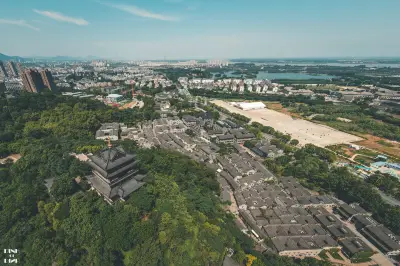
After leaving Meiyuan, we drove across the Yingchun Bridge over the Fengcheng River and turned left to reach the Wanghai Tower scenic area. In fact, from Meiyuan, you can already see the Wanghai Tower on the opposite bank of the Fengcheng River. Wanghai Tower is a landmark of Taizhou. First built in the second year of the Shaoding era of the Southern Song Dynasty, it is known as the "First Tower of Jianghuai." This tower has been destroyed and rebuilt many times, mostly by war and then restored in prosperous times. The current Wanghai Tower was rebuilt in 2006 in the style of Song Dynasty architecture. It is over 30 meters high, with a three-story circular corridor on the exterior. The main colors are chestnut shell and bluish gray, simple and elegant. The entire building is taller and more magnificent than historical records, with smooth and graceful lines, elegant and refined expression, maintaining a harmonious style with existing ancient buildings in Taizhou. Taizhou was historically called Hailing, with a long history of over 2,100 years. For thousands of years, it has enjoyed favorable weather, stability, and peace. It has the reputation of "the flourishing of Confucianism has always crowned Huainan." Now the sea has receded far away, but the name "Wanghai" (Viewing the Sea) remains. We climbed to the top of Wanghai Tower, enjoying a panoramic view of the beautiful scenery on both sides of the Fengcheng River. The Fengcheng River is the moat outside Taizhou city. "The city is in the water, and the water is in the city"—this double-layered city moat gives Taizhou a rare water city layout in China. If the Qinhuai River is the mother river of Nanjing, then the Fengcheng River is undoubtedly the mother river of Taizhou. The "First Tower of Jianghuai" Wanghai Tower, together with its unique opera culture, highlights the city's heritage. Water weaves a dense network for Taizhou, carrying the city. Although no trace of the sea can be seen from Wanghai Tower today, the city of Taizhou, despite rising high-rise buildings everywhere, still retains its ancient charm, becoming even more enchanting. Perhaps it is this antique flavor that makes the nostalgia and vicissitudes of this old city appear more natural. The slowly flowing waters of the Fengcheng River perfectly match the meaning of "a peaceful state and a prosperous people, an auspicious and peaceful Taizhou."
The admission fee for the Wanghai Tower scenic area is 40 yuan. There are also attractions such as the ancient city ruins within the scenic area. At night, Wanghai Tower and the buildings along both sides of the Fengcheng River are lit up. Taking a painted boat for a night tour of the Fengcheng River is also a highlight of Taizhou tourism.
After visiting Wanghai Tower, it was already past three in the afternoon. We left Hailing District, the old city of Taizhou, and headed to the Hotel Nikko Taizhou in Gaogang District, where we were staying. After a 20-minute drive, we arrived at the Hotel Nikko Taizhou in the Medical High-tech Zone, Gaogang District. The hotel is located at Building C, No. 799, Yaocheng Avenue, east of Taigao Road, Gaogang District. The hotel's interior is very new, with a modern decoration style. The lobby is grand, and there are many public areas. Small details are well taken care of. The room facilities are complete, including central air conditioning, a magnifying mirror in the bathroom, 24-hour hot water, free toiletries, bathrobes, an iron, a hairdryer, slippers, an umbrella, an independent desk, multiple power sockets, wireless internet (and independent network), a safe, an electric kettle, free bottled water, a minibar, etc. Guests can use the swimming pool and fitness center for free. According to travel guides, the hotel's Japanese restaurant is also very good. The only slight drawback is that the standard king room we stayed in was a bit small in size. Also, it is more than ten kilometers away from Hailing District, the old city. However, because we booked through a platform with a very affordable price using a voucher, the cost-performance ratio was still quite good.
As they say, a good hotel is a scenery, and a comfortable stay is a journey. After checking in, we first settled our bodies and minds in the room, entering a slow-paced leisure and comfortable vacation mode. While relaxing, we also went to the hotel's swimming pool, swam a few laps, burned some calories, and prepared for better enjoyment of food later.
Taizhou cuisine, similar to Yangzhou's eating habits, is mainly Huaiyang cuisine. The ingredients are mostly aquatic products, mainly river and lake fresh catches, supported by top cooking skills, emphasizing natural flavors, and aiming to please all tastes, appealing to both refined and popular tastes without losing elegance. Especially the unique concept of "harmony, refinement, clarity, and freshness" suits our preference for light and umami flavors. Therefore, in Taizhou, we definitely chose a Huaiyang cuisine restaurant. Before coming to Taizhou, I did some research. According to reviews, Baiweicang Restaurant has a good reputation, with several chain stores in Taizhou. We chose Baiweicang (Mingliu branch), the closest to our hotel. When we went there around seven in the evening, the restaurant was still full. Just then, a table of guests finished, so we quickly took their seats. This is a restaurant that serves innovative Huaiyang cuisine. The environment has also been upgraded in quality, with a simple style like a tea restaurant, open kitchens, and mobile QR code ordering. Fish soup wontons and Baiwei chicken are signature dishes. Traditional Huaiyang dishes like stir-fried eels and boiled dry tofu shreds (tang gan si) are also very authentic. We found that Taizhou's boiled dry tofu shreds are softer than Yangzhou's, and the taste is no less than Yangzhou's. No wonder business is so booming. However, there was one thing that felt a bit off: we didn't expect business to end so early. Maybe it's related to the mall they rent. At half past eight in the evening, most guests had already left, and the staff began to clear tables and clean. Although they didn't rush us, seeing that we were the only table left in the entire hall, we felt a bit embarrassed and hastened to eat. Even so, we couldn't finish, so we had to pack the rest and take it back to the hotel to continue eating and drinking.
As the saying goes, each place nurtures its own people. The delicacy and gentleness of the water town, the generosity of the north, are actually revealed in the breakfast culture. Historically, many places have the custom of morning tea, but only the Yangzhou-Taizhou area in Jiangsu has inherited it. Every year when I go to Yangzhou, I have morning tea. Not only to enjoy the food, but morning tea has also become a ritual. Coming to Taizhou, which shares the same lineage as Yangzhou, not getting up early for morning tea would be a regret for the whole day. I had long planned to have morning tea in Taizhou, and I had to find an old shop in Hailing District, the old city of Taizhou. Although we had packed food back to the Hotel Nikko and continued eating and drinking until the early hours, I gave up sleeping in and insisted on getting up at 7:30. After freshening up, we checked out at 8:00 and drove more than ten kilometers to Hailing District. In Taizhou, where morning tea culture is developed, there are places for morning tea everywhere. Because I had done research before coming, I not only wanted good food but also a sense of ritual. We went to Huibinlou (Gulou branch), one of the representative morning tea restaurants in Taizhou. Besides morning tea, it is also a famous restaurant in Taizhou. Many local families choose it for happy occasions. We arrived at 8:30 in the morning, and it was already hard to find a seat. After waiting in line for a while, our group of four could only share a table with a local family of three. Again, we ordered via QR code. Taizhou morning tea emphasizes the "Three Treasures": boiled dry tofu shreds, fish soup noodles, and crab roe buns. Since we had already tasted Jingjiang crab roe soup dumplings, we skipped the crab roe buns today. We asked the local couple sharing the table, and they recommended yangcao buns (made with clover). We also ordered shrimp roe dry-tossed noodles, winter mushroom shaomai, five-ingredient buns, bean paste buns, and jellied meat. After ordering, the waitress quickly brought everything at once, and the table couldn't hold all the dishes. Huibinlou's signature five-flavor handmade boiled dry tofu shreds were indeed no less delicious than Yangzhou's large-boiled dry tofu shreds. Taizhou's shrimp roe dry-tossed noodles use thicker noodles than Yangzhou's, topped with a pinch of shrimp roe. The appearance and taste were really good. I originally wanted to order Huibinlou's signature malantou (Indian aster) shaomai, but it's seasonal and past its season, so we substituted winter mushroom shaomai. This winter mushroom shaomai uses fine ingredients like winter mushrooms and dried shrimp, and it's very distinctive. The most distinctive was the yangcao bun. Yangcao is actually what we call clover. We've all eaten vegetable buns made with choy sum, but I never thought clover buns could be so delicious, with a unique fragrance. In countless Yangzhou morning tea experiences, I don't think I've had fish soup noodles. In Taizhou, fish soup noodles are a must-order. It seems that fish soup noodles are one of the biggest differences between Taizhou and Yangzhou morning tea. In Taizhou, there is a saying, "Having a bowl of fish soup noodles is better than being a long-lived star." And Taizhou's fish soup noodles are not made by just stewing any fish; it's quite labor-intensive. It requires adding pork bones, fish bones, eel bones, etc., giving a fishy aroma without any fishy taste, smooth and delicious, not greasy at all. Unfortunately, we ordered a bit too much. Even though the fish soup noodles were delicious, we only ate half. The five-ingredient buns and bean paste buns were completely uneatable, so we had to pack them. Huibinlou gave me the feeling of a very honest old shop. They use generous ingredients, fair prices, and good service, with nothing to complain about. It's no less than the famous Yangzhou tea houses with the character "Chun" in their names. When we finally left the restaurant, we clearly felt that we wouldn't be able to eat lunch today.
Taizhou and Yangzhou share the same culture, lifestyle, and dietary customs. Therefore, like Yangzhou, they love "skin wrapped in water in the morning, water wrapped in skin in the evening" (morning tea and evening bath). This leisurely small city has places for morning tea everywhere. Moreover, what Yangzhou has, Taizhou also has, and it can be even slower by three or four beats. Morning tea styles and types are basically the same as Yangzhou's, but Taizhou also has its own characteristics. Taizhou morning tea emphasizes "one tea, three dishes, one noodle." "One tea" means a cup of tea and a plate of boiled dry tofu shreds (tea appetizer), similar to Yangzhou. But personally, I think the boiled dry tofu shreds in Taizhou are thicker, and in terms of texture, Yangzhou's shreds are drier, while Taizhou's are softer and moister. "Three dishes" usually refer to various filled buns, steamed dumplings, and shaomai. Among them, yangcao buns are something I haven't had in Yangzhou. The other three dishes have their own merits compared to Yangzhou's. "One noodle" refers to fish soup noodles, which are unique to Taizhou morning tea and very distinctive.
Huibinlou, with its excellent reviews, has a good environment. However, note that on weekends and holidays, there will be many people (mostly locals), and the wait time can be long. The peak time is around 8 a.m. The restaurant will arrange sharing tables with other guests according to the number of people. Moreover, Huibinlou is not only busy with morning tea; it is also a famous restaurant in Taizhou with very good lunch and dinner business. Morning tea basically ends at 10 a.m. At 10 a.m., staff begin to clean up in preparation for lunch. If you are not on a budget, Huibinlou has luxury private rooms on the second floor for morning tea, where you don't have to wait in line, but you need to consume at least 100 yuan per person. I can't figure out how to finish 100 yuan worth of morning tea, unless the private room dim sum is more refined and prices differ from those downstairs. Additionally, parking near Huibinlou is tight; you need to find your own space.
After morning tea, it was past 10 a.m. To digest, we drove again to the Fengcheng River. First, we went to Taizhou Old Street, opposite Wanghai Tower across the river. Taizhou Old Street, outside the Taoyuan Scenic Area along the Fengcheng River, is a belt of ancient buildings with green bricks and black tiles, filled with the fragrant aroma of snacks and long, drawn-out hawking calls, stretching 600 meters. In fact, Taizhou Old Street is not a genuine old street. The land, including the adjacent Taoyuan area, was originally farmland and village residential land of Dongjiao Baoba Village. With the planning and development of the Fengcheng River Scenic Area, Taizhou Old Street broke ground in 2007 and took two years to form its current scale. To be precise, Taizhou Old Street is an antique tourist spot that rose from farmland. Of course, its formation has gathered some popularity, but such an old street cannot be seen in the old city of Taizhou itself. Since the peach blossom season was over, we didn't enter the paid Taoyuan area. Instead, we strolled along the cobblestone alleys of the Old Street. On the street, there are many time-honored restaurants, such as "Guyuelou," "Hailingchun," "Laotaizhou Taizhou Cai," "Haitangchun," etc., as well as an ancient opera stage, a morning tea museum, and a Pian Zai Huang Museum, all free to visit.
There weren't many tourists on the Old Street, so we could walk slowly and observe carefully, experiencing the leisurely life of Taizhou people. This rare tranquility was enjoyable, and I cherished this occasional state of being detached from the world.
Among all provinces in China, Jiangsu has the most 5A scenic spots, with 24. Many 5A spots are well-known. Taizhou also has one and only one 5A scenic spot: the Qinhu National Wetland Park in Jiangyan District under its jurisdiction. The wetland park is located in the Lixiahe area, one of the country's three major depressions. The planned area is 806.9 hectares, with a wetland area of 588.6 hectares and a wetland rate of 72.9%. The wetlands are divided into three types: lake wetlands, river wetlands, and marsh wetlands, and three subtypes: permanent freshwater lakes, permanent rivers, and herbaceous marshes. It is divided into three functional zones: wetland conservation area, wetland restoration area, and rational utilization area. It is a pearl embedded in Taizhou.
I have been to the wetland park twice before, but that was over ten years ago. I imagine it has changed a lot, but I still have some impression of Qinhu National Wetland Park. There are three highlights at Qinhu National Wetland Park: the annual Boat Festival around Qingming Festival, where drums roar and bamboo poles stand on the vast lake, with various flower boats, dragon boats, and pole boats racing. The grand scene, thrilling competition, and colorful performances make this custom, which has been handed down since the Ming Dynasty, a grand spectacle of folk culture, now listed as one of the top ten folk festival activities in China.
"In the south, there are Chengdu Lake hairy crabs; in the north, there are Qinhu broken crabs." When the autumn wind blows, crabs are restless. Those that can climb over the bamboo fences placed in the water to enter the nets are the strong and healthy Qinhu broken crabs. The unique wetland ecological environment of Qinhu breeds a large number of green and environmentally friendly specialty agricultural products, among which the "Qinhu Eight Delicacies" are famous for their freshness. The "Qinhu Eight Delicacies" come from local areas. Today, the "Qinhu Eight Delicacies" not only drive the prosperity of surrounding areas but have also become another business card of Qinhu tourism.
Today, the Qingming Boat Festival was long over, and the season for tasting Qinhu broken crabs had not yet arrived. Although the Qinhu Eight Delicacies are famous year-round, we were too full from morning tea to eat the Eight Delicacies. So we came to enjoy the natural scenery of Qinhu, themed "water, wetland, and ecology."
The main lake of Qinhu National Wetland Park, "Qinhu," also known as Magpie Lake, is 1.4 kilometers long from east to west and 1.5 kilometers from north to south, shaped like a jade pendant, with an area of about 2.1 square kilometers. It is a flowing lake connected to the Yangtze River, and the water quality at the center reaches Class II national standards. The admission fee for Qinhu National Wetland Park is 80 yuan per person, which includes a round-trip ferry from the dock at the entrance to the main scenic area of the wetland park. Ferries depart about every half hour, with a sailing time of about 20 minutes. It took about half an hour to drive from downtown Taizhou to the entrance of Qinhu National Wetland Park. Then we boarded the 1 p.m. ferry to the main scenic area. The boat sailed on the rippling waters of Qinhu. First, we saw a three-sided bronze statue of the Medicine Buddha on the lake, resplendent and very striking. It is made using imitation gold copper technology and is the world's tallest bronze statue of the Medicine Buddha. There is a stop where visitors can choose to get on or off. We chose to continue to the opposite shore of Qinhu. The lake is wide, the water clear and sweet, with gentle waves and reeds caressing. The intertwined river network and scattered islands present a unique landscape of ecological wetlands. After more than ten minutes, the boat docked steadily. We followed the crowd into the Qinhu Wetland Museum, a place to learn about the past and present of Qinhu, the history and culture of this waters, and the various creatures living here. After leaving the museum, we walked slowly along a winding wetland boardwalk, from the water corridor to the wetland park. Along the way, we could frequently see egrets, pheasants, spot-billed ducks, and pond herons skimming over the water, occasionally poking their heads out. The entire wetland park is very large. The wetland not only has beautiful natural scenery but is also a paradise for animals, housing numerous aquatic organisms and nationally protected animals, such as elk, red-crowned cranes, and Chinese alligators, which are first-level nationally protected animals. However, these precious animals are not easily seen. We only saw a few captive elk lying lazily on the ground. The wetland park also has themed entertainment facilities such as "Bagua Maze," "Water Park," "Adventure Park," "Farm Garden," and flower fields. The ecological environment in the entire wetland park is quite good, and there are not many tourists. As we wandered, water birds sang in the reeds, and wild ducks circled near the boats. This close contact with nature was enchanting and lingering. Since it was early summer, with dense vegetation and high moisture, the air in the wetland park was more humid than in open areas, making it feel slightly stuffy. We spent about two hours walking around the wetland park and quickly left, just saying we had checked in. Near Qinhu Wetland Park, there are also Qintong Ancient Town and OCT Hot Spring Town. I have visited both before. I have been to too many ancient towns in the past year, and OCT is a place for hot springs in winter. The weather today was a bit muggy, and we had no interest in visiting these two places. We left the wetland park and headed straight home.
Our two-day, one-night food-themed trip to Taizhou was quite fulfilling. Besides all the delicious food, Taizhou, a small city in northern Jiangsu, has a weak presence in Jiangsu, but it is actually an old city with a history of over 2,100 years. Although it is not as exquisite as Suzhou, nor as famous as Yangzhou, it gives a feeling of comfort, affordability, and down-to-earth charm. Especially Taizhou's cuisine made me, someone who visits Yangzhou every year for food, rediscover Taizhou. Just for the food, bypassing Taihu Lake and crossing the Yangtze River is worth it.
Itinerary: 1. 2021-05-29, Shanghai - Jingjiang (Hongyun Restaurant) - Taizhou (Meiyuan, Wanghai Tower) 2. 2021-05-30, Taizhou (Fengcheng River, Old Street) - Qinhu Wetland Park - Shanghai