Seeking Scenic Beauty and Culinary Delights: A Road Trip Through Jiangsu, Fujian, and Zhejiang
DAY 1: May 3. Beijing - Rizhao, Suning Novotel Rizhao
DAY 2: May 4. Rizhao - Taizhou, Hilton Garden Inn Hailing. Taoyuan Garden / Heyuan Garden / Geyuan Garden / Slender West Lake / Daming Temple / Diaohua Lou
DAY 4: May 6. Taizhou - Wuzhen, Grace Select Hotel. Xizha / Nanxun
DAY 6: May 8. Wuzhen - Wuyishan, Wuyi Mountain Villa. Wuyi Palace / Nine-Bend Stream / Tianyou Peak / Yixiantian / Da Hong Pao
DAY 9: May 11. Wuyi Mountain - Nanjing Tulou, Floral Hotel·Yunshui Yao Yunshui Chanshe Inn. Yunshuiyao Ancient Town / Huaiyuan Lou / Hegui Lou / Tianluokeng Tulou Cluster
DAY 10: May 12. Nanjing - Quanzhou, Tianxia Anlan Qingyuan Mountain Hotel. Kaiyuan Temple
DAY 11: May 13. Quanzhou - Fuzhou - Xiapu, Kyriad Marvelous Hotel. Three Lanes and Seven Alleys / Dongbi / Xiaohao / Beiqi / Beidou
DAY 13: May 15. Xiapu - Lishui Qingtian, Qingtian Qiaoxiang Shimao Hotel. Chen'zhai Qixing Village
DAY 14: May 16. Qingtian - Yandang Mountain, Wenzhou Sanyu Kaiyuan Mingdu Hotel. Lingyan / Dalongqiu / Fangdong
DAY 16: May 18. Yandang Mountain - Ningbo, Mercure Ningbo Yinzhou. Xikou / Shaoxing / Tianyi Pavilion / Ningbo Museum
DAY 20: May 22. Ningbo - Wuxi, Wuxi Center Wanda Yi Hua Hotel. Qingming Bridge / Nanchang Street / Nanchan Temple
DAY 21: May 23. Wuxi - Rizhao, Wulian Pine Moon Lake Blue Horizon Junhua Hotel
DAY 22: May 24. Rizhao - Beijing
Taking advantage of the May Day holiday policies for a road trip, we drove south as far as Nanjing Tulou, covering a round trip of 5,964 kilometers. Fuel cost 4,063 yuan, and highway tolls, with three days exempted, came to 1,952 yuan. Accommodation for a standard twin room over 21 nights totaled 7,969 yuan. The most expensive was the 498-yuan night in Wuxi, also the most disappointing; the cheapest was in Quanzhou at 263 yuan a night. Compared to the Wuxi hotel, its public areas were a bit more basic, but in room size, bathroom facilities, modernity, and breakfast, it wasn't inferior in the slightest. The most beautiful was the Wuyi Mountain Villa. Our favorite was the Sanyu Kaiyuan Mingdu Hotel in Hongqiao Town, Wenzhou—at 404 yuan we enjoyed a near-luxury stay. We basically ate one proper meal a day. We'd stuff ourselves at the hotel breakfast buffet, go sightseeing until afternoon, then find a restaurant for a big meal. On average, 70–80 yuan per person. The most expensive meal was in Quanzhou, over 300 yuan per head, a wonderful experience. The cheapest was in Rizhao, only 18 yuan per person, with very tasty home-style dishes. Not a single meal disappointed. Entrance fees were another major expense—2,497 yuan for two people. My husband is over 60, so he got half-price on most tickets.
Rizhao was just a rest stop. We chose the Suning Novotel because it's near the highway exit and highly rated. The actual stay was quite good—well-laid-out room, luggage rack that held two pieces, comfortable bed, strong shower. For me, those two things are enough. Plus, breakfast was abundant (though average quality), with a commendable coffee machine and yogurt. A shopping mall right next door made dining and shopping easy. Parking in the mall's underground lot was possible, but tough when crowded. On the way back, this hotel's rates shot up, so we switched to Wulian Pine Moon Lake Blue Horizon Junhua Hotel. Getting there from the highway meant driving national and local roads—easy but time-consuming. The hotel is in a scenic area, lovely environment, beautiful building with floor-to-ceiling windows along an entire wall. The bed was a bit firm, bedding average. The bathroom was spacious and well-arranged, but shower pressure was weak and the floor didn't drain well, leaving puddles. Staff were friendly and attentive; upon check-in they brought fruit and nuts. The room's light strip kept flickering, but maintenance fixed it quickly. No dining options nearby, so we ate at the hotel. Their à la carte menu was extensive and reasonably priced. The steamed seafood's scallops weren't cleaned well—some were stale and smelled bad, and the shrimp hadn't been deveined. Breakfast was mostly Chinese—over ten types of cold and hot dishes plus various staples, quite tasty. The wall of windows made the already spacious room brighter; downsides were the firm bed, weak shower, and slow drainage. Service was excellent—staff greeted us, responded promptly, and gave complimentary fruit and nuts. The Chinese breakfast had limited variety but was enjoyable.
We arrived at our first stop, Taizhou, after noon. After eating, we took a taxi to Taoyuan Garden. It's located by the old city moat, with many parks and cultural sites. Taoyuan Garden is themed around Kong Shangren and his play 'The Peach Blossom Fan', with dozens of peach tree varieties that draw crowds during bloom. Now it was wonderfully tranquil. The Qingfeng Pavilion was closed, perhaps due to the pandemic or something else. The Stone Boat, once a stage for local operas, is now a restaurant with no à la carte—dinners set by the owner at two or three hundred yuan per person. The kitchen was tiny and ramshackle on a slope by the water, raising hygiene concerns, especially in rain. The Chen'an Nunnery was the most charming spot—not as refined as famous southern gardens, but the lack of crowds was a huge plus. The stone lions at the gate had amusing long beards. We hadn't had our fill before closing time and were shooed out. Right outside was Old Street, a newly built Ming-Qing style area, like all such streets across the country, packed with restaurants and local specialties. We browsed a Hanfu shop and a fairly large Dangdang bookstore.
Then we spotted Haitangchun Tea House, boldly proclaiming 'Established 1925' at the entrance. We chatted with a young man at the door who said proudly he was the fourth-generation owner. Without hesitation we went in. The place was small, with an off-limits second floor. Tables were packed tight and full; we had to share with two other diners. While we looked at the menu, a waitress rushed us to order. My husband doesn't eat meat, so I asked which dishes were vegetarian. She seemed stumped and fetched the young man to explain cooking methods to confirm animal ingredients. Pure vegetarian options were scant. As we were still deciding, the young man, looking impatient, claimed a phone call and left. Then two more customers were also seated at our table. We protested it was too cramped, but the waitress said that was the only way. So we had no choice but to leave. From owner to staff, all had an air of arrogance—truly experiencing 'a big shop bullies its customers.' Moving further along the street we found Qinfu Baju Fresh Food Restaurant. It was also full, with noticeably less polished decor, but the waitress warmly greeted us and cleverly set up a work table outside the kitchen for us. She helped with suggestions and introductions; on her recommendation we ordered braised pufferfish, fish ball and fish cake stew, plus shredded dried tofu and lettuce. We ate very comfortably. Especially the pufferfish—its liver and skin were prepared separately, paired with alfalfa, fresh and refreshing. Afterward we strolled the street. Evening crowds were lively. Newly baked Huangqiao sesame cakes sparked our appetite again; we bought two to try—delicious, 2 yuan for a tiny one. Later, at a highway service area, we saw Huangqiao cakes at 3 yuan each and couldn't resist comparing—more expensive and rock-hard.
The next morning we went to Yangzhou, the last day of the May Day holiday. All attractions were crowded. First we visited Heyuan Garden. Worried about parking, we left the car a kilometer away. On the way we passed the Beijing-Hangzhou Grand Canal, beautifully landscaped on both sides, the water flowing quietly, blending comfortably into the city. The front courtyard at Heyuan was tiny, dominated by a large Taihu Lake rock. Further in was the East Garden, with a central open-sided hall and a rockery stacked in a corner—a landscape feature that also served as stairs to the upper floor. From here a covered corridor connected to the West Garden's building, and you could loop around to the southern courtyard—reportedly 1,500 meters long. The East and West Garden buildings are Chinese style, while the south building is Western. The corridor features Chinese-style lattice windows in the garden, but turning the corner to the south side reveals French-imported iron railings with Chinese patterns, showing the ingenious design. Many imported fixtures inside were exquisite, providing the owner both garden beauty and modern comfort. Then we went to Geyuan Garden, a purely Chinese courtyard with the residence in front and garden at the back. We mainly toured the rear garden, where a pond is surrounded by Taihu Lake rockeries, including a dragon formed from Taihu stones. Exiting Geyuan's front gate led to a pedestrian street with snacks and handicrafts. Seeing pushcarts selling small cakes and rock-sugar baked pears felt steeped in nostalgia.
In the afternoon we visited Daming Temple, parking on the roadside and climbing a flight of steps to the gate. Originally built in the 5th century, it was repeatedly destroyed and rebuilt, the current halls dating from the Tongzhi reign of the Qing Dynasty, with multiple restorations since the Republic era and after 1949. Monk Jianzhen served as abbot here before going to Japan, so a memorial hall was built imitating Toshodaiji in Nara. The seated statue of Jianzhen inside is also a replica of the one at Toshodaiji, carved from nanmu wood. The Reclining Buddha Hall was closed. The Qiling Pagoda stood out, offering views over the temple and Slender West Lake (for an extra fee). The Jianzhen Memorial, Sutra Pavilion, and Qiling Pagoda are all relatively recent constructions. The temple felt relaxed and quiet, free from the smoky incense common in many temples. A few hundred meters out led to the north gate of Slender West Lake. I wanted to stroll leisurely to the south gate, but my husband, fearing fatigue and lateness, took a 20-yuan, 10-minute sightseeing car to the Twenty-Four Bridge. We lingered at the Five Pavilion Bridge and Fishing Terrace, but by the time we reached the south gate around 6:30, the inner gardens had mostly closed. We'd visited Geyuan and Slender West Lake before, a return trip, yet squeezing in four sites in one day was still rushed. I'd planned three and bought a combo ticket, but my husband insisted on ticking off all, so we got a separate Geyuan ticket. Entrance fees exceeded 300 yuan that day. For lunch we ate at Shang Palace in Shangri-La Hotel, featuring Yangzhou salt merchant cuisine. We arrived just before closing, rushed to order; the staff were warm and efficient. The braised eel in sweet sauce and crystal shrimp were the most popular. Sweet-and-sour yellow croaker was beautifully presented, crispy and tangy, though slightly earthy.
In Taizhou we stayed at the Hilton Garden Inn Hailing, the only hotel on this trip where we didn't include breakfast, just so we could try Taizhou's famous morning tea. The location was a bit out of the way, but Taizhou is small, so we could get anywhere quickly. The room was fairly clean and spacious, with a comfortable bed and strong shower. However, there was no luggage rack, which was inconvenient. The lobby only offered hot water, watered-down orange juice, and cheap store-bought cookies. By Hilton Garden Inn standards, it fell short. Taizhou's morning tea is renowned, traditionally consisting of a cup of tea, a dish of blanched shredded dry tofu, a basket of buns, shaomai or steamed dumplings, plus a bowl of fish soup noodles—what locals call 'one tea, three snacks, one noodle.' We tried Huibinlou and Fuchun. At 7 a.m. we arrived at Huibinlou; the large restaurant was already full. The staff found us a shared table, but my husband held out and soon got a small one. We ordered shredded dry tofu, two bowls of fish soup noodles, and four kinds of buns—crab roe soup dumplings a must. Our favorites were the alfalfa buns and vegetable buns: vibrant green, light and subtly sweet. The soup dumplings, however, were a bit fishy and not very palatable. The shredded tofu and noodles were such huge portions, we left a lot. By the time we finished, a long queue had formed outside—glad we came early. The next day, at Fuchun Grand Hotel, it was much quieter; clearly a local haunt. The place was equally large but with dated decor and furniture. You order and pay at the counter, then find a seat. Many varieties again. We ordered shredded tofu, buns, and noodles—at less than half the price. The tofu was silky and served in a reasonable smaller portion. Buns were slightly inferior to Huibinlou's, but I loved the wild vegetable shaomai. The fish soup noodles were good. The cleaning lady was diligent, constantly tidying up. While eating, I saw her casually drink the leftover soft drink from a package at a vacated table—probably a frequent occurrence. It tugged at my heart, a reminder of how tough life can be for the urban underclass. Also worth mentioning is Southern Song Ancient Market, where we had our first meal upon arriving in Taizhou. The staff were already cleaning up to close, but we barged in hungry. We ordered the signature 'Southern Song Bridal Sedan Chicken.' Before long, a bridal sedan arrived at our table to the sound of suona and drums, instantly dispelling our travel fatigue. I frantically tried to capture it on my phone, but missed the moment. The festive atmosphere whetted our appetite, and we filled up on several light, tasty dishes.
On the last day before leaving, we visited Diaohua Lou (Carved Building). This was once where Yue Fei stationed troops; now an antique-style street connects several temples and old residences. Perhaps because the holiday was over or we were early, we were practically the only ones on the street. We parked at the street entrance and walked over a li to reach the building, though parking near the visitor center might have been possible. The 40-yuan ticket wasn't cheap. The complex mainly resulted from a local Confucian merchant, Li Songru, expanding his old residence during the Republic era. It features exquisite wood and brick carvings, representing the pinnacle of design and craft at the time—every little corner attended to with meticulous skill. Guanlan Tower is a recent replica. This garden isn't well-known, only promoted in recent years. There were fewer than ten visitors. In our rush to get on the road, we only did a quick walk-through and later realized we'd missed its essence—the Carved Building itself!
We arrived in Wuzhen again in the afternoon. The May Day rush was over, and the streets were deserted. Our Didi driver said a few days earlier there was no place to stay or eat, with crowds everywhere. We found Xunwu Shuiyan Restaurant still serving; there was even a queue at the door, a sign of its popularity. The entrance was nicely decorated, the restaurant quite characteristic, but the restrooms were basic and not so clean. The whitewater fish was small but very fresh and tender. The 'Typhoon Shelter Shrimp' was simply fried shrimp with Huang Fei Hong peanuts—easy to make yet delicious. Nothing particularly distinctive, but great value for money.
After lunch we visited Xizha. The 180-yuan admission shocked me; boat rides cost extra. Xizha is large with plenty to see, and visitors will spend on food, drink, and entertainment—they really shouldn't charge such a high entrance fee. Though Wuzhen's streets were quiet, Xizha was teeming. I'd hold up my camera and wait ages just to reduce the number or size of heads in the frame, sometimes giving up entirely. Crowds aside, Wuzhen is truly beautiful, evoking the image of green water encircling homes. The renovated houses retain their old-world charm while looking tidier and more attractive. Glass windows bring in light and transparency, flagstone streets are smooth and clean, stone bridges are artfully arranged, and beyond the water are wide swaths of greenery. The whole town—temples, ancestral halls, residences, shops—is orderly. The newly built theater and Mu Xin Art Museum add a special touch. The downside: shops sell too few distinctive products, and there are far too many trash bins; even nicely decorated, they stand out in photos. I first saw Dingsheng Cake here—a white, bowl-shaped rice cake with a pink center, quite pretty, but the queue was too long. A vendor selling shredded radish cakes also drew crowds. There were luxurious high-end restaurants and various small eateries; a humble noodle shop was nearly full. Having developed an interest in Mu Xin, I learned there was a Mu Xin Art Museum in Xizha and decided to go. Another 20 yuan! The museum's design is thoughtfully done, mostly black and white, wood-dominated, with lots of blank space, interplay between interior and exterior, meticulous details and an air of sophistication. Exhibits include his paintings and numerous manuscripts. His paintings, often monochrome, dim, semi-abstract, were beyond me. But reading his prison essays—tiny writing on scraps of paper—evoked sighs of sympathy and immense respect. His cultivation and elegance were enviable. I felt glad he could return home to spend his final years in peace.
That evening we checked into the Grace Select Hotel. It's relatively new and nearly empty after the holiday. By the time we arrived, the bar street out front was mostly shuttered, just one open but seemingly empty. Yet that bar played music until around ten every night. The front desk girl warmly poured us homemade tea and introduced the gym and laundry room. The room was fairly clean, with unremarkable furnishings and decor, but the bed was comfortable. The shower had only a handheld head but strong water pressure. The laundry room even had detergent, disinfectant, and alcohol. Breakfast wasn't abundant and just average quality. The next day, due to few guests, it was changed to a set meal—just staples, no side dishes.
Early next morning we drove to Nanxun—the only water town blending Chinese and Western styles. Compared to Wuzhen, besides the commonality of waterfront living, there were more differences. Many wealthy families once lived here, ranked by fortune: the so-called 'Four Elephants, Eight Oxen, and Twenty-Four Dogs'—wealth measured in tonnage. Nanxun's canals are wider and bridges higher because the boats were larger. The rich here were well-educated, many having studied abroad, embracing new ideas and technologies. This showed not only in their Westernized, fashionable houses but also in their foresight and contributions to talent cultivation, national industries, emerging sectors, and even revolutionary causes. By the time we reached Baijianlou at noon, we found Ruisi Yuan Inn with a lovely facade and courtyard. The lady owner had just finished cooking; the elderly couple was about to eat. I asked what they had available, and she listed noodles, egg dumplings, and broad beans. I said we'd discuss and let them eat first. We decided to stay: two bowls of veggie noodles, a clay pot of egg dumplings with cabbage and vermicelli soup, and a plate of broad beans. The egg dumpling soup was a bit salty, but everything else was fine—simple, home-style comfort. The lady owner was very talkative; as we ate, she introduced Nanxun and her home with palpable pride. Her neighbor's house once belonged to the husband's family of Hong Kong Chief Executive Carrie Lam, now seemingly vacant. This inn-cum-restaurant is managed online by her son in Shanghai, while the elderly couple runs it. They just renovated a couple of years ago; maintaining this old house costs quite a bit. And huge mansions like Xiaolianzhuang, Zhang Shiming's Former Residence, Zhang Jingjiang's Former Residence, and Liu's Tihao must require immense human and financial resources. Each former residence has unique features—every nook, every detail, every brick and tile is deliberate. Calligraphy and paintings by famous figures are visible everywhere (likely replicas now), and there are exhibitions worth seeing. Surprisingly, there's a vinyl record museum here, even featuring records from the Guangxu period and pure gold records. When we arrived, we caught a wedding procession performance and decorated boat show. The usual commercial streets line the canals—places to eat, shop, stay—but with fewer shops, much quieter than Wuzhen. I spotted freshly made Wanfu Big Cake, tempting; bought a piece to try—so hot I could barely hold it. Not too sweet or greasy, quite filling, neither bad nor particularly good. Another kind, small round crispy cakes, sugary and oily, less healthy but tastier.
After resting a night back in Wuzhen, we set off for Wuyi Mountain, stopping at a service area to eat packed snacks. Wuyi Mountain is always a top-notch destination—beautiful scenery and well-managed. Attractions are spread out, so good route planning is needed to avoid wasting time on transport. The area has Danxia landforms. With blue skies and white clouds, the red and black rocks and the green Nine-Bend Stream created striking contrasts, though the heat was punishing. Wuyi Palace was just ahead; we passed it several times but it wasn't open, so we only viewed from outside. Two Song-dynasty osmanthus trees in the courtyard were lovely, and outside were many ancient trees and period buildings, all locked. Opposite, the short Song Street offered dining and shopping. The next day we climbed Tianyou Peak. At 408 meters, it's not even as high as Xiangshan, but the path was chiseled out of rock, tricky to navigate. The summit offered panoramic views of distant mountains and water—well worth it. We descended via Huma Ravine, passing a cliff wall carved with inscriptions by famous figures from various dynasties. The entire trail down was through dense forest (even spotted a beautiful bird, maybe a pheasant), a stark contrast to the bare rocks ahead. After descending, I rewarded myself with a creative popsicle shaped like Da Hong Pao tea—nearly chipped a tooth! At noon we waited at the Nine-Bend Stream dock for bamboo rafts. Eight people per boat, either self-organized or grouped by staff; our four plus another four fit perfectly. Two boatmen, one fore and one aft: the front man rowed, the rear one did the talking. As soon as we boarded, the talker announced, 'If you want quiet sightseeing, that's fine; if you want live commentary, it's 100 yuan per group.' The other group wanted it, and we didn't mind, so we paid. This 'Hujian-accented Mandarin' guy was hilarious, seamlessly blending scenery with internet jokes, talking nonstop—very dutiful. The Nine-Bend Stream was emerald green and crystal clear, the banks lined with oddly shaped, multicolored rocks—some resembling animals, human faces, abstract paintings, or ink-wash landscapes. Only Jade Maiden Peak didn't look like a maiden. Near the end, we saw the back of Dawang Mountain; the talker said a huge chunk of rock had fallen off in some year (I forget which), making the peak look like its back of the head was shaved off. The stream was gentle and beautiful, suitable for all ages. Early the third day, we went to Yixiantian. It had just rained, so the cave was dark and the steps steep and slippery—fortunately not very high. After, we followed a tea garden path to Huxiao Rock, where tung trees by the roadside were in full bloom, their white petals carpeting the ground. Huxiao is a massive rock carved with a giant Guanyin statue. Then we took a shuttle to see Da Hong Pao. The aircon in the bus felt so good, we didn't want to get off. This area had more concentrated tea gardens; Da Hong Pao was high up, its leaves sparse. Without knowing its rarity, you'd easily overlook it. The last harvest from the six mother trees was 20 grams in 2007, and no more tea is made from them. Instead, scattered big white flowers (wild lilies?) on the cliff caught our eye. Since Water Curtain Cave had no water and it was hot, we skipped it. Wuyi's stunning scenery has attracted countless celebrities and spawned many legends, giving it cultural depth. Its very name is legendary: Pengzu led his clan here, but floods ravaged the land; his sons Wu and Yi dredged rivers and built mountains to give people a home. To commemorate them, the mountain was named Wuyi. At Wuyi Mountain Villa, there's a 'Pengzu Base Rock,' identified as the site of his dwelling. Wuyi is also the birthplace of Zhu Xi's Neo-Confucianism. Wuyi rock tea is another calling card. We spent two afternoons exploring the town; tea shops lined the streets. We visited three; each owner warmly invited us for a tasting, brewing tea while chatting about tea lore and culture. Their brewing was deft, smooth, leaves and teaware seeming to obey, the tea's color lovely and aroma sublime—just watching and smelling was intoxicating. Even a tea-ignorant, non-tea-drinker like me was captivated, drinking until refreshed and clear-headed. In the end, we bought some to bring home.
Wuyi Mountain Villa is situated beside Wuyi Palace at the foot of Dawang Mountain, pleasing to the eye—an award-winning design. It's only a ten-minute walk to the scenic area bus station; step outside to tea gardens, cross a bridge to a restaurant street. Very convenient. Inside, though, it shows its age: outdated decor, worn facilities, tiny bathroom, torn sofa upholstery, uncomfortable bed. Breakfast was mainly Chinese; the Western breads and cakes were terrible, the Chinese steamed cakes and buns also poor, hot dishes mediocre. The salad bar saved me, but the kidney beans and chickpeas were sour. Both variety and quality need improvement. Our 'Mountain-Water Panorama Spring Water Shower Suite' was really two standard rooms combined, so it was huge. The windows looked onto a hillside lawn, both rooms had long chaise-like benches by the windows. The outer room had a large tea table with tea set, and a counter with a sink, bare above but a fridge below. Two bathrooms, only one with a shower. The sink console had a note saying the water was drinkable mountain spring water—a nice touch. The villa's buildings are scattered; our room was far from the lobby, up a slope. Each building basically has one elevator, and corridors and passages have many steps. Each night's booking came with a massage coupon, so we both got massages. We chose foot therapy—nice environment, complimentary fruit, biscuits, and drinks. The girls were warm and attentive; we chatted happily, soothing both body and spirit. The scenic area combo ticket (including boat and shuttle) was 225 yuan, or with tea garden experience 365 yuan, valid for three days. At the lobby, a ticket specialist was there; we asked her about routes right away. She recommended the 365-yuan ticket without mentioning the 225 one. We were so lazy we didn't even check online before buying—totally regret it. I was ashamed for the villa and that ticket seller. Actually, we only had two days and didn't visit the tea garden.
We had three proper meals in Wuyi Mountain, all quite good and reasonably priced. Wuyi's signature ingredients include stream fish, lotus seeds, mountain bamboo shoots, and tea. I'd only ever had Longjing shrimp before; this time I really experienced tea as a dish. The first evening, we went to Chuoyan Shanfangcai, a nearby restaurant. I hadn't planned to eat dinner, but on a trip, rules are broken. The decor was rustic, bamboo-themed, with tables and stools evoking a mountain village, indoor and outdoor seating. We ordered a set menu online and added steamed red-eyed fish. The fish's scales were soft and edible, the flesh fresh and tender, though boney. 'Cinnamon Aroma' had a cumin note that enhanced the meatiness, and the fried tea leaves were crispy. The small bamboo shoots with pickled cabbage were savory and great with rice. Tangyan Laowu Yi Local Cuisine got high online reviews. It was 3 p.m. when we wanted to eat—still open, bonus points. We ordered the recommended osmanthus white lotus, which we absolutely loved. The lotus seeds were so soft they turned to mush at a touch, a bit too sweet, but we finished every last bit. The mountain bamboo shoots with pickled cabbage were a bit soggy, sweet potato leaves slightly old, and the homemade flatbread just okay. Their specialty Da Hong Pao tea fish was too spicy for us and slightly muddy-tasting. The free-range chicken soup was fresh and not greasy, delicious. Minwei Private Kitchen was another restaurant open in the afternoon. We climbed to the second floor; the hall was bright, simple but clean. We ordered Nine-Bend Stream fish—quite fresh and tender. Their bamboo shoot with pickled cabbage was comparable to Chuoyan's. I liked the osmanthus lotus so much I ordered it again, and though not as good as Tangyan's, it was still nice. Among the three, I preferred Chuoyan.
After two and a half days in Wuyi, we continued south to see the tulou (earthen buildings). In the 4th century, during the Yongjia era of the Western Jin Dynasty, warfare and natural disasters drove people south, beginning centuries of Han migration into Fujian. Those entering southern Fujian mixed with locals, forming the Hoklo group with the Minnan language; others passed through Ganzhou, Jiangxi into the mountainous west, forming the Hakka group with their own dialect. The tulou region in southwestern Fujian sits at the intersection of Hoklo and Hakka areas—rugged, sparsely populated, once infested with wild animals and bandits. Clustered living not only reflected deep-rooted Confucian tradition but was a practical need for strength and defense. Tulou construction began in the Song Dynasty, matured by late Ming, Qing, and the Republic era; the youngest were built in the 1950s. Tens of thousands still stand. With so many, we chose representative ones in Nanjing County. The most exquisite is the Tianluokeng Tulou Cluster, known as 'Four Dishes and One Soup'—well-proportioned and picturesque, a World Heritage site. It's in Shangban Village, Shuyang Town, not far from the Yunshuiyao scenic area, which has the tallest tulou (Changjiao Hegui Lou) and the best-preserved double-ring Meilin Huaiyuan Lou. Yunshuiyao includes several villages; formerly called Changjiao, the name changed after the film "Yunshui Yao" was shot here. The ancient town features a long river, an old path, a waterwheel, a dozen banyan trees, dozens of tulou, surrounded by green hills and tea gardens. All townspeople share the surname Jian, originally northerners fleeing war, and starting in the Ming Dynasty, many migrated to Southeast Asia and Taiwan; now over 230,000 people in Taiwan trace their roots to Changjiao. We stayed at Floral Hotel·Yunshui Yao Yunshui Chanshe. I was drawn by its online photos, and in person it was even more stunning. A two-story building with front and back courtyards; in the front pond, fish swam cheerfully. A spiral staircase with iron railings led to the second floor. The back courtyard had tables and umbrellas by a gentle stream—perfect for breakfast or tea chats. In the lobby, a large tea table where Xiao'e, when free, brewed tea and shared tea knowledge. The host family was warm and friendly; the breakfast they made was simple and tasty, clearly understanding guests' needs. The room was simple, fully equipped bathroom, bed slightly firm, shower strong. If anything, cleanliness could be better—a hair on the shower wall, faint stains on the sheets. A common B&B issue worldwide. They also have another inn and restaurant by the waterwheel, serving decent food, plus a tea plantation with an online shop selling tea.
We arrived in the ancient town in the afternoon, ate at the inn, and as the lights came on, we strolled to Huaiyuan Lou. Built in the first year of the Xuantong reign (Qing), its core 'Shi Shi Shi' was a study for young clan members. The four-story building was neat and exquisite. Entry cost 5 yuan, as did all the tulou we visited—fair enough, you can't barge into someone's home empty-handed. Inside, tulou are mostly wooden, with several narrow, railing-less staircases. Though comfortable in slope and step depth, they required some steadiness. Each room was tiny and dark due to the encircling corridor, with no bathrooms. Cooking on the ground floor sent fumes everywhere. Some rooms had air conditioning, but overall living comfort seemed low. Many tulou now host guesthouses, and tourists enjoy the unique experience—I didn't. Tulou are still family residences with commercial activities. My least favorite part: each one sold things, from local products to cheap daily goods or souvenirs, spoiling the atmosphere. But people need to survive; it's unavoidable. The next morning, we followed the old path along the river to Hegui Lou. Passing one tulou, a middle-aged woman waved us in to see a leaning one. I knew of a 'tottering' one (Dongdaoxiwai) and thought this was it, but inside, though the pillars were tilted, it wasn't that one. I'd already paid and didn't bother to argue. Hegui Lou, built in the tenth year of the Yongzheng reign (Qing), is square, five stories, 21.5 meters tall. Strangely, after construction began, they discovered it was on swampy ground, yet they completed it—perhaps due to even weight distribution, it still stands solid after 200+ years, with cracks of varying widths on the outer wall. The old town has centuries-old remnants and Cultural Revolution traces—slogans still faintly visible on tulou walls—plus new guesthouses and entertainment, giving it both age and vitality. After breakfast, we left for Tianluokeng via a county road with no turnoffs. Near the destination, a toll booth charged 85 yuan per person, like the old town—overpriced. The entrance is on a hill with a great view overlooking the cluster. A well-built wooden walkway leads down. Up close, the tulou looked somewhat dilapidated, names and couplets on red paper torn, the couplets plain and uninspired. Hechang Lou (I hope I remembered right) had a small diameter, so I could capture the entire circular ceiling with my phone, even including a person—fun photos. A girl in the tulou kindly helped us take pictures and offered herbal tea.
The tulou were our farthest point; from here, we started back. Quanzhou wasn't far, but we had quite a stretch of mountain road before reaching the highway. We arrived at noon, again close to restaurant closing time, and rushed to order. CHIC1699 Ocean Private Kitchen had a modern, neutral-toned decor in black, white, and gray—very tasteful. They first served a pot of drink and four pastries—delightful! The steamed red grouper was cut and arranged in a circle, elegant. The hand-made fish soup was so delicious I couldn't bear to finish it or leave a drop. Every dish was a feast for the eyes and palate; the tableware was also refined. At our request, they gave us four more pastries. At over 300 yuan per person, it was truly excellent value. In Quanzhou, we had our most expensive meal and cheapest stay. Tianxia Anlan Qingyuan Mountain Hotel is just outside the Qingyuan Mountain gate, in a beautiful setting. Not much dining or shopping nearby. The ground-floor tea room was cozy, the breakfast area warm. Next door, Dicos offered discounts. The room was spacious, well-equipped, simply furnished, bed fairly comfy, shower good. It even had a smart toilet seat. Downside: the sink was near the entrance hallway, easy to splash water on the floor.
In the afternoon we visited Kaiyuan Temple in the old city—a Quanzhou landmark. Founded in the second year of the Chuigong era under Empress Wu Zetian (Tang), the 700-year-old East and West Pagodas are its most famous features. The east is 'Zhenguo Pagoda,' the west 'Renshou Pagoda,' both over 40 meters tall—the tallest pair of stone pagodas in China. The reliefs on the pagoda walls are exquisitely carved with smooth lines; the bearded Guanyin and monkey pilgrim reliefs on the west pagoda are most eye-catching. The main hall, Mahavira Hall, is nicknamed 'Hundred-Pillar Hall.' Originally planned with 100 pillars, it ended up with 86 because they lengthened beams and reduced pillars to accommodate Buddha statues and worship space. The 'Sangpeng Historic Site' features a thousand-year-old mulberry tree. The Ganlu Ordination Platform is one of only three such extant in China. The Sutra Library houses artifacts from the Tang to the Republic era. All halls were closed to entry. Early the next morning, we wanted to explore Qingyuan Mountain; I'd heard it's free before 7 a.m. But at the gate, they demanded tickets—the free access was at the back gate, several kilometers away. At 70 yuan and only an hour to spare, it wasn't worth it. We returned, grumpy, feeling misled.
Skipping the mountain, we went straight to Fuzhou. Arriving early, the Three Lanes and Seven Alleys were quiet, shops just opening. It's said to be the largest preserved historic district in China, home to aristocrats and literati since the Jin and Tang, flourishing through the Qing and Republic eras. The area is well restored, with former residences, exhibitions, clubs, dining, and shops neatly arranged. A shop selling ice jelly caught my eye; I bought a bowl—rich toppings, very tasty. Here I first saw bamboo shoot jelly, quite novel, but I was too full to try. A bakery with tempting freshly made cake led me to buy a small piece for the road, but I forgot about it and it got moldy. Starbucks occupied a two-story courtyard in the middle of Nanhou Street, sizable; we dropped in. We skipped all paid former residences but visited a free Shoushan stone exhibition. Wrapping up our brief Fuzhou visit, the last item was lunch. At Ziyang Seafood Restaurant, they'd already stopped serving. We debated where to go, fearing other places would be closed. Seeing our dilemma, a woman—perhaps a manager—offered to stay open for us, though the head chef had left and some dishes were unavailable. She helped us order and arranged a private room; we were very grateful. The signature lychee pork was beautifully presented but too sweet. Steamed scallops and stir-fried razor clams were fresh and tender. Fried noodles were chewy and packed with ingredients. The mango pomelo sago was thick and rich. A very satisfying meal, and not expensive.
After lunch we headed to Xiapu. Xiapu was my most anxious stop—little to do besides photography, and that depends heavily on the weather. With only two nights, good conditions were unlikely. Indeed, upon arrival, the scene was a vast blur, sea and sky merging, visibility extremely low. At Dongbi, it was surprisingly crowded—evidently others were as stubborn as me. I snapped a few aimless shots and returned to the hotel. Local forecasts confirmed the next day would be no better. But! I still got up at 4:30 for Beiqi. And again! Crowds. The narrow road near the parking lot was jammed, people and cars inching forward. The overlook platform already had two rows of photographers, many part of photo tours. They'd been up since 2 a.m. to stake out spots. The vague view before them belied their efforts. Despite the models' bright clothing, my camera struggled to auto-focus. Yet no one gave up! On the beach, several models posed with nets while a guide on the platform directed them with a megaphone. Arriving late, I could only shoot through gaps between shoulders or armpits. After another painful exit from Beiqi, we returned for breakfast and rest. During lunch, the sky miraculously cleared! I decided instantly to go to Xiawei Island, known for sea erosion caves. Massive boulders overlapped along the shore; you had to hop between them to find a path. Crowded, everyone posing for photos, naturally becoming each other's background. By evening, clouds returned. At Xiaohao, there wasn't much to see. We saw a group of retired folks, laughing and posing in endless combinations—they were still at it when we left, an enviable attitude! Back at Dongbi, thicker clouds and dimmer light forced us to retreat. On the last morning, another early rise: a 4:30 Didi to Beidou. There was a blush of red on the horizon; tripods already lined the shore, and a drone team buzzed overhead. Several model groups served different photo tours. As the sun rose, tour leaders directed with megaphones or walked over to instruct. The models were pros, holding poses mid-step for ages, occasionally switching formations. I freeloaded shots of all the groups, but couldn't avoid the drones—after all, they paid. The sun barely emerged from the lower clouds before slipping into the upper ones. My Xiapu photo journey ended—not perfect, but not awful either. Our hotel, the Kyriad Marvelous Hotel, was among the top three in the county. It's large, with high floors and three busy elevators—long waits. Rooms and bathrooms were spacious, minimalist style, no wardrobe, no desk, no fridge. The luggage rack held only one bag. Bedding was average. Facilities were new and fairly clean; the shower had strong water, but the stall floor wasn't sloped, so water pooled all day. The toilet paper holder was tucked in a corner, requiring a 90°+ turn to reach—unfriendly design. The laundry room was a plus. Breakfast had limited variety, so-so quality. At 7 a.m., peak time: finding a table required sharp eyes and quick legs. Everyone had risen early and was eager to eat and catch up on sleep, because soon the crowd thinned.
Qingtian was an added destination. My husband's hospital roommate was from Qingtian and had painted a vivid picture of his hometown: streets full of bars and coffee shops, everything in the world available for purchase, every family having someone abroad, people playing mahjong all day without working, every village with a bank, folks carrying bags of cash to bank queues for currency exchange.... It filled us with curiosity about this small county. Since we were nearby, we made a detour and also thought to visit him. Qingtian is a famous stone-carving town; Qingtian stone is one of China's four great ornamental stones. The stone carving museum displayed many masterpieces. The museum itself was a bit unprofessional: a hollow building that felt like a hotel, exhibition rooms on the second and third floors, but the elevator didn't stop there and lighting was poor—I wonder if it was borrowed space or converted. The friend treated us to a meal, driving far along a valley river road to 'Fangshan,' a local scenic spot, and then winding further up mountain roads to a four-story farmhouse. We wondered why he chose such a remote place instead of the town; he said there was a unique dish: paddy field fish—fish raised in rice paddies, said to be unique to the area. That's why he brought us. This 'Nongyi Wenhua Hotel' was no ordinary place. The proprietress had done business abroad for years, then returned to develop the new countryside, collaborating with the government to promote agricultural products. She was a CPPCC member, had a role in the Overseas Chinese Federation, well-connected, articulate, and charming. The featured paddy field fish was pinkish, tender, with edible scales and slightly many fine bones. There was also 'green tofu' made from leaf juice, firmer than regular tofu with a grassy fragrance. Other dishes used local organic ingredients. The hostess brought blueberry wine and personally drank and chatted with us. On the way back, we stopped at the Qingtian Stone Market. About 70-80% of the shops were locked, empty and dust-covered. The open ones had no customers; owners gathered to play cards. The friend said it used to be bustling. Back in town, we visited International Commodity Street—quite large, with new buildings under construction, shop after shop. But the goods were similar; alcohol was most abundant, supermarkets plenty, candy and snacks dominated, clothing mainly T-shirts and casual wear. Prices were higher than abroad or even online international stores on sale—contradicting the tale that selling here wasn't for profit but just for currency exchange convenience. He then treated us to coffee. He'd run a supermarket in Spain before falling ill and returning for treatment; his elder son took over, and now both sons run supermarkets abroad. That evening we went for Western food in the town center. Qingtian has many Western restaurants; Qatar had great reviews, so we chose it. It's tucked within a residential complex. The taxi dropped us at a street corner, saying we'd arrived, but there was no sign of a restaurant. After asking around, we found it. The place was small with well-spaced tables, an open kitchen, busy staff. The food looked and tasted authentic. We ordered a soup, two salads, a pasta, and a flatbread—great value. They had two more rooms in the next building, also full. After dinner we strolled back along the Oujiang River; both banks were brightly lit. Classical European-style buildings lined the north shore, modern high-rises on the south. The bridges and banks were lively with singing, dancing, and children playing.
The next day we went to Chenzhai Qixing Village, a small settlement dating back to the Song Dynasty, seemingly frozen in time. Houses had added simple modern utilities, but externally retained an ancient charm, with stacked stone walls—solid and beautiful. Yu Xiu Bridge at the village entrance was originally built in the fourth year of the Wanli era (Ming Dynasty). Only 13.81 meters long, yet so intricate: five covered pavilions on the bridge, timber frame with five purlins and two pillars, benches under the eaves at the center bay, a hip-and-gable roof with a protruding pyramidal top, small green tiles laid in alternating rows. Was it purely aesthetic, or a display of wealth? We'd driven over two hours round trip through mountains just to see this bridge. Qingtian Qiaoxiang Shimao Hotel was on the edge of the county town, easily accessible, with a large courtyard for parking. The lobby was nice; breakfast was served nearby, with more Chinese choices and fewer Western ones, but overall quality decent. The room was spacious, with a table and chairs plus a lounge chair, convenient power outlets, one-touch curtain controls. I didn't like the carpet—hard to clean. The bathroom was clean and bright with strong shower pressure. At noon the second day, we tried to eat in the town center but couldn't find parking anywhere. We returned to the hotel only to find we'd missed lunch hours. The staff were considerate, helping us order and setting us up at a large banquet table on the second floor. We ordered three dishes; after a long wait, only two arrived—the last never came and was refunded. The awkwardness of eating at off-hours was compounded by ordering on the third floor, eating on the second, and paying on the fourth. Before leaving in the afternoon, we checked out a coffee shop. The barista carefully helped select beans and made pour-over coffee with great ceremony, while a latte was also very well made.
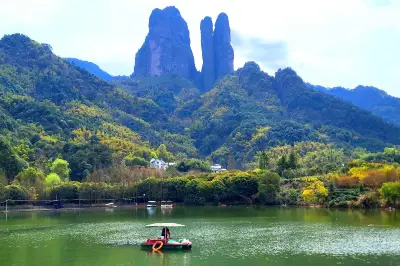
Yandang Mountain, touted as the 'No. 1 Mountain in the Southeast,' ranked among the Three Mountains and Five Sacred Mountains, is a UNESCO Global Geopark formed 120 million years ago. It's a most complete and typical Cretaceous rhyolitic paleovolcano—a caldera—on the Pacific Rim's Asian continental margin. Its rhyolite formations create graceful landscapes unique in the world. Before the scenic area, there's a large visitor center with ample parking. Normally, you park and take shuttle buses in. But with few visitors, the center was closed, and we could drive directly to each site—more convenient. Also, the center sells combo tickets; at the individual sites, tickets were separate: Lingyan and Dalongqiu 50 yuan, Fangdong 40 yuan. Inside, GPS was useless, but there was only one road, so no wrong turns. Yandang's 'Three Wonders' are Dalongqiu Falls, Lingfeng Night View, and Lingyan Fly-over. With rain most of the two days, sometimes heavy, we skipped Lingfeng. Driving along the mountain road, first stop: Lingyan, just in time for the 10 a.m. unmissable Lingyan Fly-over show. A steel cable stretched between two rock spires (Zhanqi Peak and Tianzhu Peak). Visitors sat on a platform by Lingyan Temple and looked up at a 45° angle—not free; you had to order tea from 15 yuan up. The show lasted about half an hour, with pre-recorded male and female narrators in high-pitched, exaggerated tones explaining the origins. It had two parts: first, 'flying swing,' gliding down the cliff from the peak, swaying side to side like ancient herb gatherers; second, traversing 200 meters from one 270-meter-high peak to the other, performing flips. The distance made it hard to see, and hard to feel the thrill. The cross-air performance involved crawling on the cable with hands and feet, not the 'wire walking' I'd imagined. Later, photos revealed Dalongqiu had a high-wire bicycle show, seeming more thrilling. After the show, a ten-minute walk to Xiaolongqiu: a delicate, slender waterfall. Other spots like Wolong Valley were too far. A small, moss-covered rock spire caught my eye—perfect form, delicate and pretty. Up close it was Zhuobi Peak, the inspiration for Shen Kuo's theory of fluvial erosion. On leaving, rain and fog intensified. At Fangdong, nothing was visible. I walked the plank path alone, opaque whiteness ahead. The path was carved into the 'Golden Belt' rhyolite layer from Yandang's third eruption phase, with roofed sections for shelter. In a large cave, there was a Daoist temple. Ahead, a suspension bridge many fear—but on a day like this, they wouldn't, with zero visibility. Standing there, I felt a fog of disappointment and turned back. At Dalongqiu, the rain stopped, and crowds appeared, with tour groups I could eavesdrop on. Scissors Peak was the highlight besides the falls. This petite pillar was split into two unequal halves, resembling scissors, a couple, a maiden, a woodpecker, a bear, a ship's mast from different angles—quite vivid. Rare spherical rhyolite could be seen, a stone ball maybe 20-30 cm across. As for Dalongqiu Falls, I was disappointed. The rainy season hadn't arrived; a thin trickle fell from above, gasping. You could sense the height but no power. It was nothing like Xu Xiake's description: 'The Longqiu waterfall thunders down into the pool, the cliff spread open and steep, the water free-falling, drifting, making the mind dizzy with terror.' Or Yuan Mei's: 'Above twenty zhang it's a waterfall; below, no longer a waterfall, but all turned to smoke, mist, light silk, jade dust, pearl powder, glass threads, willow-white blossoms.' It seems its fame as one of China's Four Great Waterfalls rests solely on its 190-meter height. The weather was too foul; we sadly ended our one-day Yandang tour. Nearby accommodations were mostly guesthouses. Finding no suitable hotel, we stayed at Wenzhou Sanyu Kaiyuan Mingdu Hotel in Hongqiao Town, 20 km away. Who'd expect such a high-end hotel in a small town like Hongqiao? The lobby was grand and gorgeous, elevator fast and smooth, doors heavy and solid, furniture proper, bathroom elegant and bright. There was a gym and pool. A delight. Especially the breakfast: over a hundred Chinese and Western choices, high quality, delicious. The Western cakes were authentic—so I stuffed myself with cake early in the morning.
Ningbo is close to Xikou, Zhoushan, and Shaoxing; we didn't want to keep changing hotels, so we decided to stay in Ningbo. We arrived at noon, ate at Tianyi Square, then visited Tianyi Pavilion in the afternoon. Tianyi Pavilion was founded by retiring official Fan Qin during the Jiajing reign of the Ming Dynasty (1561–1566). Fan must have loved books dearly, hence his family rule: 'No division of books; no books leave the pavilion.' His descendants, for thirteen generations, obeyed, preserving this weighty legacy. For a long time, Tianyi Pavilion was China's foremost library, holding over 70,000 volumes. Its architectural style became a model for seven later imperial libraries. When the Qianlong Emperor compiled the Siku Quanshu, Tianyi donated over 600 precious editions. After the Opium War and subsequent conflicts and thefts, only 17,000 volumes remained. In 1933, a typhoon damaged it; the government became involved in restoration and management. Post-1949, continuous repairs, expansion, and collection grew it to today's scale, housing 300,000 ancient texts. The Fan family residence is a small part; right next to the original library Dongming Thatched Cottage is the Mingzhou Stele Forest. Hundreds of stele recording ancient official education are embedded in walls enclosing a courtyard, protected by a long corridor. In the center stand the Zunjing Pavilion and Tianyi Pavilion itself. Southwards, expanded gardens—East and South Gardens—feature rockeries, ponds, pavilions elegantly arranged. The East Garden is particularly shaded with trees, many trunks covered in 'green hair'—lepidogrammitis drymoglossoides, an ancient monoecious fern and a Chinese medicinal herb. Intriguing animal stone sculptures collected from various places dot the grounds. Further south, several courtyards serve as exhibition spaces. We were lucky to meet a volunteer guide from the Ningbo Museum and an old Ningbo resident. The guide's expertise combined with the old man's vivid memories brought Tianyi Pavilion to life. The most noteworthy treasure in the garden is the stone engraving of the 'Shenlong' version of the Preface to the Orchid Pavilion. Ming calligrapher Feng Fang had it carved based on a copy traced by Feng Chengsu and others under Tang imperial order from the original. Feng Fang's own calligraphy work, 'Dizhu Xing,' is also displayed here. To the east of the exhibition area, the first exhibit is the Mahjong Museum in the Chen Ancestral Hall, showcasing mahjong tiles of all ages, materials, and from around the world. Chen Zhengyao is credited as the inventor; this game derived from ancient 'Ma Diao' cards and dice took shape in the mid-to-late Qing. He integrated and promoted it. The game became popular among Ningbo fishermen as a pastime during long sea trips, unaffected by water. The name 'mahjong' comes from the Ningbo dialect word for 'sparrow'—a land bird signifying home to returning fishermen. Because Chen knew English, he also introduced mahjong to foreigners. Japanese samurai learned it from Westerners, so the mahjong table display features Mr. Chen, a British consul in Ningbo, and a Japanese samurai, with a seat left for visitors. Many pose there, but more touch the founder's hand for luck. Going west, one room holds only a single 'Wan Gong Sedan,' hailed as the world's number one sedan chair—a 'luxury car' for Ningbo tycoons marrying off daughters. Dimensions: 150 cm long, 90 cm wide, 275 cm high. It uses red-and-gold wood carving, with gold leaf appliqué on red lacquer. Figures, flowers, birds, fish, insects are carved in multiple techniques, symbolizing blessings: heaven's bestowal, qilin delivering a son, the star of scholars tapping one's shoulder, outstanding success. Hanging gold and silver embroideries and hand-painted glass adorn the sides. Made of century-old camphor wood with mortise and tenon joints, its 238 parts can be assembled and disassembled freely. With such a luxury car, a fleet naturally follows—the saying 'a thousand mu of fertile land, ten li of red dowry' describes the grand procession. Further west is the Qin Ancestral Hall, rich in Ningbo merchant culture. Built in the 1920s by the son of magnate Qin Jun'an. The original Qin clan hall was dilapidated; when the son wanted to rebuild, his branch as a concubine's lineage faced opposition, so he chose a new site and built this branch hall. Determined, he spent lavishly on the best craftsmen. The result was a exquisite hall filled with wood, brick, and stone carvings. Lattice windows with coin and bat motifs exuded wealth. The stage is the most beautiful, especially the caisson ceiling—16 curves of bracket sets and carved panels spiraling upward to form a dome, praised as the finest in eastern Zhejiang. Back in the evening, we saw online that today was Museum Day—a meaningful day indeed.
The next day we ventured to Shaoxing in the rain, which came and went. Luck was with us: at Ke Yan, it stopped. We'd left the umbrella, so we got soaked later. Even luckier: today's tickets were discounted, 80 yuan each, probably for Tourism Day. Mount Ke was an ancient quarry, leaving behind bizarre rock pits, caves, pools, and walls. Just as we arrived, a guide was explaining to a tour group—she sounded solid, so we joined. The classic route is Ke Yan–Jianhu Lake–Lu Xun Town, including a short boat ride. First, a circular plaza with a curved wall inscribed with the full Diamond Sutra. Standing at the center point gave an echo. Soon, we saw the Stone Buddha, the painstaking work of three generations of stonemasons during the Sui-Tang period. Further ahead was Ke Yan's icon, 'Yungu' (Cloud Bone)—a 30-meter-tall inverted pagoda-shaped rock, rough-surfaced, colorful, stubbornly standing a millennium. Even more stubborn, an ancient cypress atop it, its nutrient source a mystery, surviving a thousand years alone. From the opposite shore, Yungu looked slender and graceful, like a thin top. Literati gave it an elegant name: 'Incense Pillar in Fine Weather.' We continued to a new installation, 'Three Origins Converge,' featuring statues of Laozi, Confucius, and Shakyamuni with a half-black, half-white face—deeply symbolic, I found it a bit forced. The sky was overcast, but the guide girl brought her own spring-like vivacity, talking and laughing, sharing childhood Shaoxing stories and her grandma's local dishes. She even sang a Shaoxing opera segment, sweet-voiced and precise. I understood not a word but was enchanted. There are many famous southern historical figures: Yu the Great, Goujian, Wang Xizhi, Lu You, Xu Wei, Qiu Jin, Zhou Enlai, Lu Xun, Zhu Kezhen. Lu Xun was instantly recognizable. Yu the Great stood alone in a pool, his statue's chest hollow—some say symbolizing selflessness, others a lack of family concern. A line of footprints by the pool, only right feet, because Yu's left foot rotted from long immersion in water during flood control. We were about to board the boat to Lu Xun Town when rain returned; luckily, the waiting area was covered. The black-awning boat was bigger than expected, seating over twenty. The awning was beautifully woven bamboo with neatly inlaid shells—very refined. After disembarking, we walked an ancient towpath, restored but still a bit dicey, especially in the rain. Ahead was Lu Xun Town. Before it stood a statue group: 'Pouring Wine to Encourage Troops,' depicting King Goujian of Yue on his punitive expedition against Wu, locals offering wine, which he poured into the river for soldiers to share, boosting morale. The statues and town are newly built; the commercial street was unoriginal. Lu Xun's literary settings and characters added a touch of distinction. The stage and theater once hosted performances but stopped after the pandemic. We toured the town in the rain, then returned to the city for a meal. For parking ease, we chose Yue Du Fu at Crowne Plaza Shimao. Again, it was near closing time; we ate hastily and took a taxi to Lu Xun's Former Residence—again without umbrella or shoe covers. The rain intensified. The residence had covered corridors, so walking around was fine. Many rooms, exquisite facilities—you could sense the Lu family's affluence. Even though Lu Xun later opposed the government, he still enjoyed a high salary and fame, which required great wisdom. Hearing that the 'Calligraphy Sage's Hometown' was worth a visit, we took another taxi. By then, our clothes were soaked. This area is also newly restored, unknown to many; the driver didn't know it either, following GPS through winding alleys and dropping us at an intersection. No signs, no people. To the right was a residential area; after asking several people, we learned we should go left. Rain soaked through clothes and shoes; eyes barely open. After a few dozen meters, we saw an archway reading 'Calligraphy Sage's Hometown.' I left my husband under an eave and ventured into the dark, foggy rain. Nothing but a pond, two locked houses, and overgrown vegetation—no person. At the end, I finally met a lady still out walking in the rain. She said it was just a small park, and Wang Xizhi's former home was in the community where we'd been dropped off. I retraced my steps; it was a bit of a walk, and visiting would take time. Worried about my husband waiting, I turned back. We took a taxi back to the restaurant parking lot and drove to Ningbo.