Fang Weng's Great Brush Now in Use: Glimpses of Taizhou, Jiangsu
In the eighth month of the Bing Shen year (2016), osmanthus flowers were wafting fragrance, scenting Taizhou on both banks of the Fengcheng River. Just after the Autumn Equinox, “the heat retreats, autumn clears, and the air turns cool; daylight and night become equally long.”
“The prefecture was established in Southern Tang, and culture flourished in Northern Song.” Taizhou has been since ancient times “a key water and land thoroughfare, a strategic pass commanding the region.” It bridges the north and south, standing as a prominent gateway in central Jiangsu, thus becoming a land of fish and rice, a place of abundance, imbued with “the bounty of nature and the brilliance of human talent.” This has been so from antiquity and continues to this day.
Taizhou was called Haiyang in the Qin dynasty, and later Hailing in the Han dynasty. In Southern Tang (937) it was made a prefecture and first named Taizhou, meaning “the state of peace and prosperity for the people.” The Venetian Marco Polo (1254-1324) visited Taizhou after the Yuan dynasty and praised it with the words, “This city is not large, but it abounds in all kinds of worldly happiness,” which greatly enhanced Taizhou’s reputation, stunning far and wide and drawing crowds of people.
With a history of over two thousand years, Taizhou is auspicious and rich, endowed with spiritual beauty, so that “generation after generation, talents emerge, each leading the trend for hundreds of years.” In the Ming dynasty, Wang Gen (1483-1541) founded the Taizhou School of Wang Yangming’s philosophy; in the Qing dynasty, Liu Xizai (1813-1881) wrote the great work of literary criticism, *The Outline of Art*; at the end of Yuan and beginning of Ming, Shi Nai’an (1296-1370) left behind one of the four great classics of Chinese literature, *Water Margin*; in the Qing dynasty, Zheng Banqiao (1693-1766) was renowned for his “three perfections” across poetry, calligraphy, and painting; Mei Lanfang (1894-1961), “a bright and lustrous pearl, a graceful phoenix” of the opera circles in the Republican era. All these figures were born here, unparalleled for centuries, demonstrating the spiritual richness of the land that produced outstanding talents!
Taizhou is an auspicious and peaceful prefecture, dynamic and vibrant, thanks largely to the Fengcheng River, which nourishes both banks and winds around the city. Through thousands of years of gentle time, it has become a water town with “weeping willows and green poplars in ancient city mist,” standing gracefully in central Jiangsu, outstanding among its peers, with a carefree and elegant bearing.
It is evident that Taizhou has never lacked “the bounty of nature,” full of dazzling treasures. The prefectural city ruins, Wanghai Tower, and Wenhui Hall shine like sun and stars, resting on the west bank of the river; Liu Garden, Mei Garden, and Peach Garden are exquisite and elegant, scattered on the east bank; Jitang Bridge, Yinlong Bridge, Shisheng Bridge, and Baifeng Bridge are ingeniously crafted, strung in a row over the water, spanning thousands of years from the Five Dynasties to the Ming and Qing, filling the ancient city’s skeleton and meridians, keeping Taizhou well-proportioned and vigorous.
Taizhou’s scenic spots are as numerous as stars, overwhelming the eyes. Among them, Taizhou Old Street is a particularly outstanding choice that cannot be missed!
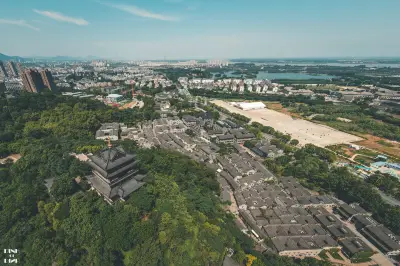
Old Street lies in the southeast corner of Taizhou city, covering over fifty mu, actually a lane extending about one li, paved with granite slabs, filled with ancient charm, Ming and Qing elements dancing in abundance, with dark tiles and green bricks lining both sides, wrapped in “old crafts” and “old trades,” many of which are “lost to time with the break of master-apprentice transmission.” It is attached to the Taoyuan Scenic Area beside the Fengcheng River, deliberately designed for fame, but the commercial intent is self-evident!
Old Street is a high-quality replica, rooted in Taizhou yet surpassing Taizhou’s ordinary, so it was built here to recreate the lost thousand-year cultural context and texture of Taizhou, full of ancient charm and as authentic as ever. In the city of Taizhou, there is no longer a complete old street, because the authorities were once ignorant and short-sighted, keen on demolishing the old to make way for the new, believing that new means prosperity and old means obsolescence; little did they know that repairing the worn and restoring the abandoned is no less than innovation, and that the longer something lasts, the more fragrant it becomes, making it an eternal attraction.
As time passed, the authorities finally saw the light through extensive reasoning, like being poured with enlightenment, and urgently wanted to mend the fold after the sheep were lost. Alas! The fold remains but the sheep are gone. In desperation, based on the style of Taizhou’s ancient old streets and lanes, they built a new street in a chosen location, filled it with Taizhou’s old elements, and gathered secular culture and life, thus forming a bustling thoroughfare full of history. Since its inception, it has always been “visitors leave at dusk, drunk and sober in a noisy crowd.”
Old Street runs north-south in a strip shape. At the north entrance stands an ancient archway, common everywhere under heaven, “not only here and now, but since ancient times,” indeed due to customary regulations. The front plaque of the archway reads “Old Street,” and the back plaque reads “The Great Way Is Boundless,” which suddenly endows Old Street with the profound flavor of ancient Chinese philosophy, as if Old Street is not just the right path, but the right path is boundless, clearly implying that the pursuit of a noble and correct ultimate goal requires lifelong effort and unwavering perseverance to achieve even a little.
At the same time, it also suggests that strolling through Old Street is akin to a great path of cultivation, cultivating day and night, cultivating with persistence. In short, frequent visits to this Old Street are essential for pursuing the right path in life!
Passing through this ancient archway, you enter Old Street, stepping onto granite slabs and seeing arcade corridors. The dust of centuries comes rushing, as if wandering in Ming and Qing times. This lane stretches about twenty zhang, with large red lanterns hanging along the corridor, festive and warm; shops line both sides of the street in a row, full of ancient charm, flowing from shop signs, plaques, and flags, simple and rustic.
The lane unfolds like a scroll, displaying local customs and life, winding gracefully to its end, then seeming like “mountains multiply and streams double without a path ahead,” leaving you wanting more; at its end is a corner, and turning it brings sudden clarity: “another village in the shadow of willows and bright flowers”: “the land is flat and open, houses neatly arranged,” unexpectedly a small yet spacious square, a garden of jade, standing prominently.
An ancient stage sits at the south end of the square, with carved beams and embroidered pillars, richly ornamented, once often presenting “dancing low the willows and the moon over the tower, singing out the peach blossom fan’s wind” — spectacular performances; a stream murmurs softly, running along the west side of the square, light and smooth, without ripples. Only a waterwheel, boasting itself as “the first in central Jiangsu,” stands in the water, showing that it sometimes turns, swirling the stream and splashing water from high to low, like “drizzly rain moistening clothes.” A giant gong, five feet four inches in diameter and claiming to be “the first sounding gong in China,” hangs proudly near the waterwheel and the ancient stage. But it is not known why it is called “the first in China”: because of its largest diameter? Or its loudest sound?
On the east side of the square is a short lane, directly facing the side profile of the ancient stage, with eyes focused straight ahead. At its end stands a floor-to-ceiling relief, condensing Taizhou’s traditional market culture and life, vivid and lifelike, among which the Huaiyang market feature “skin wraps water, water wraps skin” is particularly eye-catching.
Old Street, rather than being called a broadly conceptual commercial street, is better described as a precisely positioned food lane. The “skin wraps water” tea house is elegant, enough to spend all day with skin wrapping water, and constantly filled with melodious pingtan strings and sweet soft Wu dialect; the Taizhou grass-oven baked cake shop is authentic, “fragrant and delicious, a top product of the human world,” always wafting the fresh scent of wheat flour and the rich aroma of sesame; the Guyue Tower is dignified, “Jingjiang soup dumplings,” “Taizhou shredded tofu,” and Taizhou fish soup noodles have always left a lingering taste on the lips and teeth, infused with an endless aftertaste of nostalgia; the Qinhu Eight Delicacies restaurant is genuine, offering the “Qinhu Eight Delicacies” feast, a table full of delicacies, irresistible, making one eager to dig in heartily... ...
Fortunately, the food on Taizhou Old Street is not limited to local and Huaiyang flavors; it also embraces all rivers, accommodating delicacies from all over the country, such as Changshu “beggar’s chicken,” Jiaxing zongzi, Shaoxing old Taimen soup dumplings, Tianjin meat rolls, Yunnan crossing-the-bridge rice noodles, Chongqing hotpot, etc., all occupying a place on Old Street. Although this is not a dedicated food street for local cuisine only, deviating from the original intention of its creation, the authorities have no choice but to tolerate it, unwilling to see it gradually decline. Such an approach is also “harmony in diversity,” aiming for “beauty in commonality” in the future.
2021.07.28.