Taizhou Slow Life | How to Spend a Two-Day, One-Night Weekend?
A few days ago, I was talking with friends about the place I most want to visit recently—Taizhou. I want to taste Taizhou's morning tea, stroll through its old streets and ancient towns, and see its water forest and wetlands. This weekend, we happened to be free, so we decided on the spur of the moment to drive to Taizhou for a trip.
Taizhou gets its name from the phrase 'the country is prosperous and the people are at peace.' This place has produced many talented individuals, with Wang Gen, Liu Xizai, Shi Nai'an, Zheng Banqiao, and Mei Lanfang being outstanding representatives of Taizhou's cultural and artistic history.
Our first stop was Li Zhong Water Forest Park. Originally a barren beach, it has been transformed into the largest artificial ecological forest in Jiangsu Province.
The park is planted with more than 100,000 trees of species such as metasequoia and pond cypress, and it is also a paradise for migratory birds like red-crowned cranes, black storks, owls, grey herons, egrets, and white herons—like a real-life 'The Wizard of Oz.'
The Water Forest Park is especially enchanting this season. Late autumn has dyed the leaves gold and red, and stepping into the scenic area feels like entering a painting.
There weren't many people when we went, and we could hear the rustling sound of wind blowing through the leaves. We didn't expect to find such a unique tranquility here.
The Misty Forest Wonderland is a must-see. It is held six times a day, on the hour (please refer to the scenic area's announcements for the exact schedule). A man-made mist rises in the forest, dreamlike and surreal, adding a touch of fantasy to the fairytale forest.
If you enjoy photography, don't miss it. We went at noon, and the sunlight streamed down from above. The golden rays, white mist, and dense woods created a scene like a paradise on earth. Walking through the mist felt like treading on clouds.
After passing through the Misty Forest Wonderland, you can take a bamboo raft ride. The bamboo rafts are manually paddled by boatmen, slowly gliding across the water, weaving through the water forest. It's a scene of people traveling within a painting.
Sunlight filtered through the leaves onto the river, creating stunning light and shadow effects.
We had lunch in the urban area of Xinghua. How could you visit Xinghua without trying the freshwater delicacies from the lake? Crab roe tofu and fish balls are must-order dishes here.
Fish balls have a long history in Xinghua, dating back to the late Ming and early Qing dynasties. They are snow-white, smooth, tender, and delicious.
The hairy crabs this season are also particularly plump and tasty.
In the afternoon, we visited the Xinghua City Museum. The museum is a three-story pseudo-classical building with white walls, black tiles, and horse-head walls, exuding an antique charm.
Upon entering the exhibition hall, we saw a folding fan printed with the characters 'Rare is a fool'—calligraphy by Zheng Banqiao.
Everyone is familiar with Zheng Banqiao. He was a native of Xinghua and a famous calligrapher, painter, and writer of the Qing Dynasty. In the courtyard of the exhibition hall, there is a granite statue of him and a huge marble relief of his bamboo and orchid works.
The museum has permanent exhibitions such as 'Zheng Banqiao's Life and Artistic Achievements,' 'Shi Nai'an Cultural Relics,' and 'Exhibition of Historical Figures of Xinghua,' which are open to the public year-round.
We first visited the Xinghua History Exhibition Hall, where you can learn about the historical development of Xinghua. Many artifacts unearthed in Xinghua are displayed, with the most interesting being a folk-collected bronze statue of a shepherd boy on a water buffalo, which looks incredibly cute.
You must visit the Zheng Banqiao Memorial Hall here. Previously, I only knew Zheng Banqiao from history books.
Here, you can clearly understand Zheng Banqiao's life. Together with Jin Nong, Huang Shen, Li Shan, Li Fangying, Wang Shishen, Luo Ping, and Gao Xiang, he was known as the 'Eight Eccentrics of Yangzhou,' achieving great artistic accomplishments in calligraphy and painting.
'A scholar at age 20 under Kangxi, a provincial graduate under Yongzheng, and a metropolitan graduate under Qianlong.' His life can be roughly divided into three stages: before age 40, he struggled in poverty; from 40 to 61, he passed the imperial examinations and became an official; after 61, he lived as a guest in Yangzhou, selling his calligraphy and paintings until his death.
The museum houses 33 pieces of Zheng Banqiao's ink-wash calligraphy and paintings.
We were fortunate to hear Banqiao Daoqing there, which consists of ten pieces of Daoqing music created by Zheng Banqiao. These ten pieces have been passed down from the Qing Dynasty to the Republic of China era for 200 years without decline, and even in primary schools during the 1930s and 1940s, children could sing them. The rhythm is strong, the melody pleasant, and the lyrics blend the refined and the popular, singing with lingering charm and a feeling of deep emotion.
After visiting, we drove back to Taizhou's urban area.
The must-visit spots in Taizhou's urban area are relatively clustered: Fengcheng River, Old Street, Mei Garden, Peach Garden, Willow Garden, Wanghai Tower, etc.
It gets dark early now. After returning from Xinghua, we could only visit Mei Garden first.
The famous Peking Opera master Mei Lanfang's ancestral home is in Taizhou. In 1984, on the 90th anniversary of Mei Lanfang's birth, this Mei Garden was built.
The scenic area includes Mei Lanfang's sitting statue square, historical materials exhibition area, Peking Opera knowledge corridor, antique stage, Mei Lanfang memorial pavilion, Meiyuan area, and riverside pavilions.
If you want to understand Mr. Mei's life, you must visit this place. Mei Lanfang's artistic achievements have long transcended national boundaries, and he is as renowned as world art masters Stanislavski and Brecht, collectively known as the three major performance systems in the world.
The Mei Lanfang Historical Materials Exhibition Hall displays a large number of photos and objects from the master's lifetime. There is a robe worn by Mr. Mei Lanfang during performances, which seems to let you see him performing. Also preserved are his lipstick and accessories.
After visiting Mei Garden, it was almost dark. We decided to have dinner in Old Street, eating local cuisine. Since there was still time before dinner, we took a walk along the old street.
The Old Street is adjacent to Peach Garden. Passing through the ancient memorial archway, we entered the old cobblestone lanes. On both sides of the street, there are antique-style shops with red lanterns, shop banners, and plaques, giving the old street a rich charm.
Here you can find Taizhou's specialty Huangqiao sesame cakes and some local snacks.
There is a Morning Tea Museum on the street. I had heard about Taizhou's morning tea culture before. Unlike in Guangdong, the traditional summary is 'one tea, three bites, and one noodle.' One tea means a cup of tea and a serving of blanched shredded dried tofu, with the tofu serving as a 'tea head'; the three bites refer to three famous Taizhou morning snacks: baozi, steamed dumplings, and shumai; and the one noodle is fish soup noodles.
Behind the Morning Tea Museum is the famous century-old restaurant Gu Yue Lou, where we planned to have morning tea the next day.
On the Old Street, there is also an ancient opera stage with upturned eaves, painted beams, and carved rafters. Under the night sky and lights, it shone even more brightly.
For dinner, we chose Lao Taizhou Taizhou Cuisine, an authentic Taizhou restaurant. The first floor's lobby has an open kitchen design, allowing you to see the cooking process.
A must-order in Taizhou is Qinhu Eight Immortals.
Delicious blanched shredded dried tofu and house-made wine-braised pork are also recommended. Other dishes were quite tasty as well.
The restaurant also features special performances of Banqiao Daoqing and Huai Opera, allowing you to enjoy food and shows simultaneously.
After dinner, a few hundred meters' walk takes you to the pier for a night cruise on Fengcheng River. The night cruise on Fengcheng River is also a must-do in Taizhou.
The boat glides along Fengcheng River, not only allowing you to see the cityscape and ancient buildings on both banks but also experiencing scheduled performances. Each time the boat reaches a certain point, there is a stage with actors singing classic pieces.
The night scenery was particularly enchanting. The lights sparkled on the river, and you could see in the distance Wanghai Tower, Wenchang Pavilion, Jitang Bridge, Yingchun Bridge, and the Peach Garden we had visited that afternoon.
The day's trip ended with the night cruise.
The next morning, we got up early to have morning tea at the century-old Gu Yue Lou we had passed by yesterday.
I highly recommend trying the crab roe and crab meat baozi. They are not the soup-filled type. The crab roe and meat are mixed with pork—so delicious!
The restaurant's yangcao baozi and red bean paste baozi were also very tasty. The yangcao was refreshing, and the red bean paste was dense but not too sweet—just perfect!
Blanched shredded dried tofu and fish soup noodles are also must-orders. The shredded dried tofu here is different from what I've had before; Taizhou's version is softer, almost like eating tofu. The fish soup noodles had a very fresh broth, not fishy at all, with a hint of pepper.
After morning tea, we visited Wanghai Tower, which we didn't have time for yesterday.
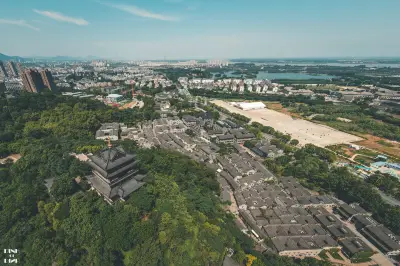
Wanghai Tower is a landmark of Taizhou. It was first built in the second year of the Shaoding era of the Southern Song Dynasty and is known as 'the first tower of Jianghuai.' The current Wanghai Tower follows the architectural style of the Song Dynasty, with a three-story circular corridor and a color scheme of chestnut brown and greyish blue, giving it a simple and elegant feel.
Upon entering the Wanghai Tower scenic area, you see a large bamboo forest surrounding a stele garden. I heard the bamboo was brought from Anji.
The steles in the garden display 20 selected poems praising Taizhou by famous figures from the Five Dynasties to the modern era, including works by Wang Wei, Lu You, and Zheng Banqiao. Strolling through the bamboo grove, savoring the poems, was full of charm.
Further in is the Zhoucheng Ruins, the only remaining section of Taizhou's old city wall.
Entering Wanghai Tower, the first thing that catches your eye is a gold-lacquered plaque with 'Record of the Reconstruction of Wanghai Tower.' The third floor has an exhibition about Taizhou, and the fourth floor is an observation deck where you can walk around and enjoy the surrounding scenery.
After visiting Wanghai Tower, we drove to Qinhu National Wetland Park.
Qinhu National Wetland Park is also a must-visit in Taizhou. It features a vast lake surface and interlaced waterways.
First, you need to take a boat to the main scenic area's East Lake Pier. In about ten minutes, you can enjoy the lakeside scenery. The local Qintong Boat Festival is held on this lake, from the day after Qingming Festival to around May 1st. If you plan to travel during that time, keep an eye on the festival schedule. In the distance, you can also see the Ancient Shousheng Temple and the Medicine Buddha Pagoda.
After disembarking, you can first visit the China Qinhu Wetland Science Museum near the pier to get a preliminary understanding of the wetland's ecology.
The science museum has three floors. The first floor's theme is 'Tracing Qinhu,' with eight exhibition areas including 'Water Breeds Qinhu,' 'Bird Watching Paradise,' 'Hometown of Elk,' 'Green Shadow Creatures,' 'Qinhu Night,' 'Footprints and Stars,' 'Qinhu Rhythms,' and 'Immersive Qinhu.' The second floor's theme is 'Exploring Origins,' with areas like 'Exploring Scenery,' 'Wetland Galaxy,' 'Qinhu Boat Festival,' 'Qinhu Bricks and Tiles,' 'Crisis and Recovery,' 'Kidney of the Earth,' and 'Eco Garden,' introducing Qinhu's geographical location, local cultural characteristics, and customs, while explaining the role of wetlands. The third floor has a large scene 'A Hundred Magpies Return to Their Nests,' showcasing major events in global wetland and nature protection efforts.
After visiting the science museum, you can walk around the scenic area. The wetland has a unique charm this season. Walking on the waterfront boardwalk, the lake water is particularly clear at this time of year, and you can see small fish underwater.
You must experience the local yulū boat ride. The boat women row and sing folk songs as the boat rocks gently across the water, allowing you to leisurely enjoy the wetland scenery.
After the boat ride, you can visit the Agricultural Fun Park. The rice had already been harvested when we went, so I recommend coming before the harvest to take some nice portrait photos.
The Elk Sightseeing Park is also a must-visit. There is a dedicated viewing platform where you can look out at the elk and wetland scenery. We skipped feeding the elk because it was almost lunchtime.
For lunch, we chose a restaurant within the scenic area to see if the Qinhu Eight Immortals here differed from those elsewhere.
We ordered some lake delicacies and specialty dishes. The chicken soup was surprisingly delicious—my friend had two large bowls.
I had been recommended by friends to try the Qinhu duàn crab. Since ancient times, 'In the south there is the Yangcheng Lake sluice crab, in the north there is the Qinhu duàn crab,' also known as 'south sluice, north duàn.' You must eat duàn crab when visiting Qinhu. The crabs are quite large, with green eyes and red hairs, and their meat is sweet and tender. Both male and female crabs are excellent this season.
After lunch, we went to the nearby Qintong Ancient Town—a must not miss when visiting Taizhou.
It has a history of over a thousand years. Unlike the ancient towns in Jiangnan, every brick and tile here retains local characteristics.
It mainly consists of eight scenic spots and the surrounding ancient town streets. There is also a hidden treasure 'commercial street' here. Although called a 'commercial street,' it is not commercial at all. Both sides of the street are filled with local specialties: duàn crab, Huangqiao sesame cakes, fish balls, fish cakes, rice cakes, Jingjiang dried meat, stinky tofu, etc. The enthusiastic shop owners proactively offer samples. These are not the usual items sold in ancient towns; many locals come specifically to buy, giving the street a strong sense of daily life.
Egg-yolk lion's head meatballs, super large, are made fresh in many shops.
Osmanthus rice cakes are light and emit a faint osmanthus fragrance—you can eat several in one go. The first shop at the entrance of the ancient town has amazing craftsmanship; we watched the master turn rice flour into a whole tray of rice cakes in minutes.
Jingjiang dried meat: If you like dried meat, don't miss it. It's a bit softer than what I've bought online. You can try samples; many shops sell it.
Huangqiao sesame cakes come in so many flavors! I bought over twenty to take home. Small ones are great as gifts.
Duàn crab: We ate duàn crab at several meals in Taizhou. The meat is tender and sweet, and the value for money is excellent—the crabs are quite large.
Fish balls and fish cakes are made fresh. They are very fresh and can be bought to cook at home. They come in two types: deep-fried and boiled.
In addition, the alleys of Qintong Ancient Town also have a strong sense of history, with local residential houses full of the atmosphere of everyday life.
The eight scenic spots are: Former Residence of Academicians, Camellia Courtyard, Distillery, Folk Custom Museum, Water Dragon Bureau, Former Residence of Gao Ershi, Wedding Customs Museum, and Green Tree Zen Temple.
At the end of our trip, we decided to visit the Taizhou Naval Vessel Cultural Park.
Taizhou is known as 'the birthplace of the navy and the mother city of sailors.' Since 2011, the navy has donated three retired warships and one submarine to Gaogang District, forming this Naval Vessel Cultural Park.
The three ships and one submarine are: supply ship 881 Hongze Lake, destroyer 108 Xining, frigate 515 Xiamen, and submarine 274.
This place is especially suitable for families with children or naval enthusiasts. You can bring kids for patriotic education.
Coincidentally, the sunset on the day we went was beautiful. The gentle afterglow gave the ships a romantic warmth.
What do you think of this two-day, one-night trip to Taizhou?