A Day Trip to Taizhou
This is an old travelogue:
On September 19 last year, I took a bullet train from Nanjing to Taizhou in the morning.
Excerpt from Baidu:
Taizhou, abbreviated as "Tai", is a prefecture-level city in Jiangsu Province, located in the central part of Jiangsu. It borders the Yangtze River to the south, Yancheng to the north, Nantong to the east, and Yangzhou to the west. The total area of the city is 5,787.26 square kilometers, of which land accounts for 77.85% and water area accounts for 22.15%. The urban area covers 1,567.13 square kilometers. Taizhou was called Haiyang in the Qin Dynasty, Hailing in the Han Dynasty, established as a prefecture in the Southern Tang Dynasty, and flourished in culture during the Northern Song Dynasty. In the Southern Tang Dynasty (937 AD), it became the seat of a prefecture, named Taizhou, meaning "the country is peaceful and the people are safe". Taizhou has a rich cultural heritage and numerous outstanding figures, with "Confucian customs being particularly flourishing in Huainan". Wang Gen, Liu Xizai, Shi Nai'an, Zheng Banqiao, and Mei Lanfang are outstanding representatives of Taizhou's cultural and artistic history.
Taizhou is a strategic water and land hub connecting the north and south, serving as the gateway to central Jiangsu. Since ancient times, it has been known as "a vital water and land route, a throat of the region". Over 700 years ago, Marco Polo visited Taizhou and praised it, saying, "This city is not large, but it abounds with all kinds of worldly pleasures."
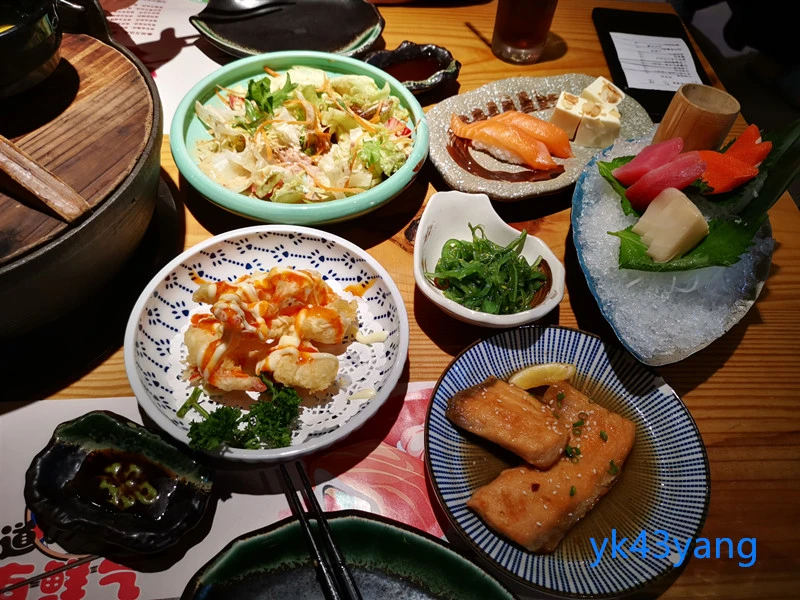
After getting off the train, I chose a hotel in the city center to stay. After a short rest, I went out for lunch. This time I opted for Japanese cuisine. The freshness of the ingredients and the deliciousness of the dishes were both satisfying.
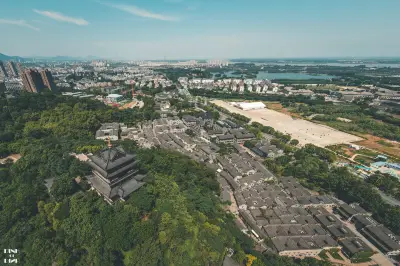
In the afternoon, I visited the city's attractions as planned. First, I came to the Wanghai Tower in the Fengcheng River Scenic Area.
Wanghai Tower was first built in the second year of the Shaoding era of the Southern Song Dynasty (1229 AD) and is known as "the first tower in Jianghuai". However, it was repeatedly destroyed and rebuilt, experiencing many vicissitudes. The first time, the tower was destroyed at the end of the Southern Song Dynasty, and was rebuilt in the 28th year of the Jiajing era of the Ming Dynasty (1549 AD) by Prefect Bao Long. The second time, it was destroyed in the 31st year of the Wanli era (1603 AD) and rebuilt soon after. The third time, at the end of the Ming Dynasty, it was destroyed by war, and during the Kangxi era of the Qing Dynasty, it was rebuilt and renamed Jinghai Tower. The fourth time, at the beginning of the Jiaqing era of the Qing Dynasty, the tower was almost collapsing, and Prefect Yang Xi dismantled and rebuilt it. The fifth time, during the Anti-Japanese War, the tower was demolished. The current tower was rebuilt in 2006.
I arrived at the scenic area gate. The gate tower has a three-bay facade with a hip-and-gable roof. Under the eaves hang three horizontal plaques, reading: "Scenic Wonder of Jiangzuo", "Ancient Prefecture of Han and Tang Dynasties", and "Famous Region of Huaihai". On the columns of the front porch hangs a couplet: "Magnificent momentum reaching the southeast. Gazing afar at clouds and rosy clouds emerging from the sea; Famous gardens surround left and right, welcoming plum blossoms and willows crossing the river in spring."
This is the Christian church opposite the scenic area. In the 28th year of the Guangxu era of the Qing Dynasty (1902), an American missionary named Absalom Sydenstricker came to Taizhou to preach and built this church. Incidentally, this man was the father of the famous female writer Pearl S. Buck. When I was in elementary school, I read Pearl S. Buck's novel "The Good Earth", which won the Nobel Prize in Literature in 1938.
In 1921, a church was built at Qiele Bridge in the north gate. It was demolished in 1979 due to road widening and museum expansion. The current church was relocated and rebuilt in 1997.
Entering the scenic area, there were plenty of green trees and grass. Soon I arrived at Wanghai Tower.
Wanghai Tower is three stories high, with a total height of over 30 meters, built in imitation of Song Dynasty style. First, I saw a horizontal plaque under the eaves of the second floor on the north side, inscribed by Peng Chong: "Leading the Majestic Wind of Jianghuai". On the columns of the first floor hangs a couplet: "Vast misty waves, the tower swallows the sea air. Grand and vigorous, a hundred feet soaring into the clouds."
On the front side, under the eaves of the second floor, there is a horizontal plaque inscribed by Wen Huaisha: "First Tower of Jianghuai". The main entrance plaque "Wanghai Tower" is inscribed by Shen Peng. On the columns on both sides hang a couplet: "The spirit captures the lake light and overwhelms the Five Ridges; The sword cast autumn shadows and overshadows the Three Platforms." This couplet comes from a poem by Zheng Menglai, a prefect of the Ming Dynasty.
There is an elevator inside Wanghai Tower to go directly to the top. Overlooking from above, the scenery was very beautiful.
Near Wanghai Tower, there is an ancient Song Dynasty culvert. During the reconstruction of Wanghai Tower in 2006, underground drainage facilities from the Song Dynasty Taizhou city were accidentally excavated, along with a large number of copper coins, pottery, and other artifacts, which was listed as a major archaeological discovery.
I strolled around Wanghai Tower, took a few photos, and then walked to the nearby Nanshan Temple.
Nanshan Temple was first built in the third year of the Qianfu era of Emperor Xizong of the Tang Dynasty (876 AD). At that time, the imperial court granted the name "Huguo Temple". In the first year of the Zhiping era of the Northern Song Dynasty (1064 AD), it was renamed "Zifu Zen Temple". Emperor Huizong of the Song Dynasty revered Taoism and converted the temple into a Taoist temple, naming it "Shenxiao Yuqing Wanshou Palace". In the first year of the Jianyan era of the Southern Song Dynasty (1127 AD), it was restored to a Buddhist temple named "Zifu Zen Temple".
Thereafter, the temple experienced periods of prosperity and decline. In the 24th year of the Zhizheng era of the Yuan Dynasty (1364 AD), it was rebuilt by the monk Zhuxi. In the 15th year of the Hongwu era of the Ming Dynasty (1382 AD), Nanshan Temple became a "prayer holy site" and was elevated to the administrative body for Buddhist affairs in the Taizhou area—the Monastic Office. In the 8th year of the Tianshun era (1464 AD) and the 28th year of the Jiajing era (1549 AD), the temple was expanded and rebuilt. During the Daoguang era of the Qing Dynasty, it was renamed Nanshan Teaching Temple.
Arriving at the temple, the first thing I saw was this Wenfeng Pagoda.
The Wenfeng Pagoda of Nanshan Temple is said to have been built in the Song Dynasty. Its original site was southeast of the temple, but it no longer exists. In the 48th year of the Wanli era of the Ming Dynasty (1620 AD), Prefect Wei Zongkong rebuilt it on the original site. In the third year of the Guangxu era of the Qing Dynasty (1877 AD), the pagoda was destroyed by fire, and later it was restored through fundraising led by local resident Chen Wenduo.
In front of Nanshan Temple, there is a newly built archway. Behind the archway is the Mountain Gate Hall. Then, along the central axis, are the Mahavira Hall, the Hall of Perfect Penetration, and the Sutra Depository. To the left and right of the Mahavira Hall are the Bell Tower and Drum Tower.
The most noteworthy is the Hall of Perfect Penetration (Yuantong Baodian).
The hall has a three-bay facade and a double-eave hip roof, showing the high rank of the temple. It is said that in Jiangsu, only Suzhou's Confucian Temple and Taizhou's Nanshan Temple have such high-standard ancient architecture.
Built in the Ming Dynasty, the hall is a key cultural relic protection unit of Jiangsu Province. It is supported by 12 golden nanmu columns. The east and west walls are made of 22 nanmu panels, each 30 centimeters thick, spliced together. On the wooden panels are 84 relief statues of Avalokitesvara's manifestations.
In the center of the hall is enshrined a thousand-armed, thousand-eyed Avalokitesvara, 6.24 meters high, which can be regarded as an artistic treasure.
After visiting Nanshan Temple, I walked to the bus stop and took a bus to the Mei Garden.
The "Mei" in Mei Garden does not refer to the plum blossom (mei) of Wuxi's Mei Garden, but the surname "Mei" of Mei Lanfang.
Mei Lanfang was born in Beijing. His training and stage performances were mostly in Beijing as well. But his ancestral home was in Taizhou. In Mei Lanfang's "Forty Years of Stage Life", there is a section "Grandmother's Recollections" where Mei Lanfang recounts the family stories he heard from his grandmother when he was 14: "Your great-grandfather ran a small shop in Taizhou city, which seemed to sell various wood-carved figures and Buddha statues. He had three sons. Your grandfather was the eldest. At the age of eight, he became the adopted son of the Jiang family..."
In 1959, Mei Lanfang made a brief visit and performance in Taizhou and found the ancestral home, which is now the location of the Mei Garden—Bao Village.
In 1984, on the occasion of the 90th anniversary of Mei Lanfang's birth, Taizhou built the Mei Lanfang Park, also known as "Mei Garden".
This is the statue of Mei Lanfang at the park entrance.
The horizontal plaque of this hall is inscribed "A Generation of Elegance", and the couplet on both sides reads: "Early astonished the world with song and dance; Later had disciples spreading fragrance." It depicts the life of Mr. Mei.
This statue in the pond is Mei Lanfang playing Yang Guifei in "The Story of Taizhen".
Strolling in the Mei Garden, I took many photos.
The Mei Pavilion and the trumpet creepers in the park are key highlights introduced in the park.
Across from Mei Garden is the Old Street of Taizhou. After visiting the garden, I took the opportunity to have a look. The Old Street of Taizhou is a newly built attraction. It was not very lively and frankly had little to see. That concluded the day's itinerary.