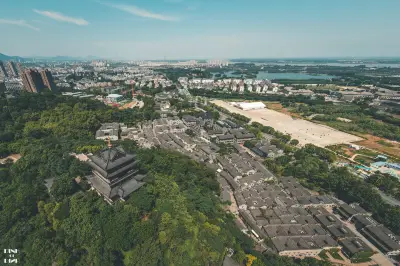
Xinghua Travelogue (4) — Xinghua Old Street
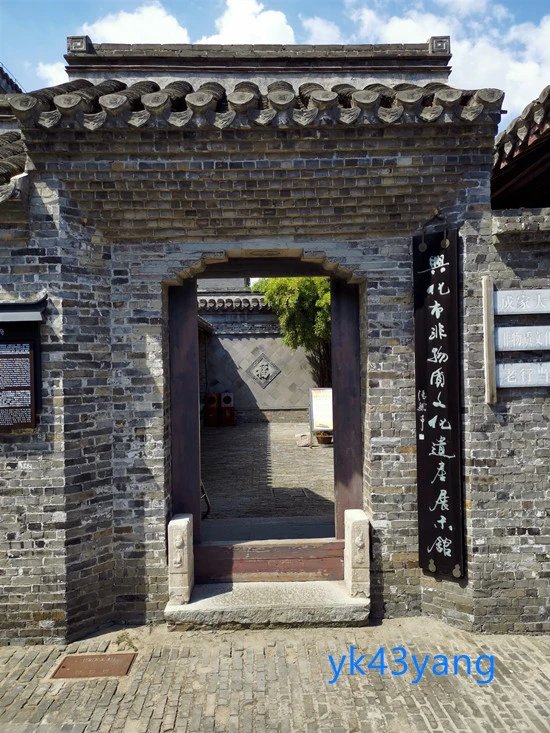
After visiting Zheng Banqiao's former residence, I walked to the nearby Cheng's Grand Marshal's Mansion — the Xinghua Intangible Cultural Heritage Exhibition Hall.
The Grand Marshal's Mansion was the residence of Cheng Jin, Minister of War during the Yongle era of the Ming Dynasty.
Cheng Jin, courtesy name Gongkai, was a native of Xinghua in the early Ming Dynasty. In the 22nd year of the Hongwu era, he entered officialdom as a tribute student, serving successively as Prefectural Director of Studies in Daizhou and Prefect of Weizhou. For his meritorious service in following Prince Yan Zhu Di in the 'Jingnan Campaign,' he was successively awarded the positions of Left Vice Minister of Personnel and Minister of War.
The Grand Marshal's Mansion was first built during the Yongle era. What is seen now appears to be a new construction. The mansion now serves as the Intangible Cultural Heritage Exhibition Hall.
This is the Dongyue Temple on the old street.
Dongyue Temple was founded during the Yongle era of the Ming Dynasty, with its first abbot being Jiang Kechang, a direct disciple of Liu Changchun of the Quanzhen sect. Some sources also state that Dongyue Temple was built in the first year of the Zhizheng era of the Yuan Dynasty. But this is just a travelogue, so I won't go into detailed textual research.
During the Jiajing era of the Ming Dynasty, Xinghua's Dongyue Temple had a famous abbot — Lu Xixing. This man founded a famous school of Taoism — the Eastern School of Internal Alchemy. His Taoist works — 'Nanhua Fumo,' 'Fanghu Waishi,' 'Lengyan Shuzhi' and others — were included in the 'Complete Library of the Four Treasuries.'
What is internal alchemy?
Taoism advocates alchemy. Using medicines to refine is called external alchemy. With the guidance of yin-yang union, using the human body as the crucible, essence, qi, and spirit as the ingredients, and self-generated three true fires to refine within the body, it is called internal alchemy. Our body's acupoint — the dantian — probably originates from this.
What is yin-yang union? Simply put, it is cultivation through male-female dual practice. Unlike other sects, the core of the Eastern School of Internal Alchemy is sexual techniques, somewhat akin to the joyful Buddha in Tibetan Buddhism involving dual cultivation.
Getting too far off topic, I won't delve deeper and stop here.
Another achievement of this Lu Xixing was writing 'Investiture of the Gods.' Some research suggests that Xu Zhonglin was just a pseudonym for Lu Xixing.
'Investiture of the Gods' is full of Taoist thought, so it makes sense that it was written by a Taoist. Some studies suggest that Jiang Ziya in 'Investiture of the Gods' alludes to Jiang Kechang, Lu Xixing's predecessor, a Xinghua Taoist. And Lu Ya the Taoist is a self-portrayal of Lu Xixing himself.
During the War of Resistance, Dongyue Temple was destroyed in the war, with only one main hall surviving. It was listed as a cultural heritage protection unit in 1987 and has undergone many repairs. The current structure is the result of restoration completed in 2009.
This is the mountain gate of Dongyue Temple.
Behind the mountain gate is the Tianzun Hall.
Leaving Dongyue Temple, not far away is the Four-Archway. This was built to honor the outstanding talents produced in the Xinghua area.
According to research, the Four-Archway was first built during the Longqing era of the Ming Dynasty. The plaque 'Zhuangyuan Grand Chancellor' inside the archway refers to Li Chunfang, the top scholar of the Jiajing era, a Grand Secretary of the Wuying Hall, and a prominent Ming official who became Chief Grand Secretary during the Longqing era.
The Four-Archway was demolished during the ten-year turmoil, and what is seen now was rebuilt in 1990.
There are 47 plaques hanging inside the archway, each honoring famous historical figures from Xinghua. From the number of plaques, one can sense that the Jiangsu region has been culturally inspiring and rich in talents.
After half a day of sightseeing, I returned to the restaurant I visited last time to enjoy a delicious Huaiyang meal.
Today I ordered braised yellow croaker with pickled vegetables and 'Family Happiness' hot pot.
The braised yellow croaker with pickled vegetables is likely a northern Chinese preparation; in Shanghai it would be called yellow croaker with pickled potherb mustard, made from potherb mustard.
'Family Happiness' should be a mixed hotpot in a clay pot, but what came was a stainless steel pot. Clay pots have high heat capacity and retain warmth well, while stainless steel pots dissipate heat quickly — not the right flavor!
The yellow croaker was very fresh and tasty. The 'Family Happiness' was somewhat lacking; it should have had items like egg dumplings. But overall, I was quite satisfied with this meal.