Solitary Hill, a Truly Lonely Little Hill
★Travel Location: Gushan, Jingjiang, Taizhou
Hangzhou's Solitary Hill is known to the world for its scenery and culture. In fact, across the river, Jingjiang also has a Solitary Hill. The reason it's named 'solitary' is truly because this hill is very lonely; the entire Jingjiang, even Taizhou, is flat land, and this is the only hill.
Gushan is the earliest land in Jingjiang. Originally an isolated island in the sea, it has an elevation of 55.6 meters, a circumference of 1.5 kilometers, and covers an area of 50,000 square meters. No matter how you look at it, it's pitifully small. Yet, because it is the only hill in Taizhou and Jingjiang, it attracts some visitors. Despite its tiny size, this hill is a remnant of the Tianmu Mountain range, sharing the same vein as Huangshan in Jiangyin on the southern bank of the Yangtze River.
At the foot of the hill is Gushan Town, with a small market. The roads here are not well paved, to the point that halfway through, I seriously suspected there was a problem with the car's tires and even stopped by the roadside to check. It turned out the road was the issue. The parking lot at the foot of the hill was very empty, though there was a small market nearby, seemingly for the residents of Gushan Town.
Gushan resembles a sitting lion, covered with trees. Even in the cold winter, the entire hill is lush green. Although this hill is extremely small, the people of Jingjiang have been deliberately adorning it since the first year of the Zhengde era of the Ming Dynasty. The Gushan Temple on the hill dates back at least to the Yuan Dynasty, so by the Ming Dynasty, Gushan became a famous tourist destination. Of course, its fame cannot compare with that of the small island of the same name on West Lake.
Climbing from the southern slope, there were quite a few tourists. The hill is not high, so we didn't need to conserve energy and just climbed straight up. Halfway up, there is a relief of Maitreya Buddha, golden in color, looking quite new, probably built not long ago.
Beside it is a stone archway with the inscription 'Niyun' (Stepping on Clouds), hence called 'Niyun Archway', meaning 'stepping on clouds and ascending'. I looked up at the height of the hill; the clouds were really too far away. It just shows that literati and poets are a group full of imagination. This archway is the oldest existing stone archway in Jingjiang, with a history of over 400 years. On the stone pillars on both sides, a couplet is engraved, but the characters are blurry. However, there is a text explanation next to it, stating the full couplet: 'Facing this great river, the misty waves of Zuoli still exist; standing atop the peak, how does the breeze and moonlight of West Lake compare?' Like the inscription, it is the work of Zhao Ying, the magistrate of Jingjiang during the Wanli era of the Ming Dynasty. The couplet is quite grand in spirit, but compared to the breeze and moonlight of West Lake, it still falls short. However, matters of scenery are always a matter of personal opinion.
Below the archway, there is also a cliffside stone carving, said to be even older than the Niyun Archway. In the summer of the Jiajing era of the Ming Dynasty, Jingjiang suffered a severe drought. A Taoist priest named Yi Zibo Zhen, from Sanzi in Hunan, prayed here for rain. To commemorate this rain prayer, the local people carved an inscription on a nearby boulder: 'In the summer of the Bingxu year of the Jiajing era, the Taoist Yi Zibo Zhen from Sanzi, Hunan, prayed for rain here.'
Continuing up, there are reliefs on the enclosing walls, no longer glittering gold but brick-colored. The reliefs were large, lacking a bit of delicacy. Nearby, there is also a niche with a Buddha statue; I'm not sure which Buddha it is, and many people were burning incense there.
All the way to the top, there is another temple named 'Gushan Zhengjian Temple'. I wonder if this is part of Gushan Temple. Given the small size of the hill, it's questionable whether two temples are necessary. Of course, Jiangyin's Junshan, which is neither high nor large, also has two temples: one Buddhist and one Taoist. Upon entering, I found that this temple on the hill is still Buddhist. The halls were impressive, but many Buddha statues had yet to be gilded, probably newly built.
Standing at the summit and looking into the distance, there are very few high-rise buildings in Jingjiang. One can see the Yangtze River at a glance, with large tracts of farmland and one- to two-story residential buildings in between. For those of us who grew up by the Yangtze River, the scenery here is nothing special.
When descending, I deliberately took a detour to the other side of the back hill. There are many pagodas here, where eminent monks from various dynasties are mostly buried. There is also a seated statue of the Eastern Peak Emperor (Dongyue Dadi). Logically, there should be a palace for the Eastern Peak Emperor. An area was cordoned off, perhaps for the construction of some building.
It is said that the Gushan Temple Fair is famous far and wide, held annually on the third day of the third lunar month. This is the most grand temple fair in the area, a custom that has lasted for a hundred years, usually continuing for three days. There is a local saying, 'On the third of the third, go to Gushan.' Now it's still the first lunar month, so the temple fair is still far off. Although Jiangyin and Jingjiang are not far apart, I don't enjoy the hustle and bustle of temple fairs.
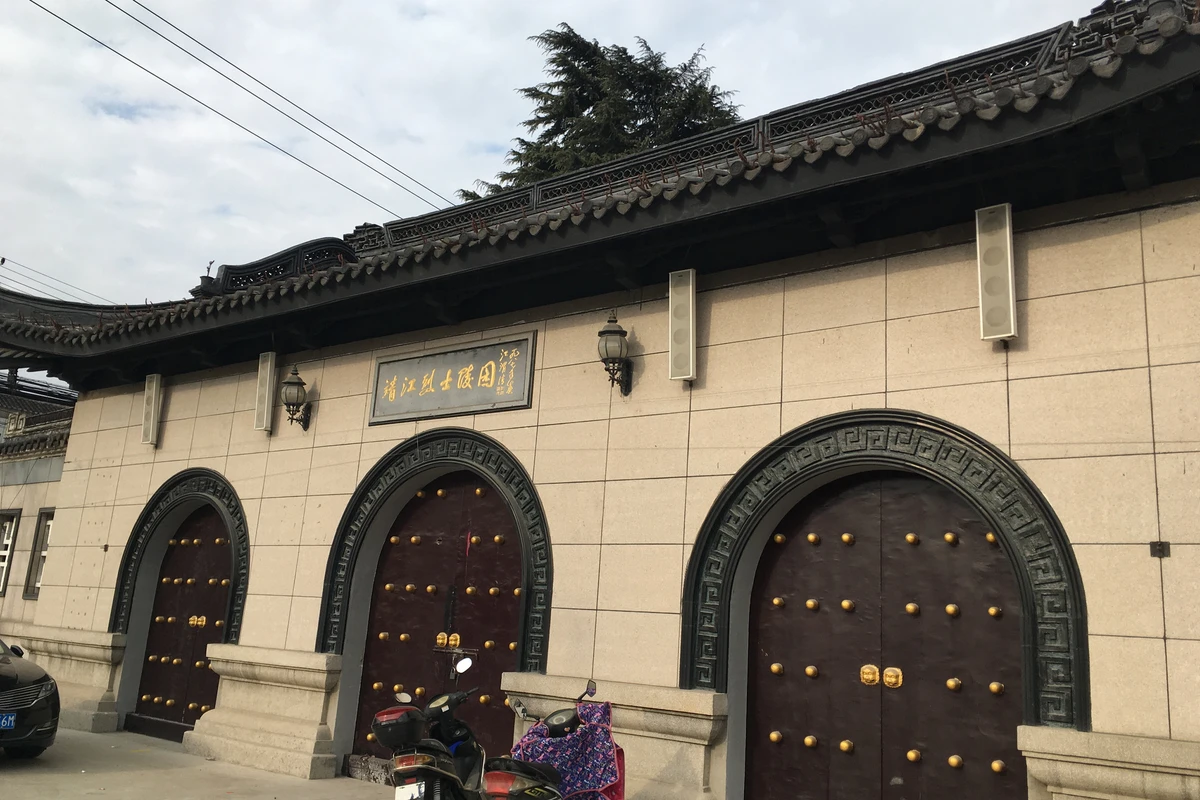
After descending the hill, I wandered around and saw the Jingjiang Martyrs Cemetery. The surrounding area is an ordinary small town, not bustling, and actually quite peaceful.