Slow Travel in Taizhou: Immersive Experience of 'Taizhou-style' Water Culture and Night Economy
The year before last and last year, I visited Xinghua, Taizhou twice. However, each time after marveling at the renowned Qianduo waterborne rapeseed flowers, I would hurry away. This time, on my trip to Taizhou, Jiangsu, I finally got my wish and spent three days savoring Taizhou at a leisurely pace. I explored the Fengcheng River Scenic Area, Taizhou Old Street, Qintong Ancient Town, and Qinhu National Wetland Park, and also experienced a nighttime tour of Taizhou. Additionally, I visited the Baziqiao Cultural and Tourism Leisure Block in Xinghua and the Binjiang New Town Leisure Water Street in Jingjiang.
For this trip, I set off from Hangzhou, Zhejiang, heading to Taizhou, Jiangsu. It was a three-day, two-night journey with the following itinerary:
Day 1: Hangzhou East Station – Taizhou Station – Huibinlou Hotel – Fengcheng River Scenic Area.
Day 2: Morning tea at Huibinlou Hotel – Jingjiang Binjiang New Town Leisure Water Street – Xinghua Baziqiao Cultural and Tourism Leisure Block – Taizhou Old Street.
Day 3: Taizhou Qintong Ancient Town – Qinhu National Wetland Park – return journey.
With numerous attractions spread across different cities, it’s recommended to take the high-speed train to Taizhou and then rent a car to drive to the various sites. Alternatively, you can take long-distance buses between Taizhou, Xinghua, and Jingjiang, as there are frequent services. Most attractions are located in bustling urban areas, making dining, accommodation, and transportation very convenient.
Taizhou, a thousand-year-old city, was known as Haiyang in the Qin Dynasty and Hailing in the Han Dynasty. A land of outstanding people and rich heritage, it is a National Historical and Cultural City. Local guides often say that over 700 years ago, Marco Polo visited Taizhou and praised it highly: 'This city is not very large, but it contains a great many worldly pleasures.' The Fengcheng River is a relatively well-preserved thousand-year-old city moat and is also considered the mother river of Taizhou.
Taizhou is a city of water, with a distinctive water culture system. The Fengcheng River Scenic Area highlights four thematic cultures: history, opera, folklore, and commerce. Along the riverbank, there are over 30 attractions, including Wanghai Tower, the City Site Ruins, the Stele Garden, Peach Garden, Wenhui Hall, and Mei Garden. When night falls, a 'Fengcheng River night cruise' becomes an essential experience for visitors to Taizhou. The scenic area comes alive with colorful illuminations, bathing famous towers and gardens in a dazzling glow. Drifting slowly on a painted pleasure boat, you can enjoy the gentle breeze and the dreamy waterside charm.
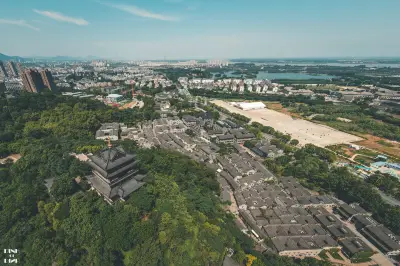
Wanghai Tower is one of the core attractions in the Fengcheng River Scenic Area. Built in the Song Dynasty, it is hailed as the 'No. 1 Tower of Jianghuai' and is one of Taizhou’s landmark buildings. Though the sea is no longer visible today, the name 'Wanghai' (Sea View) endures.
The Mei Lanfang Memorial Hall is located within Mei Garden in the Fengcheng River Scenic Area. Mei Lanfang was an outstanding figure in Taizhou’s cultural and artistic history and a master dedicated to 'promoting the nation’s fine culture and revitalizing the art of Peking Opera.' This garden-style memorial hall, primarily in Ming and Qing architectural styles, houses the Mei Lanfang Historical Materials Exhibition Hall, showcasing his life story and artistic achievements.
There are many more attractions to explore in the scenic area, including the City Site Ruins, Stele Garden, Wenhui Hall, and Peach Garden, all popular with visitors. During the day, you can tour historic sites and cultural spots; at night, you can immerse yourself in the famous night economy. The area offers eight nighttime activities: night cruises, night markets, night opera, night shows, night banquets, night fishing, night reading, and night cinema, allowing you to fully enjoy Taizhou’s water culture and night economy. I especially recommend a painted pleasure boat cruise, where the onboard commentary introduces the riverside sights and the local history and culture. Drift leisurely along the Fengcheng River, take in the enchanting evening scenery, and experience an immersive 'Taizhou-style' water culture and night economy.
Located just outside the Peach Garden Scenic Area along the Fengcheng River, Taizhou Old Street is a roughly 600-meter-long strip of ancient buildings with grey bricks and black tiles, and it is a hub for Taizhou’s intangible cultural heritage. The entire street blends old-world charm with bustling local life. Strolling along the ancient flagstone lanes, you’ll see a profusion of traditional shops on both sides. Strings of red lanterns, an ancient opera stage with flying eaves, and a variety of traditional Taizhou snacks vividly display the old city’s way of life.
Qintong Ancient Town is situated in Qintong Town, Jiangyan District, Taizhou. Known as Qinhong in ancient times, it is a renowned town of Chinese history and culture. Surrounded by water and with beautiful surroundings, it preserves over 20,000 square meters of Ming and Qing dynasty architecture. The entire ancient town is an open free-access area, but the eight main attractions inside require separate tickets, which can be purchased at the visitor center.
The most famous feature of Qintong Ancient Town is the 'Three Trees of Qintong.' The first is a Song-dynasty camellia tree, located in the Camellia Courtyard. Recognized by the 'Guinness World Records' as the longest-living artificially cultivated camellia, it is also called the 'King of Camellias,' with an estimated age of about 1,000 years. The tree is 10.5 meters tall, with a crown of 5 by 6 meters and a trunk base diameter of 1.5 meters; it can bloom with up to 30,000 flowers at its peak.
The second tree is a Tang-dynasty sacred locust tree, standing within the Lüshun Temple. Experts have confirmed it is over 1,100 years old. Its main branch extends beyond the temple wall into the street, a true testament to the greatness of nature.
The third tree—a Ming-dynasty boxwood? No. Local guides say the third 'tree' is actually very special: it’s the Li family of Qintong. 'One family, three academicians, with an ancestor who was a zhuangyuan (top scholar).' Qintong has long valued culture and education, producing over a hundred jinshi and juren degree holders over the centuries. The three brothers Li Deren, Li Deyi, and Li Dequn—known as the 'three brothers, six academicians'—all came from the 'Zhuangyuan Mansion' in Qintong.
Qinhu National Wetland Park is a national 5A-level tourist attraction. Situated in the Lixiahe region, one of China’s three famous low-lying areas, the park is themed around 'water, wetlands, and ecology.' It boasts fresh air, a beautiful environment, and abundant wildlife. With facilities such as hot spring hotels, a waterfront commercial street, and an ocean world, it’s a wonderful place for leisure and holiday-making.
Locals in Taizhou like to say that their day revolves around 'eating water in the morning and soaking in water at night.' 'Eating water in the morning' refers to Taizhou’s morning tea, while 'soaking in water at night' means taking a bath—this is the 'slow life of the water city' for Taizhou people. During this trip, I didn’t try the evening bath, but I thoroughly enjoyed Taizhou morning tea every day.
As the saying goes, 'Taizhou morning tea, come early to Taizhou.' Taizhou’s morning tea culture has a long history, and morning tea shops can be found everywhere. Locals can leisurely enjoy their morning tea from 6 a.m. to 10 a.m., which is wonderfully relaxing. The Huibinlou Hotel where I stayed is also a famous morning tea spot. In addition to hotel guests, many local residents come to chat over tea. Taizhou morning tea offers a rich variety of dishes: a cup of tea, along with a plate of hot-dried tofu shreds, a bowl of fish soup noodles, and a crab roe soup dumpling, is the perfect way to start a leisurely day in Taizhou.
The Baziqiao Cultural and Tourism Leisure Block sits at the heart of the old town of Xinghua, Taizhou. Xinghua, known as Zhaoyang in ancient times and also called Chushui, has over two thousand years of history. Zheng Banqiao, the leading figure of the 'Eight Eccentrics of Yangzhou,' and Shi Nai’an, author of the classic 'Water Margin,' were both born in Xinghua. The block mainly consists of the Xinghua Museum, Liyuan Boat Hall, the old Xinghua County Government Office, Bazi Bridge, Si Pai Lou, and the surrounding area. The Xinghua Museum is the only national-level museum in the Taizhou region, housing the Xinghua History Gallery and the Zheng Banqiao Memorial Hall. Li Garden and the old county office are buildings with deep historical roots, while Bazi Bridge and Si Pai Lou are iconic landmarks of Xinghua, renowned far and wide!
Jingjiang, a county-level city in Taizhou, lies south of Taizhou’s urban area and north of the Yangtze River. The Binjiang New Town Leisure Water Street, a highlight of Jingjiang, is located just south of Mazhou Park. Comprising 13 distinctive Jiangnan-style buildings, it has become a popular local photo spot. The Water Street features restaurants, a landscaped canal, a wedding lawn, an art hotel, boutique cafés, and more, with the In City shopping center right across from it. In short, it’s a leisure and tourism block that offers a full range of services: dining, accommodation, transport, sightseeing, shopping, and entertainment. Also, being so close to the Yangtze River, a visit there is highly recommended.
I truly enjoyed my trip to Taizhou this time. Be it the morning tea, the night cruises, the natural scenery, the cultural sites, or the cultural tourism consumption hubs, everything is worth experiencing. I’ve visited Taizhou for three consecutive years, and I’m already looking forward to my next trip there next year!
Travel Directory: 1. [Slow Travel in Taizhou] 2. [Itinerary Overview] 3. [Practical Tips] 4. [Taizhou Fengcheng River Scenic Area] 5. [Taizhou Old Street] 6. [Qintong Ancient Town] 7. [Qinhu National Wetland Park] 8. [Taizhou Morning Tea] 9. [Xinghua Baziqiao Cultural and Tourism Leisure Block] 10. [Jingjiang Binjiang New Town Leisure Water Street] 11. [Afterword] Travel Information | Hotel Index | Travel Guide Index | Air Ticket Index | Website Navigation | Travel Index | Cruise Index | Corporate Travel Index | Affiliate Program | Distribution Alliance | Friendly Links | Corporate Gift Card Procurement | Insurance Agency | Agency Cooperation | Hotel Affiliation | Destination & Scenic Spot Cooperation | More Affiliate Cooperation | About Ctrip | Ctrip Hot Topics | Contact Us | Careers | User Agreement | Privacy Policy | Business License | Security Center | Ctrip Content Center | Intellectual Property | Trip.com Group Algorithm Announcement