Daohe, Six Hundred Years of Blue Bricks in Five Lanes (Part 1)
★ Tourist Location: Taizhou Daohe Historical and Cultural District
The July sun is truly blazing, but even such high temperatures could not stop my determination to go to Daohe. Although the umbrella in my car might not block ultraviolet rays, it was better than nothing. So I got out of the car with my only sun-shading tool and headed to the entrance of the ancient Daohe district.
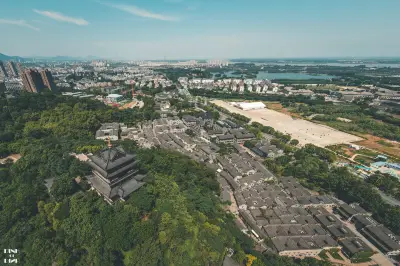
The visitor center is located by the river, which is the Daohe River. The river is not very wide; flowing north-south, it bends southwest near the ancient district and then reaches its end. The ancient district is situated near the end of the Daohe River, on its northwest bank.
The planned area of the ancient district is 154,700 square meters, with the Daohe River, Caohe River, and Five Lanes district as its core historical and cultural area. The Caohe River lies east of the Daohe River and is a narrower stream. The area between the two rivers, though featuring imitation antique buildings, is mostly commercial shops and the like. So I only walked a short stretch before turning back to the northwest bank of the Daohe River.
The Daohe ancient district took shape in the late Yuan and early Ming dynasties, over six hundred years ago, and is the largest Taizhou-style residential complex in Taizhou. During the Ming and Qing dynasties, many banks, oil mills, and warehouses were set up along the Daohe and Caohe rivers, forming a neighborhood of small bridges and flowing water. However, unlike the ancient towns of Jiangnan, the houses here are built of brick with a gray overall tone. And when we say "small bridges and flowing water," it really only refers to the Daohe and Caohe rivers. The ancient towns in Jiangnan have well-developed water systems with multiple rivers within their boundaries.
Perhaps due to the intense heat, I didn't see a single person as I walked in. I looked up at the scorching sun and felt that even through the umbrella, the sun on my arms was hot. No wonder I only spotted a group of people after walking for a long time; it was so quiet that I could only hear my own footsteps.
As the saying goes: "Hanxi and Five Lanes are divided east and west, Daohe and Caohe run north and south." This describes the Daohe ancient district. The so-called Five Lanes are five alleyways arranged side by side, with lanes in between, crisscrossing to form the spatial layout of the scenic area. Hence, there is a local saying: "Enter the Five Lanes and you'll be lost like you've taken a magic potion."
In the late Yuan and early Ming, Taizhou city was devastated by war, and the main urban area gradually declined. The streets outside the north gate, like Pozi Street and Caiyi Street, extended northward, while the areas along the Daohe and Mohe rivers gradually prospered. The Bohe River expanded westward from its original Xibaokou north, becoming more and more prosperous. As more residents gathered on the north side, the Five Lanes were formed. The Five Lanes run north-south, arranged east-west side by side. The main gates of the houses face east, while the back doors open into the next alley facing west. The inner courtyards face south, which is quite interesting.
I randomly picked an alley and walked in. The buildings looked very new, as if they had been completely rebuilt, and I didn't see any traces of old structures nearby. Some houses had their gates wide open; when I went in, I found that construction was not yet finished, and the items inside didn't look like antiques.
By the roadside were wells, all appearing to be of some age. The well rims were pitted with marks left by time, though I couldn't tell which dynasty they were from. I looked around and saw no signboards, so they probably aren't too ancient.
I was quite interested in these wells. As I walked along, I actually came across a Qing Dynasty well. It had a hexagonal well ring and was surrounded by low walls. It is said that the residents of the district used well water for washing rice and vegetables, and the water was sweet and tasty. In the era before tap water, having a well made daily life much more convenient. I peered down and saw that there was still water in the well.
I reached an open area where there was a stage, but unlike the typical ancient stages that are raised half a story, this one was flush with the ground, only slightly elevated on a base. There was a cloth banner that read "Cultural Grand Stage," suggesting it was built later.
The former site of Five Lanes Primary School is at No. 23 Five Lanes. Its predecessor was a private school founded in 1909, which moved here in 1913. The original site was the ancient forest monastery of Beishan Temple, called "Peiying Women's Vocational School." Later it was renamed as Minxin Town Second Central National School, and after liberation, it was renamed Five Lanes Primary School. Now only six rooms and a ginkgo tree remain.
The facade was not visible; it didn't look like the main entrance. When I went inside, it did resemble the style of an old school. On the wall were the words "Study hard and make progress every day," a popular slogan from that era. Former President Hu Jintao lived in Duo'er Lane as a child, very close to Five Lanes Primary School, and studied there.
The stone slabs on the Five Lanes are made of granite nearly one meter long, which is typical of Ming and Qing street paving in the Taizhou area. Although the district is not small, this is probably the only remaining stone-paved lane.
There are also two copperplate paintings in the lane, depicting scenes of daily life in the ancient district. Nearby are some bronze sculptures, seemingly selling local specialties.
There is also an octagonal well from the Song Dynasty, with an octagonal rim made of volcanic rock. It is said that this type of well is common in Taizhou city, but rare in the Five Lanes area outside the north gate. Octagonal rims of volcanic rock are generally relics from before the Song Dynasty, indicating that people lived in the ancient district before the Song. It is said that not far to the north, an even older well has been discovered, further evidence of earlier habitation in Daohe.
At the corner is the Taizhou Scientific Development View Exhibition Hall, reportedly designed by He Jingtang, the chief designer of the China Pavilion at the Shanghai World Expo. It showcases Taizhou's urban construction achievements, including photos and documents of Comrade Hu Jintao's inspection visits to Taizhou, achievements in practicing the scientific development view, and cultural construction.
The exhibition hall has two floors. Standing at the second-floor window, you can see a residential building detached from the Five Lanes in the distance. Although it looks quite new, there are still places that show the original features of old houses.
When I saw the wall titled "City of Glory," I was a bit surprised because I hadn't expected Taizhou to have so many "glories." After all, among the Thirteen Cities of Jiangsu, besides the provincial capital Nanjing, Suzhou, Wuxi, and Changzhou lead the pack. Nantong has only recently caught up with Changzhou with great effort, and Taizhou's GDP has no particular advantage.
However, when I saw the data bar chart of "Telling Taizhou in Numbers," I suddenly understood. Compared with its own past, the bars that grow higher and higher indeed speak volumes.
Shanren Nunnery originally had three halls, but two were demolished during the Cultural Revolution. A large ginkgo tree was also cut down. Now the nunnery is a Qing Dynasty building. It is said that the main hall has a beam-lifting structure, but since it was not open to the public, I couldn't see inside.
Daohe's Five Lanes have weathered wind and rain,
Black tiles and blue bricks for six hundred years.
Thinly coated with time's gentle hues,
Brightly inlaid with fresh scenes, writing new notes.