Pozijie and Tianzihe Park by the Greenbelt
★Travel Location: Taizhou Pozijie and Tianzihe Park
Leaving Daohe, it is not far to Pozijie. This is Taizhou’s old commercial street and one of its busiest thoroughfares. It is well-known throughout the Lixiahe region and ranks as the third-largest commercial center there. The street is not long, about half a li, paved with hemp stone slabs. Being an old street, it naturally has some time-honored brands.
The name “Pozijie” (Slope Street) is quite interesting. Looking at today’s bustling street, you can hardly see the origin of the name “slope.” As early as the Southern Song Dynasty, this was merely a raised path formed by digging a river and filling it with earth, with the south high and the north low, so locals called it “Pozhi” (the slope). During the Hongwu reign of the Ming Dynasty, because dams were built on the Daohe and Caohe rivers, the upper and lower reaches were blocked. Travelers and goods had to cross the dam here, so outside the north gate, merchants gathered, residents increased day by day, and business flourished. Gradually, the slope developed into a street lined with shops, and the name Pozijie spread. Today, Pozijie has no traces of the past; the shops on both sides are modern in style. However, on the scenic bridge, there are carvings depicting the prosperity of bygone days.
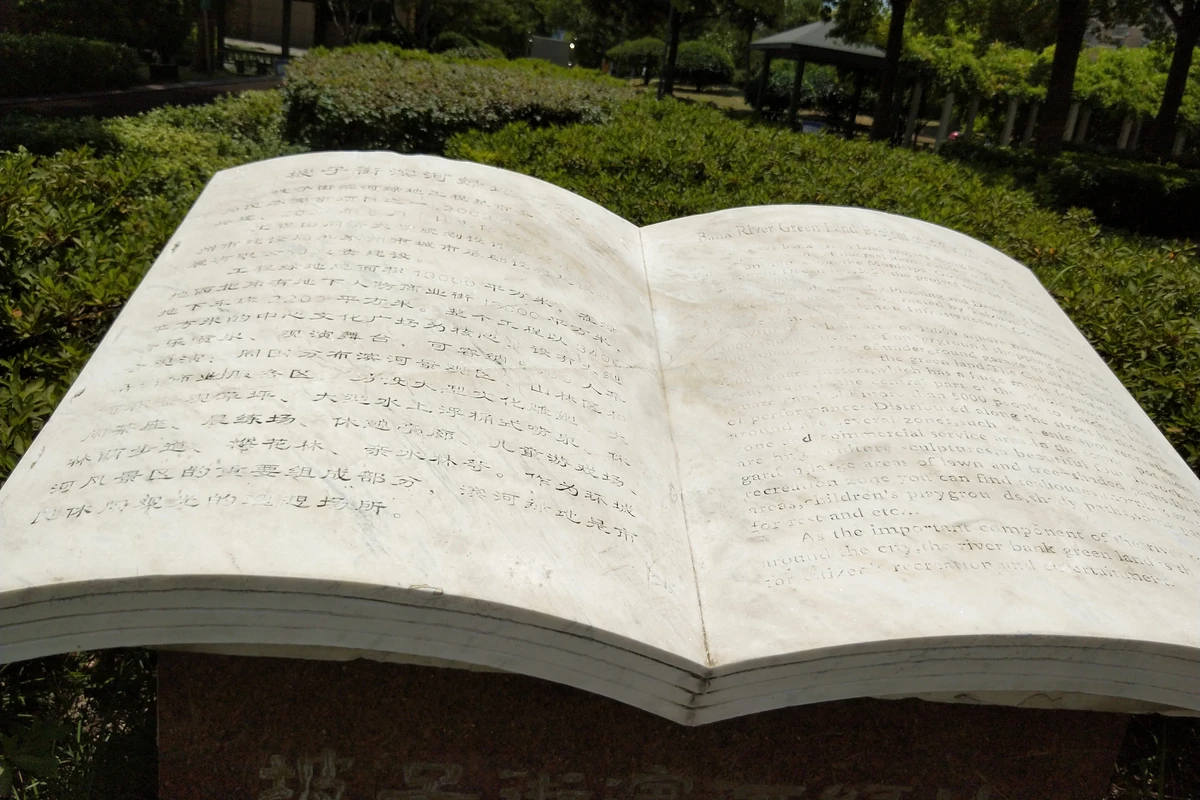
The riverside greenbelt covers 19,000 square meters, which is quite large for a green space. The greenbelt borders the river, and the wind blowing from the river carries heat. The weather is too hot, so no citizens are strolling here.
Holding an umbrella that is not very effective against UV rays, I walk alone on the greenbelt path. A corridor on one side is covered with wisteria, but it is past the flowering season. The leaves, however, are lush, casting a cool shade on the corridor.
Passing through Gulou North Road, I arrive at Tianzihe Park. Being a park, it is naturally much larger than the greenbelt. Tianzihe Park is a riverside park built along the Dongcheng River. It has recreational facilities and tent-shaped “pavilions.” Many parks install one or two of these tent structures. They are beautiful, but in terms of function, traditional pavilions are probably more practical.
There is a water-facing platform extending into the river. I initially thought it was an accessible water platform, and indeed some people were “touching the water,” perhaps washing hands or catching something. But its actual purpose is to hold a metal sculpture. Since there is no explanatory sign, I did not understand the meaning of this sculpture. However, this is an excellent spot to view Gulou Bridge. The bridge spans the Dongcheng River and is very distinctive: it has a covered corridor connecting the whole bridge, with delicate small pavilions in between. The pavilion shapes differ—the main and secondary pavilions have double-eaved roofs, while the side pavilions are single-eave pyramidal roofs. The corridor is decorated with lattice windows. Stretching over a hundred meters, this bridge corridor combines arch bridge, pavilion, and corridor structures organically, creating a unique, practical, and scenic design.
By the river, a small pond has been separated, planted with some water lilies. There are not many lilies, just as decoration, adding a touch of color to the water scene.
A pavilion by the river is also quite distinctive: double-eaved and pyramidal, with an extra layer at the base, making it appear tall and slender. Next to it is a small rockery, though not large.
Inside the park there is a riverside commercial city, but I have no interest in entering. The pyramid-shaped curtain wall building outside is interesting. On the opposite bank, there are pleasure boats.
Walking along the elevated boardwalk, it is a bit sunny, but the view is good. I can see the park’s greenery and the buildings across the river.
Surprisingly, quite a few people have gathered by the river. Walking closer, I see that next to it is a cultural tourism city library, but there are almost no people inside. Maybe people prefer to get close to nature.
Continuing along the river, I suddenly see a brick-walled building. Going closer, it turns out to be the Ancient Guandi Temple, which looks quite old, but unfortunately it is not open.
Further on, there is another ancient structure, the Ancient Zhunti Nunnery. Although the nunnery looks quite new from the outside, its style is quite similar to that of the Ancient Guandi Temple, probably renovated around the same time. Since it is called “ancient,” its initial construction date must be early, but again it is not open to the public.
Outside the nunnery, large jars contain lotus flowers, and some bonsai are arranged in a row. A bell placed in the open bears the nunnery’s name, now rusted heavily—unknown if it is made of bronze or iron.
Beside it stands a tall ginkgo tree, which according to the introduction is two hundred years old. Having seen enough ancient ginkgo trees at Huishan in Wuxi, I do not feel much about this one, though it is also a notably old tree.