Daohe: The Six-Hundred-Year-Old Blue Bricks of Five Alleys (Part 2)
★Travel Location: Taizhou Daohe Historical and Cultural Block
The Cao Jun Art Museum displays the paintings of Cao Jun, an outstanding representative of Chinese Americans. The exhibition hall is fully filled. Cao Jun, born in 1966 in Jiangyan, Taizhou, now lives in New York, USA. He is referred to by UN officials as a 'Chinese art master influencing the world.' His works have been included in top American university textbooks and collected multiple times by the Rockefeller family.
As soon as I stepped in, I was struck by the thick and heavy colors in the paintings. Although I knew Mr. Cao was a Chinese painter living abroad, naturally different from the landscape styles of Ni Yunlin and Huang Gongwang, I didn't expect his use of color to be so gorgeous and bold. That bewitching red almost swept across the entire canvas; that deep blue also covered most of the area.
However, the animal themes have a style of Chinese ink wash painting, with light and elegant colors, capturing both form and spirit. Especially the tigers, which seem to form a series.
The art museum also displays some porcelain, mainly blue-and-white. They don't seem like antiques, but rather modern or contemporary works, also very delicate.
While strolling through the alley, I noticed a hole in the wall with a shape below it, and I didn't know what it was for. The wall was too new, and it didn't look damaged; it should be a deliberate design.
The Ming Dynasty bluestone well is a relic from the Ming Dynasty. The mouth of the well curb has grooves. Because bluestone has a glutinous quality and is relatively soft, not as hard as volcanic rock, the rope rubbed back and forth here when drawing water, creating these grooves.
The residence at No. 7, Fourth Alley is the home of Xu Luanshical, a famous traditional Chinese medicine practitioner in Taizhou. It still preserves the main gate, ceremonial gate, reception hall, main hall, and central room, etc., but it was not open.
The Taizhou Library also has a Daohe branch located in the alley. However, what puzzled me was that there seemed to be no residents living in the block. It might also be because it was too hot during the day and everyone stayed indoors. Otherwise, it would be pointless to open a library branch here, since not many tourists could calm down to read.
The Pan Residence in Fourth Alley is said to be a relatively well-preserved folk house. The existing structures include the main gate, the front hall (or most of the front), the passage hall, and the main hall in three sections. It should be a common type of folk house.
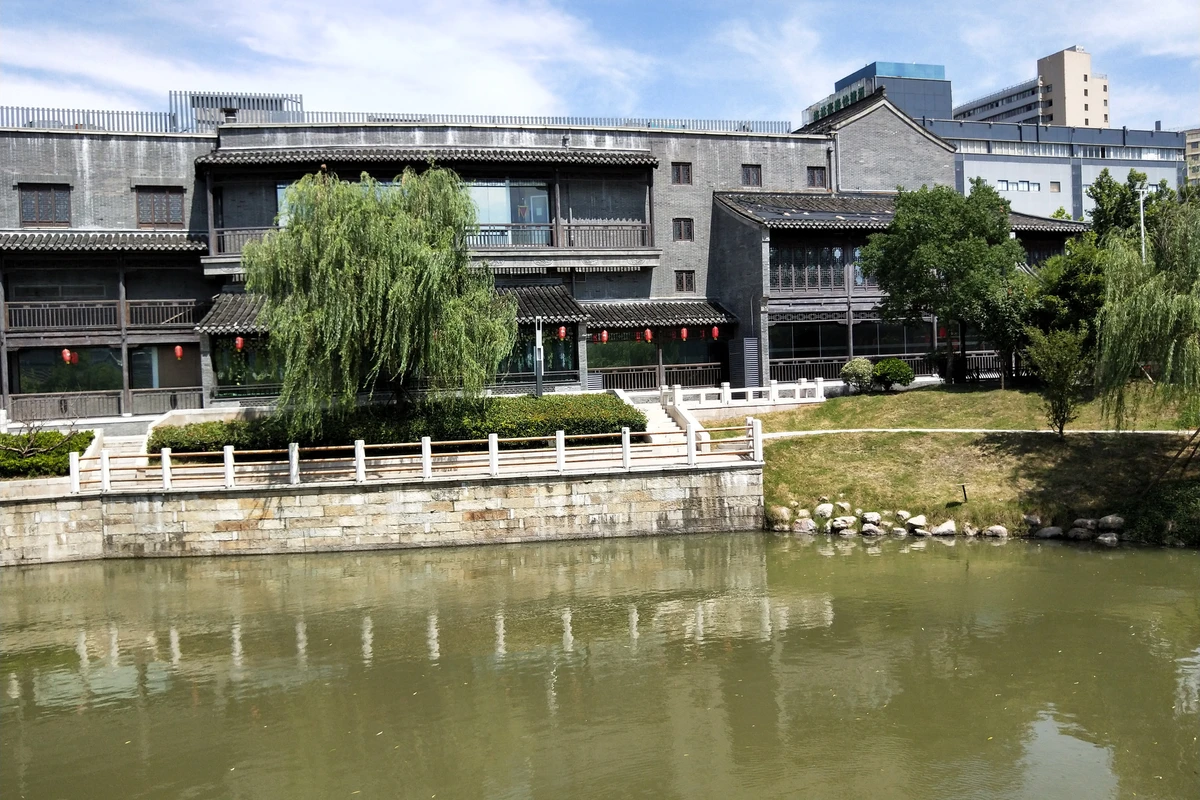
The trumpet creeper climbed from the ground to the roof, blooming profusely. Against the blue sky and white clouds, clinging to the gray walls and black tiles, the color combination was really harmonious.
The Li Residence on First Alley is a two-story small building. It was originally the residence of the Li family, built in 1951. The overall plan is lock-shaped, with wooden railings, in the style of the Republic of China.
The Gao Residence at No. 3, Big Dabao Alley is also a common folk house. It still has the main gate, main hall, etc., and is said to be a Qing Dynasty building. However, judging from its appearance, it has been renovated.
The Ge Residence is a Ming Dynasty building. The exact year of its initial construction is unknown; it is only known that it came into the possession of the Ge family during the Qing Dynasty. The main gate faces east, with splayed walls on both sides, and there are door ornaments outside. It appears relatively large in scale. It is said to have a depth of seven purlins and is well-preserved.
After wandering around the block for a long while, I finally saw some old houses. These houses are all single-story bungalows. The walls are mottled; it can be seen that they were originally painted white, but now most of the paint has peeled off.
When I saw the former residence of Qian Guisen, I almost mistook it for the former residence of Qian Xuesen. This house was built by Qian Guisen, a jinshi (imperial scholar) of the fifth year of the Daoguang reign. The gate tower is built with polished bricks, and it is said to be relatively well-preserved. Looking at its appearance, I had to believe it; this is one of the few old houses in Daohe.
Next to it is the Qian Guisen and Qian Cunxun Memorial Hall. Qian Guisen was a late Qing educator and book collector. His original name was Guizhi, later changed to Guisen. The name may be unfamiliar to many, but he had two very famous students: Xu Shichang and Duan Qirui. It is said that he was a good friend of Weng Tonghe, the imperial tutor. The Hailing Qian family originated from the Wuyue Qian family, and moved to Taizhou from the Changmen of Suzhou during the Yongle reign of the Ming Dynasty. Since settling down, the Hailing Qian family has been a bureaucratic and scholarly family. Qian Cunxun is Qian Guisen's great-grandson, a famous sinologist and the most influential East Asian studies librarian in North America. Both the former residence and the memorial hall are open.
The Hou Residence on Small Dabao Alley is the ancestral house of the Hou family, with three sections from front to back. The Hou family ancestors were merchants, running the Hou family clothing store. Next to it, I finally saw a map of the Daohe ancient block, but why were all the spots commercial establishments?
In fact, the truly ancient buildings in Daohe are few in number, but those several wells do have history. Logically speaking, the ancient wells here are quite distinctive. Why weren't they indicated on the map?