Phoenix Garden, Three Loyalty Garden by the Phoenix River
★Travel Location: Taizhou Phoenix River
Since it was near the Golden Phoenix Hotel, I took a leisurely stroll along the Phoenix River after dinner. With increasing attention to environmental hygiene, the landscapes along both banks are quite well-developed.
The Phoenix River is an important drainage channel in the main urban area of Taizhou, located in the southeastern corner of the old city, running north-south. The scenic belt built along its banks is named the Phoenix River National Water Conservancy Scenic Area. Since it's called a scenic area, there are naturally some landscapes along the way. The scenic area stretches 5.43 kilometers in length, with a green area of 500,000 square meters.
Given such a long scenic belt, I couldn't possibly walk the entire length from start to finish, so I chose the Phoenix Garden, the closest to the hotel, as my starting point.
After crossing Yin Feng Road, I arrived at Phoenix Garden, located at the junction of two rivers. The north-south river is the Phoenix River, while the east-west river is narrower—I'm not sure what it's called.
In Phoenix Garden, there is a brick carving indicating that this is actually the "Three Loyalty Garden," commemorating the deeds of Li Tingzhi, Jiang Cai, Sun Huchen, and others. But I always thought Li Tingzhi resisted the Mongol army in the Yangzhou area; I didn't know he had connections with Taizhou.
After the Southern Song court surrendered, Xia Gui surrendered to the Yuan and gave up Huaixi, but in Huai East, Li Tingzhi, Jiang Cai, and others persisted in resistance and refused to surrender. After Lin'an surrendered, the Yuan sent envoys to Yangzhou to persuade them to surrender, but Li Tingzhi, then prefect of Yangzhou, killed them without a second thought. Later, Kublai Khan sent several more envoys to offer amnesty, but Li Tingzhi remained resolute. Jiang Cai was originally a subordinate of Sun Huchen; after his troops were scattered, he garrisoned Yangzhou. After the small court in Fuzhou was established, Li Tingzhi and Jiang Cai led their troops to Taizhou, preparing to move south to fight, leaving their subordinate Zhu Huan to guard Yangzhou. However, just as they managed to enter Taizhou with difficulty, Zhu Huan surrendered Yangzhou, and Li Tingzhi's family in Yangzhou was captured. But Li Tingzhi's determination to resist the Mongols remained unchanged; even after Jiang Cai fell seriously ill, he still held out in the isolated city of Taizhou. Unfortunately, despite their resolve to resist foreign invasion, subordinate generals like Sun Gui secretly opened the city gates and surrendered to the Mongol general Aju. Li Tingzhi jumped into the Lotus Pond in the city to commit suicide, but because the water was shallow, he was captured alive by the Mongols. Jiang Cai, still ill in bed, was also captured. Both were escorted back to Yangzhou. Even then, Li and Jiang remained steadfast in their refusal to surrender and were beheaded in Yangzhou. There is also a place called Double Loyalty Shrine, dedicated to Li Tingzhi and Jiang Cai.
Phoenix Garden is not large; it's just a relatively wide area along the Phoenix River. I originally thought it would have a bit of Jiangnan garden style, but it's not a classical garden. There is a stone inscribed with "Willing Ox" (Ruziniu), but Taizhou probably has no direct connection with Lu Xun. It's just that the meaning of these three words encourages the people of Taizhou to work diligently like an ox.
Although there are no pavilions or towers, the summer flowers are blooming quite nicely, including bi-colored coreopsis with bright colors. There are also verbena (beauty-berries) in rose-red and a white variety with a circle of bright pink in the center, which is also beautiful.
One stone is engraved with Cao Cao's poem "Though the Tortoise Lives Long" (from the "Short Song Style"), carved in ancient characters. I could only recognize the character "Cao." Fortunately, there is a translation behind it in simplified Chinese.
Heading north, there is a square, not very large, but built clean and tidy along the river. A nearby stone is inscribed with "Beginning of Autumn Square." I suspect that many such small squares have been built corresponding to the solar terms. Although it cannot host large events, it's certainly suitable for square dancing or fitness exercises.
Around the square, there are many hosta plants, mostly white, with a few purple ones. The purple-flowered garlic chives are also blooming nicely. Though they are just herbaceous plants, they add decoration to the ground, making the riverside path less monotonous.
One stone is engraved with "Three Kingdoms Ground Carvings." I pondered for a while; besides the earlier "Though the Tortoise Lives Long," there doesn't seem to be much related to the Three Kingdoms period.
The small earthen slope is actually quite low, but it has many steps with a very gentle gradient. As I walked up the steps, I noticed that the small platforms had carvings of scenes, probably Three Kingdoms stories, which then matched the "Three Kingdoms Ground Carvings."
At the top of the slope, there is a circular pavilion, not in a classical style, with a phoenix carved on its roof—it's called the "Heavenly Phoenix Pavilion." Perhaps there is a beautiful legend about the Phoenix River related to a phoenix.
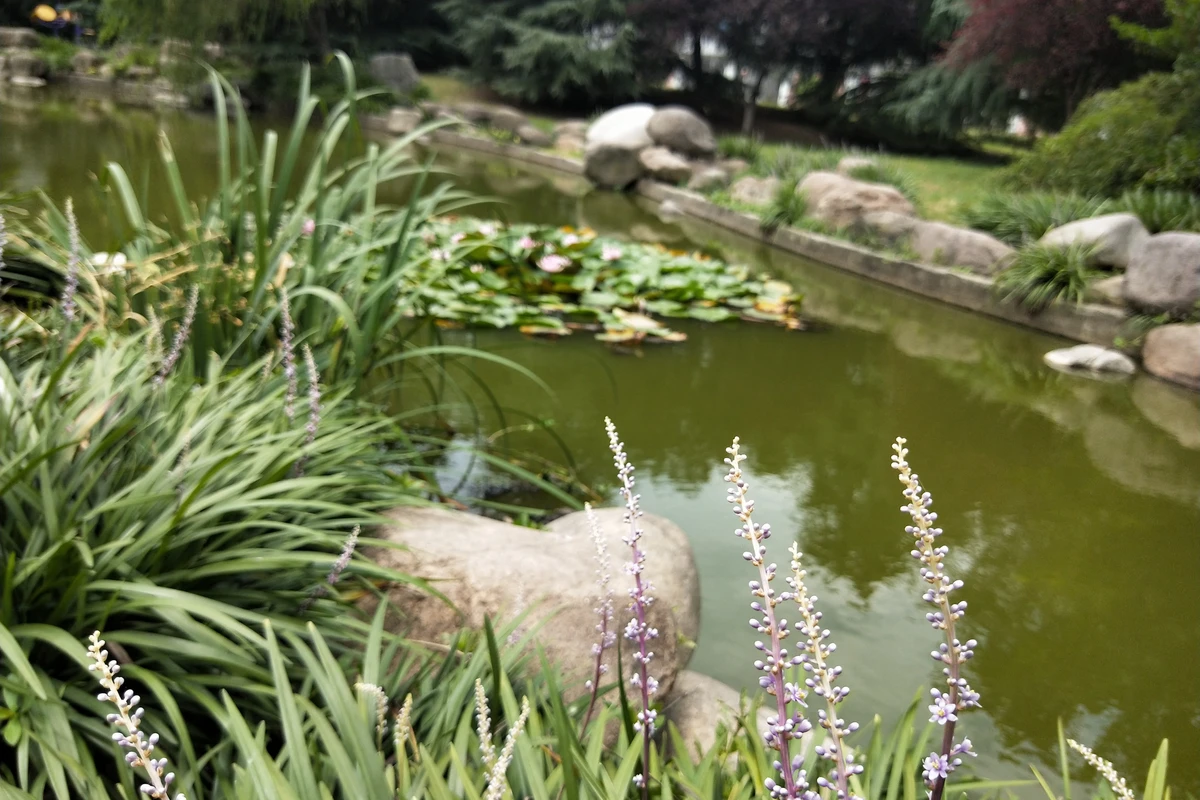
There are actually lotus flowers blooming in the lotus pond. Although the pond is not very large, it is a pleasant surprise. Most of the lotus here are white varieties, with a few pink ones.
Ahead is the "Minor Heat Square." I blinked—so it seems I chose a south-to-north route, but perhaps I'm going the wrong way?
At the foot of the Colorful Phoenix Bridge, there is a temple, not large in scale, with only a few basic halls. Calling them halls, they are far from the multi-eaved, painted structures I imagine; they are just ordinary buildings, but painted bright yellow, so they can be recognized as a temple from a distance.
Of course, as the saying goes, "A mountain need not be high to be famous for its immortal; water need not be deep to be famous for its dragon." A temple does not have to be grand; even a thatched hut can be a place for sincere worship. Besides, although this temple is small, it has complete statues of Shakyamuni Buddha, Maitreya Buddha, and Guanyin Bodhisattva. The main hall, though modest in size, has both a bell and a drum.
Near the Double Phoenix Bridge, there is a long corridor with benches on three sides, providing a place out of the sun to quietly enjoy the river breeze, which makes the heat feel less oppressive.
Returning to the hotel, I was drenched in sweat. Although my pace was not fast, the temperature was indeed too high.