Donghu Garden: A Few Plum Blossoms Outside the Bamboo
★Travel Location: Donghu Garden, Jingjiang, Taizhou
Donghu Garden is located in Dongjiao Village, Jingcheng Town. It was built along both sides of the canal on East Ring Road, resulting in a long and narrow shape. The park covers a total area of over 170 mu (about 28 acres), including 55 mu (about 9 acres) of water area. It was fully completed and opened in 2009.
Later, due to the construction of Chengdong Avenue, the park's landscape was damaged to some extent. After renovation and improvement, it reopened. Since I had never been there before 2014, I don't know what the original Donghu Garden was like. I imagine the improved version is even better than before.
Although it was not built very early, Donghu Garden is the second park in Jingjiang's history, so it has received considerable attention since its opening. Of course, as a non-local of Jingjiang, we simply drove by and followed the road signs to get here.
The entire park is laid out according to the four themes of spring, summer, autumn, and winter. Among the pavilions, terraces, winding bridges, and waterside pavilions, there are vegetation and ornamental stones. It is said that there are over a hundred species of terrestrial, aquatic, and wetland plants here, from the lush spring to the passionate summer, the colorful autumn, and finally the noble and pure winter.
Unfortunately, although Jingjiang is located north of the Yangtze River, it is right on the riverbank, so snow in winter is extremely rare. For example, even now, we cannot experience the elegance of the season.
Entering Donghu Garden, we are greeted by a forest of dawn redwoods. The tall trees have shed their soft leaves, leaving only upright trunks, standing like a guard of honor at the entrance to the park.
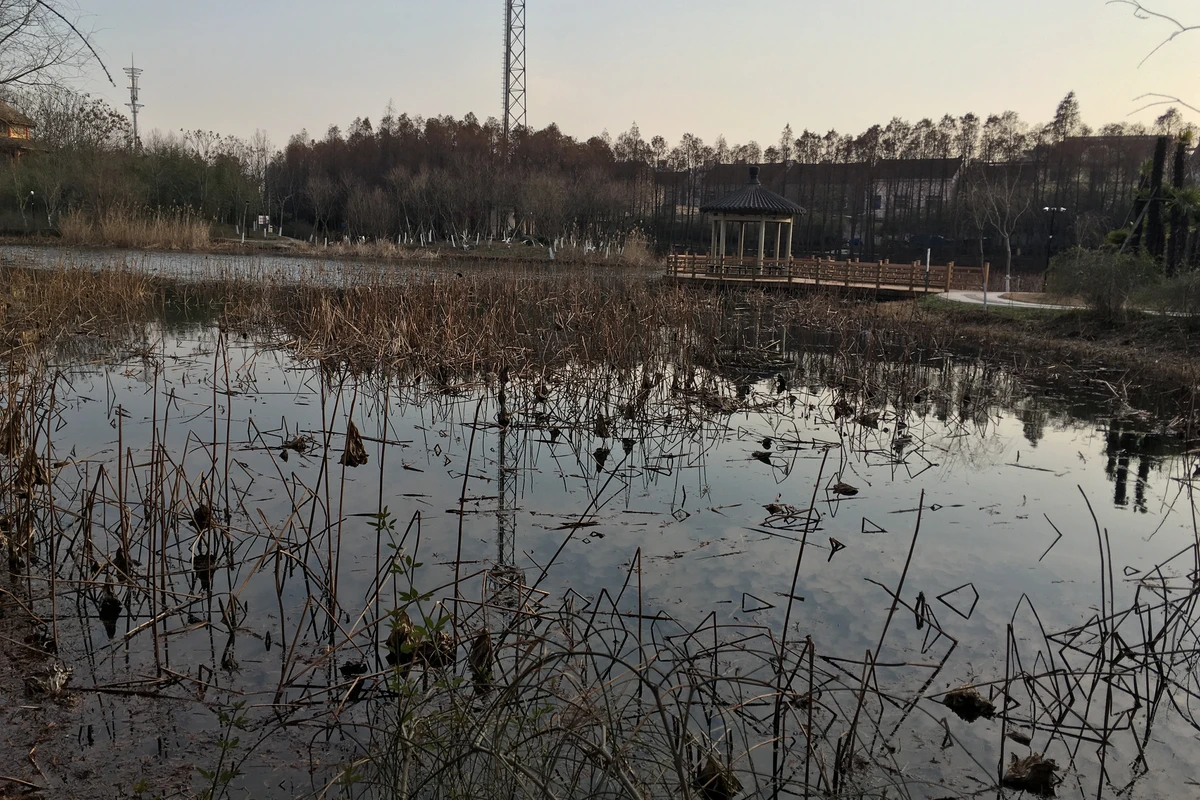
In a pond nearby, we can see withered lotus leaves. This area is likely designed for summer scenery. During the blooming season of lotus flowers, the dawn redwoods are also at their most lush, creating a truly pleasant view.
A wooden bridge extends to the center of the lake, with a small pavilion at the end. It should be the Ruilian Pavilion. Its circular style blends harmoniously in the middle of the water. Of course, there are also some evergreen trees around, adding a bit of vitality to this bleak winter scene.
The Yicui Pavilion is nestled in a bamboo grove, which is indeed a fitting name. Although called a pavilion, it is actually open, and it looks more picturesque from a distance than up close.
A waterside pavilion was built by the lake, with railings overlooking the water. The willow trees by the lake have only their slender branches left. However, the soft willow twigs still have a graceful beauty.
The aquatic plants by the lake are all withered, and it's hard to tell what species they are. Probably reeds are present, because there is a scenic spot called "Reed Flowers Like Flying Snow".
To see the reed flowers flying like snow, one must come in late autumn. We arrived a bit late. Judging by the scale, this reed area is not very large, and we don't plan to make a special trip again.
As for "Dream Marsh with Flying Egrets", the egrets have gone south for the winter. So facing this lake, we cannot feel the atmosphere of "Dream Marsh" at all.
The long corridor by the water reflects its image in the lake, with graceful lines that have the flavor of Jiangnan gardens. A three-arched bridge spans the canal, a standard feature of the Jiangnan water town. "Rainbow Arch Reflecting the Moon" does have that meaning.
At Chengdong Avenue, the canal is narrow, which naturally divides Donghu Garden into eastern and western halves. The space under the bridge is not wasted; there is a small landscape of a waterfall and flowing spring.
Passing through the bridge opening, the water surface widens again. Along the lake is a long corridor, and at the end is the Shuiyun Pavilion. This open pavilion has too many pillars, which, while sturdy, somewhat detracts from its aesthetics.
The opposite bank is rich in colors: the deep green of evergreen trees, the reddish-brown of dawn redwoods, and the withered yellow of tree trunks. The layers of colors are reflected in the water, creating a rich tapestry.
Walking along the lake to the end of Donghu Garden, there is a rockery and a stream. I don't know if it's because the water volume is low in winter, but what should be a waterfall is only a shallow spring.
In the spring are sculptures of egrets, some about to take flight, others strolling leisurely. Scattered in the small pool, they add a touch of liveliness.
Here, the fragrance of plum blossoms is strong; winter-sweet (Chimonanthus) is in full bloom, with a rich scent. Mei blossoms occasionally show a couple of smiles, and you need to get close to smell their fragrance.
Further on is the east gate of Donghu Garden, and we turn to the north bank. Actually, the scenery on both sides of the lake is similar: vegetation and water areas, supplemented by pavilions and terraces.
The Zhuoqing Hall is closed, so we cannot see inside. I guess it might be a place for tea and conversation? After all, the scenery in this area is really nice.
White clouds are reflected in the lake, as if we see another sky within reach. Around a lakeside pavilion, the plum blossoms are already about 30-40% open. Sitting in the pavilion, the faint scent of plum blossoms in our nostrils makes winter suddenly beautiful.
The Baiyue Pavilion is a half-pavilion. On one side, a white wall has a fan-shaped window. Looking out from here, bamboo branches slant horizontally with green leaves, forming a fan painting.
There are also some waterside platforms protruding over the water. Looking from the north bank at the Yicui Pavilion hidden in bamboo and dense trees on the south bank, it seems to have a more serene atmosphere. Chinese classical gardens are sometimes better viewed from a distance.
There should also be a scenic spot called "Flower Sea Welcoming Spring". I wonder what flowers will bloom in spring at Donghu Garden, and how beautiful it will be.
According to reports, this park was designed based on the poetic imagery of Hui Chong's famous poem "Spring River Evening Scene": "Two or three peach blossoms outside the bamboo, / The duck is the first to know the warmth of the spring river. / Artemisia covers the ground, reed sprouts are short, / It is the time when the pufferfish is about to come upstream."
Thus, the best season to visit this park should be late spring. We came at the wrong time. We cannot see peach blossoms outside the bamboo, only the winter scene of "a few plum blossoms outside the bamboo".
Flowers fall, mud is not spring, East Lake's lone crane shadows in pairs.
Morning light faintly cold over Xiling moon, setting sun gently cool on fine lattice windows.