Slow Travel in Taizhou: Ancient Towns and Old Streets with the Purest Hailing Flavor
Over the years, I have visited Taizhou many times, and each time I gain new insights into the city. In spring, I saw peach blossoms in Peach Garden; I listened to a traditional opera in Plum Garden; I also climbed up to Wanghai Tower for a panoramic view... I have always known that Taizhou has a long history, with many cultures once flourishing on this land, and many ancient towns and streets preserved. So this time in Taizhou, I wanted to explore these places and walk the old paths paved with bluestone. The itinerary is simple, covering ancient towns and streets across Taizhou; it is also rich, as these places hold Taizhou's history. Let me capture them all through images.
Taizhou Old Street: old-time charm in the city.
The authentic hustle and bustle of Huangqiao Ancient Town.
Night view of Daohe Old Street, with twinkling lights.
A golden orange glow under the setting sun.
Xinghua Old Street, a quiet ancient neighborhood. Below is my itinerary, which is relatively focused (suitable for those who especially love ancient towns or are visiting Taizhou for the second or third time) for your reference: Day 1: Nanjing → Taizhou, visit Qintong Ancient Town, night tour of Fengcheng River. Day 2: Huangqiao Ancient Town → Taizhou Old Street → Daohe Old Street. Day 3: Xinghua Old Street → Return to Nanjing.
Taizhou is not far from Nanjing, about a 2-hour drive, which is very convenient. Autumn is especially suitable for self-driving, and the weather at this time is really comfortable. Pack your bags and set off.
Qintong Ancient Town, located in Qintong Town, Jiangyan District, Taizhou City, has a history of over a thousand years. Every brick and tile, every old courtyard carries the flavor of the past, quietly telling stories from earlier times. The town is not very large; the outermost old street is full of lively everyday atmosphere. Approaching noon, the street became bustling with tour groups and vendors enthusiastically hawking their goods.
On a short food street, besides fixed shops, many people bring their food on tricycles. There are duck eggs I love—every single one is rich with yolk and has an excellent texture. Besides regular duck eggs, there are also vendors specializing in double-yolk eggs—I must take a bag home. They also sell freshly harvested water chestnuts this season; I haven't had them in years, so I bought some to take home. There are also fried radish cakes, various rice cakes, and many snacks—I couldn't stop browsing.
“Free taste!” “Freshly fried fish balls!” “Delicious crab roe tofu pudding!” Each call tempted my appetite... Tourists didn't hesitate; they tried one shop after another, buying a little of whatever they liked. Whether to take home or enjoy along the way, tourists left satisfied, and vendors smiled happily.
Just take a leisurely stroll on this street. It is filled with a rich atmosphere of life, with food creating unique memories of this place.
There are indeed many delicious foods on this street. People from different places eat and chat, creating a lively scene.
There are Huangqiao baked flatbreads that I didn't even encounter in Huangqiao itself, available in various sweet and savory flavors, such as pork floss, crab roe, red bean paste, chestnut, etc. These flatbreads look very tempting, golden and round, really appetizing. I prefer the savory ones; I bought one or two and finished them while wandering around—this style of eating on the go adds a unique charm.
There is also the well-known Jingjiang dried meat from Jingjiang; since I didn't have time to visit Jingjiang this time, I tried it here. The slices have an appealing color. There are several price ranges—pork and beef—the cheaper ones usually contain more flour, and the difference in taste is obvious once you eat them.
Of course, the most common items on this street are fish balls and fish cakes. As the old saying goes, “Living by the water, one lives off the water.” Almost every household here makes them and the taste is excellent. The vendors selling fish balls and fish cakes work quickly—one calls out while another fries, cooperating smoothly. The fish balls expand and float as soon as they hit the oil; they are ready when golden brown. Freshly made fish balls are truly delicious, bouncy and chewy, perfect for stir-fries or soups.
Stepping away from the lively food street, I plunged into the quiet Qintong Ancient Town. The houses built with grey bricks have some cement patches, silently telling us their history. In the alleys, the noise and bustle of the previous street have nothing to do with this place; it is very peaceful here.
I found a shop specializing in rice cakes in the alley. There was no excessive advertising, and most customers were locals. The cakes were handmade on the spot, and the aroma of rice filled the air as soon as they came out of the steamer. With a sweet fragrance, neither too sweet nor greasy, soft and sticky—one bite was very satisfying.
There is a well-preserved cluster of Ming and Qing architecture in the ancient town, but more common are local residences where people still live. The locals live a leisurely life, walking on the bluestone paths and stopping to chat with an elderly woman at a doorstep. At noon, some set up small stools at the entrance, eating and chatting about daily life.
Ancient houses, old streets, and bluestone paths stretching forward—though this ancient town is located north of the Yangtze River, it still retains the unique charm of a Jiangnan water town. It is not crowded with tourists; it simply remains quiet and true to itself.
Qintong: In ancient times, the Yangtze River and Huaihe River converged here before flowing into the sea. Although not much water can be seen inside the town, the surrounding area is encircled by water. Not far from Qintong Ancient Town, there is the Qintong National Wetland Park. If you have time, you can visit it after exploring the town.
Narrow roads lined with old houses tightly packed, winding paths that seem endless. Jiangnan residences have a strong historical charm. The ancient architecture here is simple in style but elegant in appearance. Mostly built with brick and wood, the sloping roofs are practical in the rainy regions of Jiangsu and Zhejiang. Walking quietly here, you might encounter a busy local at one corner, a Catholic church at the next, and then the Zhang Family Wood Art Museum at another. Every corner in this ancient town brings surprises.
In the evening, we arrived near Peach Garden Pier. Taizhou's nightlife becomes colorful with night tours. Peach Garden Pier is near the old street; after dinner at the old street, you can come here at the right time.
Before dark, I took photos of the surroundings. The painted boats moored in the river will have performers on board during the evening.
Painted boats and covered corridors, lanterns swaying—walking among them gives a feeling of being in a Jiangnan water town.
As the sun set, orange-red began to tinge the sky, and the big round sun looked like a duck egg yolk. As the sky darkened, the river was filled with orange hues. After taking this photo and strolling a bit more, I boarded the boat.
The night boat tour on Fengcheng River: the ticket price is not high, and the boat ride lasts about 40 minutes. Along the way, besides the illuminated Wanghai Tower, there are many performances. From the Peking Opera performance at Plum Garden to the Kunqu opera performance at Peach Garden and the Pingtan performance at Liufang Tea House, watching performances while cruising—I suddenly seemed to understand the elegance of the ancients.
I have seen many night tours before, but few combine scenery and culture as well as Taizhou.
Boat route: Old Street Pier → Wanghai Tower → Wenchang Pavilion → Yingchun Bridge → Plum Garden → Liufang Tea House → Gulou Bridge → Old Street Pier. This route covers most of Taizhou's famous attractions. After enjoying the scenery during the day, you can see the same places beautifully illuminated at night. Just go with the breeze and savor it.
Huangqiao Ancient Town was built during the Yuanfeng period of Emperor Shenzong of the Northern Song Dynasty. It is a thousand-year-old ancient town with a long history and a rich cultural legacy. In the past, my impression of Huangqiao was limited to the Huangqiao Campaign and Huangqiao baked flatbreads. So, after all these years, I only set foot here now. Adjacent to the ancient town is Huangqiao Park, with small bridges and flowing water. The locals like to take a stroll here after meals and chat.
The locals live a leisurely life. When it drizzles, they gather in the long covered corridor—some play chess, some play cards, with a small table surrounded by a crowd. A local who arrived late saw us taking photos and chatted with us in the Huangqiao dialect, “Are you interested in this? This is a common scene here every day.” We asked, “Why not gather enough people to start another table?” He replied, “Oh, you don’t understand. Watching also has its fun; sometimes watching others play cards or chess is more enjoyable than playing yourself.” We said, “Oh...” (though we really didn’t understand inside).
Speaking of Huangqiao, one must mention the famous Huangqiao Campaign. This place was originally an important gateway from central and northern Jiangsu to southern Jiangsu, and was once the largest market town in the region. During the Anti-Japanese War, the Huangqiao Campaign laid a solid foundation for the anti-Japanese base in northern Jiangsu and opened a new chapter in the anti-Japanese struggle in central China. Today, there is the Huangqiao Campaign Memorial Hall in Huangqiao, where you can learn more about this history.
Grey bricks and tiles, wooden doors and windows, red lanterns, bluestone paths... Huangqiao Ancient Town quietly tells of its past. Everything here is as it used to be. Entering this place, time slows down, and you can hardly feel its passage.
The ancient town is not very large; the main street is only a few hundred meters long, but there are many small alleys on both sides, each with its own name. One is called Nanyingxiang Alley. In the past, there were many silversmiths in this alley; passing by during the day, you could hear the sound of hammers striking silver, one after another. But now fewer people live in the alley, and there are even fewer silversmiths. When the alley was named, a homophone was used to pray for good luck: “Nan (south) Yingxiang” and “Bei (north) Yingxiang,” hence the name.
Today, most residents of Huangqiao Ancient Town are middle-aged or elderly. The deep alleys are filled with a real living atmosphere. The places we tour curiously through are just daily life for the locals—their daily necessities.
There is not much commercialization here; the entire ancient town is exceptionally quiet. The rich culture is embedded in these bricks and stones, and the passage of time is gradually reflected in the coming and going crowd. Welcoming and bidding farewell, the wind in Huangqiao already carries the smell of autumn.
In Huangqiao Ancient Town, there is also a century-old public bathhouse. I wonder how many people have seen such a communal bathhouse (maybe more in northern regions). In a room not too large, men and women are separated, each bringing their own toiletries. Some come together, others alone. The busiest time is usually in the afternoon and evening. Such bathhouses were very popular in the past. Now the facilities are ordinary, but the elderly prefer them because the price is low, the hot water is good and warm, and people can even chat while bathing. Seeing this bathhouse brought a hint of familiarity; I haven't seen one in many years.
How can you visit Huangqiao without trying its baked flatbreads? Freshly baked flatbreads are plump, golden, and fragrant. The flavors here are not too many, but include both sweet and savory. One bite is very crispy, with the aroma of sesame seeds combined with the baked dough and filling—truly living up to its reputation. They mainly sell flatbreads and pastries, which are available at fixed times each day. As soon as they come out of the oven, locals surround the stall.
In the afternoon, it's time for the stalls to open. Shopkeepers start to get busy: an aunt going out to pick up her grandson, a sister returning after buying groceries, an uncle waiting for the first batch of pastries... The ancient town seems to come alive, welcoming and sending off these people, cycling back and forth in the long river of time.
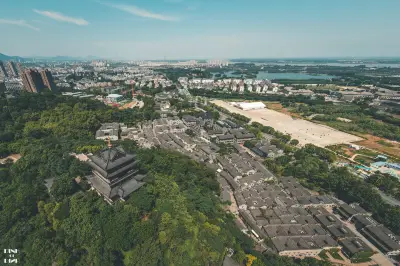
Taizhou Old Street is a scenic spot in Hailing District, Taizhou City, Jiangsu Province. It is not a traditional old street in the strict sense; construction began in 2007, and it took two years to take its current form. Although it is a young ancient block, its imitation ancient architecture is well done, offering food, drink, and places to explore—a good place to visit during holidays.
Upon entering Taizhou Old Street, you'll be attracted by the aroma of plum blossom cakes (meihuagao). These cakes are a local specialty and a traditional sweet snack. I used to eat only sweet ones, with flavors like red bean, bean paste, banana, etc. But to my surprise, I discovered a savory minced pork flavor in Taizhou! How could I not try it? The savory plum blossom cake seemed like a new discovery. The meat filling burst with juice when bitten, and the sweet-salty taste matched our palate. It had a combination texture of Suzhou-style savory mooncakes and savory tangyuan—very unique but delicious!
At the entrance of the old street, there are lanterns inscribed with Taizhou dialects and place names. These dialects and place names are truly Taizhou. These dialects, which you may not hear outside, represent the nostalgia of Taizhou locals. The old street preserves Taizhou's culture in this way.
I stood under the lanterns, looking up. Some local accents were familiar; Nanjing dialect and Taizhou dialect both belong to the Jianghuai Mandarin group. So in Taizhou, I could understand about seventy to eighty percent of what locals said.
There are occasional performances during festivals. With upturned eaves, carved beams, painted pillars, an ancient stage, a large sedan chair, and small boats quietly floating on the river, the square is thoughtfully decorated, making you feel like you have traveled back in time.
I found a little cat with its paws tucked in. It watched the tourists coming and going every day without any fear.
Taizhou-style residences are elegant and graceful, yet there is a grandeur reminiscent of northern courtyard houses. The paths are winding and deep, creating a strong sense of depth. Red lanterns hang above the shops, and one- or two-story houses are scattered at different heights—very photogenic.
Even the trendy signboards can be found here now.
At the exit of the old street is the Taizhou Caolu flatbread shop I missed so much. Caolu flatbread is made mainly from wheat flour and baked by sticking it to the inner wall of a brick oven fueled by dry grass or wheat straw. This shop was established to preserve this technique. The taste is slightly different from Huangqiao flatbread; there are also sweet and savory flavors. It's best eaten hot.
Guyuelou is a time-honored restaurant in Taizhou. There is a saying in Taizhou: “In the morning, skin wraps water; in the evening, water wraps skin.” It means that in the morning you should enjoy dim sum (the skin wraps the water), and in the evening you should enjoy a foot massage (the water wraps the skin). For morning tea, this restaurant is a sure choice. A cup of good Longjing tea, paired with a bowl of shredded dried tofu (tanggan si), a bowl of fish soup noodles, and a basket of crab roe buns—these are the three classic items Taizhou people must order. If you have more people, you can also try other Taizhou dim sum, like shepard's purse soup dumplings, wild vegetable soup buns, shrimp dumplings, etc. All are delicious.
Daohe Old Street is located in the center of Taizhou city, about 2-3 kilometers from Taizhou Old Street. It is a historical and cultural area centered on Daohe, Caohe, and Wu Xiang (Five Alleys). It was built in the late Yuan and early Ming dynasties. During the Ming and Qing dynasties, it was a distribution center for agricultural products of the Lixiahe region. Today, although there are fewer agricultural products, there is more tranquility.
This area is now a well-developed scenic spot, with a complete parking lot and visitor center. In addition, there are many attractions to visit if you come during the day.
Daohe Old Street is the first historical and cultural area in Taizhou to undergo renovation and revival, with the aim of revival through renovation. Everywhere you can see Taizhou-style architecture, one of the four major Jiangnan residential architectural styles. We jokingly call it the Grand View Garden of Taizhou architecture. As the street lights came on, occasional groups of tourists could be seen. The aroma of food drifted along the alley.
My favorite time is just after dark in the ancient town, when the warm yellow lights and the dark blue sky create a contrast of warm and cool tones. Red and yellow dominate, warming every passerby in the chilly night.
When talking about Xinghua, the first thing that comes to mind is the thousands of acres of rapeseed flowers. But the flowers only bloom around the Qingming Festival. This early autumn, I came to Xinghua to see Xinghua Old Street. The old street is in the central area of Xinghua city, surrounded by a strong atmosphere of daily life, bustling with people.
Xinghua Old Street is close to the Xinghua Museum. If you want to learn about Xinghua's history, you can visit the museum. Xinghua is located in central Jiangsu Province, on the northern wing of the Yangtze River Delta, between the Yangtze and Huaihe rivers, in the hinterland of the Lixiahe region. It is a famous historical and cultural city in Jiangsu Province. Its historical and cultural heritage is profound and long-standing. So a walk along Xinghua Old Street will let you feel some of its ancient charm.
Gujinge (Ancient and Modern Pavilion)—I wonder if it means to reflect on the past and view the present.
At the entrance of Xinghua Old Street, there are many tea shops. Jiangsu people love tea; they like to bring a cup wherever they go, so tea shops do good business. The antique buildings match the tea, and the shops play serene guqin music, creating a calming atmosphere.
Xinghua County Office, near Pailou Road, is a very old building. In front of the door are two somewhat weathered stone statues with peculiar shapes; I vaguely recognized them as stone lions. The county office is not open to the public. This was the county government office in the past, a county-level administrative organ. All affairs, big and small, of Xinghua were under its jurisdiction.
Xinghua Old Street is similar to many old streets: narrow alleys, local-style residences, many of which have been converted into shops. The foot traffic is not particularly heavy, but the shopkeepers seem content. Follow the arrows to find places you want to go.
In a small alley, various styles of lanterns are hung, in red, orange, yellow, blue, and other colors, creating a festive feeling. Here, commercial atmosphere coexists with original residential life. The bricks and tiles show the marks of time. I like such old streets—a little commercial but not too noisy to disturb the original tranquility.
The old street is mainly where locals live and run businesses, including chess clubs, mahjong halls, cafes, and tea houses, all with a slow pace of life. The rich historical traces and ancient buildings can be savored along this street.
Entering a nameless dessert shop gave me a perfect mood today.
Passing by a tea house, the strong fragrance of tea drew me in. At the entrance of the tea shop is a courtyard with several pots of water. In the Jiangnan region, since ancient times, water has represented wealth. With historically rich architecture and antique tea sets, this tea house in the ancient town, though not as bustling as modern ones, has its own charm.
Xinghua has produced many famous people in history. On this wall are the celebrities from Xinghua's history. Among them, the most familiar to us are probably Shi Nai'an and Zheng Banqiao. The former is one of the four great masters of Ming-Qing novels, author of Water Margin; the latter is a Qing Dynasty painter, calligrapher, and one of the Eight Eccentrics of Yangzhou.
Like many ancient towns and old streets, the top is also hung with signs of local places. We passed by Xu Family Tea House, Zheng Banqiao Memorial Hall, Xinghua International Chess School, etc. These old houses are heavy, mottled. In Xinghua's old streets, I don't know what stories once happened, but through these buildings, one can imagine their history and the years they have gone through.
Another slow journey through Taizhou with 3 days and 2 nights. This trip was entirely arranged around ancient towns and old streets. 3 days and 2 nights was just enough to cover them without feeling too visually tired. The thousand-year-old culture in these places of Taizhou integrates and is reborn. Taizhou, this 'slow' city, I will see you next time.