Wanghai Tower, the First Tower of Jianghuai
★ Travel Location: Wanghai Tower, Taizhou
When I heard the next stop was Wanghai Tower, I was puzzled: "Taizhou isn't near the sea—geographically, you can't see the sea, right?" The guide explained that Taizhou used to be able to see the sea, but now the sea has receded far away, so naturally you can't see the seawater, yet the name "Wanghai" (Gazing at the Sea) has been preserved.
Wanghai Tower is a landmark of Taizhou, originally built in the second year of the Shaoding era of the Southern Song Dynasty (1229), and is known as the "First Tower of Jianghuai." The current tower is a reconstruction; the original was repeatedly destroyed and rebuilt, mostly lost to war. Legend has it that during the Kangxi reign, when it was being rebuilt, it first experienced heavy rain and thunder, then clear skies and cranes soaring—the people saw this as a very auspicious omen, deepening their affection for Wanghai Tower.
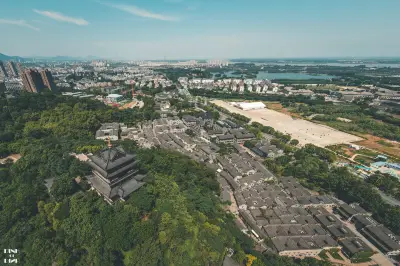
Entering the gate, Wanghai Tower immediately catches the eye; the scenic area is built around the tower as its center. If reconstructed to its original dimensions, this tower truly deserves the title "First Tower of Jianghuai." The tower is over 30 meters tall, in Song Dynasty architectural style, with a three-story ringed corridor on the exterior. The main colors are chestnut and grayish-blue, giving it an antique feel, though the whole structure looks a bit too brand new. It is said that the reconstruction plan for Wanghai Tower was designed by Professor Du Baoshun, the designer of one of China's four famous towers—Nanjing Yuejiang Tower—after six months and three revisions. Both Yuejiang Tower and Wanghai Tower imply gazing at rivers and seas.
The Stele Garden lies hidden in a bamboo grove, with several stone steles lined along the path, including works by famous masters such as Zheng Banqiao and Jiang Chunlin. The calligraphy on these steles varies in style—some are simple and dignified, others elegant and free. But for us, we only look at their forms. Attractions like stele corridors and stele forests are niche. Although many scenic spots have such features, few people truly stop to appreciate them.
Beside Wanghai Tower, there is a large carved map of the ancient city layout, showing the approximate scope of old Taizhou, which appears quite prosperous.
A section of the city wall remains, with an aged appearance—unknown whether it was relocated or restored to its old form. One part is covered with ivy; if it were a bit later, when the ivy leaves turn red, it would be truly beautiful. Some group members loved it, striking various poses for photos by the wall.
Dragging our feet, we finally reached Wanghai Tower. We didn't rush to enter; the guide led us to Fengcheng River beside the tower. The river is wide here, with many boats moored along the bank. In peak tourist season, visitors probably board boats here to head to the next attraction.
Entering Wanghai Tower, the lobby has an introduction to the tower. One advantage of having a guide is not having to read the text yourself—the guide naturally explains. It turns out that Taizhou was once called Hailing, and in the past, standing on Wanghai Tower one could truly see a vast ocean. Now the sea has receded far, and all of Taizhou is no longer coastal, but the name Wanghai Tower has been retained. Although you can no longer see the sea from Wanghai Tower, you can see Fengcheng River, which is a small compensation.
Ascending the tower for a distant view is the highlight of the Wanghai Tower scenic area. After walking such a long way from the entrance, I felt it was worth it just for this moment. Outside the tower lies Fengcheng River, with bright yellow sightseeing boats resting quietly by the shore—seemingly fewer than before, probably because some tourists have boarded.
Fengcheng River is calm, lying quietly beside Wanghai Tower. This river can be called the mother river of Taizhou, holding an extraordinary place in the hearts of the locals. For those of us who grew up drinking the Yangtze River, Fengcheng River is not very wide, but it has its own charm.
On the opposite bank is Fengcheng River Peach Garden, and next to it is Plum Garden. The architecture is very consistent with Wanghai Tower's style—perhaps the designers considered style consistency from the start. In spring, the banks of Fengcheng River should be even more beautiful. Further away are high-rise buildings, the standard feature of a modern city. Though not the scenery we wanted to see, in the city center, it's inevitable.
Two reddish-peaked cream-colored buildings are churches, likely Catholic churches, standing out among the surrounding classical and modern structures.
After finishing the high-altitude view, we still had some time before assembly, so we took the chance to wander from the top floor to the first floor. The tower is not very tall, and its displays are not extensive—there are a few large paintings, an introduction to Wanghai Tower, and photos and information about General Secretary Jiang Zemin's inspection of Jianghai Tower.
Exiting Wanghai Tower, there is also a China Historical and Cultural Famous Tower Exhibition Hall next door. Inside, there was an "Old Trades Photography Exhibition," but we didn't have time to appreciate these old trades of Taizhou in detail.
After gathering downstairs, we headed to Hui Lan Stream on the other side. This is a natural scenic spot with clear, calm water, lush vegetation, and piled rockeries.
Walking forward from Hui Lan Stream, there is a bronze statue of Fan Zhongyan. He is dressed in wide robes and long sleeves, gazing straight ahead with a thoughtful expression, his brow slightly furrowed. I wonder if this great minister of the Song Dynasty was "worrying about the world's troubles before the world does."
Behind the statue is the Wenhui Hall, five bays wide, in an antique architectural style. I can't quite tell whether it has a flush gable roof or a hip-and-gable roof. Inside, tables and chairs are set up—perhaps some ancient-style activities are held here sometimes.
Beside Wenhui Hall is a stone called the "Four Tai Stone." On its four sides are carved four characters of "Tai" (泰), each selected from the calligraphy of four successive Chinese leaders: Mao Zedong's character is in the top center, the eastern side bears Deng Xiaoping's, the western side Jiang Zemin's, and the front side Hu Jintao's.
The Five Phases Tree is quite peculiar. From the base, the tree splits into five branches, forming a circle. The central branch is slightly thicker, while the surrounding ones vary in thickness but are roughly similar—very interesting.
The Five Phases Tree and the Four Tai Stone