Fengcheng River, a Pleasant Boat Ride in the Autumn Breeze
★ Travel Location: Taizhou Fengcheng River
Although we envied the boats below when we stood on Wanghai Tower, we never expected that our cheap tour fee actually included a boat ride on Fengcheng River. So when we gathered at the dock, my companions and I were very happy.
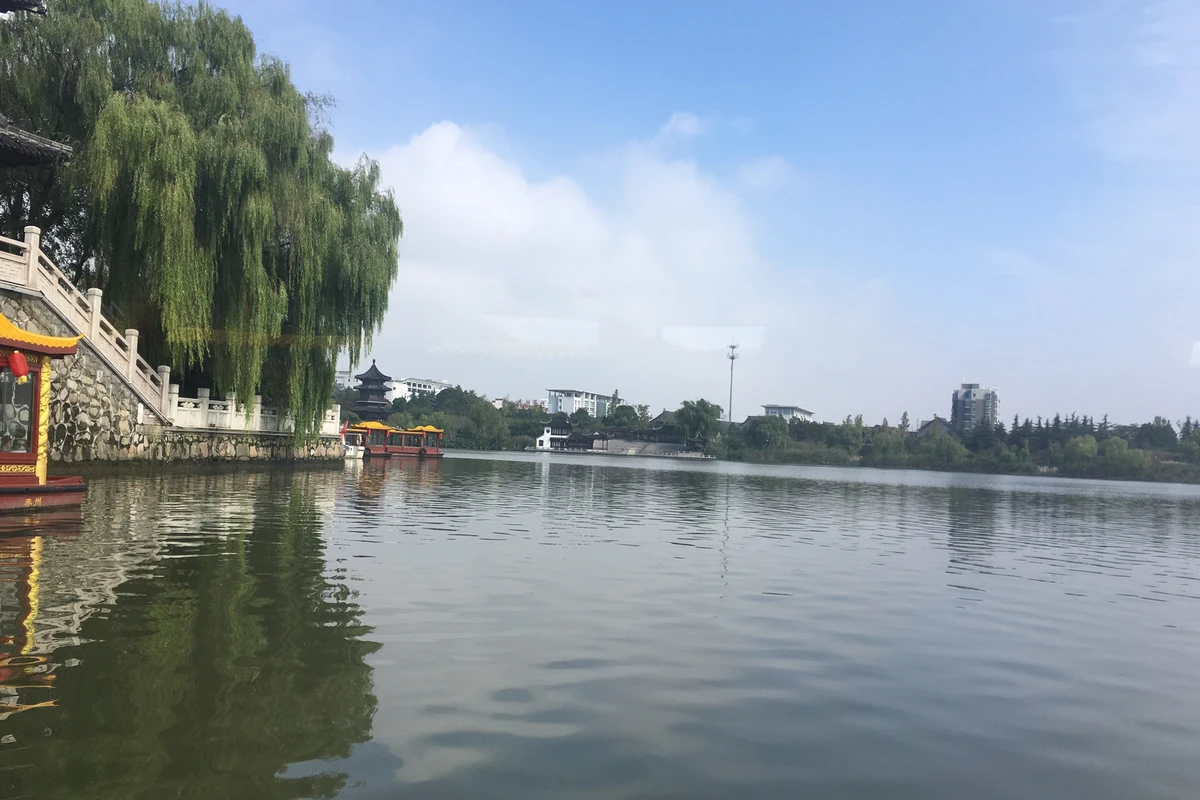
The boats were all bright yellow, a color that shone brilliantly in the sunlight. In feudal dynasties, commoners like us could not use such yellow.
Our group exactly filled one boat, with plenty of seats, so we happily fluttered like butterflies, now leaning left, now right, constantly swapping positions, capturing all the scenery on both sides of Fengcheng River. The cabin broadcast an introduction, explaining the history of Taizhou and Fengcheng River, as well as the historical relics on both banks.
Fengcheng River is the mother river of Taizhou people and one of the few relatively complete thousand-year-old ancient city rivers still existing in Jiangsu Province. Across the river from Wanghai Tower is Taoyuan, named after Kong Shangren’s creation of "The Peach Blossom Fan" while lodging at Chen’an in Taizhou. Nearby are Meiyuan and Liuyuan, forming the famous "Three Villages of Opera Culture" along a line. Taoyuan, needless to say, is about opera, though not necessarily Kunqu. Meiyuan focuses on drama, while Liuyuan features storytelling, each garden with its own characteristics. Of course, it is not the best season to visit the three gardens now; in spring when peach blossoms are red and willows green, you can enjoy flowers in addition to experiencing opera culture. But after listening to the commentary, I understood that Meiyuan, Taoyuan, and Liuyuan are not primarily known for natural scenery; each has its own origin. Taoyuan commemorates the opera writer Kong Shangren who wrote "The Peach Blossom Fan", Meiyuan commemorates the Peking Opera master Mei Lanfang, and Liuyuan commemorates the storytelling master Liu Jingting. Although the names "Tao" in Taoyuan, "Mei" in Meiyuan, and "Liu" in Liuyuan are for commemorating historical figures, since they include these characters, presumably they will have planted plum blossoms, peach blossoms, and willow trees accordingly.
Speaking of Taizhou, it is said that "the prefecture was established in the Southern Tang and flourished in the Northern Song." Indeed, during the Northern Song, five famous prime ministers served as officials in Taizhou: Yan Shu, Fan Zhongyan, Fu Bi, Han Qi, and Lü Yijian. They are the five distinguished civil officials commemorated by the "Five Prime Ministers Tree" at Wanghai Tower.
The boat first headed west. On the right side was a Wenchang Pavilion, not too grand, but said to have considerable history. However, the building looked very new; the original Wenchang Pavilion had been destroyed, leaving only a high platform foundation, and this one was rebuilt in the new century.
Since the Ming and Qing dynasties, various places built Wenchang palaces, towers, and pavilions to enshrine the Wenchang Emperor, naturally hoping for cultural prosperity. This Wenchang Pavilion in Taizhou is one of the earlier ones in China, founded by Li Xiang, a Confucian instructor of Taizhou, built during the Wanli period of the Ming Dynasty. It was repeatedly destroyed and rebuilt, and during the Qing Dynasty, it was repaired four or five times in the reigns of Qianlong, Jiaqing, Xianfeng, and Guangxu. In the third year of Guangxu, a major renovation was carried out, adding the worship of Cangjie, the legendary inventor of Chinese characters, alongside the Wenchang Emperor. In the 1940s, the Wang Jingwei puppet army demolished the pavilion.
Wenfeng Pagoda, also known as Nanshan Temple Pagoda, is located southeast of Nanshan Lü Temple, separated from Wenchang Pavilion by Wenfeng Road. The reflection of Wenfeng Pagoda was once one of the "Eight Scenes of Hailing," and because it fell over Feng Pond like a writing brush, it was called "Fengchi Biying" (Brush Tip in Phoenix Pond). Now Feng Pond is gone, and Wenfeng Pagoda was also dismantled by a factory during the Cultural Revolution. It was not until the beginning of this century that Nanshan Temple and Wenfeng Pagoda were rebuilt. The current Wenfeng Pagoda has seven stories above ground and one underground crypt, with a height of 56 meters, possibly larger than the original.
The rebuilt Wenchang Pavilion and Wenfeng Pagoda stand on the banks of Fengcheng River, becoming part of the Fengcheng River scenic area. Further away is the Taizhou TV Station.
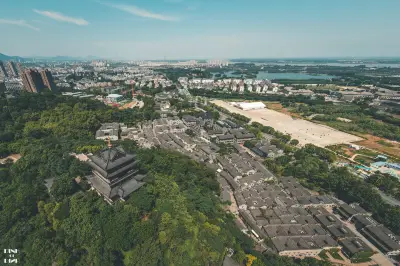
Both sides of Fengcheng River are densely wooded, and the buildings on the banks are in a unified style with Wanghai Tower, all in antique style with upturned eaves, dark tiles, and white walls, but all looking very new, probably built in recent years.
Several bridges on the river are also interesting, each with different shapes, arched or flat. Speaking of Taizhou's water area, it truly rivals the famous water town Suzhou, so naturally there are many bridges. However, Suzhou retains many ancient bridges, while here, though the bridges imitate ancient styles, both bricks and railings are brand new.
The scenery was like this all along. One of my companions really enjoyed this way of touring, as it saved walking, sitting on the seat listening to the commentary and feeling the river breeze — a very pleasant arrangement.
This tour was quite long; it didn't just last twenty or thirty minutes. It even went to Pozi Street, where we saw a distinctive covered bridge. Beside the river was a bustling commercial district, as well as Tianzi River Park.
On the return, we didn't dock back at Wanghai Tower; I'm not sure if it was the Meiyuan or Taoyuan dock. After getting off, we followed the tour guide for a short walk and arrived at Taizhou Old Street.