Jiangsu Travel | Highlights of a Short Holiday Route
Spent a relaxed weekend in the low-key Jiangsu city of Taizhou, loving the slow pace of this city. This comfort is shown in every aspect, even in the architecture, making it very suitable for a weekend trip from Jiangsu, Zhejiang, and Shanghai.
Woke up at 5:30 in the morning, washed up, and had breakfast.
First stop: Nantong Forest Wildlife Park, which has a walking area and a self-driving area. In the self-driving area, you can drive your own car in, and there are some spots where you can get out to interact with animals. For example, at the first stop, we reach the llama area. These animals are completely free-range, wandering freely around the park. When they see visitors arriving, they swarm and chase the cars, begging for food.
Tip: In the driving tour area, you can choose to take a free animal-shaped mini train or drive your own car (requires an additional ticket for the self-driving vehicle). The route is the same for both. Compared to the train, the advantage of driving yourself is that you can stop at designated spots to look.
The park sells carrots that you can buy to feed them, or you can bring some carrots from home.
The most interesting are the brown bears: when they saw us coming, they immediately stood up and waved at us, sometimes making begging gestures. They also like carrots, and apples are fine too.
Of course, all animals in the predator area are kept in enclosures, and visitors can only get off the vehicle after reaching the designated area.
The park houses over 300 representative rare animal species from around the world, nearly 20,000 wild animals, making it one of the larger wildlife parks in the Yangtze River Delta.
The King Tribe is the core exhibition area of the vehicle route, simulating the natural ecological environment of the wild based on animal habits.
Here you can find black bears, brown bears, wolves, the national first-class protected animal Siberian tiger, and rare white lions, among other fierce animals.
You can stop here to watch scenes of natural animal behavior, such as tigers diving into water, brown bears catching fish, and black bears climbing trees.
After saying goodbye to the Wind and Grass Meadow, the next stop is the Peruvian Plateau. Peru is the birthplace of the Inca civilization, and Peruvian culture mainly originates from Indian and Spanish traditions but is also influenced by African, Asian, and European groups. Here live the internet-famous divine beasts—alpacas.
Of course, the park also has our national treasure pandas: the twin panda siblings Xinghui and Xingfan.
It felt like returning to a colorful childhood playground, free and joyful, leaving with contentment.
Full-price ticket: 180 yuan/person
Discounted ticket: 90 yuan/person
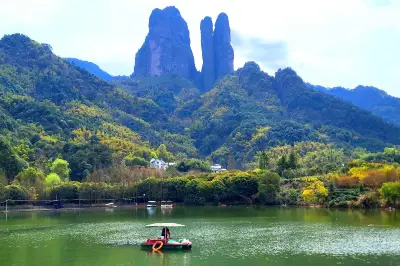
Nantong Langshan Scenic Area (4A national scenic area) is located on the north bank of the Yangtze River, six kilometers south of Nantong city. It consists of five mountains: Junshan, Jianshan, Langshan, Ma'anshan, and Huangni Mountain. With a long history and beautiful scenery, many literati throughout the ages have left inscriptions here. Through the changes of time, there are many historical sites, earning it the reputation of "natural water and stone bonsai."
Attractions include Zilang Zen Temple, Zhiyun Pagoda Courtyard, Luo Binwang's Tomb, General Jin Ying's Tomb, Liu Mingfang's Tomb, Zi Yayu's Tomb, Shen Shou's Tomb, Meilin Chunxiao, Dragon Claw Garden, Yu Tower, and Junshan Observatory.
Anyone who has been to Jiangsu knows that there are many places called "mountains" in Jiangsu, but few are memorable. For example, Langshan in Nantong is the first of the eight famous Buddhist mountains in China, also known as "the number one mountain south of the Yangtze River." In fact, Langshan is only 109 meters above sea level, which is negligible compared to the great rivers and mountains of the motherland. But climbing Langshan still gives a sense of looking down at all other mountains, overlooking the modern cityscape and the sea merging with the sky—a wonderful feeling.
Langshan has no wolves ("lang" in Chinese), but it has numerous cultural relics and historical sites. The entire Langshan Scenic Area consists of Junshan, Langshan, Jianshan, Ma'anshan, and Huangni Mountain. Langshan is the head of the five mountains, and the other four surround it like stars around the moon, standing majestically by the river. The mountains are beautiful, clear, and natural, making it a must-visit for tourists in Nantong and also a city park for locals.
Climb Langshan and look afar at the river and sea city. Looking back at the ginkgo tree at the entrance, which is over 500 years old, with autumn wind blowing and ginkgo leaves falling, there is a sense of worldly reincarnation and seeing through vicissitudes. The human heart is originally untainted; when the mind is still, it becomes clear naturally.
Antique charm—Qintong Ancient Town
Don't say flowers are splendid south of the Yangtze River; Qintong's watery country surpasses Jiangnan.
Two things impressed me deeply in this antique ancient town: first, the green bricks, small tiles, and quiet courtyards. Located at the junction of Nantong, Yancheng, and Taizhou, it was once said that "a dog's bark can be heard in three counties." The area is interlaced with rivers and moist climate.
The town is surrounded by water on all sides, with sparkling waves and beautiful environment, known as "the pearl of the watery region." Qintong is rich in rice, cotton, fish, shrimp, and crabs, truly a land of fish and rice.
Except for the main street entrance, the crowd of people coming and going in the town is not large. The courtyards are small and exquisitely crafted, with bricks and tiles embodying the essence of traditional architecture. There is a strong scholarly atmosphere,沉淀着丰厚的文化底蕴。A calm and peaceful life flows through these narrow alleys, and the sesame cakes from afar are a nostalgic memory you can take away.
What our ancestors left us is not only a good family tradition but also the precious spiritual wealth of "loving the country and family, being thrifty and honest," influencing generations to come.
The second is the old locust tree. It grows tall and dense, with branches like twisting dragons, its leaves clustered tightly blocking the sun, leaving a cool shade. Imagining the scene when the locust flowers bloom, it feels like I can come again.
Water Paradise—Qinhu National Wetland Park
Ten miles of Qinhu Lake, autumn scenery picturesque, Taizhou's happy water paradise.
Taizhou's slow life starts from Ten Miles Qinhu Lake. Qinhu Lake, also known as Magpie Lake, gets its name from its shape resembling a magpie spreading its wings to fly. Qinhu Lake has a network of rivers and ponds, with nine main rivers converging into the lake from all directions, forming the strange landscape of "nine dragons paying homage to the throne."
Take a painted boat from the visitor center to the wetland park. On the way, you pass a three-sided pagoda, under which is the ancient Shousheng Temple built in the Song Dynasty, over 700 years old. It was one of the fourteen major Buddhist monasteries in Taizhou.
Take a hand-rowed boat through the waterways of Qinhu Lake, having intimate contact with the clear water and blue sky. Reeds and grasses are lush on both sides, the air is fresh, full of the unique natural and folk customs of the Lixiahe region.
A few white-walled, black-tiled houses, some vegetable gardens and rice fields, recreate the simple charm of the water village. The most beautiful season is before the rice harvest, which is great for photography.
The world-famous homeland of the Pere David's deer (milu). On the deer observation platform, you can enjoy the original ecological herd of milu.
Qinhu Wetland Science Museum has three floors. The first floor's theme is "Tracing Qinhu," with eight exhibition areas: Water Birth of Qinhu, Bird Watching Paradise, Hometown of Milu, Green Shadow Creatures, Qinhu Night, Footprint Starry Sky, Qinhu Rhyme, and Immersive Qinhu. The second floor's theme is "Exploring the Origin," with exhibition areas like Exploring Wonders, Wetland Galaxy, Qinhu Boat Gathering, Qinhu Bricks and Tiles, Crisis and Recovery, Kidney of the Earth, and Eco-Garden, introducing Qinhu's geographical location, local cultural features, and customs, showcasing and explaining the role of wetlands.
If time permits, you can also visit the Wetland Adventure Park, Military Sports Park, soak in Sanyuan Hot Springs, and experience the slow life of Taizhou's "water wraps skin."
Emerald Wonderland—Lizhong Water Forest Park
Taizhou Xinghua, Emerald Wonderland, Water Forest Fairyland.
This year I have a special fate with forests. From summer to autumn, I have photographed forests about three times. Although sunshine creates dreamy light and shadow in the forest, the drizzly rain also makes it enchanting.
At this time, Lizhong Water Forest Park is gradually entering the off-season, with few tourists, but I especially like this tranquility. The colors are gradually becoming richer. The park is planted with 100,000 metasequoia and pond cypress trees, tall and dense, full of vitality. According to the local guide, the forest stock volume has reached 15,000 cubic meters, and it increases by 12% annually.
The lake surface in front is as smooth as a mirror, reflections dancing, light and shadow flowing. The trees on both sides have different postures, so they have been given many vivid and appropriate names, such as "Hero Forest," "Confused Forest," etc.
Must-experience in the water forest: Mist Forest Fantasy
About 500 meters from the entrance, there is a mist forest performance area. There are six shows a day, on the hour. The last show is at 3:00 PM. At the scheduled time, artificial fog is released in the forest, dreamlike, a must-photo spot for fairies. The mist lasts about 10 minutes.
Charming Ancient Town—Huai Opera Town
Jianhu · Huai Opera Town, Jianhu "has drama"
The Jianhu Huai Opera Town is being built with archways, ancient bridges, green bricks and black tiles, plank roads and flowing water, performance squares and stages. Every water, soil, grass, tree, brick, tile, person, and thing shows boundless charm.
After walking through the town's archway, on the south side is the Art Center transformed from an old grain depot. In the exhibition hall on the first floor, every step is linked to Huai opera costumes.
Walking west along the street, there are people singing Huai opera on the square, people singing Huai songs in the alleys, rehearsal rooms for Huai opera enthusiasts, sales of Huai opera instruments, and studios of famous Huai opera artists. Everyone who comes to the town feels the rich flavor of Huai, the talent of Huai, and Huai tunes everywhere. Following the principle of unchanged street fabric and architectural style, the ancient Shazhuang Street and old houses have been restored "repairing the old as old." The Dragon King Temple, Zhuangbian Ancient Ferry, Guangyu Lane, and Pan Family Ancestral Hall all reflect the shadow of Shazhuang's history and culture.
Among the "Nine Dragons and Nine Workshops," the traditional craftsmanship and folk commerce of Shazhuang's farming era have been preserved and developed. Unique traditional shops decorate the newly developed old street, also showing modern cultural creativity.
Dengying Pavilion is very beautiful. The garden design is quite lively, with layers of rockeries and waterfalls. The surrounding greenery is also well arranged. Going into the rockery feels like entering a water curtain cave.
Yancheng's "Eight Big Bowls"—the nostalgic taste of Yancheng people's hometown.
Characterized by half meat, half vegetable, healthy and nutritious, they are truly delicious, with perfect color, aroma, and taste, suitable for friends who first come to Yancheng.
The exterior environment of the restaurant is antique, with pavilions, terraces, and towers, alleys with bricks and tiles, pond and flowing water, away from the hustle and bustle of the city. Inside, there is an open kitchen, where you can see the dishes and order on the spot, cooked immediately. There are both seats in the main hall and relatively quiet private rooms.
Leaning on the railing, remembering Jiangnan, feeling lost. Looking at the setting sun in Jiangnan, feeling content. Dreaming of Jiangnan in the wind, feeling ethereal. Picking up the fragrance and sending it to Jiangnan, feeling free.
Traveling through the green mountains and clear waters of the south, I can better feel the gifts of nature: seeing the mountains as "empty mountains after a fresh rain," seeing the water as "sitting and watching when clouds rise."