Mid-Autumn Festival, an Encounter with the Port Carved Building
This year, the Mid-Autumn Festival and National Day have fortunately coincided again. As a deeply socially anxious person, thinking of the crowded scenes outside, I couldn’t help but break out in a cold sweat. I decisively remembered the 4A tourist scenic area near my home. It has been a scenic spot for over a decade, but I had never visited it. I decided to take a tour during this holiday.
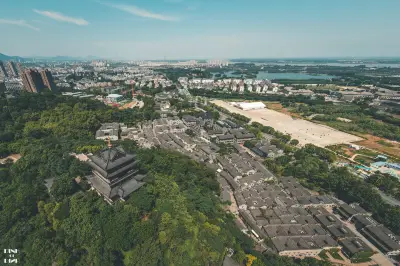
There are two ancient carved buildings in Jiangsu: one in Dongshan, Suzhou, and the other here in Gaogang, Taizhou. The Gaogang Carved Building was built in the mid-18th century by the Yao family, who came from south of the Yangtze River and were in the timber business. It took over two years from site selection to construction, and was officially completed in the fourth year of the Qianlong reign of the Qing Dynasty (1739). In the late Qing, as the country faced turmoil and the Westernization Movement arose, the Yao family, which had prospered for over 160 years, declined due to poor management and sold the property to Li Songru, who was in the shipping business. After buying the Yao family compound, Li spent a great deal of money on large-scale renovations and expansions, resulting in the scale we see today. Since Li’s expansion, nearly a hundred years have passed. During this time, it suffered damage and destruction from the War of Resistance against Japan, the War of Liberation, and the Cultural Revolution, leaving it in a dilapidated state. In 2004, the government decided to renovate the Carved Building, restoring it basically to its original appearance.
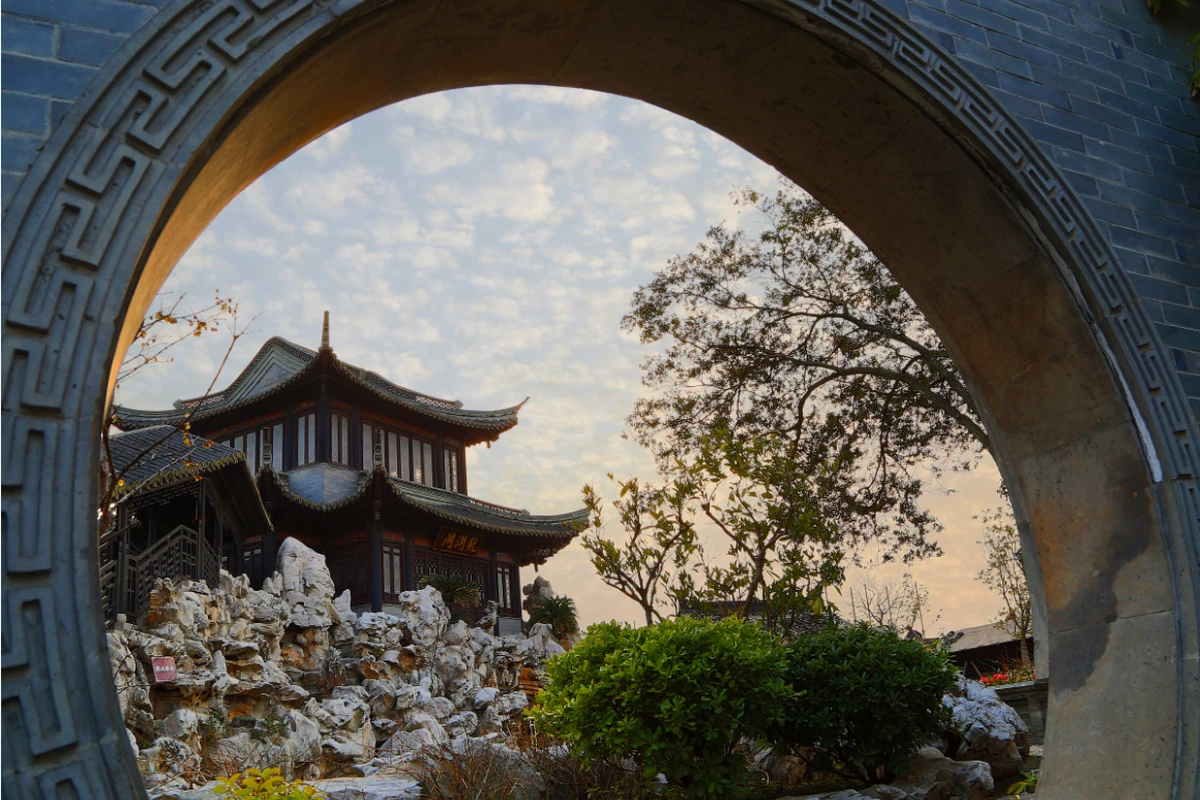
Entering the Port Carved Building, the front consists of three rows of single-story rooms, while the rear is a combination of buildings and gardens. The Carved Building is square-shaped, composed of two main two-story buildings of five rooms each at the front and back, with wing buildings of three rooms on each side. In the middle is a courtyard, surrounded by the buildings. It is also called the “Square Building.” The entire site covers an area of 13,000 square meters. The building has a width of five rooms, with three bright rooms and two dark rooms, and a front porch. On the central eave pillar of the porch, two inverted lions face visitors with joyful expressions. The practice of placing lions under the doorstep is common in ancient residences in Anhui and Zhejiang, but extremely rare in central Jiangsu. The couplet beside the main gate reads: “The sound of the river never ceases as the tide just rises; the clouds part as the moon is full.” This reflects the prosperity and peak success of the building’s owner at the time.
The front hall is spacious and bright. The calligraphy and paintings on the screen doors and the plaques are all works by famous masters. The Eight Immortals table and Taishi chairs displayed in the hall are valuable rosewood furniture. The strip screens between the wall panels on both sides are inlaid with marble, depicting vivid landscapes with mountains and water. Walking around the screen door of the front hall and looking up, you see the most exquisite feature of the Carved Building: various types of carvings.
Today we share the carvings on the north facade. At the bottom of the north facade is the north gate of the Carved Building. In the center of the courtyard inside the north gate, a carved gate tower with double eaves is built. Inside the gate, a bat holds a string of copper coins in its mouth. On the lower right side of the gate, a qilin looks back. Outside the gate, there are four more bats. Can you see them? These four bats fly toward the gate tower from nearby, creating an auspicious scene of “Five Blessings Arriving at the Door.” “Fu” (blessing) is represented by bats, “five blessings” by five bats, “lin” (arriving) by the qilin, and “qian” (front) by the string of coins. This is the wood carving piece “Five Blessings Arriving at the Door” created by Taizhou carvers!
Looking to the left, a bat holds something in its mouth. Below, a vine bears two large melons, and there is a large crab. This means “Blessings as Vast as the Eastern Sea.” “Fu” is the bat, “ru” (as) is the ruyi in the bat’s mouth, “dong” (east) is represented by the two winter melons on the vine, thus expressing “Blessings as Vast as the Eastern Sea.”
“Five Blessings Arriving at the Door” and “Blessings as Vast as the Eastern Sea” are both blessings that ancient people hoped for. Besides blessings, the wood carvings of the Carved Building also hide emolument. Look at this set of patterns on the left: there are many deer with various poses, beautifully carved. Some are running, some leaping, very lifelike. Let’s count them: exactly ten, no more, no less. Ten deer is homophonous with “shilu” (food and emolument), implying “enjoying the imperial stipend,” equivalent to the salary that the state now pays to civil servants—eating from the state’s rice bowl. This shows that since ancient times, being an official and eating from the imperial treasury has always been a desirable thing in people’s hearts.
After seeing the deer here, look at the sheep over there. Amid the undulating peaks and under the branches of pines and willows, six goats are leisurely at ease, all facing the word “sun” in the sky. Here we see not three but six goats, which carries the meaning of both “Three Yangs Bringing Prosperity” and “Everything Going Smoothly.”
I’ve written quite a lot, enough for you to digest slowly. I look forward to your visit to the Port Carved Building.