Impression of Cháixū: The Port Carved Tower in Winter
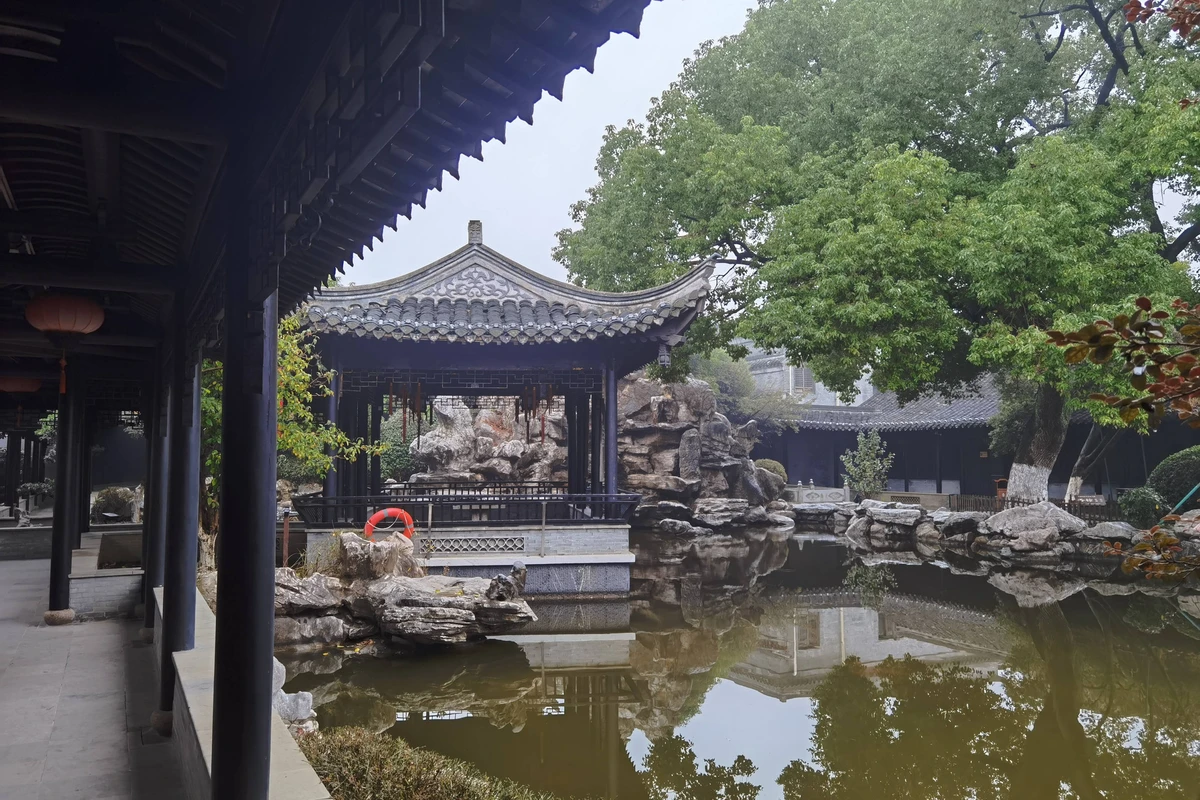
On an early winter morning, after the rain, mist swirled. After breakfast, I had nothing to do but take a stroll through the Port Carved Tower scenic area, to aid digestion while also enjoying a quiet moment in the garden. The fast pace of work and life makes us forget what life is really like.
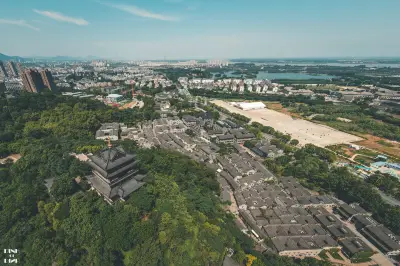
The Port Carved Tower scenic area was completed in the fourth year of the Qianlong reign (1739), nearly 300 years ago. It has gone through the Qing Dynasty, the Republic of China, and the new China. The building is five bays wide, with three bright rooms and two dark rooms, and a front covered corridor. On the two eave pillars in the middle of the corridor, there are two inverted stone lions. One holds a small lion, representing offspring, and the other represents power. In our Jiangsu region, there is a saying: 'Touch the lion's head, you'll never worry about food or drink; touch the lion's tail, you'll have smooth winds and smooth waters; from head to tail, wealth will flow like water.' The couplet on the main gate reads: 'The river's sound never ceases as the tide begins to rise; the cloud curtain just opens as the moon is full.' This reflects how the building's original owner was at the height of his career and prosperity.
The front hall is spacious and bright, furnished with an Eight Immortals table and a grand master's chair, both made of珍贵的 rosewood (Siam rosewood). The chair backs are inlaid with marble naturally selected by the building's owner, and from a distance, they look like ink wash paintings. Above hangs a plaque inscribed with the characters '云水襟怀' (meaning 'a mind as broad as clouds and water'), written by the Chinese calligraphy master Yu Tianchi. Below the plaque is a piece of calligraphy featuring bamboo in the center. Seeing this piece, one might feel it looks familiar and inevitably think of the words '难得糊涂' (meaning 'It's hard to be foolish'). During the Qianlong reign of the Qing Dynasty, Mr. Zheng Banqiao traveled from Yangzhou to Zhejiang to visit a friend, and he had to take the waterway through our place. In today's terms, Mr. Banqiao was a backpacker who loved to travel, but at that time he didn't have much money. He was already somewhat famous, so he thought of exchanging his calligraphy for free accommodation. As we know, scholars, farmers, artisans, and merchants—merchants were ranked last in old society and didn't have high status. The building owner also needed some refined literati elegance to enhance his own facade, so he readily agreed to Mr. Banqiao's request. This story has been passed down locally as a much-told tale.
In the side chamber, there are photos of films and TV series shot on location here, including 'From Slave to General', 'Snowless Winter', and 'Eastern Advance Prelude'.
Passing through the Carved Tower, one walks along the road to Guānlán Gé (Wave-Viewing Pavilion). The pavilion is three stories high, with a street in front and water behind. The water's edge is protected by lake stones. Inside the garden, the pavilion is built on a natural rockery of lake stones. The second floor is surrounded by white stone balustrades carved from Zhenjiang stone, each panel carved with various dragon patterns. Inside the pavilion, the entire ceiling is carved with dragon motifs, a host of dragons soaring together.
Inside the pavilion is a root carving made from a millennium-old ginkgo root dug from deep in the mountains. It was carved over more than a year by a master craftsman from the Dongyang Wood Carving Factory in Zhejiang. The highly skilled artisans discovered nine dragons hidden in the ancient ginkgo root. They carefully removed the excess root around the dragons, revealing nine vivid dragons. The Gaogang area is rich in ginkgo and also a place where dragons hide. This root carving placed in the Tenglong Pavilion (Soaring Dragon Pavilion) of the Carved Tower seems tailor-made and naturally perfect.
After seeing the Nine-Dragon Root Carving, let's go up one more floor to the top of the pavilion. The beams of the pavilion are Ming-style flat beams, painted with various dragon motifs. Adding up all the dragon patterns in the entire pavilion, there are a total of 1,001 dragons, symbolizing a thousand dragons gathering together, with one dragon as the leader, bringing peace to the world and good fortune!
Looking out from Guānlán Gé, some visitors might notice that our building doesn't seem to face south. In fact, the entire Carved Tower is built facing east. There are three reasons for this: first, the building's owner was in the firewood business, and east belongs to wood in the Five Elements; second, in the Five Elements, east is Jia Yi wood, south is Bing Ding fire. Facing east means the five elements generate each other (wood→fire→earth→metal→water→wood), while facing south means they overcome each other (metal→wood→earth→water→fire); third, good feng shui requires a front facing water and a back resting on a support. The first support of our Carved Tower is the rockery of Guānlán Gé, and the second is the thousand-mile Yangtze River embankment. The former embankment was to the west, so the Carved Tower sits in the west facing east, thus having a 'great backing mountain'.