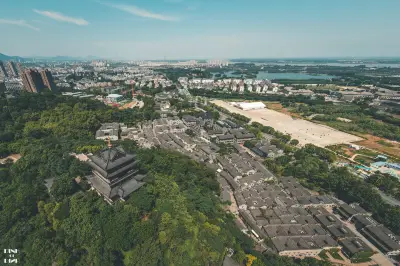
Having Morning Tea in Taizhou
When it comes to morning tea, we often divide it into two major schools: the Lingnan morning tea represented by Guangzhou and Hong Kong, and the Jiangnan morning tea. Among Jiangnan morning tea, people often talk more about Yangzhou morning tea. But there is actually another place with a very rich morning tea culture – the city of Taizhou.
Taizhou is located in the central part of Jiangsu Province, historically known as Hailing. It borders Yangzhou. Perhaps influenced by Yangzhou, the morning tea culture here is thriving. During our two days in Taizhou, when we went for morning tea, we encountered long queues – not the kind of trendy queues full of outsiders, but genuinely filled with locals practicing their morning lifestyle of "skin-wrapping-water" (enjoying tea and snacks). It is said that since the Qing Dynasty, as a necessary passage on the Grand Canal, Taizhou was a prosperous commercial hub with merchants gathering. There were nearly 3,000 grain firms, oil mills, and warehouses, and it was also a gathering place for salt merchants. Consequently, small tea houses that served both clear tea and dim sum gradually became ideal places for businessmen to negotiate deals and exchange information.
Today in Taizhou, savoring morning tea is a lifestyle, and sharing it with friends is a kind of happiness. So that morning, we went to Wanghai Yaju on Wuyi Road for morning tea, and not surprisingly, there was a long queue. This tea house not only has great food but also a beautiful environment.
The tea house was formerly the famous Fan Family Garden. The style and ancient charm of Ming and Qing Dynasty mansions are perfectly preserved here. The high walls and deep courtyards shut out the noise and clamor of the outside world, leaving only the tranquility and peace of time.
The elegant environment further whetted our appetites. After waiting in line for nearly 40 minutes, we finally got a table for four on the courtyard cloister.
Opening the menu, I wondered: What to order? I had heard that Taizhou morning tea, which developed since the Qing Dynasty, gradually took a fixed form, with the so-called "one tea, three dim sum, one noodle" principle. "One tea" does not simply mean tea water; it refers to a cup of tea paired with a serving of scalded shredded dried tofu, commonly known as the "tea starter". "Three dim sum" refers to steamed buns, steamed dumplings, and siu mai. "One noodle" is fish broth noodles. After some deliberation, I ordered scalded shredded dried tofu, steamed buns, siu mai, lard cake, the famous Zhenjiang jellied pork, dry-stirred noodles, and fish broth wontons.
Having lived in Shanghai for many years, I had eaten a lot of these Jiangnan dim sum, so some items like siu mai and xiaolongbao were rather ordinary. But the scalded shredded dried tofu was amazing. Unlike the boiled shredded dried tofu in Huaiyang cuisine, Taizhou's version is smooth, tender, and delicious, rightly called the "soul" of Taizhou morning tea. This dish was recorded in Qing Dynasty Yuan Mei's "Suiyuan Food List". The book simply states: "Cut the dried tofu into extremely fine shreds, mix with shrimp roe and shrimp oil (soy sauce)." However, to prepare this "soul" dish well requires considerable skill. After returning home, I looked up the book and realized that making scalded shredded dried tofu first tests the chef's knife skills. A piece of dried tofu must be horizontally sliced into more than 20 layers, then cut diagonally into fine shreds. This horizontal slicing technique is called "piao" by the Taizhou people. Only when the "piao" results in even thickness can it be considered qualified. Secondly, the scalding process is also particular. Taizhou uses hot alkaline water for scalding; the ratio of water to alkali and the duration of soaking are very delicate, requiring consideration of temperature effects. If too long, the shreds become mushy with no texture; if too short, they are too hard and not right.
Another dish that left me endlessly reminiscing was the dry-stirred noodles. The rich aroma of lard, the fragrant scallion, and the finely chopped pickled mustard greens and minced meat danced on my tongue. One mouthful brought great satisfaction. Then a spoonful of fish broth wontons – ah! It was an indescribable feast for the taste buds!
Pots of warm tea, plates of steaming dim sum – amidst the ritual of morning tea, a beautiful day begins!
Then go for a boat ride at Qinhu Wetland, stroll through Taizhou Old Street in the evening, and grab dinner there.
I really hope to visit the old towns of Jiangnan in mild seasons. Here, culture blends with the hustle and bustle of daily life, beautiful scenery coexists with tradition, and a thousand years of heritage bring joy to both body and mind.