This City Is Not Big, but It Overflows with All Kinds of Earthly Happiness
Over 700 years ago, Marco Polo visited Taizhou and praised, 'This city is not big, but it overflows with all kinds of earthly happiness.' A few years ago, I came across Marco Polo's seemingly casual yet profoundly complimentary description of this city, which sparked my impulse to visit. Moreover, Taizhou's renowned morning tea tempted me to set off in the midst of spring's vibrant bloom.
There is a direct high-speed rail from Hangzhou to Taizhou, but I chose to transfer in Nanjing for two reasons: saving about 40 yuan on the ticket and about an hour of travel time. Some might say, 'But doesn't the transfer time from Nanjing South to Nanjing Station also take time?' I hadn't been to Nanjing for a long time, so the four-hour layover gave me a chance to take a bus tour around Nanjing.
I arrived at Nanjing South around 8:30 and took a bus to Nanjing Station. The buildings flashing by outside the window all exuded the solemn grandeur of this 'ancient capital of six dynasties' and 'metropolis of ten dynasties.'
Seeing this shop on the road, I quickly jumped off the bus. In Nanjing, you must try the beef pot stickers.
Seeing that there was still plenty of time, I insisted on citywalking with my luggage, taking in the street views and casually checking out Nanjing's real estate situation.
As I wandered, I came upon this cherry blossom avenue crowded with people. I had arrived at Xuanwu Lake Scenic Area.
Jiming Temple is located on this avenue, also known as Ancient Jiming Temple. It was first built in the first year of Yongkang of the Western Jin Dynasty (300 AD) and has a history of over 1,700 years. It is one of the oldest Buddhist temples and royal temples in Nanjing, with enduring incense worship. Since ancient times, it has been known as the 'First Temple of the Southern Dynasties.'
Going deeper, I arrived at the shore of Xuanwu Lake.
I took a high-speed train from Nanjing Station and arrived in Taizhou shortly before 3:00 PM.
The hotel I booked on Ctrip is located on Gulou South Road, Hailing District, Taizhou City, adjacent to the Fengcheng River Scenic Area, with many attractions within a few hundred meters.
After dropping off my luggage, I started checking in at the scenic spots closest to the hotel.
Wanghai Tower is a landmark attraction in Taizhou, located within the Fengcheng River Scenic Area. Originally built in the second year of Shaoding of the Southern Song Dynasty, it is known as the 'First Tower in Jianghuai.'
This tower has been repeatedly destroyed and rebuilt, mostly destroyed by war and rebuilt in prosperous times. It adopts the architectural style of the Song Dynasty, with a three-story circular corridor on the exterior, built on a high stone platform. The floor plan is a cross-folded square shape, with a three-story double-eave cross-shaped roof, and a middle floor with a corridor and flat seat. The main colors are chestnut shell and blue-gray.
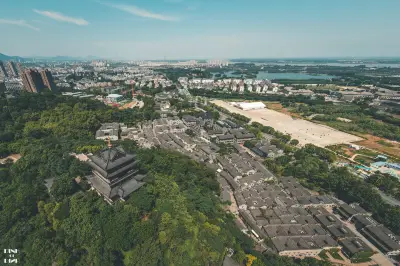
Climbing to the top of Wanghai Tower, I had a 360-degree panoramic view.
To the west of Wanghai Tower is a Wenhui Hall. According to historical records, it was originally built by Teng Zijing in the Northern Song Dynasty. It was a salon for 'making friends through literature' and a lecture hall for spreading Confucianism. The hall displays historical materials of five people who served as officials in Taizhou during the Northern Song Dynasty and later were promoted to prime ministers: Yan Shu, Fan Zhongyan, Fu Bi, Han Qi, and Lü Yijian. In front of the hall, there are 'Five Prime Ministers Trees,' and a bronze statue of Fan Zhongyan by Wu Weishan, president of the Chinese Academy of Sculpture.
From the Wanghai Tower scenic area, I looked across the Fengcheng River at the spring scenery on the opposite bank.
The scenic area also contains the thousand-year-old city site, which is the only remaining section of the old city wall in Taizhou.
The ground carving is made of brass, shaped like a sand table, immediately evoking the bustling scene of ancient Taizhou.
The scenic area has a lush bamboo forest, not only beautiful but also hiding many historical traces. You will see oddly shaped stones inscribed with selected poems praising Taizhou from the Five Dynasties to the present day.
Taizhou has over 2,000 years of history and has produced many celebrities. Some were born here, some grew up here, some served as officials here, and some lived here temporarily, leaving behind countless exquisite poems. Many calligraphers from Taizhou have written these poems with brush and ink, which were then carved onto stones, creating a stele garden with unique personality and artistic value.
From the top of Wanghai Tower, I had already seen this cream-colored church up close, which is the Taizhou Catholic Church.
I strolled along the Fengcheng River towards Taizhou Old Street to find food!
Known as the 'No. 1 Snack Street in Central Jiangsu,' Taizhou Old Street is located at the southeast corner of Taizhou's ancient city, a 600-meter-long Ming and Qing-style pedestrian street along the Fengcheng River.
Passing through the ancient archway into the old cobblestone alleys, the streets are lined with old-fashioned shops, with strings of big red lanterns hanging from the arcades. Various shop signs, plaques, and banners complement each other.
I couldn't resist and tried a plum blossom cake, but I didn't think it was as good as Nanjing's.
I had prepared a Taizhou travel guide a year ago, and the most important motivation for this trip was Taizhou morning tea.
Because it is very close to Yangzhou, Taizhou's morning tea shares the same lineage as Yangzhou morning tea. As the morning tea culture flourished, Taizhou integrated it into the city's culinary名片.
A morning tea session at Guyue Tower is a must for tourists visiting Taizhou.
For morning tea, various steamed buns are usually a must-order. However, since it was dinner time, the buns were leftovers from the morning, so I decisively skipped them. I ordered a serving of boiled dry shredded tofu, and it was indeed authentic! How could one visit Jiangsu without risking death to try pufferfish?! I also had a bowl of fish soup wontons, which had a strong pepper flavor. I still prefer clear soup.
The neighboring Haitang Chun is also a good morning tea shop.
The name 'Fengcheng River' itself has a Jianghuai flavor. Within the old city, over 30 scenic spots are scattered along the Fengcheng River that surrounds the city, becoming even more enchanting at night.
In fact, Taizhou Old Street is located within the Taoyuan Scenic Area of the Fengcheng River Scenic Area. So, just a turn from Guyue Tower, I entered Taoyuan. Taoyuan is a theme park built to commemorate the Qing Dynasty playwright Kong Shangren, who wrote 'The Peach Blossom Fan' in Taizhou.
Across the road from Taoyuan is Mei Garden (Mei Lanfang Memorial Hall), which was already closed.
In the early morning, I paid homage to Nanshan Lü Temple (abbreviated as Nanshan Temple).
Upon entering, I looked up and saw a pagoda. This is the Taizhou Wenfeng Pagoda, also known as Nanshan Temple Pagoda. At sunset, the shadow of Wenfeng Pagoda falls into the Fengchi outside the examination hall, resembling a writing brush, hence the name 'Fengchi Biying,' listed as one of the 'Eight Scenic Spots of Hailing.'
It is said that the original Nanshan Temple Pagoda, south of the Fengcheng River, had three floors and eight sides, a dense-eave brick-wood structure, with bells on the upturned eaves, each sound entering the ear, forming a harmonious whole with the Nanshan Temple.
The newly built Wenfeng Pagoda is about 56 meters high, with a seven-story body and a one-story underground palace of 5.3 meters. The underground palace houses the handprints of 108 eminent monks from around the world and also enshrines a tongue relic of Shakyamuni brought back from Sri Lanka.
Nanshan Temple was first built in the third year of Qianfu of Emperor Xizong of Tang (876 AD) by the monk Tiexinjian, and the court granted it the name 'Huguo Temple.'
The temple sits north and faces south, divided into two axes: main and secondary. On the main axis, from south to north, are the mountain gate, the second hall, and the Mahavira Hall. To the left and right of the main hall are bell and drum towers. Between the halls are side halls and corridor houses, forming three- or four-sided courtyard layouts.
On the secondary axis, there are two halls with five bays each at the front and back, with a larger hall on one side in the middle, along with some auxiliary rooms.
Nanshan Temple only retains the Mahavira Hall and a few attached rooms on the east side. The Mahavira Hall has a hip-and-gable double-eave roof, nanmu golden pillars, with internal and external pillars of equal height. The ridge purlin uses a forked hand, a technique common before the Yuan Dynasty. The dougong is in the Ming style, with a caisson ceiling using grass beams, and colored paintings on the beams and lintels depicting two dragons playing with a pearl, the Tang Sanzang master and disciples on their journey to the West, and animal and plant patterns. The hall is five bays wide and six bays deep, with tile ends and drip tiles decorated with dragon and phoenix patterns. The overall style is mid-Ming, while the roof inherits Tang architectural techniques. Despite a thousand years of wind and frost, it still stands tall with upturned eaves.
Since I passed by, I couldn't let it go. I had a bowl of pork liver noodles for breakfast.
Today's main itinerary is the Port Carved Flower Building, about 20 kilometers from the city center, also known as the 'First Building in Jiangzuo.'
On the way to the bus stop, I saw this steel tower across the middle of the road for the first time. It is the Taizhou Radio and Television Tower, the first cross-road large-scale steel tower in China, hailed as the 'Eiffel Tower of Hailing.'
After an hour and a half bus ride, I arrived at the Port Carved Flower Building Scenic Area in Gaogang District, Taizhou City.
The most famous attraction in the scenic area is undoubtedly the Port Carved Flower Building.
In the fourth year of Qianlong of the Qing Dynasty (1739 AD), a wood merchant from Jiangnan surnamed Yao began building this carved flower building (East Building) at the port. In the early years of the Republic of China, the building was transferred to Li Songru, a local Confucian merchant engaged in Yangtze River shipping. Li expanded the West Building and wing buildings according to the original style over three years and completed the garden project outside the building.
The garden features elegant and delicate pavilions, terraces, towers, and galleries, with winding streams and flowing cups, creating a splendid scene.
This Guanlan Pavilion looks similar to many garden pavilions, but inside it hides a different world.
Follow the corridor and stairs to have a look.
Upon entering, I was dazzled by the carved dragons on the beams above.
Especially this 'Nine Dragons Playing with a Pearl' wood carving, made from ginkgo tree roots. The entire carving is lifelike, with each dragon whisker distinct upon closer inspection.
The garden is filled with rockeries, surrounded by long corridors, with towers hidden and winding paths leading to secluded spots.
I arrived at the true 'First Building in Jiangzuo,' the East Building, the Carved Flower Building. The building is square, with blue brick walls and black tile roofs, consisting of a two-story main building with five bays and three bays of wing buildings on each side.
The interior of the entire building is wooden, filled with carvings in a dazzling array of styles, exquisitely crafted. There are auspicious flowers, birds, insects, fish, animals, figures, and historical stories, making it a treasure of wood carving art.
One of the four residences in the Port Carved Flower Building Scenic Area is the Qi Family Jinshi Mansion, a Ming Dynasty official residence, solemn and grand. It is now the 'Chinese Martial Jinshi Museum,' the only venue in the country dedicated to showcasing martial jinshi culture.
The Cai Shen Temple, City God Temple, and Guan Di Temple in the Port Carved Flower Building Scenic Area are all located on Qingyuan Old Street. This Qingyuan archway is also a triangular archway.
The Cai Shen Temple and the City God Temple are adjacent, jokingly called 'one step, two temples.'
The City God Temple is not large, but it has an elaborate stage built inside.
The Guan Di Temple is across the street from the two temples but closely connected. Since their completion in the second year of Xianping of the Northern Song Dynasty (999 AD), these three temples have enjoyed flourishing incense and widespread fame, becoming an important center of Taoist culture.
Back in the city, the Qiao Garden, often overlooked by the world, possesses the most beautiful form of Jiangnan gardens.
Passing through Shisheng Street, you can reach Qiao Garden.
Qiao Garden is one of the oldest gardens in northern Jiangsu, known as the 'First Garden in Huainan.' It was originally the former residence of Chen Yuan in the Ming Dynasty. During the Wanli period, his grandson, Chen Yingfang, the Grand Master of the Imperial Stud, built a garden adjacent to the residence, taking the meaning of 'I take pleasure in my garden day by day' from Tao Yuanming's 'Returning to Live in the Country,' naming it 'Rishe Garden.' In the early reign of Kangxi of the Qing Dynasty, it was transferred to the Tian family. During the Yongzheng period, it was owned by Gao Fengzhu and renamed 'Sanfeng Garden.' In the ninth year of Xianfeng, Wu Wenxi purchased the garden and renamed it 'Zhe Garden.' Later, it came under the name of Qiao Songnian, the Salt Transport Commissioner of Lianghuai, hence the name 'Qiao Garden,' which has been used to this day.
The ancients preferred to live without meat rather than without bamboo, and this is well reflected here. Passing through the corridor surrounded by green bamboo, you can reach the core of the garden, the Laiqing Pavilion.
The garden is mainly divided into eastern and western parts, separated by a courtyard wall, connected by the Laiqing Pavilion, which offers a 'view of the entire garden.'
The central Jiaoyu Pavilion is surrounded by water on three sides. Sitting here for a moment, the greenery before my eyes is refreshing.
The entire garden consists of buildings, landscapes, flowers, and trees, with ancient cypresses, strange rocks, and the use of flowers and trees to express the changes of the four seasons as its distinctive features.
Approaching Qiao Garden, stepping over the threshold also steps into the world of the past, and this world is the old beauty of Jiangnan.
Liu Garden is a garden built by Taizhou City to commemorate Liu Jingting, the master of storytelling. It is located at Dayu Bay, south of the East City River, at No. 23 Koutai Road in Taizhou city center. It is one of the ancient 'Eight Scenic Spots of Hailing,' known as 'Nanhao Yuchang' (Fishing Songs of the South Moat).
Outside the garden, a willow embankment surrounds it. Inside, willow trees, bamboo forests, osmanthus forests, and magnolia forests intermingle, with winding paths leading to secluded spots, preserving an ancient charm and unique scenery.
Liu Jingting, a master storyteller of humble origins, was active during the turbulent transition between the Ming and Qing dynasties, and his life was full of legends.
Within Liu Garden, there is also the Chinese Storytelling Museum, the only museum in China dedicated to comprehensively showcasing the history and artists of the art of storytelling and评书. It opened in 2016 and combines exhibition, research, and performance functions. The architecture blends Taizhou residential style with the Republic of China style, and its collection covers Liu Jingting's life to the history of modern storytelling.
In fact, Liu Garden and Nanshan Temple are separated only by the Fengcheng River. Standing by the Fengcheng River at the exit of Liu Garden, I could see Wenfeng Pagoda, Wenchang Pavilion, and Wanghai Tower arranged in sequence from near to far.
The Daohe Ancient Quarter is located in the north of Hailing District, Taizhou City, centered on the Daohe River, Caohe River, and Wuxiang block. During the Ming and Qing dynasties, Taizhou became the agricultural product distribution center of the Lixiahe region, with many grain shops, oil mills, and warehouses established along the Daohe and Caohe rivers, forming a 'small bridge, flowing water, and houses' neighborhood. There were eight ancient bridges alone on the Daohe River, creating an urban neighborhood landscape of 'two streets sandwiching one river' (Handong, Hanxi, and Caohe).
In the Daohe Ancient Quarter, there is a modern building, the Construction and Scientific Development Concept Exhibition Hall.
There are 46 traditional residences with certain preservation value in the ancient quarter, and to the west is the former residence of celebrities, 'No. 1, Duo'er Lane.'
The ancient quarter also has a Wuxiang Primary School, where some celebrities studied in the past.
After renovation and revitalization, the ancient quarter once again showcases the charming style of traditional Taizhou residences, with the quietly flowing Daohe River and the old-time scenery of deep alleys, ancient houses, blue bricks, black tiles, and small buildings by the water.
There may be 100 ways to promote Taizhou to the outside world, and each way inevitably includes the business card of Peking Opera master Mei Lanfang.
Mei Lanfang's ancestral home is in Taizhou. He was not only an outstanding modern Peking Opera performer but also a respected social activist. In the 1950s, Mei Lanfang visited Taizhou and found the former residence of his ancestors from four generations ago, which was then located in Bao Ba Village. The current location of Mei Garden is exactly that place. In 1984, to commemorate the 90th anniversary of Mei Lanfang's birth, the people of Taizhou decided to build Mei Garden, officially named Mei Lanfang Park.
The white marble statue of Mei Lanfang facing the main gate is very eye-catching. It was meticulously created by the famous sculptor Liu Kaiqu, with a lifelike expression, elegant and dignified posture, especially the mesmerizing eyes.
The Mei Lanfang Life Exhibition Hall is divided into five exhibition areas: 'Mei Blossoms in China,' 'Mei Fragrance Spreads Worldwide,' 'Mei's Unyielding Spirit,' 'Mei's Virtue Like Jade,' and 'Mei's Roots in Taizhou,' summarizing Mei Lanfang's brilliant life.
Another striking spot in Mei Garden is the large white marble artistic image of Yang Guifei, the character Mei Lanfang played in 'The Legend of Lady Yang.'
This is an antique-style stage, with couplets on both sides: 'Startling Dream, Farewell to the Concubine, the Ultimate Performance of Life and Death; Feigning Madness, Drunkenness, the Eternal Wonder.'
To the west of the stage is the Mei Lanfang Memorial Pavilion, with a five-cornered pyramidal roof shaped like a blooming plum blossom. The pavilion floor plan is a five-cornered plum blossom shape, with flying eaves, pillars, and sitting rails all designed in the shape of plum blossoms. The hanging panels under the eaves form a double plum blossom pattern. Looking up inside the pavilion, there are carvings of five representative works of Mei Lanfang: 'Farewell to My Concubine,' 'Drunken Beauty,' 'Goddess Luo,' 'The Cosmic Blade,' and 'The Commander-in-Chief Mu Guiying.'
Following the slate path west of the plum pavilion, I arrived at the lakeside pavilion, where I saw a painted boat cruising on the river.
Following the garden path, I went to see Mr. Mei's daily necessities and costumes.
Taking advantage of the remaining daylight, I strolled through Taoyuan opposite Mei Garden to see what it looks like during the day.
Qingfeng Pavilion, according to historical records, was built by Zeng Zhiyao, the prefect of Taizhou in the early Northern Song Dynasty. Wang Anshi, during his tenure as a judge in Huainan, visited Taizhou many times and ascended the pavilion several times, composing a poem 'Qingfeng Pavilion.' The rebuilt Qingfeng Pavilion is a Song-style three-story, eight-cornered, double-eave structure about 20 meters high, reflecting Wanghai Tower across the river. Ascending this pavilion, a gentle breeze blows, allowing one to appreciate the legacy of a famous prime minister.
Laifeng Tower, according to historical records, was first built in the fourth year of Hongwu of the Ming Dynasty. The bell is a relic from the Yongning Palace of the Southern Tang. Folklore tells of 'ten brothers carrying a bronze bell together,' also commonly known as the 'Flying Bell.' The current Laifeng Tower is a Song-style octagonal double-eave structure, with a plaque inscribed with the characters 'Sheng Wen Si Da' (Sound Reaches Four Directions) written by the abbot Xingkong of Hanshan Temple in Suzhou. Inside, there is a replica of the Five Dynasties bronze bell from Guangxiao Temple, made by Nanjing Chenguang Group, with a stele recording the bell's origin.
Back on the old street, at the end of the street, I found this century-old intangible cultural heritage grass-stove sesame cake shop. Grass-stove sesame cakes are made from wheat flour as the main ingredient, using red firewood or wheat straw as fuel, and baked on the stove. I took two as my dinner.
With the sesame cakes in my stomach, I walked back from the south of Taoyuan along the Fengcheng River under the sunset.
The miniature arch bridge looked like a model. The distant Wanghai Tower and all the reflections in the water created an artistic conception that can only be expressed in pictures.
Walking west along the Fengcheng River, I arrived at Gulou Road and saw Wenchang Pavilion on the northeast side of Wenchang Bridge. Wenchang Pavilion was built by Li Xiang, a Confucian instructor in Taizhou, in the seventeenth year of Wanli of the Ming Dynasty (1589).
I waited for nightfall, waited for the lights to come on, and saw Wenchang Pavilion under the lights.
Under the night sky, the Fengcheng River lit up with a light show.
I heard that in Taizhou, morning tea shops that close by noon are the ones where people truly have morning tea and are more authentic. So, early in the morning, I went to Fengdeyuan.
I ordered three steamed buns, with soft and fluffy skins. The bun topped with shredded ginger was the signature crab roe bun.
Taking a bite of the crab roe bun, it was slightly sweet and salty with a hint of fishiness. A bit of shredded ginger helped neutralize it.
The wild rice stem bun was fresh and sweet, like eating soft sweet greens. I was hooked by this bun.
The five-ingredient bun is an innovation based on the three-ingredient bun, with main ingredients including ginseng, chicken, pork, bamboo shoots, and shrimp. I felt like I didn't taste any of the ingredients.
Let's go to Taishan Park, the most popular morning exercise spot for Taizhou people. Yes, you read that right, Taishan Park in Taizhou!
Taishan Park is located on the west side of the main urban area of Taizhou, Jiangsu. It is the oldest and largest park in the city. All year round, the park is full of fragrant grass, fallen petals, towering trees, and lush greenery. Every morning, the lawns, lakeshores, and woods are filled with people exercising.
Yue Wumu Shrine stands atop Taishan Hill, sheltered by dense trees, greeting the morning sun and evening glow every day.
Among the 'Eight Scenic Spots of Hailing' in the main urban area of Taizhou, Taishan Park accounts for two: 'West Lake Spring Rain' and 'Ancient Slope Setting Sun.'
The building with double-eave hip-and-gable roof and upturned eaves below is an imitation of the original Hailing Pavilion. The exquisite brick carvings on the building depict the 'Eight Scenic Spots of Hailing,' recreating the historical appearance of the ancient city of Taizhou.
I was originally heading to Guangxiao Temple, but I arrived too early and it wasn't open yet. Unexpectedly, I encountered the Chongru Shrine, dedicated to Wang Gen, the founder of the Taizhou School, right next to the thousand-year-old Guangxiao Temple, which hadn't been on my itinerary.
Wang Gen was a salt worker from the Anfeng Salt Field in Taizhou (now part of Dongtai City) during the Ming Dynasty. He was born in the nineteenth year of Chenghua (1483) and died in the nineteenth year of Jiajing (1540) at the age of 58. He came from a poor family, followed his father to boil salt from a young age, attended a private school for only three or four years, but later studied diligently on his own, becoming a Confucian master and the leader of a philosophical school.
Confucianism advocates that 'the benevolent love others' and requires Confucians to 'take the world as their responsibility.' Throughout history, countless Confucians in ancient China pursued the ideal of 'establishing the heart for heaven and earth, establishing the destiny for the people, continuing the lost teachings of the sages, and establishing peace for all generations.' Wang Gen was one of the outstanding figures.
In the minds of past thinkers, the 'Way' could only be understood and mastered by 'sages,' and ordinary people could never know it. However, Wang Gen equated the 'Way' with 'daily life of the people,' believing that 'the daily life of the people is the Way.' The 'Way' exists in the daily necessities, food, clothing, shelter, and various natural desires of ordinary people, pointing to the satisfaction of the material needs of the common people. He clearly affirmed the realistic rationality and non-deprivation of the people's daily life as an ontological existence.
Against the backdrop of the rising influence of Wang Yangming's philosophy at the time, Wang Gen became a disciple of Wang Yangming, and together with his followers, through academic innovation and various lecture activities, gradually formed the Taizhou School. After Wang Gen's death, his second son Wang Bi continued to preside over the lectures, not only expanding the Taizhou School but also further promoting its academic thought. The Ming Dynasty thinker and writer Li Zhi was a disciple of his school, and Yan Jun, Luo Rufang, Tang Xianzu, and others were second, third, or fourth-generation disciples of Wang Gen.
The Chongru Shrine in Taizhou was first built in the fourth year of Wanli of the Ming Dynasty (1576). The shrine consists of four halls arranged from south to north. The first hall is the main gate, a small tiled house with three bays, similar to an ordinary residence.
The first gate was rebuilt, with a stone plaque reading 'Chongru Shrine' embedded above. Stone drums stand on both sides of the gate, and an eight-character wall is built on each side. The plaque 'Taizhou School Memorial Hall' in front of the gate was personally written by contemporary philosopher Hou Wailu. The three characters 'Chongru Shrine' on the stone plaque are collected from the calligraphy of the great calligrapher Zhao Mengfu. The old-fashioned black-lacquered gate, still in its original style, is adorned with two bronze knocker rings. High thresholds are placed on both sides, each with a white marble drum engraved with a lion playing with a ball pattern. The blue brick walls on the east and west sides are complemented by eight-character walls, simple and solemn.
The second hall is the Liben Hall, three bays wide, with a gable-and-hip roof structure, which underwent major renovation. With the main gate open and the ceremonial gate opened, looking inward from the front door, it appeared quiet, deep, and even somewhat mysterious.
The third hall is the Lexue Hall, a Ming Dynasty building with a raised-beam frame structure. Stone bases in the shape of inverted bowls are placed under the pillars, and the pillar tops have a slight taper. The hall is three bays wide, 10.5 meters, and seven purlins deep, 6.05 meters, with a ridge purlin height of 5.5 meters. After restoration, the original architectural style was maintained.
The fourth hall is the Xianren Hall, which features a newly sculpted half-length bust of Wang Gen and a newly carved marble inscription of Wang Gen's 'Song of Joyful Learning,' along with exhibits of Wang Gen's cultural relics, historical materials, and famous calligraphy and paintings.
Guangxiao Temple, located in Hailing District, Taizhou City, Jiangsu Province, was first built during the Yixi period of the Eastern Jin Dynasty. It was originally named Wanshou Temple. Later, during the Southern Song Dynasty, Emperor Gaozong Zhao Gou ordered the temple to hold a memorial service for the souls of Emperors Huizong and Qinzong, and decreed that it be renamed 'Bao'en Guangxiao Temple.' During the Qianlong period of the Qing Dynasty, it was renamed 'Bao'en Guangxiao Lü Temple.'
The temple includes the Mountain Gate Hall, Heavenly Kings Hall, the Most Auspicious Hall (the only Mahavira Hall in the country named 'Most Auspicious'), and the Sutra Depository.
Guangxiao Temple has three temple treasures: 1. Song Dynasty rubbing of 'Ru Tie,' Lu You's 'Stele Inscription of the Most Auspicious Hall,' and Yuan Dynasty Wang Zhenpeng's 'Portraits of Virtuous Queens and Consorts,' among other paintings and calligraphy. 2. A Southern Tang bronze bell ('Flying Bell'), weighing 2,500 kilograms, one of the four largest bronze bells in Jiangsu Province. 3. The Qianlong edition of the 'Dragon Sutra,' with over 7,000 volumes.
Corresponding to the bronze bell is a drum.
The Qianhua Master of Guangxiao Temple, also known as Master Xinghui, with the courtesy name Bingyi and the style name Huanyun, was the founding patriarch of Guangxiao Temple. He presided over the reconstruction of the Qianhua Ordination Platform, one of the important religious facilities of Guangxiao Temple. Historically, during the ordination period, it attracted thousands of monks to receive precepts here.
Guangxiao Lü Temple is not only a religious sanctuary but also trained many eminent monks. In the early 1930s, Master Changxing, then Secretary-General of the Chinese Buddhist Association, founded the Guangxiao Buddhist Studies Society (Guangxiao Buddhist Academy). Over several years, it trained batches of eminent monks, exerting significant influence in modern Chinese Buddhist history and even in contemporary overseas Chinese Buddhist history. Famous monks such as Nanting, Chengyi, Zhenchan, Xuefan, Yuanzhan, Miaoran, Zili, and Liaozhong all emerged from here to the national and world Buddhist stage.
For a layperson like me, the best part was that behind this solemn and majestic temple lies such an elegant and Zen-filled back garden.
The Jiangsu Salt Tax Museum is located on the bank of the Taizhou City River, north of Guangxiao Temple. It was the site of the historical Taibaijiancha Department and is the only museum in China themed around salt tax culture.
Taizhou is an ancient historical and cultural city born from salt and prospering from taxation. It has always been known for its 'abundance of red millet and salt profits,' making it one of the important birthplaces of China's salt tax culture.
Here, you can deeply understand salt tax resources, salt tax reforms, and the significant contributions of salt tax to the country and society, experiencing the profound heritage of salt tax culture.
On the road, I happened upon the former residence of Zhi Hengrong, located at No. 215 Gulou North Road, Hailing District, Taizhou City. Zhi Hengrong (1849–1915), courtesy name Jiqing, was a native of Dantu County, Zhenjiang Prefecture, Jiangsu Province. He was an important political and cultural figure in the late Qing and early Republic of China. He supported the petitions of reformers, established normal schools, and supported the transformation of a girls' school in Hangzhou into Zhejiang Women's Normal School, demonstrating his open attitude towards educational reform. His actions in Zhejiang showed that he was not conservative but enlightened and diligent, actively promoting educational reform and constitutionalism. Zhi Hengrong's life represents the inheritance and development of Chinese traditional culture and education. His political career and educational reform measures had a profound impact on future generations.
The Academic Examination Hall, also known as 'Yangjun Examination Hall,' is located at the intersection of Wuyi Road and Gulou Road in Taizhou City, Jiangsu Province. It was the place where the Jiangsu Education Commissioner presided over the prefectural examinations. From the Kangxi to Guangxu periods of the Qing Dynasty, the Yangjun Examination Hall was set up in Taizhou, serving as the examination venue for child students from the eight counties of Yangzhou Prefecture to become scholars under the imperial examination system. Because the examinations were always presided over by the provincial education commissioner, it was also called the Academic Examination Hall. Historically, the Academic Examination Hall had a complete architectural structure and grand scale, including the main gate, ceremonial gate, main hall, Sibu Hall, East Tower, West Tower, upper rooms, lower rooms, examination sheds, and Fushen Shrine.
The Academic Examination Hall is a representative ancient building from the late Ming and early Qing dynasties. It is one of the few remaining prefectural examination venues, a tangible witness to China's imperial examination system, and a historical testament to Taizhou's status as an important cultural center in the Jianghuai region.
I only lingered at the entrance and didn't go inside.
Across from the Academic Examination Hall, I bumped into another famous Taizhou morning tea house, Huibinlou (Gulou Branch).
I had lunch here, which was also my last meal in Taizhou.
Gushuiwu Street in Taizhou's old city has an archway on the east side inscribed with 'Gushuiwu Street.' Standing under the archway and looking west, about 500 meters away, is another identical archway. On the inner sides of both archways is the inscription 'Han and Tang Ancient Prefecture, Huaihai Famous Region' by Lin Sanzhi. The street is very clean, with various shops on both sides.
An ancient Ming Dynasty building in Taizhou worth seeing is the Jiangke Jinshi Mansion at No. 112 Shuidong Street, Hailing District, Taizhou City, Jiangsu Province.
It was the residence built by Jiang Ke after he passed the imperial examination and became a jinshi in the Ming Dynasty, reflecting the elegance and taste of scholars at the time. The entire building complex is well-structured and elegant, combining the delicacy and softness of Jiangnan water towns with the solemnity and majesty of an official residence.
A bronze statue of someone frying oil wheels on the street had been mischievously fitted with a mask, reminding me of the unbearable pandemic times. I smiled bitterly.
As I was about to leave Taizhou, I visited the Fengcheng River again. A strong cold front was moving south, fitting the reluctant parting scene.
In the evening, I took the high-speed train to Huai'an, simply because you are in that city.
My former classmate, who used to be career-focused, is now so virtuous and capable, making me reflect on the polishing effects of time.
Breakfast was bought from outside. One type called spicy soup was something I tried for the first time.
My classmate insists on grinding coffee every day, very bourgeois.
After grinding the coffee, she added fresh milk, which was as good as any big brand.
In the morning, she also prepared a loving bento box lunch for her hardworking daughter, including meat, vegetables, and grains.
Huai'an, I've been here before. As a guest, I followed my host's arrangements and didn't make any guide this time.
As a local, my classmate first took me directly to the ancient city center of Huai'an, a famous historical and cultural district. Every alley retains its original antique charm.
Longwo Lane, over 300 meters long, runs north-south. According to legend, there was a Longwo Tower in the lane, a Tang Dynasty building famous in the Song Dynasty. Zhao Kuangyin lived here for 13 days in January 958. After he ascended the throne, the lane was named 'Longwo Lane.'
No. 15 Longwo Lane, the famous Chinese building Longwo Tower, faces east. It is a double-eave hip-and-gable roof structure, 15.9 meters high, 25.7 meters deep, and 30.5 meters wide, with high eaves and numerous dougong brackets, making it a unique masterpiece of traditional Chinese architecture.
Longwo Tower was first built in the Tang Dynasty and became famous in the Song Dynasty. It was repeatedly built and destroyed through the ages, with countless literati leaving precious poems here. In the old days, it was listed as one of the four commanding heights of Huaicheng, along with Wentong Pagoda, Zhenhuai Tower, and Longguang Pavilion.
Longwo Tower now houses the Maotai Wine Art Museum, initiated and founded by Mr. Zhao Chen, China's first Maotai collection museum.
Fuma Lane is a historic alley, originally named Wangxian Lane. It was renamed because Huang Chen, a Ming Dynasty imperial son-in-law, lived here. It is now famous for the former residence of Zhou Enlai. Fuma Lane is about 800 meters long, with archways at both the north and south ends. A 'Fuma Lane Stele Inscription' on the north wall records its history.
The buildings along the street are mostly blue bricks and gray tiles, with high ridges and exquisite wood and brick carvings, making one feel immersed in distant history.
The world-famous former residence of Comrade Zhou Enlai is located on this lane, built in Ming and Qing style. It is now a national key cultural relic protection unit and part of a 5A-level scenic area.
Our beloved Premier Zhou Enlai lived here from birth until the age of 12.
Adjacent to the former residence of Comrade Zhou Enlai is a memorial garden for Deng Yingchao, introducing her life and the touching love story between her and Zhou Enlai.
Shangban Street, adjacent to Longwo Lane and Fuma Lane, is a traditional commercial street running north-south, about 360 meters long. The street got its name from a modern segment naming of the central street. Due to its higher elevation, it was called 'Shangban Street.' During the Ming and Qing dynasties, it was the main thoroughfare of Huai'an Prefecture, bustling with commerce and rich in cultural relics and historic sites. Existing historical buildings include the Chuyuan King Temple, Wang Suiliang's former residence, and the Xu Family Ancestral Hall.
Zhenhuai Tower stands majestically in the center of Huai'an District, Huai'an City, Jiangsu Province. Originally named Qiao Tower, meaning a watchtower on the city gate, it has a history of over 1,000 years, dating back to the Northern and Southern Dynasties through Jin, Sui, Tang, Song, Yuan, Ming, and Qing. The exact date of its construction is unknown. It was repaired by prefects Chen Xian and Song Jixian in the Northern Song Dynasty and the Hongzhi and Jiajing periods of the Ming Dynasty.
During the Qianlong period of the Qing Dynasty, due to frequent floods, it was renamed 'Zhenhuai Tower' to suppress the Huai River. The existing building was rebuilt in October of the seventh year of Guangxu of the Qing Dynasty (1881), but expanded on the original basis. It faces south, with a brick base that is 28 meters long, 14 meters wide, and 8 meters high, slightly trapezoidal, solid and stable. The center of the base has an arched doorway, resembling a city gate.
On the base of Zhenhuai Tower is a two-story brick-wood structure, three bays wide and 18.5 meters high, with a double-eave, nine-ridge roof. The four corners feature upturned dragon heads with wide-open eyes, appearing as if they are about to soar, swallowing clouds and mist.
A large drum on the outer platform upstairs was used for night watches and alarms, so it is also called 'Drum Tower.'
I struck the bell earnestly to pray for my family.
Zhenhuai Tower is now used as the exhibition hall of the Old Huai'an Museum, with an introduction to Huai'an's history.
It also displays a Ming Dynasty 'bronze clepsydra,' used for timekeeping, which I saw for the first time, expanding my knowledge.
Zhenhuai Tower is one of the ancient and civilized symbols of Huai'an. It has now become the symbol and geographical central axis of Huai'an District, with the entire district planned and developed with Zhenhuai Tower as the central axis.
The Governor-General's Grain Transport Department, located north of Zhenhuai Tower across the street, is on the same central axis as Zhenhuai Tower and the Huai'an Prefecture Hall. It was the only institution in history that managed nationwide grain transport, covering an area of about 30,000 square meters. It is a national AAAA-level scenic spot, a historical witness to the rise and fall of China's feudal economy and a miracle of Chinese civilization.
Huai'an Chuzhou was the hub of north-south water transport and the bridge for east-west traffic. The transport of grain from the south to the north and salt from the north to the south both passed through Huai'an Chuzhou, making it a distribution center for grain and salt transport and objectively forming a special status in the history of grain transport.
Since the Sui Dynasty, the central government set up a special grain transport office in Huai'an Chuzhou. In the Song Dynasty, the Jianghuai Transport Commissioner was established, with grain from six southern circuits transported via the Huai River to the Bian River to the capital. In the Ming and Qing dynasties, the Governor-General's Grain Transport Department was established here to supervise and expedite grain transport matters, managing the transportation of grain from the south to the north and salt from the north to the south.
The construction date of the Governor-General's Grain Transport Department can be traced back to the sixth year of Qiandao of the Song Dynasty (1170). It was initially the Huai'an Road General Administration and underwent many renovations and expansions, becoming the official office of the Ming and Qing grain transport governors. This institution not only managed grain transport but also served as a provincial inspector, so it was also called the Grain Transport Inspectorate. The building complex was grand, including the main hall, second hall, Daguan Tower, Huaihai Festival Tower, and other auxiliary buildings such as official halls, clerks' offices, and the Donglin Book House.
For lunch, my classmate took me to the 'Old Huai'an' restaurant, highly recommended by locals. It was excellent.
Soft-backed eel is a 'golden signboard' dish of Huai'an cuisine. It uses wild eels from Hongze Lake. Because its back resembles a bamboo pocket and the eel's head and tail shrink when put into the pot, like a child's bib, it is named 'soft-backed.' It is said that Qing Dynasty literatus Yuan Mei recorded in his 'Suiyuan Food List' that eel 'meat is shredded for soup, called soft-backed,' making the dish famous. After slaughtering and deboning, it is simmered in white broth, seasoned with soy sauce, garlic paste, etc., and then reduced over high heat.
The finished eel is extremely tender, smooth as tofu on the palate, with a perfect blend of garlic and sauce flavors. The back tendons are elastic and chewy. The essence of this dish lies in the 'three quick steps': quick slaughter for freshness, quick stir-frying to lock in juice, and quick plating for color.
The version my classmate ordered was the premium soft-backed eel, with the belly meat cooked separately in another plate.
Pingqiao tofu is a classic braised dish in Huaiyang cuisine. It uses high-quality local tender tofu, cut into thin strips like hair, and cooked with chicken broth, shrimp, ham, mushrooms, and other ingredients. The tofu is blanched to remove the beany taste, then combined with the ingredients, thickened with starch, and slowly simmered over low heat. Legend has it that Emperor Qianlong stopped at Pingqiao Town during his southern tour, tasted this dish, and praised it highly, making Pingqiao tofu famous.
The finished soup is milky white and thick, with the tofu as smooth as fat, melting in the mouth. The salty ham, sweet shrimp, and tofu blend perfectly. Its preparation requires 'three finenesses': fine cutting of tofu, fine selection of ingredients, and fine simmering of the broth.
Old diners exclaim, 'Pingqiao tofu looks ordinary, but you only know how refined it is when you eat it! Every spoonful brings the tenderness of the tofu and the richness of the broth. No wonder it's a century-old flavor.'
The special small foot rolls are unleavened bread made from fermented dough. The outer layer is soft and fluffy, while the bottom is crispy, giving a crunchy texture with pores and chewiness. Best eaten hot, especially with the secret green chili sauce, it's absolutely delicious.
My classmate was very hospitable. The food was already enough for two, but she insisted on adding a turtle soup, which kept my weight from returning to normal for a long time.
The turtle is cut into small pieces, cooked with dried scallops, ham, mushrooms, and other ingredients. After blanching, simmering, and thickening, it is slowly stewed over low heat until the soup is thick.
The soup has a golden color, with the turtle tender and flavorful, the skirt full of collagen, and the broth rich, thick, and smooth. The key points of preparation are 'three slow steps': slow simmering for flavor, slow thickening for evenness, and slow seasoning for freshness.
After the meal, I could walk to the Zhou Enlai Memorial Hall, which began construction in March 1988 and is the largest comprehensive memorial hall dedicated to Zhou Enlai's life.
Through the lake, I could clearly see the main hall of the Zhou Enlai Memorial Hall.
The main hall of the Zhou Enlai Memorial Hall sits on a green lawn base, with a solemn and dignified appearance, complementing the surrounding clear waves and green water. It is 26 meters high, the same height as Nanjing's Sun Yat-sen Mausoleum and the Yuhuatai Martyrs' Memorial Hall. The main hall has three floors: the ground floor is a video hall, the second floor is the memorial hall with a white marble seated statue of Premier Zhou, on a 4.7-meter-high base, and the third floor is a viewing platform. The attached hall is the Zhou Enlai Life Achievements Exhibition Hall, featuring the basic exhibition 'The People's Premier Zhou Enlai.'
On the 800-meter north-south axis of the memorial hall, there are also the Zhou Enlai Bronze Statue Square and an imitation of the Xihuating in Zhongnanhai, among other commemorative buildings.
The bronze statue of Zhou Enlai in the square is 7.8 meters high, including a 3.6-meter base and a 4.2-meter statue. The total height symbolizes the 78 glorious years of Zhou Enlai's life.
The imitation Xihuating has an upper floor in late Qing style, designed as a northern courtyard house. It was designed and built at a 1:1 scale based on the layout of Xihuating in Zhongnanhai, Beijing.
From east to west, the courtyard includes Zhou Enlai's activity room, office, guard duty room, rear living room, Deng Yingchao's bedroom, Deng Yingchao's office, and Zhou Enlai's bedroom. The side rooms on the east and west are for Zhou Enlai's close staff, relatives, and children of martyrs. The lower floor houses the museum's artifact storage and office rooms.
Exiting the memorial hall, the entire surrounding area belongs to the Zhou Enlai Hometown Scenic Area, with a strong Jiangnan flavor along the way.
Look, streams, stone bridges, and pavilions.
I even encountered a miniature version of the Qingming Riverside Garden Rainbow Bridge here, perfectly fitting.
The next scenic spot my classmate wanted to take me to was Hexia Ancient Town, formerly known as 'Beichen Town,' located on the northwestern edge of Huai'an District. The town took shape at the end of the Spring and Autumn period, with a history of about 2,500 years. During the Ming and Qing dynasties, it produced 67 jinshi, 123 juren, and 12 hanlin scholars, earning the reputation of 'complete with three top titles.' It is a World Cultural Heritage protection area along the Beijing-Hangzhou Grand Canal.
The main attractions in Hexia Ancient Town include Huzui Street, Wu Cheng'en's Former Residence, Wu Jutong Chinese Medicine Museum, Zhuangyuan Tower, Wenlou, and Wensi Temple. The main local foods include eel feast, soup dumplings, and tea crisps.
Hexia Zhuangyuanli, whose name originates from the history of jinshi and scholars living there during the Ming and Qing dynasties, mainly consists of three ancient buildings: Jinshi Mansion, Taishi Mansion, and Wenkui Tower, along with Chinese classical gardens.
Wu Jutong Chinese Medicine Museum was founded in 2007 and is a Jiangsu Province Chinese medicine culture education and promotion base. The museum focuses on the academic thought of Wu Jutong, a Qing Dynasty warm disease specialist, and promotes Chinese medicine culture through artifact exhibitions, medical services, and cultural activities. The architecture features the Huai-style garden style. In 2025, it launched a traditional Chinese medicine health class for the elderly, integrating 'Chinese medicine + health care + cultural tourism.'
Wenlou is a century-old restaurant in Huai'an, Jiangsu, famous for its crab roe soup dumplings and other Huaiyang dishes. It was first built in the eighth year of Daoguang of the Qing Dynasty (1828). The simple brick-wood structure is elegant and dignified. Through the changes of time, Wenlou has maintained its unique appearance and become one of the landmark buildings of Hexia Ancient Town.
My classmate took me to experience Huai'an's fashionable public transport, the 'grass-flying' tram. Most of the tram stops are in the middle of the road, allowing one to feel the train穿梭 between cities and watch the scenery pass by.
From Hexia Ancient Town to the Forest Park, the tram was extremely convenient, very comfortable, and great.
The Forest Park is located in the core area of Huai'an Eco-Cultural Tourism Zone, covering a total area of about 3,000 mu. It was completed at the end of 2011 and opened to the public for free. The park is based on seven functional areas, including sparse forest grassland, sunny lawn, and wetland ecology. It has planted more than 30,000 trees and shrubs, covering over 300 plant species. As one of the first batch of sponge city pilot projects in Jiangsu Province, the park achieves ecological regulation through permeable pavement, rain gardens, and other facilities. It also has shared green spaces, fitness trails, and other facilities.
Standing in the park and looking towards the other end of the city, the trendy and tall buildings in sight also reflect the rapid development of third- and fourth-tier cities in recent years.
In the evening, my classmate used wheat flour from her hometown to make hand-pulled noodles, which looked very appetizing.
Today is the weekend. My classmate's husband drove us to Hongze Lake Ancient Weir.
Hongze Lake Ancient Weir is a scenic area integrating history, culture, and natural landscapes, located on the shores of Hongze Lake, one of China's four largest freshwater lakes. As an outstanding representative of ancient water conservancy projects, the ancient weir not only carries rich historical memories but also serves as an important window to understand ancient water management wisdom. The dam and sluice structures here showcase the ingenious design of ancient engineering techniques, attracting many history enthusiasts and tourists.
Strolling on the ancient weir, visitors can enjoy the natural beauty of the lake and water. The lake surface sparkles, and the ecological environment here is good, making it an ideal place for bird watching and getting close to nature.
In addition to enjoying the natural scenery, the scenic area also offers aquatic products from the lake to satisfy the palate. The water quality of Hongze Lake is good, and the snails here are famous, attracting many tourists.
After eating and drinking, we returned to the lakeside. This type of boat ride offers a more exciting way to experience the vastness of the lake.
It seems that the South-North Water Transfer Project also passes through here.
Wherever there is a lake, there are anglers, whether it's allowed or not?
Direct net casting is much faster. It looked very relaxing, and my classmate didn't want to leave.
The newly built high-speed rail station is not inferior to those in big cities. Looking into the distance at this city, I hope it will have even greater development in the future.
For my return from Huai'an to Hangzhou, I chose to transfer at Nanjing South Station again. It saved time and the ticket was cheaper. Even better, I could also explore the trendy buildings around Nanjing South Station.
Nanjing South Station, known as 'Asia's largest train station,' is not only a special-class railway passenger station in China but also the largest transportation hub in East China. It is located in Yuhuatai District, Nanjing. The architectural design adheres to the concept of 'new station for an ancient capital,' incorporating numerous classical Chinese architectural elements such as caissons, dougong, window grilles, and wood grain textures. At the same time, it blends Chinese and Western styles, fully utilizing the advantages and characteristics of Chinese palace architecture, embodying the rich style and unique temperament of the ancient capital Nanjing.
The high-end office buildings with glass curtain walls near Nanjing South Station mainly include Vanke Jiudu Hui A1 Tower, Hanrui Center, Greenland Window Link Office Shared Space, and Mingyang Group Commercial Complex. These cover traditional Class A office buildings and emerging shared office models, with convenient transportation and complete facilities.
Look, this uniquely designed office building is called Zhengda Himalaya Tower. With its towering gray-white appearance and smooth lines, it resembles continuous mountain peaks from a distance. Its design not only reflects the minimalist beauty of modern architecture but also incorporates natural elements, conveying a sense of tranquility that echoes mountains.
Travel Log Table of Contents
1. DAY 1: Nanjing Xuanwu Lake, Taizhou Wanghai Tower, Old Street
2. DAY 2: Taizhou Nanshan Lü Temple, Port Carved Flower Building, Qiao Garden, Liu Garden, Daohe District, Mei Garden
3. DAY 3: Taishan Park, Chongru Shrine, Ancient Guangxiao Temple, Jiangsu Salt Tax Museum
4. DAY 4: Huai'an District Historical and Cultural District
5. DAY 5: Huai'an Hongze Lake Ancient Weir Scenic Area
6. DAY 6: Huai'an High-Speed Rail Station, Nanjing South Station
Travel Information
Hotel Index
Guide Index
Airfare Index
Website Navigation
Travel Index
Cruise Index
Corporate Travel Index
Join Cooperation
Distribution Alliance
Friendship Links
Corporate Gift Card Procurement
Insurance Agent
Agent Cooperation
Hotel Franchise
Destination and Attraction Cooperation
More Cooperation
About Ctrip
About Ctrip
Ctrip Hot Topics
Contact Us
Careers
User Agreement
Privacy Policy
Business License
Safety Center
Ctrip Content Center
Intellectual Property
Trip.com Group Algorithm Announcement