Tour of Four Countries: England, France, Switzerland, Italy Part 5 Italy: Venice
9/14, rain turning clear. Today's itinerary: morning bus and boat to visit Venice; afternoon drive to Florence. Yesterday afternoon we went from Milan to Venice. The hotel we stayed at, although said to be in Venice, was on the mainland. So today we first took a bus to the ferry terminal, then a boat to Venice.
Early in the morning, heavy rain started. Our rain jackets finally came in handy—it would have been such a waste to bring them and not wear them. Wearing the rain jackets made it much easier to handle luggage in the rain. From Milan to Venice to Florence, we stayed one night in each city, so every morning we had to load and unload luggage.
Venice is a city in northeastern Italy, an important port on the northwestern coast of the Venetian Gulf in the Adriatic Sea (middle-aged people know the Adriatic Sea, as Albania and Italy face each other across it). It is a small island about 4 km off the coast. The main island covers less than 7.8 square kilometers but consists of 118 small islands, connected by 177 canals and 401 bridges, with boats as the main means of transportation. Known as the "Water City," it is the only city in the world without cars, but every household has a boat.
According to legend, Venice's history dates back to 453 AD. Around the 14th century, it had developed into Italy's busiest port city, renowned as the Mediterranean's most famous water city for commerce, trade, and tourism. The 14th to 15th centuries were Venice's golden age, when it became Italy's most powerful and wealthiest maritime trading center, as well as a world-famous tourist and vacation destination.
Taking this boat to Venice.
Once on the boat, the rain had mostly stopped, but all the chairs on the deck were wet. The staff hadn't had time to clean them, so we had to stand and enjoy the view.
This is a high-rise building built on the sea. Such tall buildings are rare in Venice.
The following few photos were taken on the boat to Venice, showing the sea scenery.
On the boat, watching the 14th-century buildings along the coast gradually recede, I felt lost in thought, as if experiencing a sense of time travel, returning to medieval Venice?
On the boat, I saw the bell tower of St. Mark's Square, the tallest building in Venice.
The tour boat docked, and we went ashore. The guide told us that we would have lunch at the restaurant across the street at noon, then led us south along the coast.
From here to St. Mark's Square, we had to cross four bridges.
Since we still had to take a gondola ride after arriving at St. Mark's Square, and we were afraid it would be crowded later, the guide walked very quickly across the four bridges. I didn't have time to take photos; the guide said we could take them during free time later. So I only managed to take a few hurried shots.
This is the famous Bridge of Sighs.
St. Mark's Square is the central square of Venice. It has always been the political, religious, and festive center of Venice, as well as the location of all major government institutions. On the south side of the square, near the sea, is the welcome entrance, with two tall columns. One bears the symbol of Venice, the "Winged Lion," and the other bears Saint Theodore, the earliest patron saint of Venice. These two stone columns are the official city gates of Venice. Nearby are the former Mint, the Doge's Palace, the Old Procuratie, and other buildings. On the west side of the square stands the tall bell tower. The square-shaped bell tower is the tallest building in Venice, with a brownish-yellow body and dark green top. At the top is a large bell that emits a deep, resonant sound, visible and audible from far out at sea.
This photo above and the one below, together forming a row of three-story buildings, are the buildings on the north and south sides of the square. Originally government offices, they are now used for commercial purposes. The ground floors house various shops, including restaurants, gold jewelry, glassware, bedding, clothing, souvenirs, etc. The shops are small but exquisite, especially the window displays, which are very attractive and catch the eyes of many tourists.
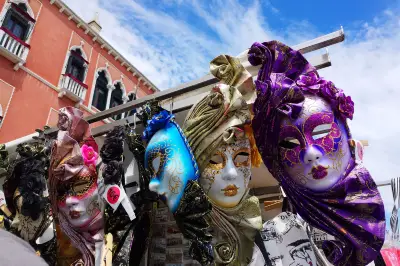
Glassware in a small shop window, including a pair of "Thousand-li Horses" made for the Chinese Year of the Horse. The asking price was too high, even for Chinese aunties.
We arrived at the gondola dock. It was very small, just a few steps.
While waiting for the gondola at the dock, we occasionally saw passing boats.
The gondola is a distinctive feature of Venice. This light, slender, uniquely shaped boat has a history of over a thousand years and has always been a means of transportation for the people of the water city. Each gondola has three rows of seats, seating up to six people, with the gondolier steering at the stern. The gondolas are finely made, with paint so shiny you can see your reflection. The gondoliers wear uniform striped T-shirts, either blue or red. They stand tall and look spirited, with bright eyes—very handsome.
Singing a song on the boat is a feature of gondola rides.
Our boat set off, winding along the curved canals...
The outer walls of the houses were peeling off, looking very old, as if they hadn't been repaired for a hundred years. In reality, it might be just a few years, because seawater erosion is very strong. It is said that after a cargo ship sails at sea for a month, the paint on the deck will peel off. In the past, the hardest job for sailors was scraping and repainting the deck.
The small boat passed through narrow waterways. A boat coming from the opposite direction had loud singing; someone was playing the guitar and someone was singing loudly. It sounded wonderful, so I quickly took a photo. This is also a service offered by Venice gondola rides: a group of two singers and musicians can accompany the boat. No wonder the singing was so professional and pleasant, and they didn't use microphones. It is said that with this service, gondoliers rarely sing anymore.
Look at the water stains on the lower part of the houses to see how high the tide rises. The windows on the first floor would get water.
Look at the outer walls eroded by seawater, but inside the houses were brightly lit, splendid, and full of life.
The boat passed through the narrow canal and entered the Grand Canal, the main waterway running through Venice. The water surface widened, making the gondola look much smaller, confirming the saying that even without wind, there are still waves. Fortunately, the boat was stable. Soon the boat turned back into a narrow urban canal and returned to the dock. After disembarking, we had two hours of free time, then gathered at the restaurant at noon for lunch.
Is that the Statue of Liberty?
Twins! My T-shirt is exactly the same as that handsome guy's.
Luckily, I didn't show much of this T-shirt on the boat; otherwise, if I matched the boatman's shirt, wouldn't we be a handsome couple?
The narrow canals of Venice are even narrower than those in Zhouzhuang, China's water town. But here it's seawater, not river water.
Narrow waterways, countless bridges, old and ancient houses, stone foundations submerged in water, stones covered in patches of marine life, windows with shutters to protect against wind and moisture, many rusty—this is Venice. But I love the patches of old age in this water city, its historical traces, its customs. It is worth reminiscing and pondering, worthy of admiration.
The sky cleared, the sun came out, and it became hot again. I took off my rain jacket and walked through the streets and alleys of Venice, no longer caring about matching shirts with the handsome guy.
We wandered through the winding streets, large and small. I enjoyed strolling in empty alleys, with their melancholic yet mysterious and charming atmosphere. The wet stone slabs, the faint air, the quiet paths—so romantic.
Touching the ancient walls—listening to them tell stories of history.
The tide was rising. The square's drains lead to the sea. When the tide rises, seawater also comes up from the manholes. In just a few minutes, there was 3-5 cm of water on the square.
As I was photographing the rising seawater from a manhole in the square, a little boy broke free from his mother's hand and came to play in the water.
Look at the little boy's expression as he played—how focused and joyful.
His mother called him to come home for lunch, and he responded like this... so innocent and adorable.
I forgot the name of this scenic spot.
These posts standing in the water are for tying boat mooring lines, just like parking spaces for cars on land.
There are several cafes on the square, all setting up white umbrellas. Under the white canopy is a stage where a band performs live. Musicians in suits and ties play instruments, making a lively and bustling atmosphere that draws tourists to stop and listen.
The rectangular square is surrounded on three sides by three-story buildings, with one side facing the sea (I am facing the sea).
There are many pigeons in the square, not afraid of strangers. If you have food in your hand, all the pigeons will rush toward you—it's a bit scary.
It is said that the most beautiful moment in St. Mark's Square is when the tide rises and floods the square. When seawater covers the square and the walkways of the colonnades, the square becomes shimmering like a huge silver mirror, with all the buildings reflected in it. Such scenes are rare, occurring only a few times a year. Unfortunately, today's tide was too low, leaving only a few puddles on the square. Using this little water, I captured the reflection of the upper part of the bell tower. Beautiful, isn't it?
Look at the reflection of the house in the water.
The water on the ground is from the rising tide. Behind me is St. Mark's Basilica.
St. Mark's Basilica and the bell tower by the square.
I couldn't capture the full upper part of the bell tower, but from the reflection in the puddle, I could see the upper part.
On the east side of the square is St. Mark's Basilica, with five large domes typical of Eastern art. The basilica has 400 marble columns inside and out, as well as 4,000 square meters of mosaic art. The most famous are the five glass mosaic panels above the entrance arch, depicting scenes from the life of St. Mark: "Transporting St. Mark's Body from Constantinople," "The Body Arrives in Venice," "The Last Judgment," "Glorification of St. Mark," and "St. Mark Entering St. Mark's Basilica." Having endured over 400 years of wind and rain, they remain resplendent and dazzling. It is said these are the earliest glass mosaic panels in the world.
The glass mosaic panels from over 400 years ago are still vivid. Many tourists gaze at them, exclaiming in awe.
Please look carefully at the lower part of the photo. There are many overturned tables. Guess what they are for? Whenever the tide rises and floods the entire square (up to 20-30 cm high), the locals set up tables in rows to form pathways leading to various shops, making it easier for tourists to walk and sightsee. In recent years, due to global warming and rising sea levels, it is said that by 2050, the entire Venice will be submerged.
The guide said that Venice receives up to 25 million tourists each year, 100 times the local population.
We headed back, still needing to cross four bridges. Now we had plenty of time to take photos.
Can you hold up the bell tower with one hand?
Look at the rising tide, it has already covered the shore.
Every bridge leaves its beauty.
A pair of handsome guys and a beautiful girl.
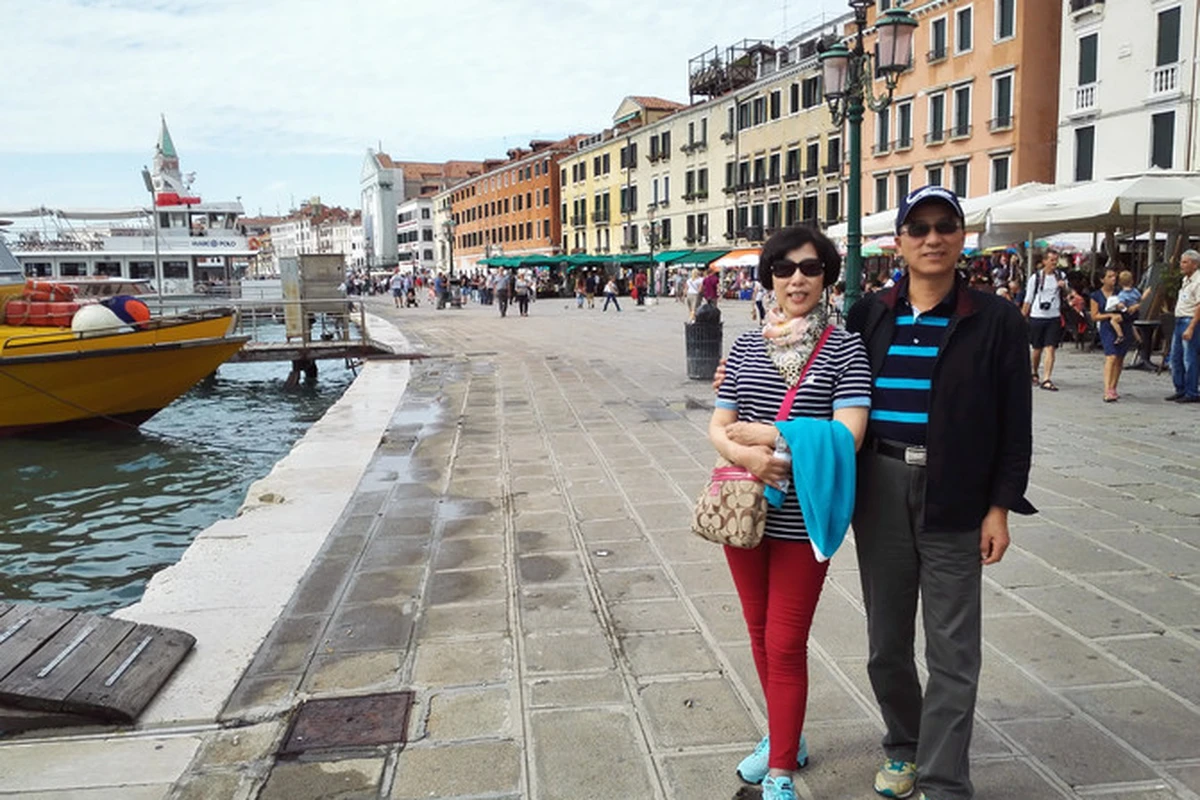
There are many small stalls by the sea selling small items, many of which are produced in Yiwu, China. They can fool foreigners, but Chinese tourists don't bother with them.
Endless beautiful scenery, countless beautiful photos.
Look at the piles of tables and wooden boards under the bridge. They are used to build makeshift bridges for tourists when the road is flooded.
Between the second and third bridges there is a square with a bronze equestrian statue of Victor Emmanuel II in military uniform.
At noon, we gathered at the restaurant by the sea, a seafood restaurant where we tasted the famous squid ink pasta. The restaurant had tables by the sea, allowing you to enjoy the view while eating—a nice environment. We were seated inside. First, each person was served a glass of water, and there was a basket of bread on the table. Everyone eagerly started eating the bread. Soon, the main course of squid ink pasta was served. On the plate was a heap of black stuff—squid ink mixed with Italian pasta, along with a few small squid. It tasted salty and fresh, with a slight fishy smell. After finishing, another plate came with fried seafood and a vegetable salad...
About to leave this dazzling, mysterious, dreamlike water city, Venice. The seawater beneath our feet, the gondolas on the canals, the magnificent palaces, the towering bell tower, the quiet streets and alleys—all tell the story of Venice's past, present, and future... Even though it will be submerged in decades, I will never forget its beauty.
A seagull stopped on a mooring post.
After lunch, we took the bus to Florence, a 270 km drive taking over 3 hours. We checked into the hotel in Florence in the evening.
This is at a highway rest stop.
Ending our Venice tour, my overall feeling: those who have never been to Venice cannot imagine its beauty; those who have been to Venice can never forget its beauty. Along the way, I couldn't bear to blink, afraid of missing its beauty.
Tomorrow (9/15), we will start our tour of Florence. Stay tuned for the next travelogue: "Tour of Four Countries: England, France, Switzerland, Italy Part 6: Italy (Florence)".