Venice, the City of the Winged Lion
This article was published during the pandemic, in the 9th issue of 2020 of the World Vision magazine. Due to space limitations, the text and images in the published version have been edited and abridged. Now posted here is my original manuscript and accompanying pictures.
*****************
During the COVID-19 pandemic at the turn of spring and summer 2020, Italy and Spain were the hardest hit in Europe. The outbreak in Italy was more severe in the north. The two regions around Venice and Milan, Veneto and Lombardy, one being Italy's tourism capital and the other its economic engine, may not see the bustling crowds of the past for a long time after this virus ravage. This article is dedicated to the cultural landscapes that will be temporarily inaccessible for a year or two, and I hope the world will soon recover and clear the clouds away.
Venice's history is relatively short among Italy's famous cities. In ancient Roman times, there was no water city called Venice. This area was originally coastal marshes and islands, plagued by mosquitoes, and the saline mudflats could not grow crops, making it unsuitable for human habitation. However, during the chaotic years of the fall of the Western Roman Empire, locals fled here to escape the invasion of the Germanic Lombard barbarians, valuing its strategic defensibility. The early settlers of Venice elected their first city leader in the early 7th century, with the title Doge, derived from the Latin word for duke. But Venice's so-called "duke" was a rotating office, with two dukes ruling concurrently in the same year, resembling the consuls of the Roman Republic. Thus Venice was historically an aristocratic republic. As an independent city-state, it submitted to the Byzantine emperor, who inherited the Roman legal tradition. In 800 AD, the Frankish Empire under Charlemagne conquered northern Italy but could not take Venice. Later, he compromised with the Byzantine Empire, recognizing Venice as part of Byzantium's sphere of influence with trade privileges in the Adriatic, effectively independent. This laid the foundation for Venice's special independent status as a nominal vassal of Byzantium, monopolizing trade throughout the Mediterranean, and maritime trade became the source of Venice's wealth for the next 800 years.
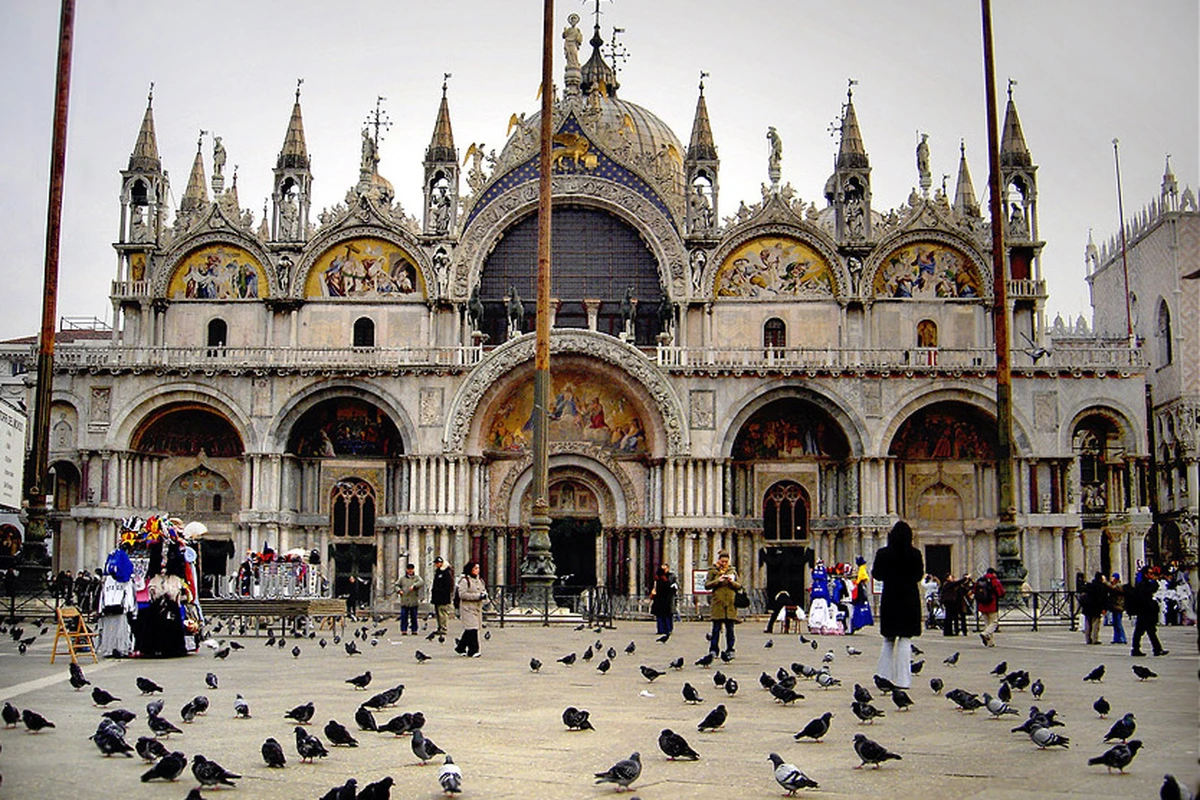
In 828 AD, a significant event in Venetian history occurred. The most important part of the Christian New Testament is the four Gospels, written by John and Matthew, two of Jesus Christ's twelve apostles, and Mark and Luke, who were disciples of Christ's followers. Legend has it that Saint Mark himself came to the earliest Venetian area, converting the locals to Christianity, so Venice adopted Saint Mark as its patron saint. Saint Mark lived in Alexandria, Egypt, and after his death, his remains were buried there. In 828, two Venetian merchants smuggled Saint Mark's relics from Alexandria back to Venice. In medieval Europe, people were superstitious, and possessing the relics of a saint was crucial for any city, enhancing its status and attracting many pilgrims, whose consumption stimulated the local economy, much like today's tourists. Venice was overjoyed to obtain its patron saint's relics and began building a magnificent cathedral to house the treasure and welcome the steady stream of pilgrims. This is today's St. Mark's Basilica at the center of St. Mark's Square.
With their advanced sailing skills and powerful fleet, the Venetians expanded southward along the opposite shore of the Adriatic Sea, already possessing sufficient military and economic strength to seek a monopoly on Mediterranean trade and establish a maritime empire. Byzantine Emperor Alexios I Komnenos decreed that Venetian merchants be exempted from trade taxes in the Mediterranean, laying the foundation for Venice's monopoly on the spice and silk trade from the Arab world to Europe. During the subsequent Crusades, Venice actively participated with its navy. In the process, Venice, whose territory had already expanded across the Adriatic and Aegean islands, gradually grew disloyal, always plotting to expand its maritime trade empire at the expense of its former suzerain, Byzantium. In 1204, during the Fourth Crusade, the Venetian fleet and the Crusaders did not go to the Holy Land but sailed to the Byzantine capital, Constantinople, taking advantage of the internal power struggle for the imperial throne. They conquered Constantinople. During this unjust act of usurpation, the Venetian army looted four ancient Greek bronze horses from Constantinople, which are now the most treasured artifacts in St. Mark's Basilica. Venice also took control of the Aegean islands belonging to the Byzantine Empire, especially Crete.
St. Mark's Basilica is very different from the towering Gothic churches popular in the Western Middle Ages. Construction began in 828, before the Romanesque architectural style emerged in Western Europe, and the later Gothic style was even less known. Since Venice was a nominal vassal of the Byzantine Empire, the architectural style of St. Mark's Basilica is classic Byzantine, easily identifiable by the golden mosaic panels on the external facade and the intricate rounded arches and domes.
The golden mosaic panels on the front facade depict the story of Venetian merchants stealing Saint Mark's bones from the Muslim infidels in Egypt. Mosaic panels are a typical ancient Roman art form, inherited by Eastern Roman-Byzantine church architecture. Inside St. Mark's, there are even more murals, more magnificent, covering almost the entire history of Christianity. As you enter, you first see the Apocalypse and the Last Judgment. Moving toward the altar, the murals roughly go in reverse chronological order: from the resurrection of Jesus Christ after his crucifixion, to his passion, to his life, to his birth, and further back to scenes from the Old Testament. At the far end, above the altar, is a mosaic of Jesus Christ, symbolizing both the beginning and the end of the world.
The church itself is free, but note that in summer, visitors' clothing must cover shoulders and knees. Those wearing sleeveless T-shirts, miniskirts, or shorts must borrow appropriate coverings. The golden altar, treasury, and St. Mark's Museum on the second-floor balcony charge separate fees. I think the four bronze horses in St. Mark's Museum on the second floor are most worth seeing. They are ancient Greek works cast during the time of Alexander the Great, originally pulling the chariot of the sun god Apollo. They were once gilded with ruby eyes, but now the gold and gems are gone, yet the horses' spirited postures remain lifelike. These four horses were moved to Rome by the Roman emperor Nero in the 1st century AD. In the 4th century, Constantine the Great moved them to Constantinople. Finally, during the Fourth Crusade in the Middle Ages, which attacked the Byzantine capital instead of the Muslims, the four horses were brought to Venice by the Venetian army. The originals of these four bronze horses are inside the museum on the second floor, while replicas stand in their original positions on the outdoor balcony.
St. Mark's Basilica is located at the eastern end of the world-famous St. Mark's Square. The large balcony upstairs is the best place to overlook the entire square. The whole square is rectangular, longer from east to west and narrower from north to south. The buildings on the north, south, and west sides are continuous; the two long sides are administrative offices, and the short west side facing St. Mark's is the Correr Museum. If the queue at the entrance of the Doge's Palace on the southeast side of the square is too long, you can buy a combined ticket for the Venetian museums at the Correr Museum, which allows you to visit various museums in the city without queuing at the entrance. This is a shortcut to avoid the line at the Doge's Palace. The Correr Museum itself is the city history museum of Venice, displaying historical artifacts and ancient armor and weapons. The main entrances and exits of St. Mark's Square are on the east side because the two connected main buildings on the east side, St. Mark's Basilica and the Doge's Palace, are not connected to the office buildings on the north and south long sides, leaving two exits on the east side, one north and one south. The northeast exit leads to the winding streets of the old city, with a clock tower at the exit. At the top, bronze figures strike the bell on the hour. The dark blue astronomical clock on the tower's face shows the zodiac, and the blue central part also shows the moon phase.
At the southeast exit of the square stands an independent bell tower about a hundred meters tall, square and slender with a pyramidal top. Since the square's south side faces the Grand Canal, the tower also serves as a beacon for navigation. It was built around 900 AD.
The southeast exit of St. Mark's Square opens onto the Grand Canal, forming a small square. The Doge's Palace is located here. The palace is exquisitely built, constructed during Venice's period of peak power. It features the Gothic style prevalent in medieval Western Europe but incorporates elements of Byzantine and Arab architecture, creating Venice's unique architectural style.
From the perspective of art history, after Romanesque architecture influenced by late Roman buildings, the Gothic style that emerged from France in the 12th century swept across Europe. Gothic features include pointed arches between columns, which is the most obvious visual difference from the round arches of Romanesque architecture. Gothic buildings also forgo wall pilasters, develop vertically with soaring lines, and often use slender towers. Lightweight flying buttresses support the walls externally. Because walls don't need to be as thick as in Romanesque buildings, large windows can be opened, with colorful and complex rose windows and stained glass being distinctive Gothic features, greatly improving interior lighting compared to Romanesque churches. Another Gothic characteristic is exquisite stone carving everywhere, such as layered statues of saints at church entrances, gargoyle drainage spouts on exterior eaves, and interior ribbed vaults outlined in red brick from column tops to arches, all leaving a strong impression.
But the Gothic style was never mainstream in Italy. Italian churches and palaces long adhered to late Roman and Byzantine architectural styles, with few classic Gothic examples. For instance, look closely at the double-arched colonnade on the second floor of the Doge's Palace: the columns are connected by pointed arches, but the two sides of the pointed arches curve to form a trefoil shape, with circular windows carved into four-petal flowers directly above each pair of pointed arches. Such column styles and windows, though Gothic, are unique in all of Europe, sometimes called "Venetian Gothic."
Inside the Doge's Palace, there is a "Mouth of Truth." Unlike the legend in the film "Roman Holiday" where the mouth eats the hand of a liar, this mouth is a beast-headed letterbox allowing anyone to anonymously send letters to the Doge, denouncing anyone. Whether it was a petition office or a tool of terror, perhaps both. The large golden staircase in the palace is impressive: not only are the marble stairs ornately carved, but the ceiling is covered with pure gold leaf, flaunting Venice's wealth and power to envoys from various countries. Additionally, in the palace's hall is Tintoretto's world's largest oil painting, "Paradise." If it were a fresco directly painted on a wall or ceiling, its size wouldn't be surprising, but this is an oil painting on canvas, covering an entire wall behind the throne, 9 meters high and 22 meters wide, making it the largest oil painting in the world.
Behind the Doge's Palace, the famous Bridge of Sighs connects the palace to the prison. Crossing it, you can visit the prison.
The pink facade of the Doge's Palace and its unique "Venetian Gothic" colonnade witness Venice's rise to its peak. On the palace's waterfront landing, there are two 12th-century stone columns. Like the bronze horses of St. Mark's, they were looted from Constantinople during the Fourth Crusade. One pillar is topped with a winged lion statue, symbolizing Venice's commercial empire, appearing in countless photographs of St. Mark's Square. The other pillar has a statue of Saint Theodore killing a crocodile; he was Venice's patron saint before Saint Mark.
This Doge's Palace housed Venice's highest administrative body. It was built during the peak of Venetian power in the Middle Ages, when trade routes from East to West were unimpeded, with the eastern end under the unified Mongol Empire and the western end in the Eastern Mediterranean entirely controlled by Venice. Marco Polo was from that era. In fact, Marco Polo was born on the island of Korcula in today's Croatia. In the winter of 2010, I specifically visited the great traveler's former residence. But because the entire Dalmatian coast was under Venetian rule, Marco Polo can be considered both Croatian and Venetian today.
As time entered the 16th century, from a grand historical perspective, Venice began to decline due to two macro factors: first, the Age of Discovery led by Spain and Portugal gradually replaced the Mediterranean trade routes controlled by Venice as a source of wealth; second, the expansion of the Ottoman Empire on the eastern Mediterranean gradually seized maritime dominance, blocking Venice's eastern trade profits. Venice was powerless against these two trends. The specific event triggering Venice's decline was its defeat in a war against the Holy Roman Empire in the 1620s. After the war, the Black Death broke out in 1630, killing a third of Venice's population. Thereafter, Venice's national fortunes waned.
Let's leave St. Mark's Square and tour the Grand Canal. First, take a 10-minute ferry from the St. Mark's Square pier to the San Giorgio Maggiore church and monastery on the opposite side. Climb the bell tower to overlook St. Mark's Square, the entire canal, and the old city. There are three best spots for panoramic photos of Venice: the second-floor balcony of St. Mark's Basilica offers a view of the entire square but not the basilica itself; the clock tower on the square offers a distant view but, being within the square, cannot well capture the square itself and has long queues. The bell tower at San Giorgio Maggiore is the best among the three, especially if you go there in the morning before tourists crowd St. Mark's Square, you won't wait too long.
St. Mark's Square and San Giorgio Maggiore are at the end of the Grand Canal where it meets the sea. From the pier here, take water bus line 26 or a famous gondola up the S-shaped canal, ending at the railway station. On both sides of the canal are mansions of Venetian nobles and wealthy merchants from the 14th to 16th centuries. Venice is built on coastal marshes, so no building can have a direct foundation. These waterside mansions are actually supported by hundreds or thousands of wooden piles driven more than 5 meters deep through the muddy bottom into hard ground. The piles are permanently immersed in water, preferably made of alder wood resistant to decay. But even the most decay-resistant wood needs to be replaced after decades in seawater. It's easy to imagine the enormous annual maintenance costs of these centuries-old houses. The early settlers who fled to this swamp to build Venice must have been extremely afraid of war to go to such lengths to create this water city.
750 meters up the Grand Canal from St. Mark's Square, on the south bank, a square white marble building is the entrance to the Gallerie dell'Accademia. This gallery, along with the Doge's Palace, houses the finest works of the three great masters of the late Renaissance Venetian School. Art history lovers should not miss it.
In painting history, ancient Roman art featured mosaics. In the Middle Ages, when the Christian church monopolized science and art, Gothic art expanded from architecture to sculpture and painting. Representative paintings were church icons. Painters did not yet understand perspective, so they couldn't create a three-dimensional effect. Human proportions in paintings and sculptures were ridiculous: saints had large heads and small bodies, with elongated, thin figures. To convey the solemnity of religious figures, poses were extremely rigid. Not until the 15th century did the Renaissance begin in Florence, bringing revolutionary breakthroughs in painting techniques. Early Renaissance masters were all centered in Florence. Simply put, masters of the early and high Renaissance, such as Donatello and Raphael, started by studying perspective, focusing on proportions and composition. Leonardo da Vinci even scientifically studied human proportions, as in his sketch "Vitruvian Man." This style reached its perfection with Raphael, beyond which later generations could not surpass. So painters and sculptors began to find new paths. For instance, Michelangelo, another master of the High Renaissance, exaggerated forms in his later sculptures and paintings to express strong emotions. After these three masters, the center of Renaissance painting shifted to Venice. The Venetian school sought breakthroughs in color and chiaroscuro. The three most famous masters are Titian, Tintoretto, and Veronese, with the first two born in Venice. Titian was born in 1488, just five years younger than Raphael, but Raphael died young at 37, while Titian lived to 88. By age 30, he was the leading figure in Venetian art. His early masterpiece "Assumption of the Virgin" (1516) is still at the main altar of the Santa Maria Gloriosa dei Frari church in Venice, and another work, "Pesaro Madonna," is on the north wall of the same church's main aisle.
Titian was buried in this church after his death.
Today, if you exit the Gallerie dell'Accademia and take a direct land route (not following the S-shaped canal) to the train and bus station at the canal's start, the Frari church is approximately at the midpoint of this cord road. Besides Titian's two famous works and his tomb, the church also holds the tomb of the heart of the 18th-19th century Romantic sculptor Canova. Titian's skill was his vibrant colors; he also mixed special colors himself, like "Titian Red," which had a unique tone and lasted without fading, something no later artist could replicate. For nearly half a century, Titian was famous worldwide, receiving countless commissions, especially from the Habsburg courts of Austria and Spain. So most of his major works are not in Venice but scattered across Europe's great cities. For example, his 1534 painting "Venus of Urbino" is the most famous reclining nude in painting history, now in Florence's Uffizi Gallery.
Two other famous Titian works: "Bacchus and Ariadne" depicts the Greek myth of the god Bacchus (Dionysus) falling in love at first sight with Ariadne, daughter of King Minos of Crete. This painting is in London's National Gallery.
Titian's famous 1548 equestrian portrait of Holy Roman Emperor Charles V is now in the Prado Museum in Madrid, Spain. This wasn't Titian's first imperial portrait; in 1532, at age 44, he was granted the title of Count Palatine and the Order of the Golden Spur by Charles V for his paintings, a rare honor for someone not of high nobility.
The Gallerie dell'Accademia displays four or five Titian works, notably "Pietà" and "Madonna and Child."
Besides this leader of the Venetian school, the Accademia's most famous holdings include two other works: one is Leonardo da Vinci's sketch "Vitruvian Man" studying human proportions. However, sketches on paper are fragile to light, so the museum rarely displays this famous drawing.
The other work is the massive "Feast in the House of Levi" by another Venetian master, Veronese.
Veronese's real name was Paolo Caliari, born in 1538 in Verona, a generation younger than Titian. Painters of that era often used nicknames as pseudonyms, and their real names were forgotten—like Botticelli ("little barrel") or Tintoretto ("son of the dyer"). Veronese is also a nickname meaning "Veronese." He began training in painting at 13 in Verona and married his teacher's daughter at 37. Before age 20, he was already taking independent painting commissions in Verona's churches. In 1553, at 25, he came to Venice, and his first job was decorating the hall of the Council of Ten in the Doge's Palace. Veronese's famous works are mostly large religious oil paintings or frescoes. For example, "The Wedding at Cana" (1563) depicts Jesus Christ's first miracle of turning water into wine at a wedding in Cana.
This painting was originally commissioned by the San Giorgio Maggiore monastery (the monastery across the river from St. Mark's Square, where you can climb the bell tower to overlook the city). It is now in the Louvre in Paris. At the Gallerie dell'Accademia in Venice, there is another of Veronese's masterworks, "Feast in the House of Levi." Actually, this painting was originally titled "The Last Supper," but the Inquisition disapproved of Veronese's overly realistic style and his arbitrary choice of scenes and characters, such as including German mercenaries and dwarfs. Just ten years earlier, when Veronese painted "The Wedding at Cana," he could include any characters he liked; in fact, he painted himself, Titian, and Tintoretto. But in the 1570s, with the rise of the anti-German Protestant Reformation, the Catholic Church began censoring paintings like books. Major religious themes such as the Nativity, the Last Supper, and the Crucifixion had specific requirements on what could and could not be depicted. So the Inquisition ordered Veronese to modify his painting. Veronese cleverly responded: he changed none of the painting's content but did not resist the censorship authority. Instead, he simply retitled it: since I'm not painting the Last Supper, just ordinary people eating, is that okay? Levi is a figure from the Old Testament, the founder of the Levite tribe. The art censorship of the time didn't regulate such marginal biblical content. The Accademia also has another famous Veronese work, "The Battle of Lepanto," depicting the epic 1571 naval battle where the combined Spanish and Venetian fleet defeated the Ottoman navy.
The third great master of the Venetian School, Tintoretto, was born in Venice in 1518, a generation younger than Titian and ten years older than Veronese. His father was a dyer (tintore in Italian), so the son was called Tintoretto, a nickname by which he is known in art history. At 17, Tintoretto was taken by his father to Titian's workshop as an apprentice, but he was sent home after only ten days. Legend has it that Titian, seeing a sketch he drew, became jealous of his talent and refused to teach him. In fact, Titian, then 56 and already established, wouldn't be jealous of a child's talent. Perhaps Titian found Tintoretto's style incompatible with his own. Afterward, Tintoretto and Titian maintained mutual respect but had little contact. Tintoretto's workshop motto was "Michelangelo's drawing, Titian's color." His famous St. Mark series—"St. Mark Freeing a Slave" and "The Recovery of the Body of St. Mark"—are housed in the Gallerie dell'Accademia. The same series' "Discovery of the Body of St. Mark" is in the Pinacoteca di Brera in Milan.
"St. Mark Freeing a Slave"
"The Recovery of the Body of St. Mark"
"Discovery of the Body of St. Mark"
Besides the Accademia, another place in Venice concentrates Tintoretto's works: the Scuola Grande di San Rocco, near the Frari church mentioned above. Scuola means school in Italian, but it actually operated as a charitable hospital. The interior frescoes and ceiling paintings of this hospital were entirely done by Tintoretto. In two years from 1565-1567 and thirteen years from 1575-1588, Tintoretto created 52 large paintings for this charitable hospital and its church. Tintoretto also worked with Veronese on frescoes for the Doge's Palace, especially after the great fire of 1577, when all frescoes had to be repainted. The world's largest oil painting, "Paradise," in the Doge's Palace is Tintoretto's work. Initially, Veronese won the commission for the hall's fresco, but he died before starting. Tintoretto took over, producing his lifetime masterpiece. After that, until his death in 1594, Tintoretto no longer created large-scale works.
Next notable landmark along the Grand Canal is the Rialto Bridge.
It is the oldest of the four bridges spanning the Grand Canal, almost exactly at the canal's midpoint. Built in 1255 as a wooden bridge with a movable central section to allow ships to pass up the canal, it collapsed twice in the 14th and 15th centuries as Venice's population grew. The current single-arch white marble bridge was completed in 1591, with an elegant covered colonnade protecting it from weather, and many shops on it. It remains one of Venice's most photographed landmarks.
Across from St. Mark's Square at the canal mouth, the large dome of the Basilica of Santa Maria della Salute is very prominent. As mentioned earlier, the Black Death in the 1630s killed a third of Venice's population, after which the city began to decline. After the plague ended, Venice built this church to thank the Virgin Mary for protection. So it is Venice's last monumental building, in a pure Baroque style with many sculptures.
Venice's main cuisine naturally focuses on seafood. Two notable appetizers are prosciutto di San Daniele from the town of San Daniele in the Veneto region, and Sarde in saor (sardines marinated in garlic, onion, and olive oil). For main courses, any seafood is generally good: crabs, soft-shell crabs, langoustines, razor clams, squid are local specialties. Although legend says Venetian Marco Polo brought noodles from China, today's Venice is not famous for pasta or pizza. Skip pizza here; for pasta, seafood pasta is fine. Besides seafood pasta, there is risotto (seafood rice), especially the black risotto nero made with cuttlefish and its ink, which is delicious. Nero means black, but it's not suitable for formal occasions as it stains lips and teeth black. Also, there is fish soup (Zuppa di pesce). When talking about Venetian cuisine, the famous tiramisu cannot be omitted. Some books say tiramisu was invented in Venice, others in Treviso in the Veneto region. Either way, this region produces the most authentic and delicious tiramisu. This dessert is relatively recent, invented in the 1960s, made with layers of espresso, cocoa powder, Marsala wine, sweet mascarpone cheese, and ladyfinger biscuits.
Because Venice has limited space and many tourists, hotels in the old city are expensive. Many tourists stay in the mainland town of Mestre, commuting by bus or train (frequent services, half an hour). I recommend staying at least one night in the old city center. After the daytime crowds leave, walking through the empty St. Mark's Square or the winding riverside alleys at night truly lets you feel the pulse and breath of this medieval city.