Three-Month Europe Tour Part 5: The Sun of Tuscany and the Spirit of the Renaissance: Venice
Continuing from Part 4: Three-Month Europe Tour Part 4: The Sun of Tuscany and the Spirit of the Renaissance: Rome, Vatican City
On May 29, I switched from the land-based feel of Rome, the "City of Seven Hills," to Venice, a city floating on water. Saying goodbye to Rome's seven hills, I was greeted by a maze woven from 177 canals and over 400 bridges. The fatigue from the previous days of trekking through Roman forums and ruins instantly melted away with the gondolier's melodious songs and the rhythm of oars. From here, my Italian journey turned from a pilgrimage to history into a romantic dream floating on the shimmering waves of the Adriatic Sea.
I stayed at the Best Western Hotel Tritone for 5 days. The hotel is directly opposite Mestre Railway Station, and it takes only about 10 minutes by bus or train to reach the main island of Venice.
Since 2024, the Venice city government has begun charging an entrance fee for tourists visiting the main island on designated days during peak season. Paying in advance offers a discount: if paid more than 4 days before the visit date, the fee is €5; within 4 days or on the day itself, it's €10. I had bad luck—from May 30 to June 2, I had to pay the fee for four consecutive days. So I purchased the fee four days in advance.
From Mestre Railway Station, take the train one stop to Santa Lucia Railway Station (the main station), about 10 minutes, ticket price €1.50.
After getting off at Santa Lucia Station, I walked while sightseeing all the way to St. Mark's Square.
St. Mark's Square and its surrounding spaces form the social, religious, and political center of Venice. The square is a rectangular area about 170 meters long, about 80 meters wide on the east side, and about 55 meters wide on the west side, enclosed by the Doge's Palace, St. Mark's Basilica, St. Mark's Clock Tower, the Procuratie Vecchie and Procuratie Nuove, the Napoleonic Wing connecting the two, the Campanile of St. Mark's, the Marciana Library, and the Grand Canal. All the buildings around the square are exquisite Renaissance architecture. St. Mark's Square is the lowest point in Venice, so during high tide and heavy rain, it is the first area to flood.
St. Mark's Clock Tower
Campanile of St. Mark's Basilica and the Piazzetta to the south
The Piazzetta on the south side of St. Mark's Square, facing the lagoon of the Grand Canal. At the waterfront stand two famous white stone columns of Venice. One column bears a statue of Saint Theodore, the patron saint of Venice, and the other bears the winged lion of Saint Mark, another patron saint. These two columns form the official gate of Venice, where distinguished guests enter the city. This was also once the site of executions in Venice. To the right is now the Marciana Library.
St. Mark's Basilica
The Procuratie Vecchie and Procuratie Nuove, and the Napoleonic Wing connecting them.
There are restaurants and cafés on the square.
Ponte della Paglia (Straw Bridge) on the south side is an excellent spot for photographing the Bridge of Sighs and the picturesque Venetian canals.
The Bridge of Sighs photographed from Ponte della Paglia
A gondola is a black flat-bottomed boat about 12 meters long and 1.7 meters wide, elaborately decorated, with high upturned ends in a crescent shape. The hook-shaped bow allows it to easily gauge the height of bridge arches. For centuries, gondolas were the primary means of transportation within Venice.
View of San Giorgio Maggiore Island from Ponte della Paglia
Customs House (Dogana da Mar) and Basilica of Santa Maria della Salute
St. Mark's Basilica (partial facade under renovation) is a Roman Catholic cathedral in Venice, a famous example of Byzantine architecture. Its interior dome is inlaid with over 8,000 square meters of golden mosaic frescoes, earning it the nickname "Golden Church." The predecessor of St. Mark's Basilica was built in 828 to house the relics of Saint Mark, smuggled from Alexandria, Egypt, by Venetian merchants. The early church was burned down in 976. The current St. Mark's Basilica was built in 1094, featuring Byzantine domes and a Greek cross plan. The sarcophagus of Saint Mark is placed under the high altar inside the church.
The main facade of St. Mark's Basilica has five arched portals. Above each arch is a mosaic panel, together depicting the story of Saint Mark. The central panel depicts the Last Judgment.
At the top of the main facade stands a statue of Saint Mark. Below the statue is a golden winged lion holding a book of the Gospel, an image that is also the coat of arms of Venice.
The central panel depicts the Last Judgment.
The far right panel depicts the scene when two Venetian merchants transported the body of Saint Mark back. They concealed the body in a barrel of pork fat, and since the Muslim inspectors were unwilling to touch the pork barrel, the merchants were able to transport the body safely.
Above the central arch of the church are placed four bronze horses. These horses date back to the 4th century BC in ancient Greece and were looted from Constantinople during the Crusades. The ones kept outdoors now are replicas; the originals are preserved in the Museum of St. Mark's Basilica.
St. Mark's Basilica is divided into three naves by a Greek-cross layout, designed after the church built by Emperor Justinian in Constantinople. The domes are covered with bright mosaics containing gold, copper, and various precious stones. The mosaic decoration covers about 8,000 square meters. The oldest mosaic works are influenced by Byzantine and Gothic art styles. The lower walls and pillars are entirely covered with marble slabs. The central dome features mosaics of the life of Jesus. Many great painters participated in creating the mosaics, such as Veronese, Tintoretto, and others.
12th-century mosaic floor tiles
The central dome's mosaic depicts the life of Jesus. The iconostasis consists of eight red marble columns, behind which is the Pala d'Oro (Golden Altarpiece) in the sanctuary.
The Pala d'Oro requires an additional fee, €5. The altarpiece is inlaid with over 2,000 gems, pearls, and crystals, extremely ornate and exquisite. The sarcophagus of Saint Mark is placed beneath the altar.
Detail of the Pala d'Oro
Medieval exquisite floor mosaic
St. Mark's Museum (additionally charged, €7). Besides viewing the collections, you can also see the church domes and dome mosaics up close from the second floor, as well as visit the outdoor terrace.
Mosaic artwork (about 1,500 years old)
Ancient Greek sculpture dating back to the 4th century BC—the four bronze horses
These were once placed at the top of the central portal of the church facade; now they are stored inside the museum, replaced by replicas outside.
View of the dome mosaics from the museum's cloister.
Going to the second-floor terrace to view St. Mark's Square.
St. Mark's Clock Tower, built in 1499, mechanical device, very elegant appearance.
Correr Museum is located on the upper floor of the Procuratie Nuove on the south side of St. Mark's Square, adjacent to St. Mark's Basilica, the National Library of Venice, and the Venetian city hall, together forming an impressive cultural complex. The building of the Correr Museum was originally a noble palace, built in the early 18th century by the Correr noble family. The museum consists of numerous exhibition halls and luxurious corridors, housing a large collection of precious archaeological finds and art collections, ranging from paintings to sculptures, from coins to various antique books and manuscripts.
From the museum, you can overlook St. Mark's Square.
The oil paintings mainly focus on medieval Venice.
This map of the main island of Venice, painted in 1621, shows a city layout and scale almost identical to present-day Venice. The power of the Mediterranean hegemon is evident.
The Correr Museum was once the royal palace of the kings of France and Italy. It contains 9 rooms, including a ballroom, banquet hall, and royal family chambers. Queen Elisabeth of Austria (Sisi) once lived here.
The former residence of Empress Elisabeth (Sisi) presents the life and times of the Austrian empress through displayed portraits, family photos, personal items, and historical artifacts related to her.
The royal ballroom features unique decorations and an impressive vast space, a unique example of a large royal ballroom in Venice.
The Doge's Palace (Palazzo Ducale), also known as the Duchy Palace, was once the government, court, and prison of the Venetian Republic. The first palace was built around 810 AD, later destroyed by fire. In the 10th century, it was rebuilt on the current site, later undergoing coups, expansions, and other changes. The current building was mainly constructed between 1309 and 1424 in Gothic style. In 1574, another fire severely damaged the palace; during reconstruction, the Gothic style was preserved with some classical features added. In the 16th century, a new prison was built to the east, connected to the palace by the famous Bridge of Sighs. Today, the Doge's Palace, the Bridge of Sighs, and the prison together form a museum.
The sculptures in the courtyard of the Doge's Palace integrate mythological symbolism, declarations of power, and artistic decoration. Through the ages, they still tell visitors of Venice's former glory and stories. The dome visible is that of St. Mark's Basilica.
The colossal statues of Mars and Neptune symbolize Venice as a maritime republic and a powerful military force, reflecting Venice's control over the sea and its military prowess.
At the top of the balcony on the Grand Canal side of the Doge's Palace stands a statue of Justice, created by the 16th-century Venetian sculptor Alessandro Vittoria and installed in 1579. In her left hand, she holds a scale, symbolizing fairness and justice for weighing right and wrong; in her right hand, she holds a sword, representing authority and power to punish evil and uphold the dignity of the law—a prominent symbol of the rule of law and power of the Venetian Republic.
It was already 1 PM, so I had something to eat. There is a restaurant in the courtyard of the Doge's Palace serving pizza, pastries, cakes, coffee, drinks, etc.
Golden Staircase (Scala d'Oro), once only accessible to nobles and important guests, is now a required route for visitors.
Senate Chamber
Statue of Justice, symbolizing fairness and justice.
Mainly houses military weapons from various periods in Venetian history.
View of San Giorgio Maggiore Island from the window
Grand Council Chamber
The entire room is 53 meters long and 25 meters wide, not only the largest and most magnificent room in the Doge's Palace but also one of the largest rooms in Europe. It was the meeting place of the Venetian Republic's Grand Council. It houses the world's largest oil painting on canvas, "Il Paradiso" (Paradise).
View of the courtyard of the Doge's Palace from the window
Oil painting on canvas "Il Paradiso", created by Tintoretto and his workshop between 1588 and 1592.
The Bridge of Sighs connects the Doge's Palace and the prison, built in 1614. Legend has it that prisoners, after being sentenced in the courtroom, would sigh as they were led across the bridge to their cells, giving the bridge its name.
The prison was built in the mid-16th century and is connected to the Doge's Palace by the Bridge of Sighs.
End of visit, back to the courtyard of the Doge's Palace.
The Campanile of St. Mark's is one of Venice's most famous landmarks, standing 99 meters tall. You can take an elevator to the top, where you can overlook the entire main island of Venice and the surrounding lagoon.
Dome of St. Mark's Basilica
Overlooking San Giorgio Maggiore Island opposite
The best viewpoint for Basilica of Santa Maria della Salute and the Customs House
After the ascent, I headed to the Rialto Bridge.
The Grand Canal is the most important canal in Venice, running from Santa Lucia Railway Station / Piazzale Roma in the north to near St. Mark's Square in the south, 3.8 km long, 30-90 meters wide. It is also an important route for water buses (vaporetti); other canals within the main island are too narrow for water buses. Along the canal are over 170 buildings dating from the 13th to 18th centuries. There are four bridges crossing the Grand Canal, from north to south: Ponte della Costituzione, Ponte degli Scalzi, Ponte di Rialto, and Ponte dell'Accademia.
Rialto Bridge is the oldest of the four bridges spanning the Grand Canal, built in 1591 in Renaissance style. Both sides of the bridge are lined with shops and stalls.
View of both sides of the Grand Canal from Rialto Bridge
Descending from Rialto Bridge, walking along the Grand Canal.
Entered the alleys; every alley in Venice has its unique charm.
Took a water bus back to the main railway station, then back to the hotel.
The next morning, I took a water bus directly to the Accademia Bridge.
First passed by Constitution Bridge
Then passed by Scalzi Bridge
Along the way, views of the Grand Canal.
University of Venice, Ca' Foscari
Accademia Bridge is located at the southern end of the Grand Canal, completed only in 1854. It was originally made of steel, but after being damaged, it was rebuilt as a wooden bridge in the 1930s. Due to structural instability, it was rebuilt again in 1985.
From Accademia Bridge, I strolled leisurely towards the Basilica of Santa Maria della Salute.
Art shops on the street
Clothing and home decor shops
Restaurants and cafés.
Chiesa del Santissimo Redentore on Giudecca Island
Basilica of Santa Maria della Salute is a masterpiece of Venetian Baroque architecture. During the plague of 1630, the republic government decided to build this church dedicated to the Virgin Mary. Designed by the famous architect Baldassare Longhena, it was completed in 1687 (after 56 years). The basilica is adjacent to the Customs House, and its unique ornate shape and location make it one of the most photographed churches in Italy.
After visiting the Basilica of Santa Maria della Salute, I wandered aimlessly through the alleys of Venice and accidentally discovered the remnants of the Squero di San Trovaso.
What does this represent? Each viewer may feel differently.
Hilton Molino Stucky Venice
The area around Campo San Trovaso is full of charm—the San Trovaso boatyard ruins, small shops, galleries, and the delightful relaxing atmosphere along the canals.
These cabins are the 17th-century San Trovaso boatyard, used for building traditional wooden gondolas.
There are many artistic young people here, buying masks, looking at paintings, but mostly absorbing the artistic atmosphere.
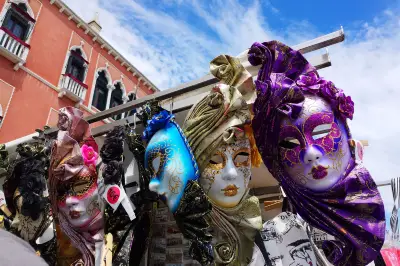
Venetian masks are world-renowned, with various shapes and types.
Galleries on the small streets.
Enjoying the ambience of Venice on the Grand Canal, feeling the charm in the alleys and lanes.
Walking through alleys, I arrived near the Rialto Bridge, from where I took a water bus to San Giorgio Maggiore Island.
Basilica of Santa Maria della Salute & Dogana da Mar Museum are located on the narrow spit of land between the Grand Canal and the St. Mark's Basin of the lagoon.
View of St. Mark's Square in the distance
Our destination: San Giorgio Maggiore Island
Dock and Basilica of Santa Maria della Salute
San Giorgio Maggiore Island lies south of the main island, and its most famous building is the San Giorgio Maggiore Church.
The church was begun in 1566 and completed in 1610. Its architectural style is typical Palladian, incorporating ancient Greek and Roman elements, with a triangular pediment supported by Corinthian columns and a geometric facade of white limestone.
Climbing the bell tower of San Giorgio Maggiore Basilica for a distant view
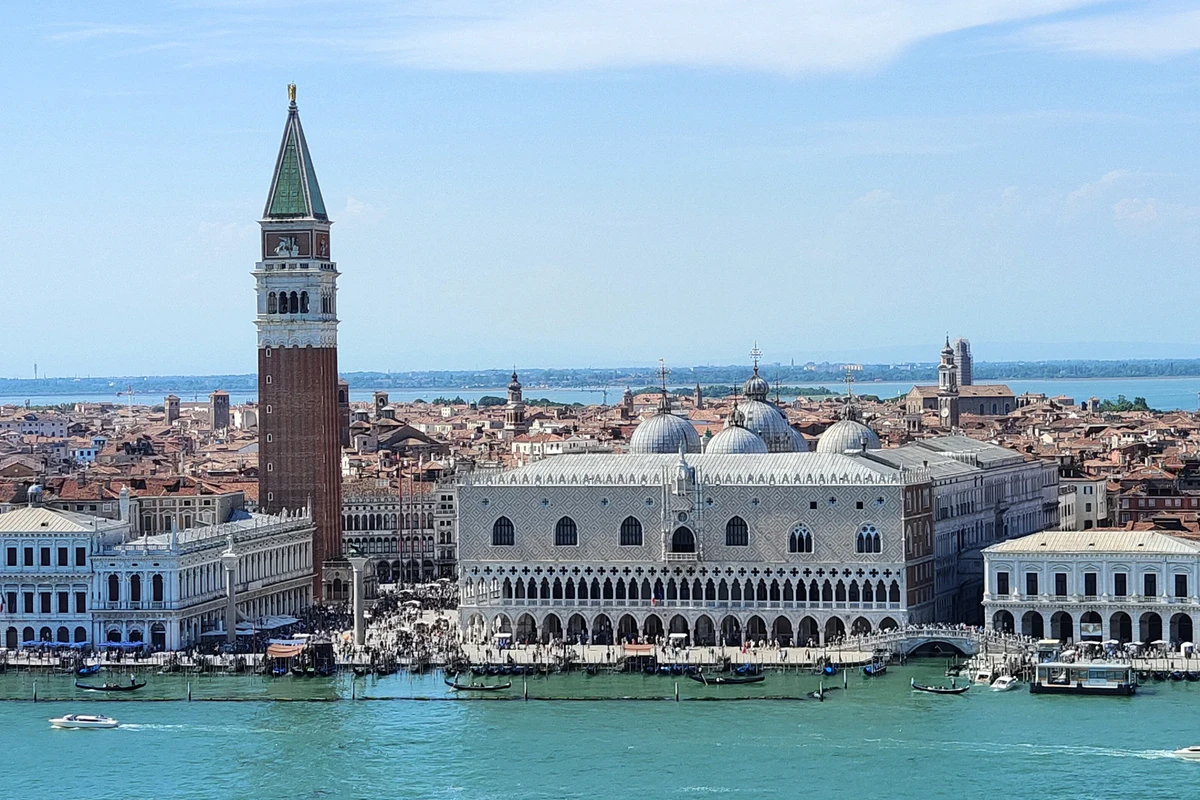
St. Mark's Square, Campanile, and Doge's Palace.
Youth hostel on Giudecca Island
Artistic young people painting by the sunset.
After visiting the island, I took a water bus home, capturing the front facade of Basilica of Santa Maria della Salute on the Grand Canal.
Ponte della Costituzione (Constitution Bridge) is the fourth bridge across the Grand Canal, connecting Santa Lucia Railway Station on the north bank with Piazzale Roma (the city's bus terminal) on the south bank, completed in 2008. Functionally and symbolically, it welcomes visitors to Venice with a panoramic view of the Grand Canal.
Near the hotel, across the road is Mestre Railway Station.
Murano is nominally an island but actually an archipelago, with islands connected by bridges, forming a single island. Murano is about 1.6 km north of Venice. Murano is world-famous for manufacturing colorful Murano glassware, especially lampworked glass.
In the morning, depart from the station dock: Line 3 (20-30 minutes, every 15 minutes), Lines 4.1 / 4.2 (30-40 minutes, every 20 minutes). The glass island has multiple docks; we disembarked at the southernmost Colonna dock and first went to the Glass Museum.
The Glass Museum was established in 1861. Its earliest collections include Roman glass from the 1st to 3rd centuries AD. It also houses a large collection of Venetian glass from the peak period of glassmaking in the 14th to 17th centuries, as well as modern masterpieces.
1930 work
2022 work
1962 work
1962 work
1962 work
1927 work
1460 work
1920 work
1920 work
1920 work
1920 work
Basilica of Santi Maria e Donato is a Roman Catholic basilica, known for its 12th-century Byzantine mosaic floor depicting roosters and foxes.
Bell tower of Basilica of Santi Maria e Donato
Murano is much quieter than the main island of Venice. If you have time and prefer tranquility, a visit here is a good choice.
Originally a factory, now converted into residential housing.
Not very lively, no commercial activity yet.
Murano has a small island reachable by water bus, with impressive buildings, a church, etc. This little island is the Murano cemetery.
View of the Murano cemetery buildings from the lagoon
Burano is an offshore island of Venice, nicknamed the "Colorful Island" because of its brightly colored houses. Burano is also famous for lacemaking and has a Lace Museum.
From the glass island, take water bus Line 12, about 37 minutes to reach Burano Island, with ferries every 20 minutes.
Seafood on the island was delicious.
Known as the "Water City," Venice has 117 waterways, 118 small islands, and 401 bridges. It is the only city in the world without cars; water buses are the only means of transportation.
By 5 PM, I had finished visiting both Murano and Burano. It was still early, and I had a day ticket for transportation. From Burano, I took Line 12 and transferred to Line 1, traveling along the Grand Canal all the way to St. Mark's Square, then took a boat home. Visiting two islands in one day was a bit tiring, so I sat on the boat, resting while slowly admiring the Grand Canal.
Lines 1 and 2 use large boats that are relatively stable. I queued for a front seat to get better shots.
Gondolas usually travel through narrow canals; entering the Grand Canal is only possible for short stretches and they must stay close to the canal bank for safety.
These wooden piles are used for mooring boats.
Passed by Accademia Bridge again. On the 30th, I didn't get a good shot of Basilica of Santa Maria della Salute. Today, I was lucky with good light and the direction of the sun; Accademia Bridge is the best spot for taking photos of the basilica.
Postcard-perfect photo of Basilica of Santa Maria della Salute
Shops around Accademia Bridge
The Cannaregio district (Jewish Ghetto) was forcibly established by the Venetian government in 1516. It is a historically and culturally significant area in Venice, not only the first "Ghetto" in the world but also a place that witnessed oppression and segregation while bearing the resilience and cultural vitality of the Jewish community.
Tall, narrow buildings
The Jewish Museum showcases the struggles and life of Jews in Venice over centuries. Unfortunately, the museum was closed.
Holocaust memorial
Campo del Ghetto Nuovo
Could not enter the museum, so I went to the next destination: Ca' d'Oro (Golden House).
Unwanted books can be left here for free exchange.
Living here, house maintenance must be very tough.
Ca' d'Oro, construction began around 1420 and was completed around 1440. It is an iconic Gothic building on the Grand Canal, famous for its once gilded facade. Today it houses the Galleria Giorgio Franchetti. Another closed door—I chose the wrong day; Monday is the museum's closing day.
Bad luck today. I then headed to the next stop: the Bookshop of the Sinking (Libreria Acqua Alta).
Passed a historic district where a guide was explaining.
A very unique bookstore featuring a gondola filled with books. In the courtyard, old books are stacked into stairs. This distinctive bookstore sells a large collection of vintage books.
Old books stacked into stairs in the courtyard
Leaving the bookstore, it was nearly 1 PM. This was my last day in Venice. Venetian seafood is renowned, so I found a seafood restaurant and had a great meal.
Venetian glassware shop
Arrived at this restaurant
Lobster pasta, squid ink pasta, tiramisu.
After eating, I took a boat to Giudecca Island.
Giudecca Island lies south of the main island of Venice, separated by the Giudecca Canal. Historically an area of large palaces and gardens, in the early 20th century it became an industrial zone with shipyards, factories, and a film studio. Most factories closed after World War II, and now it is again considered an upscale residential area. The island is known for its long promenade and churches, including the Church of the Redeemer (Il Redentore).
Molino Stucky, a striking neo-Gothic building, was once a huge flour mill. Today it has been converted into a complex containing a hotel, convention center, and residences.
In the distance, the Hilton Molino Stucky Venice
This area has become a residential neighborhood with residents.
Hilton Molino Stucky Venice
Preserved factory chimney.
Behind Hilton Molino Stucky Venice
Molino Stucky building
Residential area of Giudecca Island
Finished the Giudecca Island itinerary and took a boat home.
Basilica of Santa Maria della Salute across the canal
Il Redentore (Church of the Redeemer) is a Roman Catholic church on Giudecca Island, dominating the island's skyline. It was built as a votive church to thank God for deliverance from the plague that devastated Venice from 1575 to 1576. Construction began in May 1577 and was consecrated in 1592.
View of Hilton Molino Stucky Venice from the boat
As the water bus left Giudecca Island, it meant we were leaving Venice. Venice is a master of illusion woven with water, light, and stone bridges. The alleys branch like flowing water, leading us to silent stone bridges, under which the dark green water reflects time-worn walls, getting us lost in the alleys. It was in this willing loss that we encountered the real Venice—not the clicking camera shutters on St. Mark's Square, but the geraniums hanging from ordinary windows, the afternoon sunlight spreading like scattered gold on small canals, and the gondolier's casually hummed ancient song.
What Venice gave me was not a checklist of sights, but a metaphor for existence. It tells us that civilization can be built so lightly upon the waves, and life can bloom into art so resiliently in its struggle with water.
As the boat departed, it stood quietly in the distance, sea mist rising like a thin veil. I know that the Venice I took away is no longer a coordinate on a map, but an eternal expanse of water in my heart—a mirror flower, a moon's reflection, teaching me to discover beauty in getting lost and to cherish the moment amidst impermanence.
Next: Three-Month Europe Tour Part 6: Imperial Tri-Color: Budapest, Iron and Roses on the Danube
Travel Notes Directory:
1. Preface
2. Venice, the Water City
3. St. Mark's Square
4. St. Mark's Basilica
5. Correr Museum
6. Doge's Palace
7. Climbing St. Mark's Campanile
8. Grand Canal & Rialto Bridge
9. Grand Canal & Accademia Bridge
10. Basilica of Santa Maria della Salute & Customs House
11. San Trovaso Boatyard
12. San Giorgio Maggiore Island
13. Constitution Bridge
14. Murano (Glass Island)
15. Glass Museum
16. Basilica of Santi Maria e Donato
17. Murano District
18. Burano (Colorful Island)
19. Water Bus & Scalzi Bridge
20. Cannaregio District
21. Ca' d'Oro
22. Sinking Bookshop
23. Giudecca Island
Travel Information:
Hotel Index, Travel Strategy Index, Airfare Index, Website Navigation, Travel Index, Cruise Index, Corporate Travel Index, Join Cooperation, Distribution Alliance, Friendly Links, Corporate Gift Card Procurement, Insurance Agency, Agency Cooperation, Hotel Franchise, Destination and Scenic Area Cooperation, More Join Cooperation
About Ctrip:
About Ctrip, Ctrip Hot News, Contact Us, Careers, User Agreement, Privacy Policy, Business License, Security Center, Ctrip Content Center, Intellectual Property, Trip.com Group Algorithm Announcement