If I Had Only One Chance, I'd Still Go to Jiuzhaigou! Four Visits, Each Time Loving It More
Time flies, life is short. Most people's lives gradually unfold: first going to school, then starting work, entering society, struggling for daily necessities, and slowly growing old. Among these, sometimes we need rest, sometimes we don't feel like moving, sometimes we get sick, leaving very little time for travel and leisure. If you had only one chance for a domestic trip, where would you go? My choice—Jiuzhaigou! This is a rare masterpiece of nature, the only scenic area in China that holds three international titles: "World Natural Heritage," "World Biosphere Reserve," and "Green Globe 21."
Jiuzhaigou Scenic Area is located in Nanping County, Aba Tibetan and Qiang Autonomous Prefecture, Sichuan Province. It is named after the nine Tibetan villages surrounding it. Within the scenic area, there are 108 lakes formed by glacial moraines, which local Tibetans call "Haizi" (child of the sea). The water is clear and transparent all year round, changing in hue and charm with light variations and seasonal shifts, resembling "an overturned palette." These lakes, together with numerous springs, waterfalls, streams, shoals, mountains, and forests, form a unique water landscape system that delights the eye and makes visitors linger, earning the reputation "After visiting Jiuzhaigou, no other water scenery compares."
By a stroke of luck, I visited the fairy-tale world of Jiuzhaigou four times: in May 2005, August 2007, February 2011, and November 2025. I had the privilege of seeing attractions such as Long Lake, Five-Color Pond, Arrow Bamboo Lake, Five-Flower Lake, Pearl Shoal, Mirror Lake, Nuorilang Waterfall, Shuzheng Lakes, Spark Lake, Reed Lake, and others. I watched the "Tibetan King's Banquet Dance" and participated in the "Entering Tibetan Homes" activity. The beautiful natural scenery was intoxicating, and the rich Tibetan and Qiang customs left a lasting impression. Recently, having some free time, I browsed through the photos I took, and the scenes of my visits felt as if they had just happened. I felt joy at having been able to visit such a wonderful place multiple times. Comparing the scenery of the four seasons, I found myself loving it more with each visit.
Jiuzhaigou is surrounded by high mountain and gorge terrain, with a pristine natural environment and inconvenient transportation. The nearest major city is Chengdu, the capital of Sichuan Province, over 400 kilometers away. Most people use it as a transfer point, traveling by bus, plane, or high-speed rail.
My modes of transportation for these four visits: (1) In May 2005, I took a bus from Chengdu along the western route following the Min River, passing through Dujiangyan, Wenchuan, Mao County, and Songpan to reach the scenic area. The whole journey took over 8 hours. (2) In August 2007, I took flight CA4471 from Chengdu, flying 45 minutes to Jiuhuang Airport, then took a bus for 1.5 hours to the scenic area. The total journey took about 3 hours. (3) In February 2011, I took a bus from Chengdu along part of the eastern route, passing through Guanghan and Deyang. After visiting Sanxingdui, I didn't continue east toward Mianyang and Pingwu but turned west and north toward Beichuan and Mao County, passing through Songpan to reach the scenic area. The whole journey took over 9 hours. (4) In November 2025, I took a bullet train from Chengdu East Station to Huanglong Jiuzhai Station (1 hour 45 minutes), then took a connecting bus for 2 hours to reach the scenic area. The total journey took about 4 hours.
Red Army Long March Monument
Entering the winding mountain road "Nine Bends," the scenic area is near.
Jiuzhai Paradise International Hotel
The trip to Jiuzhaigou was very exhausting. Thinking of the "comfort" (bashi) in Chengdu, I was filled with mixed emotions.
Sichuan is located in an earthquake-prone area of China. On August 25, 1933, a 7.5-magnitude earthquake struck Diexi Town between Songpan and Mao County in Sichuan, causing mountain collapses on both sides of the Min River, blocking the river channel and forming an earthquake lake.
During the 2011 visit, I visited the ruins of the May 12, 2008, Wenchuan earthquake, and felt even more deeply the preciousness of life.
In 2007, I took a plane; in 2025, I took the bullet train. Both were much faster, but I saw relatively fewer沿途 landscapes along the way.
By the way, if you travel by high-speed rail independently, be sure to leave enough time. From the scenic area to the high-speed rail station, allow at least 3 hours. It takes about 20 minutes to walk from the entrance of Jiuzhaigou to the connecting bus station (Guoda Parking Lot or Tibetan King's Banquet Dance Parking Lot). The connecting bus to Jiuzhai Huanglong Station or Songpan Station takes about 2 hours. During peak hours, the high-speed rail station is crowded, so you should arrive at least 30 minutes early to wait.
The tour route in Jiuzhaigou Scenic Area consists of three main gullies in a "Y" shape: Shuzheng Gully, Rize Gully, and Zechawa Gully. Their intersection is Nuorilang Central Station. Rize Gully's attractions are concentrated below Arrow Bamboo Lake, including Primeval Forest, Arrow Bamboo Lake, Panda Lake, Five-Flower Lake, Pearl Shoal, and Mirror Lake. Shuzheng Gully's attractions are located from Nuorilang Waterfall to Bonsai Shoal, including Nuorilang Waterfall, Rhinoceros Lake, Tiger Lake, Shuzheng Waterfall, Shuzheng Lakes, Spark Lake, Reed Lake, and Bonsai Shoal. The main attractions in Zechawa Gully are Long Lake and Five-Color Pond.
Eco-friendly sightseeing shuttles run between major attractions. You can take the shuttle or walk along the boardwalk. Most people combine walking and riding, moving while seeing, balancing effort and rest. I recommend spending more time in Shuzheng Gully, walking along the red line on the map above, slowly savoring the magical Jiuzhaigou.
Scenic area tickets and eco-friendly sightseeing shuttle tickets are sold together. During the low season (November 16 to March 31 of the following year), tickets and shuttle tickets are 80 yuan per person each; during the high season, tickets are 220 yuan and shuttle tickets 90 yuan. A map is printed on the ticket, and major attractions have text explanations. There are guides on the shuttles, so you don't necessarily need to hire a private guide.
You can finish the entire scenic area in one day, or take two or three days... Personally, I think one day is enough for non-photography enthusiasts. Staying longer may lead to aesthetic fatigue. Low-season tickets are valid for two days, while in high season, you need to buy a ticket each day you enter the gully (since 2013, during the National Day Golden Week and other holidays, the scenic area may limit the number of visitors based on actual conditions, with a maximum of 41,000 tickets sold). I visited for one day each time. I entered the scenic area via eco-friendly shuttle around 7:00 a.m., first went to Nuorilang Central Station, then randomly toured either the left or right branch of the "Y" as directed by the scenic area dispatcher. After seeing the central vertical section, I left around 4:30 p.m., spending about 7 hours total.
The scenery is indeed beautiful. Water flows among the trees, trees grow in the water, with thousands of colors, diverse and splendid, dazzling and fantastic. The saying "After visiting Jiuzhaigou, no other water scenery compares" is well-deserved. Now, whenever I mention Jiuzhaigou, I see a pool of green, a patch of blue, and a touch of yellow before my eyes.
This is a well-managed, well-serviced, and very mature scenic area. Boardwalks connect all attractions, making walking very comfortable. There are few sections with long stairs, so you don't need to continuously climb uphill. The restrooms are very clean, without the common problem of difficult access. The best weather for visiting is sunny; the better the sunlight, the more fully the colors are displayed. As some netizens say, if it weren't for its "remote location" and "bad food," Jiuzhaigou would be almost perfect.
Undoubtedly, autumn is the most beautiful season in Jiuzhaigou. Under the blue sky, colorful forests and green mountains and waters complement each other, poetic and dreamlike. But there are many tourists; besides natural landscapes, there are also seas of people.
Spring and summer scenery are similar. Winter has less water, and the frozen Haizi are very unique, worth seeing.
Jiuzhaigou's altitude ranges from 2,000 to 3,200 meters, so altitude sickness is generally not a problem. The sunlight is strong, so sun protection is needed, and the temperature difference between day and night is large. Many people also visit Huanglong after Jiuzhaigou. The two places are over 140 kilometers apart. Huanglong is at a higher altitude, with the top Huanglong Temple at 3,558 meters, sometimes causing dizziness.
Alright, let's start posting specific scenic spot photos. For the same spot, spring and summer photos come first, full of life and lush green, easy to recognize; autumn and winter photos come later. Yellow, red, and green colored forests indicate autumn, while more dead branches, snow, or ice indicate winter. Order: Arrow Bamboo Lake, Panda Lake, Five-Flower Lake, Pearl Shoal, Mirror Lake, Long Lake, Five-Color Pond, Nuorilang Waterfall, Rhinoceros Lake, Shuzheng Lakes, Spark Lake, Reed Lake, Semo Goddess Statue, Bonsai Shoal. Some photos were taken with cameras from over a decade ago, not comparable to today's quality; please excuse the image quality.
▼ Primeval Forest, located at the northernmost end of Rize Gully, with many trees and abundant negative oxygen ions. The boardwalk from entrance to exit is 950 meters long, taking about 30 minutes. Many people skip this attraction due to time constraints. I visited it in 2005 and 2007, but not during the later two visits.
▼ Arrow Bamboo Lake, named after the arrow bamboo growing around its shores, which giant pandas love. The water surface is wide and long, the water color blue-green, with clear reflections.
▼ Panda Lake, near Arrow Bamboo Lake, said to be named because giant pandas like to frequent this area.
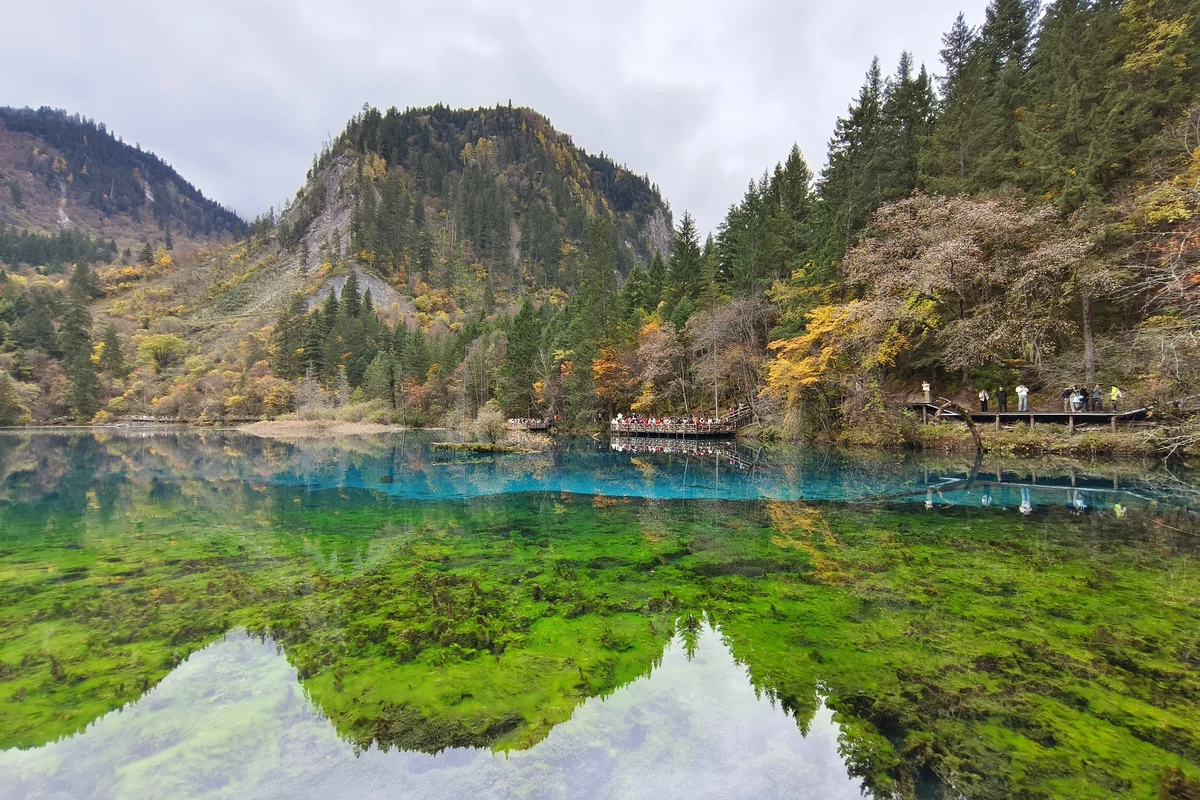
▼ Five-Flower Lake, the most colorful Haizi in Jiuzhaigou. Under light reflection and refraction, the calcareous deposits, algae, aquatic plants, and dead trees at the bottom present various colors—yellow, green, blue, cyan—vivid and dazzling. From a bird's-eye view, it resembles a peacock displaying its plumage.
Jiuzhaigou's unique cold-water fish can live in extremely cold environments.
A distant view of Five-Flower Lake shows three colors: blue, green, and yellow.
▼ Pearl Shoal, the widest shoal in Jiuzhaigou. Countless water droplets splash, resembling white pearls.
The water of Pearl Shoal cascades down to form Pearl Shoal Waterfall, 162.5 meters wide, 21 meters high, with a maximum drop of 40 meters, majestic and spectacular. The scene in the TV drama "Journey to the West" where Tang Monk and his disciples lead a horse through water was filmed here.
It can be seen that the water volume in winter is less than in spring and autumn.
▼ Mirror Lake, the third largest lake in Jiuzhaigou. When the wind is calm and the water is still, the surface is like a mirror.
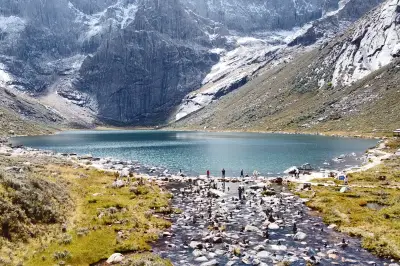
▼ Long Lake, the highest, deepest, and largest lake in Jiuzhaigou, shaped like an "S". It freezes in winter.
▼ Five-Color Pond, one of the lakes with the smallest storage capacity and the largest water level variation in Jiuzhaigou. Water seeps from Long Lake, showing obvious seasonal changes due to precipitation. It maintains a constant temperature throughout the year and does not freeze. Forgive me, even after four visits, I haven't seen five colors.
In winter, the water surface of Five-Color Pond is even smaller.
Going from Zechawa Gully's Five-Color Pond to Nuorilang Service Center, you pass by Upper Season Lake and Lower Season Lake. These are two seasonal lakes whose water surfaces change with the seasons: deep blue when full in autumn, emerald green when the water level drops in summer, and dry into grazing meadows in winter and spring.
▼ Nuorilang Waterfall, 320 meters wide, is the widest alpine calcareous waterfall in China.
Nuorilang Waterfall has a high-altitude viewing platform directly opposite the waterfall, accessible by stairs. From there, you can overlook the waterfall and the upstream Haizi.
▼ Rhinoceros Lake, the second largest Haizi after Long Lake. Legend says it was named after a high monk drank the lake water to cure his illness and then entered the lake on a rhinoceros.
▼ Tiger Lake, located upstream of Shuzheng Waterfall, connecting Rhinoceros Lake to the north and Shuzheng Lakes to the south. Fewer tourists, relatively quiet. Legend says tigers once came here to drink, and also because the colorful forest reflections in autumn are like tiger stripes.
The water is clear and transparent, with visibility over 12 meters. The submerged ancient fir and spruce trees at the bottom, wrapped in calcium deposits, have not decayed, and their branch shapes are clearly distinguishable. The dead wood surfaces are covered with white calcareous layers, forming a unique underwater forest landscape in the lake.
▼ Shuzheng Lakes, consisting of 19 Haizi, like a string of green emeralds set in deep mountains and valleys, forming a wonder of "trees growing in water, water flowing among trees." Each time I visit, I linger here for a long time, feeling the vast and enduring...
Shuzheng Lakes has a viewing platform on the boardwalk near the highway. Viewed from above, the magnificent scene is unforgettable.
▼ Wolong Lake (Crouching Dragon Lake), said to be named after a battle between a white dragon and a black dragon. There is a calcareous dike lying across the lake bottom, resembling a dragon diving underwater.
▼ Spark Lake, named because the sparkling waves look like sparks. The best time to see it is when the sun is slanting, but I never caught the right moment during my visits, so I only saw an ordinary Haizi.
▼ Reed Lake, a clear stream winding through a field of reeds.
▼ Semo Goddess Statue, on the rock face opposite Reed Lake. Semo and Dago, a couple, are the most powerful deities in Jiuzhaigou, jointly protecting the peace of the people.
▼ Bonsai Shoal, a shallow shoal where willows, poplars, cypresses, pines, and other plants grow densely, resembling a group of bonsai.
Thus ends a one-day itinerary. In the evening, you can watch the ethnic performance "Tibetan King's Banquet Dance," featuring Tibetan songs and dances, Tibetan and Qiang traditional costume displays, and you can go on stage afterward to interact with the performers.
You can also visit a Tibetan home to experience local customs.
I'll borrow a phrase as a conclusion: Every day we live now is the youngest day of the rest of our lives. Please don't grow old too fast but understand too late. While you can still move, have the time, and have the means, experience the wonders of the world. The great rivers and mountains that are worth seeing, playing, and eating are waiting for you!