May 2020 Off-Peak Self-Drive Trip to Jiuzhaigou, Huanglong, Dujiangyan, and Leshan Giant Buddha
Day 1: Chengdu - Wenchuan - Maoxian - Songpan - Jiuzhaigou (Driving time: 7-8 hours)
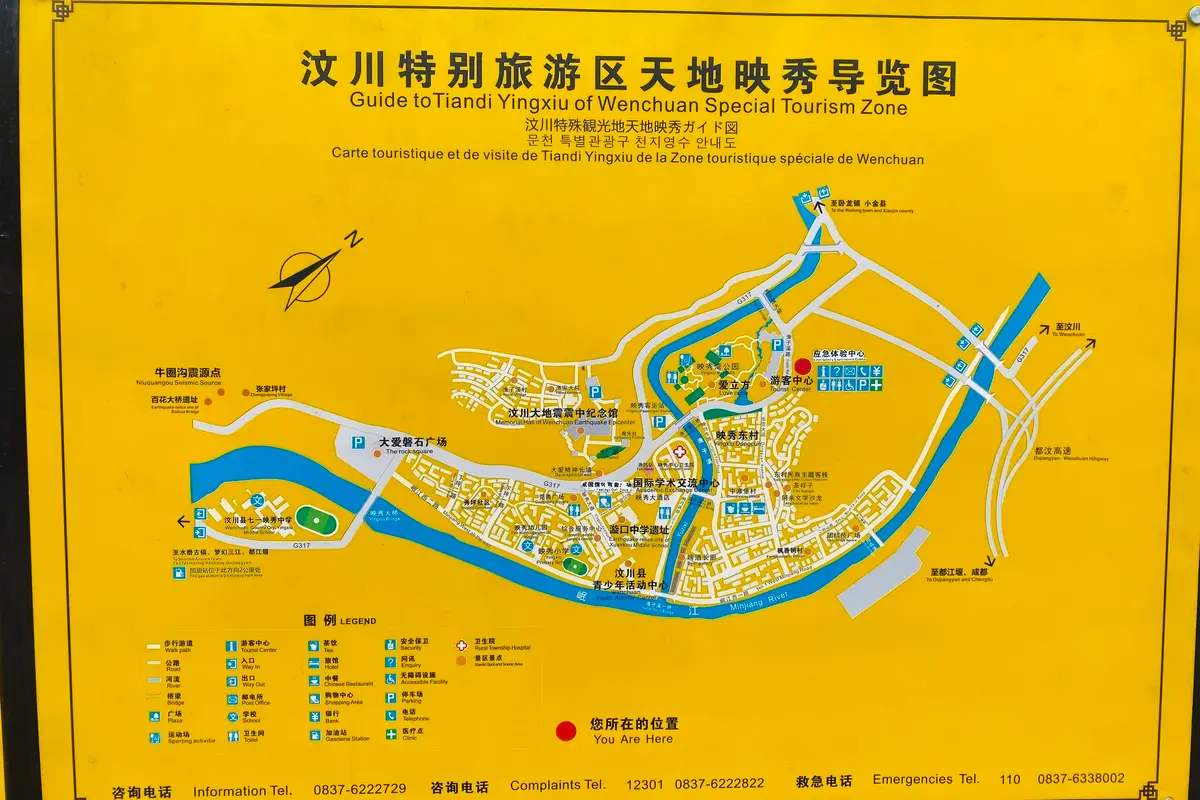
The first day was mostly on the road. Wenchuan, Maoxian, and others were along the same route. It happened to be shortly after May 12, so I thought of visiting the earthquake ruins. The first navigation destination was the Yingxiu Earthquake Epicenter Site (basically via Chengdu Ring Expressway - Rongchang Expressway, crossing the Min River multiple times along the way). After exiting the expressway onto National Road 213, the road was rough at times with lots of construction. The final navigation point was the parking lot at the visitor center. Those who don't mind walking can park there and walk down. There is a map at the entrance of the parking lot, so you can check it first.
We visited two representative places directly. First, we went down to see the Xuankou Middle School Ruins, then crossed a footbridge and climbed up the steps (you can buy flowers to pay respects on the way up), passed through the cemetery to the hillside, and saw the Wenchuan Earthquake Epicenter Memorial Museum. Honestly, these are places I never want to visit again because they are too sorrowful. Seeing the ruins and photos, you can imagine the devastation, and reality was far more tragic than imagination. The new Wenchuan is well-built. More than a decade has passed, and many people have moved on from the shadow and pain to start new lives. These ruins remain as a warning and a memory, forever accompanying those who were frozen in time on May 12, 2008.
We spent two hours here. All sites are free, but you need an ID card for the museum. During the pandemic, you also had to show the Tianfu Health Code and have a normal temperature check before entering. The museum is divided into several areas: before the earthquake, during the disaster, post-disaster reconstruction, and a science section demonstrating the effects of earthquake magnitude on buildings and people. When going downhill, you can support the local vendors. The Wenchuan big cherries sold in baskets are quite good.
The second stop was Maoxian for a rest and meal. Maoxian is a place rich in products—apples, plums, cherries, loquats, etc. It is an agricultural demonstration base. By the way, there are many Qiang people here, and there is the Ancient Qiang City (4A scenic spot) and a museum. If you have time, you can also visit. I suggest setting aside a full day here if time permits. The Qiang villages and culture are worth seeing; the place is quite large, and one or two hours are not enough.
The third stop was Songpan Ancient City, where we just took a photo at the gate. I chose to travel today also because of the weather forecast; otherwise, arriving early in Jiuzhaigou with wind and rain would not be fun. Later, on the return trip, we saw another gate of Songpan Ancient City and realized it is quite large.
Day 2: Jiuzhaigou (Visiting time: 8-9 hours)
Early in the morning, after breakfast at the hotel, we went to the temporary visitor center that we had scouted the night before (due to the 2018 earthquake, the main gate is being rebuilt, and private cars cannot drive into the scenic area; everyone must take the sightseeing bus from the temporary visitor center at the Blue Sky parking lot). Fortunately, as the hotel owner said, we managed to buy tickets at the individual visitor channel (we arrived after 6 PM the previous night and could not book online).
The Jiuzhaigou tour route is basically Y-shaped. As shown on the map, the bus goes along Shuzheng Valley, Rize Valley, up to the highest open point of Rize Valley—Five Flower Lake. On the way, when passing Mirror Lake, it was unusually calm and mirror-like, truly living up to its name. Unfortunately, the bus staff did not allow us to get off; we had to go to the top and then go down. By the time we arrived, the wind had picked up, and the mirror surface was gone—a great pity (my husband said he has been to Jiuzhaigou many times and never saw Mirror Lake like that).
The approximate route:
1. Rize Valley: Five Flower Lake - Pearl Shoal - Jinling Lake - Pearl Shoal Waterfall (filming location of Journey to the West) - 8.8 Earthquake Rock (weighing 522 tons) - Mirror Lake - Nuorilang Central Station.
Usually, the sightseeing bus takes you to Five Flower Lake, then you walk along the boardwalk, so many people take this route. If possible, go to Zechawa Valley first to avoid the crowds. The 2017 earthquake kept many attractions under maintenance and not open, such as Panda Lake, Arrow Bamboo Lake, and Swan Lake above Five Flower Lake.
Every spot has a bus stop. If you are tired or feel aesthetic fatigue from some spots, you can take a convenient bus to the next destination.
Nuorilang is a transfer center where three routes meet. To go to another route, you must transfer here.
We arrived at Nuorilang at noon. Before the crowds rushed to Long Lake, we went first. We only saw Nuorilang Waterfall on the way back to the Shuzheng Valley route.
2. Zechawa Valley: Long Lake (elevation 3000+) - Five-Color Pond - Upper and Lower Seasonal Lakes - Nuorilang Central Station.
This route is very long; one-day visitors cannot finish it on foot. After a loop at Long Lake, go directly to Five-Color Pond. When passing the Upper and Lower Seasonal Lakes, we saw they had no water. Many people returned to Nuorilang after seeing Five-Color Pond. May is the dry season with low water volume; Long Lake and Five-Color Pond were much less impressive than usual.
3. Shuzheng Valley: Nuorilang Waterfall - Rhinoceros Lake - Tiger Lake - Shuzheng Waterfall - Shuzheng Mill - Shuzheng Groves - (Crouching Dragon Lake and Double Dragon Lake not open) - Double Dragon Waterfall - Reed Lake (mostly dry) - Bonsai Shoal (sparse).
Basically, Bonsai Shoal is the last walking spot. From here, you board the bus to exit. Since Reed Lake was less attractive, some people, including me, did not bother to walk the extra 2.7 km to see this mostly dry lake.
After exiting, the parking lot is different from the one where you boarded, about 2 km apart.
Day 3: Jiuzhaigou - Jiuzhai Huanglong Airport - Chuanzhusi - Huanglong (Driving time: 2.5 hours, visiting time: 4-5 hours)
We made a detour to Jiuzhai Huanglong Airport and Chuanzhusi, not wasting much time. We arrived at Huanglong before noon. Huanglong is at a higher altitude than Jiuzhaigou, with most scenic spots around 3600m. Generally, visiting Jiuzhaigou first gives you time to acclimate from low to high altitude.
Huanglong has its own beauty, but I urge you to come in autumn, otherwise, with low water volume, it looks unremarkable and can be disappointing.
Day 4: Huanglong - Xueshanliang Viewing Platform - Red Army Long March Monument Park - Ancient Qiang City - Diexi Lake - Dujiangyan (Driving time: 6-7 hours)
The road just out of Huanglong on National Road 120 was terrifying; we didn't dare take a single photo. (The road seemed unmaintained, with fallen rocks and debris along the sides, not recommended for self-driving.) At the Xueshanliang Viewing Platform, my husband excitedly took photos everywhere while I shivered in the cold wind. At the Long March Monument, you have to climb hundreds of steps; only a few people, including my husband, climbed up. The Ancient Qiang City is in Maoxian; we took a photo at the gate and bought a kilo of big cherries from a stall. Diexi Lake's viewing platform offers a great view, but we couldn't stand the yak herder's shouting for photos and left in a few minutes.
Day 5: Dujiangyan - Mount Qingcheng (Visiting time: 4-5 hours)
During the pandemic, many temples on the front mountain were closed, so we mostly saw scenery. After being sunburned the previous day, walking through the green, shady mountain during the hottest part of the day was truly pleasant.
Tip: You can buy an audio guide to explain the attractions, but I don't recommend scanning the official scenic area code. Although the price is similar (about 10 RMB), the official one does not follow the route and cannot automatically play the introduction for your location. Having to adjust the audio while walking on mountain paths is annoying. You can buy the "Smart Electronic Guide" app, which I used during a trip to Northwest China; it was very convenient.
The hike was relatively simple, with directional signs along the way. Only the Nine Turns section was difficult, with uneven rocks and steps of varying heights and lengths. At Shangqing Palace, we could go no further, so we returned the same way or took another path down.
Day 6: Dujiangyan - Leshan - Mount Emei (Driving time: 3.5 hours, visiting time: 2.5 hours)
There were surprisingly few tourists at the Leshan Giant Buddha, so the queues for the up and down walkways were nonexistent, saving a lot of time. For a thorough visit, you can spend a whole day, and if conditions allow, stay overnight in Leshan. It is said that there is a spot in the city where you can see a reclining Buddha.
Day 7: Mount Emei - Chengdu (Driving time: 3 hours)
1. Jiuzhaigou (May is already peak season price)
Ticket + Sightseeing Bus: 259 RMB/person
Booking: Book online one day in advance (Note: Sales stop at 6 PM the day before). If lucky, you can buy tickets on the spot at the individual visitor entrance like we did (provided the daily limit is not exceeded; check the Jiuzhaigou official website for the limit, basically 10,000 people). It is recommended to book directly on the Jiuzhaigou official website, which links to the Aba Tourism official website; other platforms may add surcharges. I won't name names, but I saw such instances when checking tickets.
2. Huanglong (Unlike Jiuzhaigou, May is still low season price)
Ticket + Cable Car: 140 RMB/person (The cable car at Huanglong is really worth it. First, there is a free shuttle bus from the visitor center to the cable car entrance, then the cable car takes you directly to the top at Wanglongping, from where you can walk downhill, saving effort without missing the scenery—it saves you one way.)
Booking: Same as Jiuzhaigou.
Ticket: 80 RMB/person
One-way sightseeing car: 10 RMB/person (We were told at the drop-off point that there were still 2 km to the mountain gate. The sightseeing car only covers this section; actually, it's not long and there is a boardwalk; physically fit people can walk up.)
One-way cable car: 35 RMB/person (This covers the middle section, supposedly bypassing the Nine Turns path. In fact, we climbed up; when there are few people, it's not that difficult. If you buy only a one-way cable car, you walk 2 km from the drop-off point to the mountain gate, start climbing, then after halfway take the cable car, and after getting off, you still have the final section to climb. Round-trip cable car is the same.)
Booking: Currently, you can book on the same day; major websites are similar. But ignore the people at the drop-off point or mountain gate who try to persuade you to go to the back mountain. The front and back mountains of Mount Qingcheng each have their own features. If time is limited, I recommend visiting the front mountain first. If time permits, you can even stay on the mountain; there are hotels and Taoist temples offering accommodation.
4. Leshan Giant Buddha
Ticket: 80 RMB/person
Booking: Book one day in advance, and you also need to reserve a time slot. Details can be found on the Leshan Giant Buddha official website. Personally, I think the visitor limit is necessary because the two walkways for viewing the Buddha used to have queues of two to three hours just to enter. When crowded, it's not easy to navigate steps only 50 cm high, and you can't stop to enjoy the view.
1. Wenchuan Earthquake Ruins (Free)
See the itinerary description.
2. Maoxian Ancient Qiang City (Photo stop & paid)
See the itinerary description.
3. Songpan Ancient City (Photo stop & free)
4. Jiuzhai Huanglong Airport (Abbreviated as Jiuhuang Airport, elevation 3500m)
This is a place on the way from Jiuzhaigou to Huanglong. Flights are becoming increasingly scarce, open at fixed hours daily, only for passengers. When we went, the gate was closed, so we just looked from outside. It was a great effort to build an airport on this mountaintop, as it's hard to find a flat slope at high altitude. The scenery along the way up is very beautiful. Looking down from the mountain, you see large villages in the valley, with cattle and sheep leisurely by the road, not startled by people or cars. We even saw two highland pheasants standing in the middle of the road sunbathing.
5. Xueshanliang Viewing Platform (Elevation 4007m)
On the way from Huanglong to start the second half of the journey, because the day before we had taken the Xueshanliang Tunnel from Chuanzhusi and missed this pass, my husband was very regretful and insisted on taking County Road 120 today. So we ignored the navigation's constant suggestions to turn around and drove on the road with falling rocks and subsidence. The scenery was good; there were few beautiful snow-capped mountains at this time, but it was indeed very pretty. The ridge is about 4000m elevation, with strong winds; without warm clothing, it's not advisable to stay long. This road seems to have been unmaintained for a while, probably because the tunnel makes it unnecessary. (Self-drivers should choose this road cautiously.)
6. Red Army Long March Monument Park
The memorial hall was closed, but the square and monument were accessible. Climbing up requires hundreds of steps. There is a large paid parking lot.
7. Diexi Lake (Free)
A town is buried under the green mountains and clear waters (due to a major earthquake in 1933), a somewhat melancholic place. People with white yaks call out for photos at the viewing platform, 10 RMB each, which is reasonable. If interested, you can take a photo riding a yak; otherwise, just take your own photos.
8. Dujiangyan Irrigation System and Ancient City (Free)
If staying in Dujiangyan, you can stroll there in the evening, or find food. If it's too expensive, you can eat near Yudaiqiao Street first, then walk or use a shared bike to explore the brightly lit but peaceful old streets, carved bridges, and rushing river—an ideal place to escape the heat.
Finally, important things repeated three times: Whether the scenic spot is free or not, bring your ID card, bring your ID card, bring your ID card! Basically, you need to swipe your ID to enter!
All these scenic spots have parking lots within 1 km, with parking fees generally not exceeding 10 RMB. Self-drivers have no worries. Only for Mount Qingcheng, we took Bus 101 from Dujiangyan, which costs 2 RMB/person one way and takes about 1 hour.
Lunch: Maoxian Stone Mill Tofu Home-style Restaurant (parking available at the door; when looking at the menu, make sure to flip to the end for home-style dishes, very affordable. We ordered Shredded Pork in Beijing Sauce and Sweet and Sour Cabbage; generous portions, rice served in a bucket) Five-star rating!
Accommodation: Jiuzhaigou Fairy Tale Hotel (Tibetan Experience) (Includes breakfast and dinner, free self-service, a la carte available) (Less than 200 RMB per night)
Highly recommend this hotel: excellent value, and the owner is extremely helpful. They answered all our questions about visiting Jiuzhaigou and surrounding areas, gave us a lot of help, and the food was really delicious. They also offered homemade highland barley wine, mountain treasures like fungus, and provided foot soaking equipment.
Lunch: Self-prepared dry food within the scenic area.
Accommodation: Jiuzhaigou Fairy Tale Hotel (Tibetan Experience) (Includes breakfast and dinner, free self-service, a la carte available)
Breakfast: Hotel self-service.
Lunch: Self-prepared dry food.
Dinner: Ordered at the hotel (few tourists; the hostess cooked herself; generous home-style dishes).
Accommodation: Huanglong Yucheng Hotel (Located in a small town a few kilometers from Huanglong Scenic Area, elevation about 2800m, basically no effect on sleep. Highly recommended: newly renovated, clean and hygienic, courtyard parking, good service, can order food, breakfast available, excellent value, less than 100 RMB per night)
PS: Used the owner's mountain spring water pipe to wash the car.
Breakfast: Hostess made fried egg noodles.
Lunch: Self-prepared dry food.
Dinner: Dujiangyan Jiange Paper-Wrapped Fish (Yudaiqiao Street).
Accommodation: Dujiangyan La Faison Hotel (No meals included) (Less than 150 RMB per night) (Fresh and comfortable decoration, excellent location, good night views).
Breakfast: Yudai Noodles (Highly recommended; the shopfront is ordinary, but locals go there; probably only open in the morning, always busy. The dry mixed zhajiang noodles are amazing.)
Lunch: Self-prepared dry food.
Dinner: Taiping Zhang's Fermented Rice.
Accommodation: Dujiangyan La Faison Hotel (No meals included).
Breakfast: Yudai Noodles.
Lunch: Self-prepared dry food.
Dinner: Old Gedou Local Cuisine Restaurant.
Accommodation: Emeishan Hengbang Le Méridien Hotel (The most expensive and best accommodation on this trip).
Breakfast: Hotel self-service.
Food: Half a dozen Red Bull and coffee (to stay awake while driving), purple-skinned candy, hand-torn beef jerky, small bread, ham sausages, two packs of instant noodles.
Medication: Band-aids and Vitamin B2 (I've been to elevations above 3000m several times and am fairly acclimated; didn't bring anything for altitude sickness).
Clothing: Quick-dry short T-shirts, quick-dry outdoor pants, windproof and rainproof jacket, warm jacket, outdoor shoes.
Sun protection: Umbrella, hat, sunscreen, spray, arm sleeves, sunglasses (the high-altitude sun is not to be underestimated; my husband ended up peeling all the way back).
Other: Brought a multi-function flashlight for the car, fuel card and ETC (to speed up passage). Beauty lovers must bring hydrating face masks; high-altitude UV is harsh on the skin. Also, it's advisable to bring simple clothes hangers, laundry detergent, a spare set of toiletries, and a foot soaking bucket, as not all hotels provide everything you need.
Attraction tickets: 1173 RMB
Food and accommodation: 1731.91 RMB
Fuel and tolls: 800 RMB
Other: 322.6 RMB
Total: 4027.51 RMB
Itinerary Directory: 1. Route 2. Attraction Tickets 3. Paid Attractions 4. Free or Photo-Stop Attractions 5. Parking 6. Accommodation and Dining 7. Travel Preparation 8. Total Costs
Travel Info Hotel Index Guide Index Airline Index Website Guide Travel Index Cruise Index Corporate Travel Index Join Cooperation Affiliate Distribution Business Gift Card Purchase Insurance Agency Agency Cooperation Hotel Cooperation Destination & Scenic Area Cooperation More Join Cooperation About Ctrip About Ctrip Ctrip Hotspots Contact Us Careers User Agreement Privacy Policy Business License Security Center Ctrip Content Center Intellectual Property Trip.com Group Algorithm Disclosure}