Sichuan Travel: Jiuzhaigou, a Fairyland on Earth (Photos)
Jiuzhaigou in Sichuan is renowned both at home and abroad as a 'fairyland on earth' and a 'fairy tale world.' On June 8, 2004, after visiting Huanglong, the reporter headed to Jiuzhaigou, over 130 kilometers to the northeast. As is well known, Jiuzhaigou’s green tourism culture not only includes its picturesque natural landscapes but also incorporates the song and dance culture of the Tibetan and Qiang ethnic groups who have lived there for generations, creating a charming and unique ethnic风情 tour line.
Jiuzhaigou Memorial Stone (Photo by Feng Ganyong)
Not far from the entrance to Jiuzhaigou, the first things that catch visitors' eyes are two huge stones. On the right stone, three large red cursive characters reading 'Jiuzhaigou' are carved, with vigorous strokes and a flying-dragon-and-dancing-phoenix style, extremely eye-catching. The stone also marks the geographical location of Jiuzhaigou along with its longitude, latitude, and altitude parameters. A hada-shaped structure tightly connects the two huge stones, engraved with the Chinese and English phrase 'Tashi Delek' (Tibetan for 'good luck and auspiciousness'). Not far behind the huge stones is the monument of Jiuzhaigou Scenic Area. Following the crowd inward, one passes the ticket office and enters Jiuzhaigou.
Scenic Area Entrance (Photo by Feng Ganyong)
Known as a 'fairy tale world,' Jiuzhaigou is located in the central-southern part of Jiuzhaigou County within the Aba Tibetan and Qiang Autonomous Prefecture of Sichuan Province. It is a tributary of the Baishui River of the Jialing River in the Yangtze River system, named after nine Tibetan villages in the scenic area, including Heye, Shuzheng, and Zezhawa. The tourist area ranges from 2,000 to 3,100 meters above sea level, with a pleasant climate—no cold winds in winter, cool summers, and beautiful scenery year-round. It is one of the best tourist environment scenic areas in the world.
Sword Rock Hanging Spring (Photo by Feng Ganyong)
Jiuzhaigou Scenic Area was inscribed on the World Natural Heritage List in 1992; incorporated into the World Biosphere Reserve in 1997; rated as one of China's first batch of AAAA-level scenic spots in 2000; awarded the 'Green Globe 21' certificate in February 2001; honored as a National Excellent Scenic Area; among China's Top 40 Scenic Spots; a provincial-level civilized unit; an advanced unit for comprehensive management; and the top among Sichuan's three major tourism products.
Primeval Forest (Photo by Feng Ganyong)
Currently open to the public are three valleys: Shuzheng Valley, Rize Valley, and Zezhawa Valley. They form a 'Y' shape. The entire valley contains 114 emerald lakes, 47 springs, 17 groups of waterfalls, 11 rapids, 5 calcified shoals, and 9 Tibetan villages. The scenic area covers 1,320 square kilometers, with 30,000 hectares of primeval forest and 2,576 native species, including dozens of nationally protected animals and plants such as giant pandas, golden monkeys, and single-leaf grass.
Jiuzhaigou Long Lake (Photo by Feng Ganyong)
As the sightseeing bus travels along, the guide vividly describes the scenery along the way, prompting visitors to look left and right at the attractions outside the windows. After entering the valley, the bus first passes through Shuzheng Valley, then arrives at the intersection of the three valleys—Nuorilang Scenic Area—before continuing to the left into Zezhawa Valley, all the way to the bottom of the valley at Long Lake Scenic Area, where visitors disembark.
Arrow Bamboo Lake (Photo by Feng Ganyong)
Under the guide's direction, visitors start from Long Lake at the valley bottom and make their way back through the scenic spots of Zezhawa Valley, including Five-Color Pond, Upper Seasonal Lake, and Lower Seasonal Lake, stopping to sightsee one by one. After finishing Zezhawa Valley, they return to Nuorilang at the intersection of the three valleys, then take a bus to enter the primeval forest at the bottom of Rize Valley on the right.
Five Flower Lake (Photo by Feng Ganyong)
Upon arriving at the primeval forest, they again tour from the inside out, passing through many scenic spots of Rize Valley such as Sword Rock Hanging Spring, Fragrant Grass Lake, Swan Lake, Arrow Bamboo Lake, Panda Lake, Five Flower Lake, and Pearl Shoal, before returning to Nuorilang once more. From there, they head along Shuzheng Valley toward the valley entrance, passing through scenic spots like Nuorilang Waterfall, Mirror Lake, Rhinoceros Lake, Tiger Lake, Shuzheng Group Lakes, Crouching Dragon Lake, Spark Lake, Bonsai Shoal, and Reed Lake, finally reaching the valley entrance. Thus, the entire Jiuzhaigou tour concludes.
Bonsai Shoal (Photo by Feng Ganyong)
Along the three valley tour routes, besides the high-quality asphalt roads leading to various scenic areas, hundreds of wooden plank paths for tourism also stand within the valleys. Those who are physically fit can walk up and down the plank paths; those unwilling to exert effort can take the sightseeing bus, which stops conveniently at each station.
Pearl Shoal (Photo by Feng Ganyong)
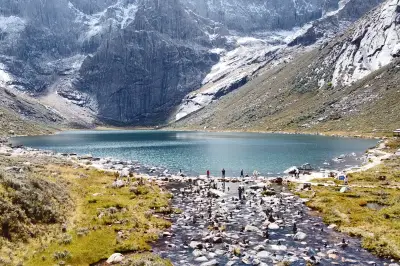
Do not underestimate this route. If one wishes to visit every scenic spot carefully, even a full day is not enough. After all, the cumulative distance amounts to dozens of kilometers. Particularly noteworthy in Jiuzhaigou are the numerous 'Haizi' (lakes). Although they vary in shape, their beautiful, clear, and expansive waters offer a delight to the eyes and mind.
Five-Color Pond (Photo by Feng Ganyong)
According to the guide, many films and TV productions have used these as outdoor locations to showcase their scenes. For instance, the thrilling sword-fighting scene in the movie 'Hero' was filmed at Arrow Bamboo Lake. Some scenes of the TV series 'Journey to the West' used Pearl Shoal as an outdoor setting. Whether countless lakes or waterfalls, they all revolve around water.
Pearl Shoal Waterfall (Photo by Feng Ganyong)
The water of Jiuzhaigou is its soul. It is azure and clear all year round, bright and transparent to the bottom. As light changes and seasons shift, it displays different colors and water rhythms. The beautiful ones are exquisitely translucent; the majestic ones are calm and vast; the tranquil ones are endearing. When the wind is calm and the waves are still, the blue sky, white clouds, distant mountains, and nearby trees are reflected in the lake. The peculiar scene of 'fish swimming in the clouds and birds soaring in the lake' appears repeatedly; above and below the water, reality and illusion are hard to distinguish; within and beyond dreams, it is both real and illusory. Five-Color Pond is a 'collaboration' of sunlight, algae, and lakebed sediments. In one lake, colors such as goose yellow, dark green, reddish brown, crimson, and emerald green form irregular geometric patterns, intermingling and mottled, like an unfolding five-colored brocade.
Nuorilang Waterfall (Photo by Feng Ganyong)
As the viewing angle moves, the colors also change—each step presents a different scene, infinitely varied. Some lakes, when rippling with the wind, sparkle under sunlight like blooming flowers. From a distance, they resemble a burning ocean; some lakes have calcified reef dikes lying at the bottom, giving a vague impression of moving dragons in the hazy water.
Shuzheng Waterfall (Photo by Feng Ganyong)
Throughout the valley, strange lakes are scattered in abundance, too many to take in. Over a hundred lakes, each surrounded by ancient trees and rare flowers, seem to be adorned with beautiful borders. The lakes are connected by swift waterfalls, like pieces of jade strung together by silver chains and white silk, each unique and endlessly varied.
Tibetan Singer Performing (Photo by Feng Ganyong)
Waterfalls are the best of water forms, a marvel of nature. Jiuzhaigou is a world of water and also a kingdom of waterfalls. Almost all waterfalls here rush out of the dense forest, like green looms tirelessly weaving white silk of various specifications.
Dance: The Fragrance of Butter Tea (Photo by Feng Ganyong)
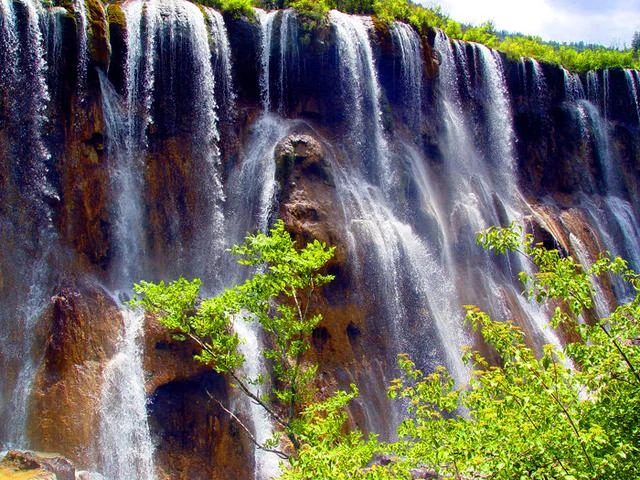
Here is Nuorilang Waterfall, the widest in China. It cascades down from high emerald cliffs like a huge curtain flying through the air, majestic and magnificent. Some waterfalls leap and roar from mountain cliffs, after several drops forming layered waterfalls, like a group of silver dragons competing to leap, roaring like rolling snow, splashing countless droplets into mist. Under the morning sun, strange and beautiful rainbows often appear, delighting the eyes and making visitors linger.
Qiang Flute Solo (Photo by Feng Ganyong)
The unique landscape formed by Jiuzhaigou’s lakes and waterfalls has given rise to the saying, 'No need to see other waters after Jiuzhaigou.' Water, reflections, millstones, Tibetan villages, prayer flags, and Tibetan and Qiang song and dance constitute the unique ethnic tourism culture of Jiuzhaigou.
Tibetan and Qiang Costume Art Exhibition (Photo by Feng Ganyong)
After a tiring day of sightseeing and a hearty dinner, sitting in the theater to watch a unique Tibetan and Qiang ethnic cultural performance not only offers a different kind of enjoyment but also serves as the best remedy for physical and mental fatigue.
Qiang Bell Dance (Photo by Feng Ganyong)
Next to the New Jiuzhai Hotel where I stayed, there is a theater called the Jiuzhaigou Ethnic Art Center. Every evening, the Jiuzhaigou Ethnic Art Troupe presents a song and dance gala featuring Tibetan and Qiang culture.
Male and Female Ethnic Performers (Photo by Feng Ganyong)
Among the many splendid programs—such as male and female ethnic singers' performances, passionate ethnic dances, Qiang flute solos, and Tibetan and Qiang costume art shows—visitors to Jiuzhaigou can fully appreciate the immense charm of the Tibetan and Qiang ethnic customs.
Reporter at Jiuzhaigou (Photo by Huang Chengyan)
The trip to Jiuzhaigou is unforgettable. In today’s world of scarce resources, Jiuzhaigou, grounded in the concept of green tourism, has increasingly improved its service facilities and has become a shining pearl in world tourism. This dreamy and poetic 'fairy tale world' is the most beautiful paradise that nature has bestowed upon humanity. Jiuzhaigou will surely continue to attract more and more visitors from home and abroad to explore this magical land. (Text & Photos: Feng Ganyong)