Away from the Hustle and Bustle: Eating, Drinking, and Fun in Sichuan – 6 Days
After so long, I finally have the patience to write this down. Traveling on non-workdays is also a good choice, and this time I managed to avoid the super peak tourist season by going just before the eight-day Double Festival holiday! Lucky me!
PS: Attraction introductions are sourced from the internet.
The reason for choosing Huanglong and Jiuzhaigou was to get away from the city, breathe fresh air in nature with fewer people. Sichuan has always been a place I wanted to go for its food, so the decision was made.
September 18 – September 23, 2020
Probably because we were just before the peak tourist season, airfare and tour fees weren't that expensive, so after all free spending, total cost was 5000 RMB.
Let me emphasize clothing: The temperature in Chengdu was fine; short sleeves plus a long-sleeve layer for morning-evening temperature difference worked. Jiuzhaigou, being in a mountainous area, and Huanglong, due to its higher altitude, both required thick jackets. Without sunlight, it felt chilly and damp. A softshell jacket with a fleece lining over a long-sleeve shirt was sufficient.
Now about altitude: Jiuzhaigou's 2000+ meters was acceptable, but Huanglong's over 3000 meters caused some trouble. Don't be reckless by jumping or running; if you can't handle it, you'll immediately get dizzy and have headaches. There's also the possibility of delayed symptoms after descending, or even high blood pressure. So know your own physical condition, and it's best to take preventive medication. On the day you go up to altitude, reduce strenuous activities and act within your limits.
Considering the difficult mountain roads and uncertain sightseeing times, I chose to join a local tour group in Chengdu.
Day01 Beijing – Chengdu
Day02 Chengdu – Huanglong – Songpan
Day03 Songpan – Jiuzhaigou
Day04 Jiuzhaigou
Day05 Jiuzhaigou – Chengdu
Day06 Chengdu – Beijing
Day01 Beijing – Chengdu
For the food, we started with the flight. Considering our schedule, we finally chose Sichuan Airlines, aiming for the airline reputed to have the most abundant and delicious meals.
Takeoff was delayed, but we arrived early. The good news: we caught the last subway, so we made it to our hotel without issue.
Day02 Chengdu – Huanglong – Songpan 7:00 – 20:30
Strictly speaking, this was the most exhausting day. Most of the day was spent on the road, plus we had to go up in altitude and climb mountains – tiring to the extreme.
The straight-line distance from Chengdu to Huanglong isn't far, but the entire route is winding mountain roads, with low speed, many trucks, and potential unexpected incidents (car accidents, mudslides, road construction, etc.).
Leaving Chengdu city, we first saw the Zipingpu Reservoir.
We passed by Yingxiu Town and Wenchuan County, areas hardest hit on May 12, 2008. New buildings have been built, new life has begun, but the historical pain will not be forgotten.
Lunch was at Chuanzhusi; a group hotpot meal with chicken broth base and various mushrooms and cordyceps flowers – very tasty.
We arrived at Huanglong at 15:30 and started queuing for the cable car. I didn't expect so many people that we had to queue; initially, I thought there would be few people.
Huanglong Scenic and Historic Interest Area is located in Songpan County, Ngawa Tibetan and Qiang Autonomous Prefecture, Sichuan Province. It covers an area of 700 square kilometers. It is the only well-preserved plateau wetland in China, 100 km from Jiuzhaigou, with an altitude of 1700–5588 meters.
Huanglong is world-famous for its four unique features: colored pools, snow mountains, valleys, and forests. Along with beach streams, ancient temples, and folk customs, these are called the "seven wonders." The scenic area includes Huanglong Gully, Danyun Gorge, Mouni Gully, Xuebaoding, Xueshanliang, Hongxing Rock, Xigou, etc. The main attractions are concentrated along the approximately 3.6 km long Huanglong Gully, which is filled with calcium carbonate deposits arranged in terraced fields. It is renowned for its rich flora and fauna, and enjoys the reputation of "World Wonder" and "Jade Pond on Earth." In 1992, it was inscribed on the World Natural Heritage list. Besides alpine scenery, you can also find various forest ecosystems, limestone formations, waterfalls, and hot springs. This area is also home to many endangered species, including giant pandas and Sichuan golden snub-nosed monkeys.
Huanglong is famous for its large-scale, structurally ingenious, and colorful surface travertine landscape, known as a rare karst landform that is astonishing both in China and abroad. It is a World Natural Heritage site, a UNESCO Man and Biosphere Reserve, a holder of the "Green Globe 21" certificate, a National AAAAA Tourist Attraction, and a National Key Scenic Area.
Riding the cable car, we went up in 4 minutes. From the cable car station to the attractions, there is a wooden forest trail. Walking slowly, breathing the humid forest air was comfortable. For us, it felt like walking in mist, with tiny water droplets floating around; for people down the mountain, it would be like walking in the clouds.
Five-Color Pond is at an altitude of 3576 meters, with a pool area of 21,000 square meters and 693 pools. It is the largest group of colored pools in Huanglong Gully, and also the largest and highest-altitude open-air travertine colored pool group in the world. The pond banks are low and irregularly arranged. The overflowing water looks from afar like pieces of jade plates. Under sunlight, colors of white, purple, blue, green vary in intensity, brilliant and beautiful. In winter, against the backdrop of snow-covered trees, the pools remain blue as jade, mysterious and fantastic. The pool banks come in various shapes—arcs, fans, skirt-like—arranged in layers, like a three-dimensional oil painting of "Jade Pool on Earth" and a wordless love poem of "Holy Land Paradise." The pool water becomes colorful due to sediment, bank color, light refraction, and depth. The changing light creates a "five-colored scene" from the same water source, making it a spectacular sight in Huanglong.
Following the boardwalk up the mountain, we reached the Five-Color Pond at the top, but it was all white due to fog.
According to online travel notes, both sides of Five-Color Pond should be accessible. But perhaps due to weather, only one side was open. There were two paths: first, near the pond for close-up views, then up to a higher viewing platform for a panorama. But with fog, it was just white.
Descending along the boardwalk, we passed other main attractions of Huanglong. To save time heading down, I took random photos, with worsening results.
At 19:30, when it was completely dark, everyone in the group finally gathered at the main gate. The way down was misty rain, and we rushed down—really thrilling.
That day, we went from an altitude of less than 1000 meters straight up to 3500 meters, then back to 2800 meters. I didn't pay attention and jogged a few steps right after getting off the cable car at Huanglong, and altitude sickness hit me immediately. Throughout the entire Huanglong tour and back at the hotel for dinner and rest, I had a continuous headache and dizziness. I managed to temporarily relieve it with Baifuning (I didn't bring a painkiller) and slept well, resting well for the night. So regardless of whether you've experienced altitude sickness before, be prepared for it. And absolutely do not engage in strenuous exercise above 3000 meters. Keep all movements as steady as possible, regulate your breathing. If you feel unwell, there are oxygen bars along the boardwalk (not open during the pandemic!).
Day03 Songpan – Jiuzhaigou / Day04 Jiuzhaigou
To prevent shortened sightseeing time due to uncontrollable factors, I deliberately chose a two-day tour in Jiuzhaigou. From the perspective of a first-time visitor, this choice was very wise.
On the first day, it took about two hours on winding mountain roads from Songpan to Jiuzhaigou. Those prone to motion sickness should take precautions. We set off around 8:00 and arrived around 10:00, just avoiding the main crowd going up the mountain, so we didn't encounter a crush at the entrance. On the second day, we arrived around 9:00, joined the main crowd, and experienced a "sea of people." I later heard that on the first day, there was pushing and shoving, and the crowd even knocked down the barriers. So on the second day, armed police were also added to maintain order.
Jiuzhaigou is located in Zhangza Town, Jiuzhaigou County, Ngawa Tibetan and Qiang Autonomous Prefecture, in the southern section of the Minshan Mountains in northwestern Sichuan Province. It lies northeast of Gonggang Ridge, on the southern segment of Minshan. It is over 400 km from Chengdu, and is a large tributary of the Baishui River, which is the upper reaches of the Jialing River in the Yangtze River system. The Jiuzhaigou Nature Reserve is higher in the south and lower in the north, with deep valleys and great height differences. The northern entrance is only 2000 meters above sea level, while central peaks are over 4000 meters, and southern edges exceed 4500 meters. The main gully is over 30 km long.
The name Jiuzhaigou comes from the nine Tibetan villages within the scenic area (Shuzheng, Zechawa, Heijiao, Heye, Panya, Yala, Jianpan, Rexi, Guodu), also known as "Heyao Nine Villages." Because these nine villages have been inhabited by Tibetans for generations, it is called Jiuzhaigou (Nine Village Gully).
Jiuzhaigou is a World Natural Heritage site, National Key Scenic Area, National AAAAA Tourist Attraction, National Nature Reserve, National Geopark, and UNESCO Biosphere Reserve. It is China's first nature reserve primarily established for protecting natural scenery. Jiuzhaigou is famous abroad: Easterners call it "fairyland on earth," while Westerners call it "fairy-tale world."
Current situation of the scenic area:
Jiuzhaigou comprises three valleys: the main Shuzheng Valley, the left branch Zechawa Valley, and the right branch Rize Valley. After the August 8 Jiuzhaigou earthquake (2017), the scenic area stopped receiving visitors. It reopened after September 27, 2019, and briefly closed in late August this year due to rainfall. Currently, all of Shuzheng Valley and Zechawa Valley are open, but Rize Valley is only open up to Five-Flower Lake; from Panda Lake Waterfall to the Primeval Forest is still closed. Additionally, due to geological conditions and rainfall, some connecting boardwalks between scenic spots are also closed.
Currently, entry into the scenic area is only via shuttle bus, costing 80 RMB per person. The boarding and alighting parking lots are in different places. Independent travelers should note the parking situation (can walk or take a taxi between the two lots). Those on a tour can follow the guide. The tour bus parking lot is about 1 km from the shuttle bus drop-off lot, which is a commercial street. During my visit, prices were very reasonable—great impression! [According to news during the National Day holiday, the main gate has reopened; check actual conditions.]
The junction of the three valleys is near Nuorilang Waterfall, serving as a transfer hub. Shuttle buses take visitors to the farthest scenic spots. Which valley you go depends on the Nuorilang Dispatch Center. If you have a clear direction, be sure to inform the driver and onboard guide when boarding. If you end up on a different route, you can get off at the Nuorilang transfer point and switch to the corresponding vehicle. Or if you board the wrong direction, you can stay on and ride back to Nuorilang.
My itinerary:
Day 1 in Jiuzhaigou: Rize Valley, Shuzheng Valley
Day 2 in Jiuzhaigou: Zechawa Valley, Shuzheng Valley
Now let's introduce the attractions~
Starting with our first itinerary – Rize Valley.
Three current attractions in Rize Valley: Five-Flower Lake, Pearl Shoal, Pearl Shoal Waterfall, and Mirror Lake.
Theoretically, you can walk the boardwalk from Five-Flower Lake to Mirror Lake, but currently the boardwalk from Pearl Shoal Waterfall to Mirror Lake is closed. It's mostly downhill. If concerned about stamina, you can take the bus between scenic spots. If you have energy, you can walk through the woods, easily drifting away from the crowds. Finally, from Mirror Lake you must take the bus back to Nuorilang.
Five-Flower Lake: Elevation 2472 m, depth 5 m, area 90,000 sq m. Known as "a unique sight of Jiuzhaigou" and "the essence of Jiuzhaigou," it sits above Pearl Shoal Waterfall, below Panda Lake, at the end of the upper reaches of Peacock River in Rize Valley. A lake harmonized by nature into colorful brilliant scenery—a magnificent sight that humans can never recreate.
Five-Flower Lake, as the first stop, was packed with people... But with enough time, consider walking around it; fewer people reveal unique scenery.
From the boardwalk from Five-Flower Lake to Pearl Shoal, looking back you can see both natural and human-made scenery.
Pearl Shoal: Located at the junction of Rize and Nanri Valleys, elevation 2433 m. A fan-shaped travertine shoal, it is one of Jiuzhaigou's spectacular sights. Pearl Shoal is a relatively wide stone shoal among Jiuzhaigou's many seas. Clear lake water rushes down the sloping, uneven stone surface, splashing into countless silver beads like pearls—hence the name. Too many people, and just then the sun came out, making it very dazzling.
Pearl Shoal Waterfall: Elevation 2445 m, height 21 m, width 162 m. It is a typical combined landscape in Jiuzhaigou. It is the place where the Tang Monk and his disciples waded through water in the opening of the TV series "Journey to the West." Pearl Shoal Waterfall is like a galaxy falling from the sky, magnificent, with a thunderous roar in the valley. The wide waterfall crashes into the valley floor, roaring like thunder, rolling up thousands of waves, creating mist in the green valley, then rushing eastward. The sound is like thunder, the mountain stream seethes, majestic.
It's a major and famous attraction (probably few haven't seen the opening of "Journey to the West"), so it's crowded. Seize gaps to take photos; you might get a solo shot.
Mirror Lake: Located at the junction of Shuzheng and Rize Valleys, elevation 2390 m, one of Jiuzhaigou's famous attractions. It is like a mirror, faithfully reflecting the scenery above. At dawn, with morning glow tinting the eastern sky, the lake is smooth as a mirror, reflecting blue sky, white clouds, and snow mountains, creating the wonder of "fish swimming in the clouds, birds flying in the water." Photography tip: Mirror Lake is famous for its calm surface (usually before 9 AM and after 5 PM when windless). Due to its relatively open terrain, especially in summer at 5 PM with sunlight, if calm, water and sky merge.
Our second itinerary – Shuzheng Valley
Attractions: Nuorilang Waterfall, Rhinoceros Lake, Tiger Lake, Shuzheng Waterfall (Shuzheng Village), Shuzheng Group Lakes, Wolong Bay, Shuanglong Lake, Reed Lake, Bonsai Lake.
Recommended route for good stamina and ample time: Walk from Nuorilang Transfer Center to Nuorilang Waterfall, then walk down about 400m to the bus stop to ride to Rhinoceros Lake (boardwalk not open). From Rhinoceros Lake to Shuzheng Village you can walk (all three routes available). From Shuzheng Village to Shuanglong Lake by bus. From Shuanglong Lake to Bonsai Lake on foot (about 2.5 km). From Bonsai Lake to Zharu Temple by bus (far, boardwalk closed). From Zharu Temple to scenic area parking lot by bus.
I walked this route exactly twice, and the scenery was different each day.
Nuorilang Waterfall: Elevation 2365 m, height 24.5 m, width 320 m. It is a retreat-type waterfall, retreating at 0.22 m/year. It is the widest travertine waterfall discovered in China so far. "Nuorilang" in Tibetan means male god, also implying tall and mighty. The roaring water comes from Nuorilang Group Lakes, plunging from the treetops at the top, like a galaxy pouring down, with powerful force and thunderous sound.
Rhinoceros Lake: About 2.2 km long, 17 m deep, elevation 2400 m, deepest point over 40 m. It is the largest lake in Shuzheng Valley and one of the most varied in scenery in Jiuzhaigou. Its reflections are arguably the best among all lakes. In early morning with drifting mist, the cloudy reflections are surreal, making it hard to distinguish sky from lake. The colorful leaves around the lakeshore are also bright and beautiful.
Tiger Lake: Elevation 2298 m, located above Shuzheng Waterfall. Deep and serene, it hides violence in silence, rebelliousness in tranquility. The Shuzheng Waterfall, cascading like clouds and snow, is its sudden burst of vitality and passion. The waterfall sound is deep and powerful, like thunder, akin to a tiger's roar. In deep autumn, the mountainside forests are dyed in brilliant colors, reflected in the clear lake, mottled like tiger stripes. Tiger Lake is 310 m long, 171-194 m wide, 25 m deep, with a capacity of about 1.1 million cubic meters, so even in winter it has abundant water.
Shuzheng Waterfall: Located in Shuzheng Valley of Jiuzhaigou Scenic Area. It is the first waterfall you see upon entering the valley, and the smallest of Jiuzhaigou's four major waterfalls. It is composed of numerous cascading waterfalls connected end to end. The water is strong and fierce, like thousands of troops beating drums and waving flags, with a thunderous roar. On the embankments stand clumps of highland shrubs, rooted in the water, standing proudly against the torrent. They remain standing and uncorrupted after years of water impact, graceful, forming a special plant community and a rare natural wonder. Shuzheng Waterfall is by the road in front of Shuzheng Village, the first waterfall upon entering the valley, and the smallest of the four major waterfalls. Yet even the smallest can thrill first-time visitors. Elevation 2295 m, height 25 m, top width 72 m. The water from Wuming Hai bursts along the lake embankment, split into thousands of streams by submerged trees, converging at the top of Shuzheng Waterfall.
Shuzheng Group Lakes Scenic Area is the gate to Jiuzhaigou's beautiful scenery. It includes Reed Lake, Shuanglong Lake, Wolong Lake, Spark Lake, Shuzheng Group Waterfalls, Shuzheng Group Lakes, and Nuorilang Waterfall. The entire Shuzheng Group Lakes valley is 13.8 km long, with 40-odd lakes (seas), accounting for about 40% of all lakes in Jiuzhaigou. Water from the upper lakes spills over the embankment, overflowing from the trees, stirring up white spray, jumping and darting among the green. The water cascades down the embankment, forming numerous curtains, graceful and ever-changing. The entire group of lakes is well-layered, with green mixed with blue, childlike innocence and nature.
Shuanglong Lake: Above Reed Lake, below the Shuzheng Group Lakes waterfalls. Through the crystal clear water, you can see two带状生物钙华礁堤 (ribbon-like biogenic travertine reefs) faintly hidden at the bottom, like two dragons lurking in the water, wriggling and ready to leap into the sky.
Reed Lake: Elevation 2140 m, length 2.2 km, a semi-swamp lake. Reeds grow densely in the lake, water birds fly, clear streams and green ripples, winding through—a true waterland scenery. In the "Reed Lake," the reeds are lush green, swaying gently in the breeze. The rustling sound is soothing, refreshing the mind.
Bonsai Shoal: At the end of Reed Lake, the river widens, reeds disappear, replaced by clusters of bushes scattered on the shoal—this is Jiuzhaigou's first scenery: Bonsai Shoal. Also called "Bonsai Lake," Tibetan name "Jiazu Cuo," it is the first shoal landscape entering Jiuzhaigou.
Zharu Temple: Located halfway along the Zharu Horse Trail, in a large apple orchard. It is the largest and most famous lama temple near Jiuzhaigou, and a sacred place for Bon believers. Tibetan name is "Ranwu Gongba." It was built in the late Ming Dynasty, underwent two renovations, with strong Tibetan temple colors. Zharu Temple belongs to "Yongzhong Bon", the authentic Buddha dharma taught by Shenrab Miwoche, also known as the oldest ancient Shangshung Buddhism.
Zharu Temple backs onto a green mountain and faces the Baoying Cliff. Golden roofs and red eaves, five-colored prayer flags whispering prayers in the wind. It has both solemn Buddhist flavor and primitive Bon remains. The temple covers an area of over 100 mu, with a building area of over 20,000 square meters. The landmark building is the "Yongzhong Lazhe Pagoda," with 5 floors: first floor museum, second exoteric hall, third esoteric hall, fourth mind hall, fifth floor houses Buddha's relic stupa and the Tripitaka "Gangyur" in 108 volumes.
Our third itinerary – Zechawa Valley
Attractions: Long Lake, Five-Color Pond, Upper Seasonal Lake, Lower Seasonal Lake.
Zechawa Valley's tour route is relatively simple: Get off at Long Lake, walk along the boardwalk to Five-Color Pond, then continue walking to Five-Color Pond bus stop to take the shuttle back to Nuorilang Transfer Center. A small note: you can spend a little time walking a bit further down from Five-Color Pond station to reach the viewing platform for Upper Seasonal Lake. There is a boardwalk from Upper to Lower Seasonal Lake, but it's very far and currently closed, so take the bus.
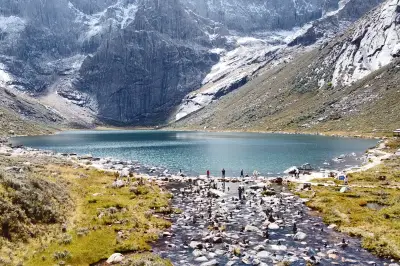
Long Lake: Elevation 3060 m, about 5 km long, 600+ m wide, area 930,000 sq m, at the end of Zechawa Valley. The peaks beside Long Lake are covered with snow year-round, surrounded by lush forests. From the viewing platform, blue sky, white clouds, and snowy peaks are all in sight, with sky and mountains blending together without distance—a major scenery of Long Lake. Long Lake is the highest and widest sea in Jiuzhaigou. The water is dark blue, sourced from alpine snowmelt. Strangely, Long Lake has no outlet, yet it doesn't overflow in summer/autumn rain, nor does it dry up in winter/spring drought. Hence locals call it a treasure gourd that can't be filled or emptied. The lake is up to 100+ meters deep, shaped like an S. Surrounding forests are lush, peaks snow-covered year-round. In winter, the ice layer can be up to 60 cm thick, making it an ideal place for ice sports.
On the roadside to Five-Color Pond, mist floats among the mountains, so I always felt like walking in the clouds.
Five-Color Pond: 1 km down from Long Lake. Elevation 2995 m, depth 6.6 m, hidden in a deep valley below the road. Though the smallest among Jiuzhaigou's seas, its colors are the most brilliant, rivaling Five-Flower Lake. Five-Color Pond is extremely clear; through the water, you can see the stone patterns on the bottom. Due to differences in bottom sediments and lakeside plant colors, the originally azure lake becomes colorful. It is the essence of Jiuzhaigou's lakes, the most exquisite sea, known as the "Eye of Jiuzhaigou."
The boardwalk here is narrow and crowded; be careful and yield to each other.
Upper and Lower Seasonal Lakes: From Five-Color Pond downward, you soon reach Upper Seasonal Lake. Lower Seasonal Lake is further down from Upper, far apart but each with its own character. They are unique seas in Jiuzhaigou, their water volume varying with seasons. They fill up in autumn, change in other seasons, mostly sleeping quietly in the mountain hollow, showing the beauty of time and harmony between heaven and earth.
Upper Seasonal Lake is adjacent to Five-Color Pond, with water changing seasonally—sometimes full, sometimes dry. In autumn rains, water rises, lake is azure; summer water is shallow and turquoise; early winter onwards, water dries up, lakebed grows grass, becoming a grazing meadow with a UN protected plant – Ruoxiweiqi.
Lower Seasonal Lake is set in a flowery and grassy hollow. Water volume varies with seasons. In autumn, abundant rain fills the lake, making it most blue and transparent, like fresh blue ink. In winter and spring, water level gradually drops until early summer, when the lake may completely dry up, the bed covered with grass, becoming a good place for grazing cattle and horses. Beside the road on the lakeshore, there are several tall trees that turn golden in autumn, shining like gold.
I was lucky to encounter a sunny day on the first day and an overcast day on the second. I saw both weather's scenery, and didn't have to rush at each spot; I could take it slow. On sunny days, the water is clear and transparent, very prominent. On overcast days, the water appears milky white, with lower contrast against the mountains, creating a fantastic overall effect, and the mist in the mountains gave a fairy-tale feeling.
About food: There is a place to eat at Nuorilang Service Center. I heard the prices are reasonable, but people may gather. I brought my own lunch and snacks for two days, enjoying them while listening to the sound of water at less crowded spots on the boardwalk—more pleasant.
About sightseeing: The shuttle buses take everyone to the highest spots, so Long Lake and Five-Flower Lake are especially crowded. The further down you go, the more dispersed people become, more comfortable. If you enter Shuzheng Valley before 1 PM, you might find spots with no one, free to take photos (most people are still in the other two valleys or at Nuorilang Service Center). In summary, by avoiding crowds through time and distance, you can easily discover beautiful scenery and enjoy a comfortable tour.
A note on accommodation: We were arranged at the New Jiuzhai Hotel at the mouth of the valley, where the Premier once stayed and inscribed a calligraphy—instantly classy!
Day05 Jiuzhaigou – Chengdu
Another day on mountain roads. Originally I planned to buy local specialties like crisp plums during a stop in Mao County, but we encountered a rare three traffic jams: first a car accident, second and third for single-lane road construction. Even the driver uncle said he had never experienced so many jams.
Return trip attractions: Minjiang River Source, Songpan Ancient Town.
Minjiang River Source: a rest area by the road, over 3000 m above sea level. From here, it's all downhill.
Songpan Ancient Town is divided into inner and outer cities. The inner city climbs over the mountain, roughly triangular, with a rectangular shape in the valley bottom east of the mountain. The outer city is adjacent to the southern valley bottom below the inner city, connected by a gate, rectangular in shape. The city wall was built in the Ming Dynasty. The blue bricks used were 50 cm long, 12 cm thick, each weighing 30 kg. The total wall length is 6.2 km, height 10 m, width 30 m, built with locally fired blue bricks, filled with earth and stone inside, 12.5 m high, 12+ m thick, bonded with mortar made from glutinous rice, lime, and tung oil, as strong as an iron wall. The gates are arched with large regular rectangular stone blocks. Songpan Ancient Town is grand and magnificent; its wall length, height, thickness, and exquisite relief carvings are unparalleled in ethnic regions. It is a provincial-level cultural relic protection unit.
During the Tang Dynasty, Tibetan king Songtsen Gampo sent an envoy to Chang'an to seek a marriage alliance. When the envoy passed through Songzhou (Songpan), he was detained by the local governor. Songtsen Gampo was furious and personally led an army of 200,000 to invade. Tang governor Han Xian was defeated. Emperor Taizong ordered the Minister of Civil Service to lead troops to Songzhou. After the Battle of Chuanzhusi, the Tang army won a great victory. Songtsen Gampo returned to Tibet and then sent envoys with gold to seek peace and marriage. Emperor Taizong, after explaining the principles, married Princess Wencheng to Songtsen Gampo, which became a much-told tale. Legend says this is where Songtsen Gampo welcomed Princess Wencheng.
Songpan is also an important revolutionary historical memorial site. The Central Committee of the CPC held five important meetings during the Long March, two of which (the Shawo Meeting and the Maoergai Meeting) took place within Songpan. In commemoration of the Long March's great feat and to promote the Long March spirit, the Central Committee and Central Military Commission decided to build the Red Army Long March Monument Park in Chuanzhusi Town, Songpan. The main monument stands tall on Yuanbao Mountain in Chuanzhusi, backed by snow mountains and forests, facing the grassland. The main monument is 41.3 m high, with a 14.8 m bronze statue of a Red Army soldier on top. The soldier holds flowers in one hand, a gun in the other, arms raised high in a "V" shape, symbolizing the great victory of the Long March. The monument body is covered with 450 copper alloy panels, triangular in shape, symbolizing the three main forces of the Red Army—First, Second, and Fourth Front Armies—marching north to resist Japan, with indestructible victory. The base is faced with white marble, surrounded by green lawn, meaning "Snowy mountains and grasslands establish a monument." The park contains China's largest modern art sculpture group, depicting the arduous journey of the Red Army through artistic imagery. The sculpture group is 72 m long, 8 m wide, highest point 12.5 m, made from 1160 cubic meters, 1440 blocks of red granite, finely carved and assembled, combining glorious revolutionary history with modern art charm, grand and awe-inspiring.
After crazy traffic jams, we finally arrived in Chengdu city and checked into the hotel at 8 PM. We rode for 11 hours; lucky it was the return trip, not a more delay-prone outbound trip.
Dinner was at Bashu Dajiang.
At 10:30 PM, I slipped over to Jinli. Few people, quiet prosperous area—unexpectedly beautiful! Though I couldn't enjoy the food, the scenery made up for it.
Day06 Chengdu – Beijing
Today's itinerary had impromptu stops: the closed US Consulate General in Chengdu, Chunxi Road, and Wuhou Shrine.
I rode a bike to the consulate early in the morning. Felt like subway construction was everywhere, making cycling not very pleasant. More amusingly, the entrance was also surrounded by subway construction barriers.
Took the subway to Chunxi Road. It had the price and feel of a tourist spot: crowded, expensive, bustling. Finding a supermarket to buy souvenirs (hotpot base, beef jerky, Sichuan pepper, chili, buckwheat tea, etc.) was a good choice.
Today's core goal: Fuqi Feipian (Couple's Lung Slices) (main store). After eating, I felt it's really a great place for meals and desserts. Must-order: Fuqi Feipian! Also, Sichuan cold noodles and ice jelly were super delicious! I recommend all spicy items. I can't handle spicy food, but I could manage it; it's not purely spicy but very aromatic—the fragrance makes you want to eat more! Highly recommend!
With spare time, we added Wuhou Shrine.
Then packed up, went to the airport, checked in, and boarded the flight home.
The biggest regret of this trip was not seeing sunny scenery at Huanglong, but that's something dependent on fate and luck—no help for it. It gives a reason to come again. I heard that a railway from Chengdu to Lanzhou is under construction; maybe in some years we can take a train to Jiuzhaigou and Huanglong.
Another regret: too little time in Chengdu—didn't eat enough, haha. I'm planning another Sichuan trip where I'll spend more time in Chengdu just for eating. If needed, I can also include surrounding attractions for check-in. The Chengdu subway covers a wide area; many attractions can be reached by subway, and inter-site shuttle buses are also a good option.
Jiuzhaigou is truly an amazing place! So, so, so worth it! Photos can only show a fraction; you have to be there to feel nature's creativity and Jiuzhaigou's stunning beauty!
Regrets pave the way for next visits. This trip to Jiuzhaigou and Huanglong was truly worthwhile!
Travelogue directory
1. Preliminary Information
2. Travel Time
3. Cost
4. Equipment
5. Itinerary
6. Summary
Travel Info, Hotel Index, Guide Index, Airfare Index, Website Navigation, Travel Index, Cruise Index, Corporate Travel Index, Join Cooperation, Distribution Alliance, Friendship Links, Corporate Gift Card Purchase, Insurance Agency, Agent Cooperation, Hotel Joining, Destination & Scenic Area Cooperation, More Join Cooperation
About Ctrip, Ctrip Hotspots, Contact Us, Career, User Agreement, Privacy Policy, Business License, Safety Center, Ctrip Content Center, Intellectual Property, Trip.com Group Algorithm Disclosure