Half Sun, Half Rain, Viewing Clouds and Mist — A 6-Day, 5-Night Guide from Chengdu to Jiuzhaigou
The decision to go to Jiuzhaigou was quite sudden. The original plan was a Qinghai Lake loop, but unfortunately the team was all female, and family were worried about safety, so we switched to Jiuzhaigou at the last minute. They say October is the best season for Jiuzhaigou, but we encountered that little misfortune: the entire trip was overcast and rainy. It wasn't easy to get our public holidays off, and we couldn't just change them... It would be a lie to say we weren't a bit upset, but luckily we had experience from a previous trip to Yellowstone in pouring rain. Since we were here, we made the best of it. Jiuzhaigou is known for seeing water on sunny days, mountains on cloudy days, and clouds and mist on half-sunny, half-cloudy days. We cheered up and got ready to go.
Given the saying "nine out of ten flights to Jiuhuang are delayed," we chose to go back and forth from Chengdu to Jiuzhaigou. The nearly 8-hour drive from Chengdu to Jiuzhaigou one way was pretty tough, plus traffic jams made it even longer. Luckily, we were all young people, and the scenery along the way was nice, so we endured it.
Considering the mountain roads, risk of falling rocks, the locals' fierce driving, and rain and snow, we didn't dare drive ourselves. We booked a chartered car through Ctrip's local guide service—a basic model for 3,200 yuan for 4 days, plus 450 yuan for the driver's meals and accommodation. That solved our transportation. Given that Huanglong is at 4,000 meters altitude, we bought a can of Rhodiola rosea in advance, but kept forgetting to take it, so who knows if it helped. By mid-October, Jiuzhaigou was already snowing. My luggage was stuffed from T-shirts to fleece jackets to down jackets (but it really depends on the person: I was still cold in thermal underwear and a down jacket, while my companion wore a JK school uniform under a down jacket with bare ankles and was fine).
We arrived at Shuangliu Airport at 1 PM. The airport was big and clean, with clear signage. We headed straight for Metro Line 10 and reached Wuhou Shrine in the city center in about half an hour. I booked the Panda Select Hotel near Wuhou Shrine in Chengdu. As a budget hotel, the price was a bit high, but the room was spacious and clean, with a three-way separated bathroom. However, they were digging a metro line next to it, so it was a bit noisy at night.
After dropping off our luggage and resting a bit, we went straight to Wuhou Shrine. No reservation was needed; you could buy tickets online or at the door. There was a ticket office on each side of the main gate, but one seemed to accept only cash. My companions and I were medical staff and got free tickets. No reservation needed; we just brought our ID and medical practice license to the visitor center by the entrance to register and exchange for tickets. Wuhou Shrine was packed with people. Although I had read the tour route in guides, faced with several tour groups pouring in, we quickly chose to go backward from the side of Huiling. Unexpectedly, next to Huiling was the famous bamboo-and-red-wall spot, which was crowded with people taking photos. The cloudy light wasn't good for photos, so people lingered even longer. Although the main halls weren't that interesting, the entire park had dense, layered greenery, with many bonsai and garden landscapes—it was beautiful. But no matter how pretty the scenery, it couldn't withstand the crowds. We strolled around casually and left.
Just 50 meters from Wuhou Shrine was an open commercial area, a bit like Shanghai's City God Temple or Beijing's Nanluoguxiang. Security guards checked health codes at the entrance—not necessarily Tianfu Health Code; any city's green code worked. Jinli seemed to exist to cram as many businesses, both characteristic and uncharacteristic, under the banner of folk culture, among ancient and pseudo-ancient buildings. Since we were already there, we took a stroll. I bought a rabbit head I'd been craving, but it wasn't tasty at all. Even I, who can only handle a little spice, felt the spicy rabbit head lacked flavor. It wasn't as good as the one I bought at the airport on the last day.
After Jinli, we decided to visit another slightly underwhelming spot. We took a Didi for less than 10 yuan to Kuanzhai Alley. It had the same commercial vibe but with a more sophisticated, upscale tone, a bit like Shanghai's Tianzifang. The area consisted of Wide Alley, Narrow Alley, and Well Alley. Every shop was thoughtfully decorated, with photogenic scenes everywhere.
Chunxi Road/IFS
Following the principle of not eating at tourist spots, we took the metro to Chunxi Road to check out Chengdu's busiest street and the iconic panda. Indeed, any city's bustling area looks the same—tall buildings and bright lights. We randomly picked a hotpot restaurant for our first hotpot in Chengdu. The service was so-so, but the taste was good.
After dinner, we went to the rooftop garden at IFS to see the panda. Although the panda was just okay, the whole rooftop garden was surprisingly interesting—great for taking photos. There weren't too many people, so we could shoot what we wanted, though the background was full of people. We enjoyed the sculptures, the evening breeze, and felt very comfortable. Also, I have to praise IFS's clean restrooms.
In the evening, we bought some drinking water, fruits, and snacks to prepare for the mountain life starting the next day.
Considering the long drive from Chengdu to Jiuzhaigou and wanting to stop by Dujiangyan, we agreed to meet the driver at 7:30 AM. The expressway out of Chengdu had a section under construction, causing a traffic jam, so the originally planned 1-hour-plus trip was extended again.
Dujiangyan tickets could be booked on the WeChat public account "Qingchengshan he Dujiangyan." Medical staff could register at the visitor center by the entrance with their ID and medical license to get free tickets, but strangely, after getting the ticket, the turnstile couldn't read my ID card, so I had to show my credentials again to enter. Dujiangyan was built by Li Bing over about 20 years and still functions for irrigation. From the entrance, we passed Baopingkou, Feishayan, and Yuzui in order. There were shuttle buses from Feishayan to Yuzui, but the queue was too long. Walking took only 20-25 minutes one way, and along the way we could see the Jinma River (inner river) and Zouma River (outer river). Yuzui was packed with people from all sides. We took a quick photo and headed back. Also, at the entrance, there was a magnificent ancient archway corridor called Nanqiao, but unfortunately, we didn't have time to visit.
Then came the long drive. The roads, both expressway and national highways, were in good condition. Dangerous areas had protective nets to prevent falling rocks. Sections damaged by previous mudslides had been mostly repaired, with some areas closing one lane for alternating traffic. Actually, driving safety was okay, but the human factor was too unpredictable—people would overtake recklessly, cut in, and squeeze others. If the road monitoring density of Shanghai were applied to this route, everyone would lose all 12 points. These reckless overtakes often blocked the opposite lane, and when accidents happened, it was hard to clear up, causing miles-long traffic jams.
The scenery along the way was quite beautiful, but the car ride was too long. We had a simple lunch in Maoxian. Out of curiosity, I ordered a wild vegetable I'd never seen: walnut flower. I thought it was a flower, but it turned out to be walnut branches... It felt like chewing on twigs.
We arrived at Jiuzhaigou at 8 PM. I had read many reviews questioning the hygiene of hotels there, so I nervously chose the more expensive Xingyu International Hotel. A price that could get a luxury hotel in Chengdu only got a modest family room here. The hotel was close to the gully entrance, and they offered a shuttle bus to the entrance in the morning, but it was about 10 km from more lively areas like the Eternal Love show. However, having a car made that less of an issue. The room was clean enough, with stable water and electricity, but service was average. Initially, the sink drained poorly, and I asked to change rooms, but was told it was full. However, a quick check online showed three similar rooms still available. That said, the hotel breakfast was quite good—I had several bowls of rice noodles. In the evening, we randomly chose a hotpot place. The owner offered free drinks in exchange for a good review on Dianping. Honestly, I would have given a good review anyway—the food was tasty, no need for incentives. It seemed competition in Jiuzhaigou's food industry was fierce.
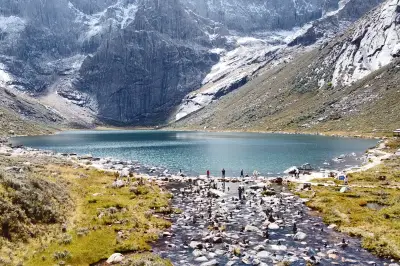
The whole day was dedicated to Jiuzhaigou. They say after visiting Jiuzhaigou, you won't care for other waters—and it's true. Later, when we went to Qingcheng Mountain, the clear springs and waterfalls felt bland. Tickets for Jiuzhaigou had to be booked in advance on Aba Tourism website. Medical staff get free entry but still need to book a 90-yuan sightseeing bus ticket. No exchange needed; just scan your ID at the entrance. Jiuzhaigou is shaped like a Y. The upper right branch is Rize Valley (ending at Five Flower Lake; areas further were undeveloped due to earthquakes), the upper left is Zechawa Valley (ending at Long Lake), and the lower vertical is Shuzheng Valley. The bus upon entry takes you to either Long Lake or Five Flower Lake as per dispatch; you can't choose. There are wooden walkways connecting spots, but not every spot has a bus stop, so managing your energy between walking and buses was key. Combining many guides, our itinerary was: From entrance, take bus to Long Lake, walk to Five-Color Pond, take bus to Five Flower Lake, walk to Pearl Shoal, walk to Mirror Lake Parking Lot, take bus to Mirror Lake (note: the parking lot and Mirror Lake are not the same; you need a one-stop bus ride), then take bus to Nuorilang Visitor Center for lunch. Honestly, the visitor center food was decent—30 yuan for a bowl of noodles wasn't bad considering the transport difficulty. After lunch, we walked to Nuorilang Waterfall, then took a bus toward the entrance to Rhinoceros Lake, walked to Tiger Lake, Shuzheng Lake, and other spots in Shuzheng Valley, and finally took the bus out. Jiuzhaigou was truly beautiful. Even on a cloudy day, it was stunning.
By the time we left around 4 PM, our feet were nearly dead. The driver took us to the Eternal Love show. Medical staff get free tickets without reservation; just bring ID and medical license to the front desk to book. The seats were great—thank you! The show was more spectacular than I expected, divided into four parts. My favorite was the first part, which was very ethereal. The complex also had many shops and eateries, like a small town. But we had dinner outside: a yak steak hotpot. The meat was good, but a bit greasy, and the vegetables were lacking. By the time we got back to the hotel, I was exhausted. I washed up and went to bed early.
We set off at 8:30 AM for Huanglong. The roads were clear and pleasant. Seeing the driver's skilled (and illegal) overtaking at the Nine Bends made me sweat. Huanglong is the highest point of the trip at 4,000 meters. The sporadic Rhodiola consumption probably didn't help much, so we relied on ourselves.
Tickets needed to be booked in advance on Aba Tourism website. Medical staff could select the free ticket option, but considering my stamina, I bought a round-trip cable car ticket—a great decision. Huanglong has no specific route; just follow the crowd. The first spot is the famous Five-Color Pond, with two paths: one for distant views and one for close-up, but they form a loop. Either way is fine. The pond was very unique, comparable to Yellowstone's Grand Prismatic Spring (though less colorful, but with more delicate geological structures).
Along the way, there were oxygen bars everywhere for those who needed to rest. There was also a visitor center with food—20 yuan for a bowl of noodles, but not tasty.
After Huanglong, we returned to Chuanzhusi for the night. They say accommodation in Chuanzhusi is better than in Songpan. I booked another expensive hotel: Songpan Minjiang Haoting International Hotel, 600+ yuan per night for a family room. It hurt, but the warm, abundant hot water and clean room made it worth it. The commercial area here was far inferior to Jiuzhaigou. We found a small nameless restaurant for dinner—over 100 yuan for three people, not bad. That night, my companion and I both felt a bit dizzy—maybe altitude sickness. We went to bed early. Here, a twist: the driver said there was a traffic control from Songpan to Maoxian. After weighing pros and cons, we gave up the planned Mouni Valley, left at 6 AM the next day, sped through the controlled section, and added Qingcheng Mountain on the fly. Not sure if it was the best choice. We had gone through a lot of ticket research and guide prep for Mouni Valley, so it was a bit regrettable.
We woke up at 5 AM and left at 6 AM, missing the hotel breakfast. No one was at the front desk; we left the key card and asked the security uncle for some hot water. Off we went, dusty and rushed. It was dark and snowing, but we made it through the controlled section safely before 9 AM.
Qingcheng Mountain needed no reservation. Tickets could be bought on the "Qingchengshan Dujiangyan" WeChat account. Medical staff don't need to reserve or exchange tickets; just show ID and license at the entrance. "After Jiuzhaigou, no interest in water" was confirmed here; the mountain scenery didn't wow me. I was mentally stuck on the song "Under Qingcheng Mountain, the White Lady." I was too exhausted to walk much, so we bought a round-trip cable car ticket. My last bit of stubbornness was climbing to the highest point, Laojun Pavilion. If I had more energy, the best route would be to take the cable car up and walk down to see all spots; we missed Tianshi Cave, which was a slight regret.
On the way back to Chengdu, we hit traffic again. We arrived back in Chengdu, and since I was very satisfied with the first hotel, I canceled the originally planned one and rebooked the same. We found a random skewer restaurant for dinner. Any hotpot or skewer place in Chengdu seems to be good.
Although I'm not a huge panda fan, since we were in Chengdu, we decided to visit. Based on everyone's tips, we arrived at Panda Avenue Station at 7:15 AM. Just outside the metro, unlicensed cabs were offering rides for 5 yuan per person—acceptable. They took us straight to the park entrance. The gate wasn't open yet, but the queue was already over 50 meters long. We could buy tickets online or on-site. Medical staff with ID and license go straight in without reservation. As early birds, by the time we entered, the first tram was already full, so we walked. It's only a 15-minute walk from the entrance to the Moonlight Nursery. Late-rising pandas sleep, early-rising pandas are watched. They were so lazy—either eating or sleeping. Two panda cubs lay motionless. If one was photogenic, it was surrounded by layers of people. The red pandas (as they called them) seemed much livelier. The whole park took about 2 hours to see quickly. Several buildings were closed, and we saw fewer than 30 pandas and red pandas.
After the pandas, we ended our Chengdu trip with a hotpot. After checking out, we wandered around Jinli again, then headed to the airport back to Shanghai. For the return flight, we booked the legendary "pig-feeding" Sichuan Airlines—and it was delicious! First, pre-meal nuts (so good I bought two bags on Taobao as soon as I landed), then pre-meal tea, then a combo rice, then a small dessert, then post-meal drinks, and finally red date tea! I think if Sichuan Airlines is struggling during the pandemic, they could just sell their meals.
1. Looking back, due to the cost of the chartered car, the itinerary was a bit rushed and demanding on physical strength. If possible, it's better to split the Chengdu-Jiuzhaigou journey into two days, with plenty of attractions along the way to avoid travel fatigue.
2. Chengdu is a great transit hub for tourism, with many worthy attractions around. We had to give up many favorites like Dagu Glacier, Siguniang Mountain, Mount Emei, Leshan, and Daocheng. Chengdu deserves another visit.
3. Compared to the surrounding tourist resources, the city's attractions are a bit boring.
4. Throughout the planning and trip, I always missed the professor's guidance. I hope one day the professor and I can drive the western Sichuan route together.
Travel Log Table of Contents
1. Origin
2. Preparation
3. Day 1: Shanghai → Chengdu
4. Day 2: Chengdu → Dujiangyan → Jiuzhaigou
5. Day 3: Jiuzhaigou
6. Day 4: Jiuzhaigou → Huanglong → Chuanzhusi
7. Day 5: Chuanzhusi → Qingcheng Mountain → Chengdu
8. Day 6: Chengdu → Shanghai
9. Summary
Travel Info
Hotel Index
Guide Index
Airfare Index
Website Navigation
Travel Index
Cruise Index
Corporate Travel Index
Affiliate Cooperation
Distribution Alliance
Friendship Links
Corporate Gift Card Purchase
Insurance Agency
Agent Cooperation
Hotel Franchise
Destination & Scenic Spot Cooperation
More Cooperation
About Ctrip
Ctrip Highlights
Contact Us
Careers
User Agreement
Privacy Policy
Business License
Security Center
Ctrip Content Center
Intellectual Property
Trip.com Group Algorithm Disclosure