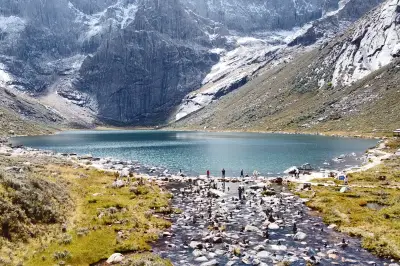
A Detailed Record of an Early Spring Trip to Jiuzhaigou
Jiuzhaigou is located in Jiuzhaigou County, Ngawa Tibetan and Qiang Autonomous Prefecture, Sichuan Province, and is known as 'a fairy tale world, a paradise on earth'. Based on photos from various magazines, autumn is the best season to visit Jiuzhaigou, with brilliant and rich colors, colorful forests contrasting with snow-capped peaks, plank roads winding through the colors into a romantic atmosphere, the passionate cascading waterfalls, and the surreal beauty of the lakes, making everyone who comes to Jiuzhaigou fascinated by its autumn scenery like a richly adorned young girl. Worries and nostalgia drift away inadvertently, and inner peace spontaneously arises.
I went from Shanghai to Chengdu in advance and took a day to rest in Chengdu. Since flights from Shanghai to Chengdu were expensive during Golden Week and the discounted flights had unfavorable schedules, I chose to take the D2206 bullet train, departing at 06:39, with a journey of about 15 hours and a ticket price of 606 RMB. The departure station was Hongqiao Railway Station, and the terminal was Chengdu East Railway Station. Bringing a book along made the journey not lonely. There are no direct flights from Shanghai to Huanglong, so a transfer is required. Therefore, sightseeing or resting in Chengdu first was a good choice. I stayed at the Wren Boutique Hotel in Kuanzhai Alley. The hotel is right inside Kuanzhai Alley, with many local snacks around. Stepping out of the hotel, you can eat grilled skewers, pig trotters, wontons (in red oil), and various kinds of noodles with toppings. On Hongwasi Street, there are two distinctive shops: Huaxi Beef Rice Noodles and Zizhong Rabbit Noodles. Near the legendary north gate of Sichuan University, you can find ice jelly (three-flavor style, no glutinous rice balls), guokui (pork filling), and egg-filled cake (mixed flavor). In a commercial building near Gonghe Village, there are old-style spicy wontons (order extra spicy), bobochicken (skewers), and Li Hua dumplings. Around Jiuyan Bridge, there is a bar street, where nightlife lovers can have fun, and late-night snacks can be had at Ziwei Grilled Fish. Also, go near Xincheng Plaza on West Street to eat Tan Tofu Pudding and Jiang Pig Trotters, and don't forget to order a serving of Sweet Noodles and Zhong Dumplings—they are really delicious! Don't ask me why you have to go there; just go! As for attractions in Chengdu, Jinsha Site and Sanxingdui Site are must-sees. Wuhou Shrine is standard, Du Fu Thatched Cottage is not worth the price, and the Sichuan Museum really doesn't have good collections. Jinli and Kuanzhai Alley have a strong commercial atmosphere—just my personal opinion, for reference.
Wren Boutique Hotel Chengdu
At first glance, I really didn't know how to read the characters '鹪(jiao)鹩(liao)'. Seeing the introduction beside it, it seemed to be a hotel, and since I hadn't settled yet, I decided to check it out.
When the door opened, the long corridor in front deeply caught my attention.
'A winding path leads to a secluded spot, a meditation room amidst deep flowers and trees; mountain light delights the birds, and the pool's reflection empties the mind.' Although it's not a meditation room, it surpasses one. Though there are no high mountains or ponds, there are flowers, trees, water, and birds, creating a very artistic atmosphere.
Wren Boutique Hotel Chengdu
After experiencing everything at the Wren, I immediately decided to stay. After settling in, I was even more pleasantly surprised. It really felt like a hidden retreat in the middle of a bustling city.
The hotel is small, with only 10 rooms, but each room is nearly 100 square meters. The entire hotel has excellent privacy, with attentive butler service that can arrange all sorts of things, big and small. The room also has a special feature: a small window called the butler service window. For inconvenient times, small items like takeout or room supplies can be placed inside, ensuring complete privacy, just like your own home. You don't have to worry about outside noise and can enjoy your own space in peace.
Service is one aspect, but the hotel's hardware facilities are also very good. The entire room's decoration and layout give a very comfortable feeling, with an overall Chinese traditional cultural style, which is my favorite.
Later, the butler introduced that the hotel is centered on Zhuangzi's culture, with a Zhuangzi cultural atmosphere everywhere, along with many old objects, antiques, etc., creating a strong cultural ambiance.
Although I only stayed for a short day, I deeply felt the charm of the Wren. The hotel is small but refined, carefree and comfortable, and the environment, atmosphere, service, and everything else are impressive. If I visit Chengdu again next time, I will surely come back to experience the charm of the Wren.
Day 1 (2015.10.07): Chengdu to Jiuzhaigou Entrance
At 7:00 AM, I gathered at the south gate of Baihuatan Park in Chengdu and took the Jiantu Westward Bus to the Jiuzhaigou entrance. The one-way ticket price was 110 RMB per person, bookable on Ctrip. The journey took about 10 hours. The drop-off point at the entrance was the Mengxiang Jiuzhaigou Parking Lot, about 5 km from the scenic area entrance. Due to a landslide in Mao County, the bus detoured via Mianyang, adding an extra 60 RMB per person. Alternatively, you can take a long-distance bus from Chadianzi or Xinnanmen Bus Station, with a ticket price of 141 RMB per person. Xinnanmen has more departures but only allows booking 7 days in advance. The included lunch was 25 RMB per person.
Day 2 (2015.10.08): Jiuzhaigou – Zechawa Gully Changhai Section
Jiuzhaigou gets its name from nine Tibetan villages, including Shuzheng, Heye, and Zechawa. The developed scenic area is laid out in a Y-shape, with a combination of walking and bus rides. The scenic area implements staggered peak visiting hours; when you get on the eco-bus, you don't know which attraction you'll go to first, which may disrupt your plans.
After visiting the Five Sacred Mountains, you don't care about other mountains; after visiting Huangshan, you don't care about other peaks. Guilin's landscape is the best under heaven, but Jiuzhaigou's scenery surpasses Guilin. Coming to Jiuzhaigou is for the water; after Jiuzhaigou, you don't care about other water. Jiuzhaigou is beautiful, spiritual, and magical because of its water; water is the soul of Jiuzhaigou, the lively spirit of Jiuzhaigou. The water of Jiuzhaigou is holy and elegant, hazy and mysterious, light and graceful, colorful, passionate, and also peaceful and serene. The six wonders—emerald lakes, layered waterfalls, colorful forests, snow peaks, Tibetan customs, and blue ice—have left the most precious treasure for the world.
After entering the scenic area, I took the eco-bus and made a brief stop at Shuzheng Qunhai before heading straight to Changhai. Changhai is the highest lake in Jiuzhaigou and has the widest surface. The lake water appears deep blue, sourced from melting snow on high mountains. Strangely, the lake is over 100 meters deep, shaped like an S. The surrounding forests are lush green, and the peaks are perpetually snow-capped. Changhai has no outlet; in the rainy season, the water doesn't overflow, and during droughts, it doesn't dry up. Therefore, it is called 'the gourd that can never be filled or emptied.' Legend says that sometimes a monster appears in Changhai; someone in the 1980s claimed to have seen a giant aquatic creature there. Strangely, no fish live in Changhai. These mysterious events add more mystery to Changhai in winter.
Walking down the wooden plank road for about 1 km leads to Wucai Chi (Five-Color Pond), the essence of Jiuzhaigou's lakes. The upper half is azure blue, the lower half orange-red, the left side sky blue, and the right side olive green. Aquatic plants like Spirogyra, Chara, and small ferns grow in the lake, along with reeds, Equisetum, and rushes. These plant communities contain different levels of chlorophyll, which appear in different colors in the calcium-rich lake water. In the same lake, some waters are azure, some shallow green, some reddish-yellow, and some pinkish-blue—ever-changing and beautiful! In winter, the surroundings are icy and snowy, but this colorful little pond doesn't freeze, which is truly miraculous. Legend has it that Wucai Chi is where the goddess Semo combs her hair. The male god Dage fetched water for her every day from Changhai. Over time, Dage's feet carved 189 steps into the cliff, and the rouge from Semo's face turned into this stunning colorful pond. Lovers believe that if they can go down the steps to the pond, make a wish silently, and then climb back up the 189 steps, they will love each other forever.
Now for the key point: after visiting Wucai Chi, you have three choices: first, take the bus from Wucai Chi station to other attractions; second, walk down along the road or plank road to visit Shangjijiehai (Upper Seasonal Lake), then return to Wucai Chi station by the same route, a one-way trip of about 20 minutes; third, hike back to Nuorilang Center. I chose the hiking route, taking about 4 hours for sightseeing and photography. Jijiehai is an off-the-beaten-path spot; you have to experience the scenery along the way yourself. After reaching Nuorilang Center, I took the bus toward the exit and got off at Huohuohai Station, then walked along the plank road to Luweihai (Reed Sea). The sea is full of reeds, water birds fly around, and a clear stream flows, swaying green and winding through the reeds—a true marsh scene. In the middle of Luweihai, there is a graceful water ribbon that winds through the reeds, dividing it into two halves. This ribbon has a luster and color like beautiful jade, so it is called Yu Dai He (Jade Belt River). Legend says this beautiful river is transformed from the belt of the mountain goddess Wonuosemo. On the cliff on one side of Luweihai, due to weathering, an image resembling the goddess's head has formed.
Day 3 (2015.10.09): Jiuzhaigou – Rize Gully Primitive Forest Section
Sunshine, rain, pine forests, and birdsong make the primitive forest a different kind of beauty compared to Jiuzhaigou's water scenery. Straight and towering pines stand like solemn and mighty soldiers guarding this beautiful nature. The temperature in the primitive forest is about 3°C lower, so keep warm! Walking down the plank road, you can pass by Fangcao Hai (Fragrant Grass Lake) and Tian'e Hai (Swan Lake).
Take the bus from Tian'e Hai to Jianzhu Hai (Arrow Bamboo Lake) and then continue to tour down to Wuhua Hai (Five Flower Lake). Arrow bamboo is the favorite food of giant pandas. The shores of Jianzhu Hai are widely covered with arrow bamboo, which is its most distinctive feature, hence the name. Jianzhu Hai has a wide and long surface with azure blue water. Reflections are so clear that it's hard to tell whether the mountains are entering the water or the water is engulfing the mountains. In Jianzhu Hai, many submerged dead trees are calcified, forming peculiar coral-like structures. On the decayed wood, new trees can sometimes be seen, a phenomenon called 'renewal of dead wood' or 'regeneration trees.' When there is no wind, you can appreciate the reflections at Jianzhu Hai, which is the closest to Jing Hai (Mirror Lake) for reflections.
Xiongmao Hai (Panda Lake) and Jianzhu Hai are sister lakes. The rock texture on the lakeside is unique, reflected in the lake. Underwater, there are white stones with black patterns that look like pandas, creating an interesting scene. Remember not to take the bus from Xiongmao Hai to Wuhua Hai; be sure to walk along the road or plank road. At Laohuzui (Tiger's Mouth), you will see the most beautiful Wuhua Hai. Alas, I forgot and missed this view—what a pity!
Wuhua Hai is the pride of Jiuzhaigou. In the same body of water, it shows colors like goose yellow, dark green, deep blue, and indigo, patchy and dazzling. The bold, intense, and ever-changing colors applied by nature's brush create a surreal scene. Looking down from Laohuzui, it resembles a peacock with full plumage spreading its tail. Under sunlight, the lake becomes even more mesmerizing, dazzling, and colorful, transporting you into a fairy tale. The ever-changing brocade of the lake is intoxicating. Through the clear water, you can see springs rising from the lakebed, making you dizzy. A mountain breeze sweeps by, and the colors intermingle, inlay, mix, and saturate each other. Wuhua Hai becomes full of life, active, and vibrant.
Take the bus to Zhenzhu Tan Pubu (Pearl Shoal Waterfall). In a sense, it resembles the Luositan Waterfall in the Huangguoshu Waterfall group. It is not just a fall from a cliff but has a shoal with an incline of about 20 degrees. The water first flows gently over the shoal. Because the shoal is composed of travertine with tiny scale-like undulations on the surface, when a thin layer of water flows over, it glistens like ten thousand pearls under sunlight, hence the name 'Pearl Shoal'. The water flow on Pearl Shoal is relatively slow, and the surface is flat, so visitors can take off their shoes and walk barefoot on the shoal. However, since the waterfall is formed by melting snow from the mountains, the water temperature is low. Even in midsummer, walking on Pearl Shoal feels piercingly cold and makes you shiver.
Continuing down, you arrive at Jing Hai (Mirror Lake), with steep valley slopes, dense forests, and seasonal changes in forest color. In the early morning light or at dawn, the lake is as smooth as a mirror. Blue sky, white clouds, distant mountains, and nearby trees are all reflected on the lake floor. The reflections are clear, with distinct lines, bright colors, and rich variation. The surreal scene of 'fish swimming in the sky above, birds flying at the bottom of the water' makes people enchanted. By the lake, a thick vine as big as a bowl tightly clings to a giant tree, reaching the same height as the tree, straight into the sky. The tree gives the vine an endless cool shade, and the vine gives the tree beautiful and pure love. Hence, Mirror Lake has an alias—Love Park.
Passing Mirror Lake, you reach Nuorilang Pubu (Nuorilang Waterfall). 'You carry the load, and I lead the horse,' folks, which role do you want to play? The opening scene of 'Journey to the West' was filmed here. 'Nuorilang' is a Tibetan transliteration meaning 'male god,' symbolizing grandeur and majesty. So Nuorilang Waterfall means a magnificent waterfall. The mighty water flows from the Nuorilang Qunhai, pouring down from the top of the waterfall like the Milky Way dropping from the sky, its roar echoing in the valley. The southern end has a vast water volume, feeling chilly, and rising mist. In the morning sunlight, rainbows often appear across the valley, making the waterfall even more charming. In autumn, the 300-meter waterfall, set against the autumn colors and mist, creates a magnificent scene.
Finally, you reach another major waterfall in Jiuzhaigou—Shuzheng Pubu (Shuzheng Waterfall). The waterfall splashes with snow-white waves, contrasting with the ancient trees—one moving, one still—forming a strong contrast yet combining into a harmonious natural picture. Someone described the strange and beautiful scenery of Shuzheng Waterfall like this: the curved trunks of green-leaved ancient trees are half immersed in the waterfall, letting the white water wash over them, like fairies with flowing hair and exposed jade bodies bathing joyfully in the holy water. Sometimes, the magical scenery of nature makes you feel as if you are in the Garden of Eden!
Day 4 (2015.10.10): Huanglong Day Trip
At 7:00 AM, I took the Jiantu Westward Bus from the Mengxiang Jiuzhaigou Parking Lot to the Huanglong cable car station. The round-trip ticket price was 80 RMB per person, and the journey took about 2.5 hours. There was a stop at a high-altitude reaction explanation station, where altitude sickness knowledge was provided and medicine could be purchased, but not compulsory. The scenic area visit time was about 6 hours. Alternatively, the Jiuzhaigou bus station also sells tickets to Huanglong, with a round-trip price of 90 RMB per person. There are only two departures: 7:00 AM and 7:30 AM, and the return departure time needs to be inquired in Huanglong.
Huanglong Scenic and Historic Interest Area is known as 'the Jade Pool on Earth' because of its many colorful ponds that change colors with the surrounding scenery and the angle of sunlight. The main scenic area, Huanglong Gully, resembles the image of a 'dragon' in Chinese people's minds, hence it is often referred to as 'the Jade Pool on Earth' and 'the Symbol of China'. It is also revered by local ethnic people; Tibetans call it 'Dongri·Serjun', meaning 'the eastern conch mountain (referring to Xuebao Mountain)' and 'golden lake (referring to Huanglong Gully)'.
Day 5 (2015.10.11): Jiuzhaigou to Chengdu
At 7:00 AM, I took the Jiantu Westward Bus from the Mengxiang Jiuzhaigou Parking Lot back to Chengdu via Mao County. The one-way ticket price was 120 RMB per person, and the journey took about 8 hours. The drop-off point was Chengdu Chadianzi Bus Station.
Due to the weather, I wasn't very satisfied with this Jiuzhai-Huanglong trip. But in life's journey, how can everything go smoothly? Whether you read ten thousand books, travel ten thousand miles, or meet countless people, you continuously improve yourself through the perception of change and understanding, ultimately reaching the highest state where form is emptiness and emptiness is form. Emptiness is not nothingness; it is the awareness of impermanence without clinging to all things, like the moon in water or flowers in a mirror—a manifestation of great wisdom. As the Sutra of Impermanence says: 'The world has no form; form arises from the mind. Visible things are not real things; perceptible events are not real events. Things and events are empty; they are shackles of the mind. The common person's mind sees prisons everywhere; only by transforming the world can one reach selflessness. Self is the world; the world is self.'
Notes and Suggestions:
1. Waterproof jacket and pants, waterproof hiking shoes are essential. In light rain, you don't need an umbrella or raincoat.
2. Start taking medication for altitude sickness prevention two weeks in advance. In high-altitude areas, drink plenty of water and rest.
3. Book tickets through travel websites whenever possible to avoid carrying too much cash. Jiuzhaigou entrance fee + eco-bus: 310 RMB per person. Online ticket collection is convenient. Huanglong entrance fee + uphill cable car: 280 RMB per person. The uphill cable car is recommended to save time. Because I spent a lot of time taking photos, 6 hours was still a bit tight.
4. For those traveling on foot, pack light and bring only some high-energy food like chocolate, Snickers, beef jerky, etc. Small attractions inside Jiuzhaigou generally sell self-heating boxed meals at 25 RMB per box. At mealtime, buy them to replenish energy. The meal sets at Nuorilang Center are not worth it with poor value; wait to eat well when returning to Chengdu. There is a Dujuanlin Service Station in Huanglong, where food is acceptable and prices are reasonable. Normally, you can arrive around 13:30. Highland barley cake + fried rice + local egg = instant noodles.
5. The advantage of entering the valley twice is that you have ample time for sightseeing and photography at each attraction. Of course, if you take the bus all the way and like to get up early, it's possible to see all of Jiuzhaigou in one day with proper planning. You can also share a private car inside Jiuzhaigou for staggered peak visiting, at an additional 210 RMB per person. Highly recommended for those who just want a quick visit.
6. Restaurant prices outside the Jiuzhaigou scenic area are roughly the same. The difference lies in snacks like wontons, which can be expensive or cheap. Ordinary grilled fish is 68 RMB or 88 RMB per fish. Don't listen if they offer a few side dishes; those side dishes are actually condiments placed inside the grilled fish. Average cost per person is about 50 RMB. For a single diner, I suggest egg fried rice + stir-fried wild vegetables or grilled fish.
7. Taxis or unlicensed cabs within the scenic area charge 10-40 RMB based on negotiation.
8. The Mao County section is prone to landslides. If traveling by bus in and out, be prepared. On my return trip, I encountered a small landslide, which took at least 6 hours to clear. If you are stuck on a section without restaurants, you may have to go hungry, and it may affect your subsequent itinerary.
9. I'm lazy; I entered the valley after 9:00 AM every day and left around 19:00. I did a lot of walking, so the schedule was still a bit rushed.
10. Some plank roads on the Changhai to Nuorilang section inside Jiuzhaigou are damaged. Please be careful. This section is not recommended for plank road walking.
11. Keep a good attitude; the scenery you see may not be what you imagined. All things change; only the mind remains unchanged.
12. Lodging prices at the entrance are very flexible. Sometimes booking in advance online is pricier. I suggest booking online if there is a good deal. I booked a standard room for 133 RMB per night. Most hotels offer pickup service; consult your hotel for details. Some hotels do not provide disposable toiletries!