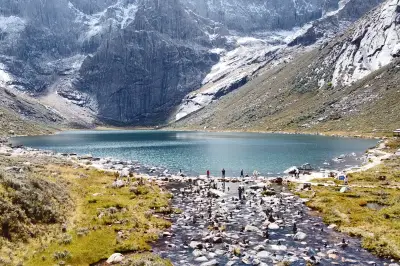
A 3-Day Tour of the Mysterious Western Sichuan and Aba: Exploring the Stunning Road to Nenensangcuo (Fairy Pool) Scenic Area...
In Sichuan, when I pack my bags and set off on a self-driving adventure, my first choice is always Western Sichuan. If I must give a reason for traveling there, it's that I can't resist the urge to explore the pristine highlands of Aba in Western Sichuan and the breathtaking scenery along the way. Beyond the well-known destinations like Daocheng Yading, Jiuzhaigou, and Huanglong, there are countless hidden gems in Western Sichuan—untouched landscapes folded into the plateau's mountains, waiting for travel enthusiasts to discover. This was an extraordinary journey of exploration. Over three days in Aba, Western Sichuan, my friend and I gained so much; the scenery was truly stunning!
Travel Dates and Itinerary:
Travel dates: April 8–10, a three-day self-driving tour along the Western Sichuan Aba loop. The specific route:
Day 1: Chengdu – Wenchuan – Lixian – Hongyuan – Ruoergai's First Bend of the Yellow River and Huahu (Flower Lake) (570 km total).
Day 2: Ruoergai Huahu – Baxi Conference Site – Dalu Tibetan Village – Fairy Pool Scenic Area – Jiuzhaigou Entrance (180 km total).
Day 3: Jiuzhaigou Entrance – Songpan – Maoxian – Chengdu (460 km total).
First Bend of the Yellow River:
This is part of the Re'erdaba Grassland in Aba Prefecture, Western Sichuan. Endless green grass stretches from the mountains to the river valley and riverbed, seemingly connecting heaven and earth. When we mention the Yellow River, most people think it exists only in the north. However, within Sichuan's territory, in Ruoergai County on the Aba Plateau, there is a remarkable section—the First Bend of the Yellow River. As the saying goes, "The water of the Yellow River comes from heaven." At Tangke Town in Ruoergai, this "heavenly water" makes a grand turn, leaving behind the spectacular first bend. The scenery is breathtakingly beautiful and unforgettable. In our conventional impression, the Yellow River is turbulent and muddy. But in Ruoergai County, all such expectations are overturned. Here, the Yellow River is like a natural beauty without makeup—pure and bright. When the wind is calm, the water surface is as smooth as a mirror, clearly reflecting the blue sky, white clouds, surrounding grasslands, and mountains. Sunrise and sunset here are worth waiting for and admiring. It's a paradise for photographers and a must-visit spot for many self-driving travelers.
Ruoergai Huahu (Flower Lake) Scenic Area:
Huahu is a natural lake on the Re'erdaba Grassland, also known as China's most beautiful wetland and the hometown of black-necked cranes. It is the second-largest wetland in China, located along National Highway 213 between Ruoergai in Sichuan and Langmusi in Gansu. Here, we fully enjoyed the stunning natural scenery, marveling at the wonders of nature. It's an excellent spot for tourism and photography, especially after snowfall, when the lake becomes even more enchanting. Strolling through Huahu felt like stepping into a pure world of the sky—our mood instantly lifted. The lake water, combined with the snow cover, the clear blue of some water areas, and the yellow of withered grass, created a colorful palette—an indescribable beauty.
Baxi Conference Site:
Following the red trail of our predecessors, we continued our journey, remembering our original aspirations, and arrived at the Baxi Conference Site. Originally known as Banyou Temple, it is located in Baxi Township, Ruoergai County (previously part of Songpan County before 1956), near the border between Sichuan and Gansu. It's a semi-agricultural, semi-pastoral Tibetan settlement, 32 km east of Ruoergai County town. The site now preserves the walls of the Main Hall. The main hall is 27.70 m wide and 33.7 m deep; the rear hall is 14.50 m wide and 6.22 m deep. The entire floor plan is convex-shaped. The walls are made of rammed yellow earth, thicker at the base (1.40 m thick) and thinner at the top, with a remaining height of 8.92 m. Besides the Baxi Conference Site, a Baxi Conference Museum has been established nearby.
Lama Ridge has an altitude close to 4000 m and is a pass on the Ruojiu Road. The terrain is open here, offering excellent panoramic views. Many photographic masterpieces on Ruojiu Road originate from this spot. The name Lama Ridge comes from its location in Qiuji Township, Ruoergai County, and is a sacred mountain in the hearts of the local people, hence the name.
Dalu Ancient Tibetan Village is one of the oldest existing villages in China. Located on a gentle slope at mid-mountain, the village's buildings are arranged in layers, preserving the most primitive plank-house structure. Having weathered over a thousand years of wind and rain, the traditional plank-roofed houses stand in rows, like a three-dimensional "Xiangba" woodcut painting spread across the landscape.
Dalu Ancient Tibetan Village, with its unique geographical location, climate conditions, and diverse regional culture, boasts rich tourism resources. These include the Fairy Pool Scenic Area, known as the "miniature of Jiuzhaigou and Huanglong," the "last ancient Tibetan village" Dalu Village, and the nearly 700-year-old Sakya Tibetan Buddhist temple, Dalu Temple. In Dalu Ancient Tibetan Village, we savored the beauty of the natural village, visited the Tibetan mill, and turned the ancient prayer wheels by hand. Here, we prayed, observed the white pagoda, and watched the prayer flags flutter in the wind.
Nenensangcuo (Fairy Pool) Scenic Area Overview:
"Nenensangcuo," also known as Fairy Pool, means "the place where fairies bathe." A real Fairy Pool not only has the magic of Huanglong but also the beauty of Jiuzhaigou. It truly combines the landscapes of both Jiuzhaigou and Huanglong. Here, the typical karst landform features large areas of slopes covered with yellow and milky-white calcium deposits, forming 2,600 pools and alpine lakes of varying sizes with bright water colors—these are what we call "haizi" and "calcareous terraces." The calcification rate here is extremely fast, the fastest in the world for modern calcification deposition.
In this legendary place where fairies bathe, the first impression of the pools at Fairy Pool is their deep blue color with a hint of green. In the pools, deadwood lies at the bottom in various shapes, and moss covers the bottom and edges. Looking up, the water surface sparkles in the wind.
At Fairy Pool Scenic Area, we also saw many large and small "terraces" spread before us, displaying a riot of colors and forms under the sunlight. Surrounded by dense forests and layered peaks, the pools look as if dressed in green gauze, exuding elegance and grace—like a serene fairy sitting quietly, guarding this pure land. The magnificent natural scenery and unique local customs offer high aesthetic value, earning it the praise of being a "photographer's paradise" and a natural oxygen bar for lung purification. It is more like a collection of pure, exquisitely shaped calcium deposits of various sizes, like natural sculptures.
The visiting route for Fairy Pool Scenic Area can be divided into three sections:
The entire scenic area is surrounded by a vast sea of forests, divided into three parts from bottom to top by tall trees and dense arrow bamboo. The lower section is called "Golden Flow Spreading Ripples," the middle section "Fairy Pool," and the upper section "Lotus Terrace Reflecting Colors." The main attractions include the Water Curtain Cave, Golden and Silver Beach, Divine Spring, Jade Pool, Azure Dragon Sea, Lotus Colorful Pool, Fairy Pool, Divine Frog Sea, Touch Fortune Cave, Fairy Flat, Ten Thousand Layer Beach, Gushing Lotus Spring, Lotus Terrace, Tibetan Village, and Tibetan folk customs. These scenic spots are distributed along a mountain valley 3,000 m long and about 300 m wide. The altitude of Fairy Pool is only about 2,200 m, and the relative height difference between scenic spots is only about 300 m. Visitors need not worry about physical exertion; touring the entire area is relatively easy.
28 Curves:
After visiting Fairy Pool Scenic Area, you can also stop by a striking and unique scenic spot called the 28 Curves. Everything here reveals the grandeur and wonder of nature, presenting a magnificent and lofty spectacle. This scene is rare both domestically and internationally. A viewing platform has been built for tourists. Standing on the platform at an altitude of over 4,000 m, I looked far into the distance. Surrounded by mountains, silver-gray snowy peaks rose in the distant clouds, appearing both real and ethereal. Among the majestic mountains, misty clouds slowly merged, intertwined, and then drifted apart, like a series of light reunions and farewells.
Food on the 3-Day Western Sichuan Aba Tour:
Along the stunning road to Fairy Pool, there are many affordable and delicious foods. The cuisine in Western Sichuan is primarily Sichuan-style, combining spicy and mild flavors to suit tourists from different regions. Local specialties include yak meat, various wild mushrooms, and cordyceps chicken soup.
Accommodation on the 3-Day Western Sichuan Aba Tour:
Throughout the route, there are good accommodation options. It is recommended to stay overnight in Ruoergai County town on the first day, and on the second day, after visiting Fairy Pool, stay in Zhangza Town, Jiuzhaigou County. Here, you can find everything from five-star hotels to budget inns, catering to different needs.
There are three roads to the Fairy Pool Scenic Area:
1. From Ruoergai via Baxi Town (Baxi Conference Site), Qiuji Township, crossing Lama Ridge (pass at 3,990 m), then through Dalu Ancient Tibetan Village and Shenxianping Campsite to Fairy Pool: 143 km total.
2. From the Shangsi Village entrance between Chuanzhusi and Jiuzhaigou, via Laleheba, the famous 28 Curves internet-famous road, Sun-Moon Viewing Platform, Yalongnari Sacred Mountain (meaning "mountain without tears," altitude 3,688 m) pass, then to Fairy Pool: 45 km total.
3. From Jiuzhaigou County town, via Heihe Bridge, with attractions along the way including Heihe Grand Canyon, Lama Stone, Hanging Spring, Jiuzhai Tianzhu, Dalu Ancient Tibetan Village, Shenxianping Campsite, etc., to Fairy Pool: 128 km total. (For details, refer to the Fairy Pool self-driving route map.)
Fairy Pool Scenic Area Ticket Information:
Peak season (June 1 – November 16): Full ticket 100 yuan, discounted ticket 80 yuan.
Off-peak season (November 17 – May 31 of the following year): Full ticket 50 yuan, discounted ticket 25 yuan.
Electric cart: 24 yuan.
Fairy Pool Scenic Area Ticket Purchase Notes:
1. Each entry requires purchasing a ticket for the Jiuzhaigou Fairy Pool Scenic Area. Please plan your time to avoid duplicate purchases.
2. One ticket per person, valid for the day only. No refunds once scanned for entry.
3. Free tickets:
(1) Children under 6 years old (including 6) or under 1.2 m in height (including 1.2 m).
(2) Seniors aged 70 and above with valid ID (free ticket; cart ticket required).
(3) Disabled revolutionary soldiers and active military personnel with valid ID (free ticket; cart ticket required).
(4) Guides and travel agency staff with valid ID (free ticket).
(5) Doctors, nurses, and medical staff nationwide (including Hong Kong, Macau, Taiwan) with valid ID: free tickets from now until December 31, 2021.
4. Discounted tickets:
(1) Minors aged 6 (excluding 6) to 18 (including 18), full-time university undergraduates and below with valid student ID (discounted ticket; cart ticket required).
(2) Seniors aged 60 (including 60) to 69 with valid ID (discounted ticket; cart ticket required).
(3) Disabled persons with valid ID (discounted ticket; cart ticket required).
(4) Teachers with teaching certificates on Teacher's Day (discounted ticket; cart ticket required).