![[Collection] May 2021 Edition of Sichuan Jiuzhaigou Travel Guide: A Must-Read for First-Time Visitors to Sichuan](/img/dedf1a05f8b07619_l.webp?src=https%3A%2F%2Fdimg04.c-ctrip.com%2Fimages%2F01016120008ml7c4b39C0_W_320_0_Q80.jpg)
[Collection] May 2021 Edition of Sichuan Jiuzhaigou Travel Guide: A Must-Read for First-Time Visitors to Sichuan
This is a May 2021 edition travel guide for Jiuzhaigou. From a traveler's perspective, the author provides the most detailed Jiuzhaigou travel guide, including pre-trip preparations, on-site itinerary arrangements, and some travel tips.
Please note: As a national 5A-level scenic area and a UNESCO World Natural Heritage site, Jiuzhaigou has already developed diverse forms of tourism, including eco-tours, Tibetan culture tours, photography tours, and more. The author has not conducted in-depth research on these niche travel styles and dare not speak recklessly. Therefore, this guide is solely for sightseeing and leisure travel by ordinary tourists.
I. Pre-Trip Preparations:
1) Overview of Jiuzhaigou
1. Geographic Location: Jiuzhaigou is located in Zhangza Town, Jiuzhaigou County, Aba Tibetan and Qiang Autonomous Prefecture, in the southern section of the Minshan Mountains in northwestern Sichuan. It lies on the northeastern side of Gonggang Ridge, southern section of Minshan. It is about 400 kilometers from Chengdu and is a large tributary valley at the source of the Baishui River, which is part of the Jialing River system in the Yangtze River basin.
2. Origin of the Name: Jiuzhaigou gets its name from nine Tibetan villages within the scenic area (Shuzheng Village, Zechawa Village, Heijiao Village, Heye Village, Panya Village, Yala Village, Jianpan Village, Rexi Village, and Guodu Village). These nine villages are also called "Heyao Nine Villages." Because Tibetan people from these nine villages have lived here for generations, it is named "Jiuzhaigou" (Nine-Village Valley).
3. Scenic Area Introduction: The attractions of Jiuzhaigou are distributed in a "Y" shape, formed by three main valleys: Zechawa Valley, Rize Valley, and Shuzheng Valley, with a total length of about 60 kilometers.
The right branch of the "Y" is Rize Valley, which is the main and most exquisite scenic area of Jiuzhaigou. It features Primeval Forest, Grass Sea, Swan Sea, Arrow Bamboo Sea, Arrow Bamboo Sea Waterfall, Panda Sea, Panda Sea Waterfall, Five-Flower Sea, Peacock River Channel, Big and Small Golden Bell Seas, Pearl Shoal, Pearl Shoal Waterfall, Mirror Sea, and Nuorilang Waterfall.
(Note: Currently, only Five-Flower Sea, Pearl Shoal, Mirror Sea, and Nuorilang Waterfall on the right side are open; the rest are still under renovation.)
The left branch of the "Y" is Zechawa Valley, with main attractions including Long Sea, Five-Color Pond, Upper Seasonal Sea, and Lower Seasonal Sea. Since the Upper and Lower Seasonal Seas are seasonal lakes, the sightseeing bus does not stop there, and walking is too far.
The lower part of the "Y" is Shuzheng Valley, with main attractions from top to bottom including Rhinoceros Sea, Tiger Sea, Shuzheng Waterfall, Shuzheng Mill, Shuzheng Village, Shuzheng Cluster Seas, Sleeping Dragon Sea, Flower Sea, Twin Dragon Sea, Reed Sea, and Bonsai Shoal.
4. Ticket Information: Jiuzhaigou has two price tiers for off-season and peak season throughout the year. Starting April 1, the peak season opening time is adjusted to 8:00 AM, with peak season ticket prices (ticket: 169 RMB/person, bus ticket: 90 RMB/person, scenic area insurance: 10 RMB/person).
Off-season tickets are generally from November 16 to March 31 of the following year, with a ticket price of 80 RMB and bus ticket of 90 RMB/person. If you are just sightseeing, the bus ticket is mandatory; otherwise, you cannot walk the entire 60 kilometers within the scenic area.
But if you are self-driving or hiking, that's another story. After purchasing the sightseeing bus ticket, it is valid all day. In fact, ticket inspection only occurs at the boarding point at the entrance; inside the scenic area, you just wait at the stops.
2) How to Get There
Jiuhuang Airport is located in Chuanzhusi Town, Songpan County, Aba Prefecture, Sichuan. It is the air transportation hub for the World Natural Heritage sites Jiuzhaigou and Huanglong, 88 kilometers from the Jiuzhaigou entrance, with a drive of about 1.5 hours. Jiuhuang Airport is a plateau airport, one of China's three major plateau airports. Upon arrival, the airport bus company has direct buses to major scenic areas.
After arriving at Jiuhuang Airport by plane, visitors need to transfer to a bus to reach the Jiuzhaigou scenic area. From Jiuhuang Airport, you can also take a bus directly to Huanglong, Mounigou, Hongyuan Wa township, Ruoergai Flower Lake, the First Bend of the Yellow River, and Chuanzhusi town. Details are as follows:
Currently, you can take a bus directly to Jiuzhaigou from Chengdu, Gansu, or Mianyang. Please choose the best boarding location based on your departure point and time.
1) From Chengdu: Both Chadianzi Bus Station and Xinnanmen Bus Station have buses to Jiuzhaigou. Xinnanmen Bus Station is on Xinnan Road, Jinjiang District, departing at 7:00 AM, direct to the valley entrance. Chadianzi Bus Station is on Section 5, West Third Ring Road, Jinniu District, with faster access to the highway; the bus stops at Zhangza Town and goes directly to Jiuzhaigou County. Specific route: Chengdu (Chadianzi/Xinnanmen) -> Wenchuan -> Maoxian -> Songpan -> Jiuzhaigou.
2) From Gansu: Lanzhou in Gansu has daily buses to Jiuzhaigou: Lanzhou Central Bus Station at 7:30 AM, East Bus Station at 8:00 AM, South Bus Station at 8:45 AM. Buses are not very frequent, so purchase tickets one day in advance. Specific route: Lanzhou -> Linxia -> Hezuo -> Luqu -> Ruoergai -> Chuanzhusi -> Jiuzhaigou.
3) From Mianyang: Direct buses from Mianyang to Jiuzhaigou depart from Pingzheng Bus Station. There are three buses daily, but only two arrive at Jiuzhaigou scenic area; the other goes to Jiuzhaigou County. Be sure to ask about the destination when buying tickets. The bus will stop for rest and meals, so it's recommended to bring snacks. Specific route: Mianyang -> Jiangyou -> Pingwu -> Jiuzhaigou.
3) Pre-Trip Gear
Jiuzhaigou is a high-altitude mountain forest area with changeable weather and frequent showers. When it's windy, umbrellas are not very useful, so vendors at the entrance sell raincoats and shoe covers. You can prepare your own before the trip.
The only shopping area within the scenic area is at the intersection of the "Y" at Nuorilang Center, which has shops offering lunch. It is also the only smoking spot in the scenic area. There is only one restaurant, offering a self-service lunch for 60 RMB per person. It is recommended to bring some dry food, as there are no other supply points if you cannot reach the restaurant during meal times.
3. Warm Clothing: The temperature difference throughout the day in Jiuzhaigou can exceed 20°C. It is particularly cold when entering the scenic area in the morning; there is still snow on the top of Long Sea mountain. By noon, the hottest time can be over 20°C.
However, due to the high altitude, if a cloud passes by, the temperature can drop sharply. It is recommended to bring a windproof and rainproof jacket that is easy to put on and take off. Otherwise, you can buy a shawl at the entrance, but not inside the scenic area.
4. Comfortable Shoes: Although there is a sightseeing bus, it only goes from point to point; sightseeing at each attraction relies on walking. The day I entered the scenic area, I walked over 35,000 steps, and my legs were exhausted.
4) Recommended Accommodation
Accommodation in Jiuzhaigou falls into two categories: staying in villages outside the scenic area, or staying in villages inside the scenic area.
If you are not in a hurry and want to slowly explore the natural scenery of Jiuzhaigou for a peaceful journey, you can stay in the villages inside Jiuzhaigou.
But please note: First, there are no standardized hotels in the villages; they are all homestays converted from village houses, so do not expect high-end conditions.
Second, after tourists leave in the evening, there is little entertainment in the villages, allowing for a healthy early-to-bed, early-to-rise lifestyle.
The advantage is that Jiuzhaigou currently implements a one-day ticket system, so if you want to stay for two days, staying in a village is more cost-effective. Otherwise, re-entering the scenic area the next day would require purchasing tickets and bus tickets again, equivalent to saving the cost of the next day's ticket and bus fare.
Exiting the Jiuzhaigou scenic area, turning left and walking about 200-300 meters, you will reach the village. The nearest standardized hotel is the Holiday Inn, with some fast-food restaurants downstairs. Continuing further, you will reach the center of the village, where there are supermarkets, shops, hotels, and homestays, offering more choices. However, since all supplies are transported from outside, prices are slightly higher.
If you are just on a regular sightseeing trip or have limited time and can only stay one day in Jiuzhaigou, I recommend staying at the village entrance outside the scenic area. The facilities are better, there are more entertainment options, and it is convenient for catching transportation the next day.
II. Itinerary Arrangement
Since one day is relatively tight, it is recommended to depart early in the morning to enter the scenic area. The entire journey should be a combination of sightseeing bus and walking. The specific itinerary is as follows:
【Morning】Valley Entrance -> Long Sea (8:00-9:00 by sightseeing bus, about 30 minutes ride, 30 minutes sightseeing)
Long Sea -> Five-Color Pond (9:00-9:15, 15 minutes walk, 15 minutes sightseeing)
Since the Upper Seasonal Sea and Lower Seasonal Sea currently have insufficient water, it is recommended to return directly to Nuorilang Central Station after visiting Five-Color Pond. When water levels are high, you can walk to visit them.
Five-Color Pond -> Nuorilang Central Station (9:15-9:30 by sightseeing bus, about 30 minutes)
Nuorilang Central Station -> Five-Flower Sea (9:30-10:10, transfer to sightseeing bus, about 10 minutes ride, 30 minutes sightseeing)
Five-Flower Sea -> Pearl Shoal (10:10-11:00, about 20 minutes walk, 30 minutes sightseeing)
Pearl Shoal -> Mirror Sea (11:00-11:40, about 10 minutes walk, 30 minutes sightseeing)
Mirror Sea -> Nuorilang Cluster Seas (11:40-11:55, transfer to sightseeing bus, about 5 minutes ride, 10 minutes sightseeing)
【Noon】Nuorilang Cluster Seas -> Nuorilang Central Station (11:55-13:30, lunch at Nuorilang Restaurant, 1.5 hours for meal and rest, can view Nuorilang Waterfall)
【Afternoon】Nuorilang Central Station -> Rhinoceros Sea (13:30-14:20 by sightseeing bus, about 30 minutes ride, 20 minutes sightseeing)
Rhinoceros Sea -> Tiger Sea -> Shuzheng Waterfall -> Shuzheng Mill -> Shuzheng Village -> Sleeping Dragon Sea -> Twin Dragon Sea (14:20-15:30, combination of walking and bus, about 1 hour sightseeing)
Friendly reminder: From Rhinoceros Sea to Twin Dragon Sea, there are two paths around these seas: one is a road, the other is a plank path along the valley. The scenery differs slightly: the road offers distant views of the valley, while the plank path offers close-up views of the seas.
Twin Dragon Sea -> Bonsai Shoal (15:30-15:50 by sightseeing bus, about 10 minutes ride, 10 minutes sightseeing)
Bonsai Shoal -> Zharu Temple (15:50-16:30 by sightseeing bus, about 10 minutes ride, 30 minutes sightseeing)
Zharu Temple -> Valley Entrance (16:30-16:40 by sightseeing bus, about 10 minutes ride)
2) Two-Day Tour: As mentioned earlier, Jiuzhaigou currently implements a same-day ticket reservation system. If you want to enter the valley a second time, you need to purchase tickets again. It is recommended to stay in the village on the first day to save ticket costs and avoid the hassle of going in and out repeatedly.
As for the itinerary, it can be more relaxed. It is recommended to avoid strenuous activity on the first day, so the first day is an adaptation period, mainly visiting Zechawa Valley and Shuzheng Valley. The second day involves more walking, mainly visiting the essence of Jiuzhaigou: Rize Valley.
【Day 1】Valley Entrance by bus -> Five-Flower Sea -> Pearl Shoal -> Mirror Lake -> Nuorilang Central Station -> Nuorilang Waterfall -> Accommodation
【Day 2】Accommodation -> Long Sea -> Five-Color Pond -> Nuorilang Central Station -> Rhinoceros Sea -> Shuzheng Waterfall -> Shuzheng Cluster Seas -> Twin Dragon Sea -> Reed Sea -> Bonsai Shoal -> Zharu Temple -> Valley Entrance
III. Must-Visit Attractions
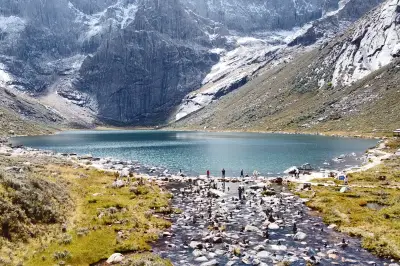
Long Sea, at an altitude of 3,060 meters, about 5 kilometers long, over 600 meters wide, covering an area of 930,000 square meters, located at the end of Zechawa Valley. The peaks beside Long Sea are covered with snow all year round, surrounded by lush forests. From the viewing platform of Long Sea, you can take in the blue sky, white clouds, and snowy peaks, feeling as if the mountains and sky are connected without distance. This is a major spectacle of Long Sea. When I went, there was still snow on the snowy mountains, very beautiful. If you go in the morning, be sure to bring thick clothes.
One kilometer down from Long Sea is Five-Color Pond, at an altitude of 2,995 meters, 6.6 meters deep, hidden in a deep valley below the road. Although Five-Color Pond is the smallest and most delicate among the seas of Jiuzhaigou, its colors are the most vibrant, rivaling Five-Flower Sea.
Five-Color Pond is exceptionally clear; through the water, you can see the rock patterns on the pond bottom. Due to differences in sediment color and the colors of plants around the pond, the originally azure lake surface becomes colorful and splendid. It is the essence of Jiuzhaigou's lakes and the most exquisite sea, known as the "Eye of Jiuzhaigou." In May, the snow on the mountains has not melted, so the water level is low, which is a slight regret.
Among the many seas of Jiuzhaigou, the most famous and beautiful is Five-Flower Sea. Five-Flower Sea is rich in variety, with myriad forms, truly the essence of the Jiuzhaigou scenic area. Five-Flower Sea in Jiuzhaigou is at an altitude of 2,472 meters, 5 meters deep, covering an area of 90,000 square meters. It is known as "the unique wonder of Jiuzhaigou" and "the essence of Jiuzhaigou," located above Pearl Shoal Waterfall and below Panda Lake, at the upper end of Peacock River in Rize Valley.
Looking down from the Tiger's Mouth viewing point, Five-Flower Sea resembles a peacock displaying its feathers, colorful and dazzling. It is a true fairy tale world, a legendary paradise of colors! Many people who bring their own food choose to have lunch here. Dining amidst green mountains and clear waters is very pleasant.
4) Pearl Shoal Waterfall
Pearl Shoal Waterfall is at an altitude of 2,445 meters, with a height of 21 meters and a width of 162 meters. It is a typical combined landscape within Jiuzhaigou and is the place where Tang Seng and his disciples led a horse wading through water in the opening scene of the TV series "Journey to the West."
Pearl Shoal Waterfall has an extremely high concentration of negative oxygen ions, hundreds of times higher than in plain areas, earning it the name "Natural Oxygen Bar." On the left side of the rapid current, there is a winding plank path, which is the best angle for viewing the waterfall and taking photos. Continue east along the plank path following the direction of the rapid current, and you will reach the east side of Pearl Shoal. One of the must-visit attractions, there are many quick photo spots and characters from "Journey to the West" for photos with tourists.
Zharu Temple backs onto a range of green mountains and faces the Precipice Mirror Cliff, with golden roofs and red eaves, and five-colored prayer flags fluttering in the wind. It is the largest and most famous Lama temple near Jiuzhaigou, as well as a sacred site for followers of the Bon religion. In Tibetan, it is called "Ranwu Gongba." It was first built at the end of the Ming Dynasty and has undergone two renovations, with strong Tibetan monastery characteristics. Zharu Temple belongs to "Yungdrung Bon," the teachings of the Tathagata Buddha Tonpa Shenrab Miwoche, also known as the most ancient Zhangzhung Buddhism in Tibet.
The temple covers a total area of over 100 mu (about 6.67 hectares), with a building area of over 20,000 square meters. Among them, the landmark building is the "Yungdrung Lhatse Stupa." It has five floors: the first floor is a museum, the second is the Sutra Hall, the third is the Tantric Hall, the fourth is the Mind Essence Hall, and the fifth floor houses the Buddha's Relic Stupa and 108 sets of the Kangyur (the Tibetan Buddhist canon). I chatted with a lama on the fifth floor, who introduced me to the temple's situation and the help the Party and the state provided for the temple's renovation after the 2017 Jiuzhaigou earthquake, expressing gratitude in his words.
Jiuzhaigou is a Tibetan area, so the most characteristic souvenirs are local Tibetan agricultural products. The Tibetan family restaurants outside the scenic area offer authentic Tibetan and Qiang cuisine: roast whole lamb, highland barley wine, butter tea, milk tea, hand-grabbed meat, lamb chops, yak meat, etc. The first half of the event involves eating and watching performances inside the Tibetan home, while the second half is held outdoors around a bonfire dance.
![[Collection] May 2021 Edition of Sichuan Jiuzhaigou Travel Guide: A Must-Read for First-Time Visitors to Sichuan image 1](/img/269f4817ca9ab2c7_l.webp?src=https%3A%2F%2Fdimg04.c-ctrip.com%2Fimages%2F01016120008ml7c4b39C0_W_640_400_Q90.jpg%3Fproc%3Dautoorient)
![[Collection] May 2021 Edition of Sichuan Jiuzhaigou Travel Guide: A Must-Read for First-Time Visitors to Sichuan image 2](/img/6f453afa75bb959b_l.webp?src=https%3A%2F%2Fdimg04.c-ctrip.com%2Fimages%2F01056120008ml796nAF7E_W_671_0_Q90.jpg%3Fproc%3Dautoorient)
![[Collection] May 2021 Edition of Sichuan Jiuzhaigou Travel Guide: A Must-Read for First-Time Visitors to Sichuan image 3](/img/b437caba1729dfa1_l.webp?src=https%3A%2F%2Fdimg04.c-ctrip.com%2Fimages%2F0100c120008ml78hf1E39_W_1024_0_Q90.jpg%3Fproc%3Dautoorient)
![[Collection] May 2021 Edition of Sichuan Jiuzhaigou Travel Guide: A Must-Read for First-Time Visitors to Sichuan image 4](/img/598c3909acdfdc73_l.webp?src=https%3A%2F%2Fdimg04.c-ctrip.com%2Fimages%2F0106y120008ml796pE49C_W_671_0_Q90.jpg%3Fproc%3Dautoorient)
![[Collection] May 2021 Edition of Sichuan Jiuzhaigou Travel Guide: A Must-Read for First-Time Visitors to Sichuan image 5](/img/7e725dc82bb42931_l.webp?src=https%3A%2F%2Fdimg04.c-ctrip.com%2Fimages%2F0100r120008ml796q9F5A_W_671_0_Q90.jpg%3Fproc%3Dautoorient)
![[Collection] May 2021 Edition of Sichuan Jiuzhaigou Travel Guide: A Must-Read for First-Time Visitors to Sichuan image 6](/img/e8c49e44f4055a60_l.webp?src=https%3A%2F%2Fdimg04.c-ctrip.com%2Fimages%2F0105z120008ml7egk55AA_W_671_0_Q90.jpg%3Fproc%3Dautoorient)
![[Collection] May 2021 Edition of Sichuan Jiuzhaigou Travel Guide: A Must-Read for First-Time Visitors to Sichuan image 7](/img/5e1c2611470466d1_l.webp?src=https%3A%2F%2Fdimg04.c-ctrip.com%2Fimages%2F0101n120008ml75lc6BE4_W_1024_0_Q90.jpg%3Fproc%3Dautoorient)
![[Collection] May 2021 Edition of Sichuan Jiuzhaigou Travel Guide: A Must-Read for First-Time Visitors to Sichuan image 8](/img/9eb8665ed7da1d82_l.webp?src=https%3A%2F%2Fdimg04.c-ctrip.com%2Fimages%2F01072120008ml73tlCDA8_W_671_0_Q90.jpg%3Fproc%3Dautoorient)
![[Collection] May 2021 Edition of Sichuan Jiuzhaigou Travel Guide: A Must-Read for First-Time Visitors to Sichuan image 9](/img/1fe2aec012311e86_l.webp?src=https%3A%2F%2Fdimg04.c-ctrip.com%2Fimages%2F01017120008ml7c4j8445_W_671_0_Q90.jpg%3Fproc%3Dautoorient)
![[Collection] May 2021 Edition of Sichuan Jiuzhaigou Travel Guide: A Must-Read for First-Time Visitors to Sichuan image 10](/img/95113ada3d8b9dde_l.webp?src=https%3A%2F%2Fdimg04.c-ctrip.com%2Fimages%2F0106g120008ml78b3EBFA_W_671_0_Q90.jpg%3Fproc%3Dautoorient)
![[Collection] May 2021 Edition of Sichuan Jiuzhaigou Travel Guide: A Must-Read for First-Time Visitors to Sichuan image 11](/img/2e2e1be090653f67_l.webp?src=https%3A%2F%2Fdimg04.c-ctrip.com%2Fimages%2F0104b120008ml796u0434_W_1024_0_Q90.jpg%3Fproc%3Dautoorient)
![[Collection] May 2021 Edition of Sichuan Jiuzhaigou Travel Guide: A Must-Read for First-Time Visitors to Sichuan image 12](/img/2daced6a8dc96ccb_l.webp?src=https%3A%2F%2Fdimg04.c-ctrip.com%2Fimages%2F0102i120008ml7gmj72DE_W_1024_0_Q90.jpg%3Fproc%3Dautoorient)