A Colorful Journey to Jiuzhaigou~
This trip was hastily decided after a drinking session, so much so that when I woke up the next morning, I wondered if it was just a joke. But whatever, there was also a sense of 'truth from wine'. I've always been stuck in this southern city, though I had the idea of going out, it was shelved for various unfounded reasons. My friend was right, don't make excuses, just do what you want. If you deny your thoughts today, you might never have any ideas tomorrow. So after five days of insufficient preparation, we flew to Sichuan.
On the first day, as soon as we got off the plane, Chengdu came into view. I thought it would dazzle me, but it turned out the opposite—it felt a bit like old Changsha. It was already 10:30 in the morning, but the sky was still gray, showing there was still some air pollution. Since it was the weekend, there weren't many cars on the road, and we quickly reached the booked hotel.
Although Chengdu's modern architecture isn't particularly distinctive, its ancient alleys and streets have a unique charm. Our first stop was the entrance of Kuanzhai Alley. As we got off the car, an old hotpot restaurant appeared before us. We were already starving, and the enticing aroma of hotpot led us straight into the restaurant.
But to be honest, the hotpot wasn't as delicious as I had imagined. Even though we were hungry and ordered a full table, it didn't leave us wanting more. Maybe we didn't try the most authentic one—next time I'll definitely search online to find the best! After eating and drinking our fill, we started strolling around the alleys. At the beginning of the alley, there were rows of snack stalls, neatly arranged on the stands, fragrant with red chili peppers, green coriander, yellow sesame oil... a clever combination that was very pleasing to the eye. On both sides of the road were rows of dazzling small shops, decorated in ethnic styles, with colorful goods inside.
Kuanzhai Alley consists of Wide Alley and Narrow Alley. Although it's called Wide Alley, it couldn't withstand the large number of tourists. We just moved slowly with the crowd. After walking through the well-arranged alleys, we took a taxi to Jinli Ancient Street. The two attractions weren't far apart, about a 10-minute drive. Compared to the combination of simple design and ancient architecture in Kuanzhai Alley, Jinli was more ethnic, with all buildings exuding an antique charm, and the goods sold also emphasized ethnic culture. However, one thing they had in common was the vibrant colors everywhere. Perhaps due to generations of heritage, the people of Chengdu seem to be good at color matching—whether it's food, clothing, or daily items, everything is a bright color, not jarring, but beautiful.
We visited these two attractions from noon until around 5 p.m. After dinner, we bought some snacks needed for the rest of the trip and returned to the hotel to rest. The hotel we stayed in that night deserves a special introduction.
Location: The hotel is located right in Kuanzhai Alley, known as the 'living room of Chengdu'.
Metro: The entrance of Kuanzhai Alley is the Metro Line 4 station.
Geographical location: The location was really great! Right in the Kuanzhai Alley scenic area, you just step out and you can shop and eat, very convenient. It's also not far from Chunxi Road, Taikoo Li, Tianfu Square, etc. You can take the metro or a taxi, and a taxi ride costs around 10 yuan.
Hotel style: The overall style of this homestay was exactly what I like. The room design is Japanese-style, made of pure wood, and the room has a unique, soothing fragrance. There are also hand-embroidered Shu embroidery in the room, and a wren bird specially painted by a master artist.
The hotel has many calligraphy, paintings, and antiques that the owner went to great lengths to collect. Every detail is thoughtfully designed, impeccable.
Room: The door uses an electronic lock for security. The entire room, including the décor and bed, is made of phoenix wood, giving off a faint woody scent that is very relaxing.
The room has a dedicated dining area, and the lunch and dinner are quite tasty.
Bathroom: When I travel, whether staying at a hotel or homestay, my top concern is always the bathroom. Its cleanliness can definitely affect my mood. The bathroom at the Wren Inn deserves full marks! The details show understated luxury. Super five-star luxury amenities: Carnation linens, King Koil mattress, Kohler bathroom products, TOTO smart toilet—even the faucet makes you feel the owner's thoughtfulness.
Washbasin area: Worth mentioning is the dry and wet separation. You can take a shower or soak in the bathtub, and the hotel provides bath salts.
The three-piece toiletries are by June Jacobs (a high-end spa skincare brand from New York). I had used this brand before at a Sheraton in Guangdong and loved it. I didn't expect to use it again in Chengdu. According to the butler, June Jacobs specially customized a treatment technique for the hotel, incorporating local culture, environment, climate, and some traditional Chinese medicine therapies, creating the hotel's unique 'Wren's Nest in the Forest'.
Bedding: It was so comfortable to lie down that I fell asleep within minutes. The quilt and mattress were very soft and skin-friendly. I like sleeping on buckwheat pillows, and the hotel thoughtfully provided one.
The biggest highlight was the hotel butler—a group of very enthusiastic people. When I was about to arrive at Kuanzhai Alley, the butler contacted me in advance, came to the alley entrance to pick us up, and even introduced the culture of Kuanzhai Alley along the way. This alone made me feel very positive about the hotel. After arriving at the hotel, the butler learned that I couldn't eat spicy food, so for breakfast, they specially prepared wontons in a non-spicy broth.
To avoid booking scattered hotels and attraction tickets individually, we booked a three-day-two-night tour from Chengdu to Huanglong to Jiuzhaigou for the 25th to 27th. Now I think it was a very wise decision. With the guide arranging food, accommodation, and transportation along the way, it saved us a lot of trouble. Since the departure time was 5:30 a.m., we got up at 4 a.m. the next day. Still half-asleep, we packed up and waited in the hotel lobby for the pickup car. This is another benefit of a group tour—you don't have to arrange transportation yourself. Chengdu is about 8 to 9 hours away from Huanglong and Jiuzhaigou. To ensure enough time to visit Huanglong that day, group tours usually depart very early, so sleep is definitely insufficient. After getting on the bus, we listened to a long introduction and instructions from the guide, and then most people on the bus fell asleep. Around 7 to 8 a.m., when it was getting light, the guide started talking again. Since we hadn't eaten much in the morning, and with the long journey and the guide's droning voice about the Wenchuan earthquake and how many people died, my stomach started churning. I really wanted to shout 'shut up', but I didn't have the courage to offend the person who would control my life for the next few days. Motion sickness medicine is really important for long bus trips! Fortunately, we stopped at a rest point midway, and I got off to breathe some fresh air, avoiding vomiting. The rest stops along the way had toilets run by local residents, charging 1 yuan each. The conditions were disgusting—I don't want to recall them. At noon, we arrived at a hotel for lunch, or rather, just to fill our stomachs. The guide had already warned us about the food, and I personally don't have high expectations for meals, but if even I say it was bad, it was really terrible. But we had no choice; when you're under someone else's roof, you have to make do. Next time, I must bring my own Lao Gan Ma chili sauce—it'll make meals delicious and keep me healthy! After eating, we set off again, winding up S-shaped mountain roads. The mountains on both sides became steeper, and the colors of the plants more varied, giving the illusion that we were about to enter a paradise. However, the constantly swaying bus kept pulling us back to reality. After twisting and turning until around 2 p.m., we finally reached the nearest medical service station to Huanglong Scenic Area. When the bus stopped, a staff member came on board to explain the scenic area tour and precautions for altitude sickness. We hadn't done much research on altitude sickness before coming; we just bought a box of Rhodiola rosea capsules, not knowing they need to be taken a week in advance. Taking them then wasn't very useful. For our own health, and since I already felt a bit of chest tightness and shortness of breath, I reluctantly bought a box of oral solution. It's worth emphasizing that altitude sickness is no joke. If you're traveling to a high-altitude place, you must prepare in advance—whether by taking medicine beforehand or buying these oral solutions to drink on the spot. They are cheaper outside the scenic area. If you really haven't prepared, don't risk not taking them to save a few yuan, because good health is fundamental. Shortly after taking the medicine, the bus arrived at the gate of Huanglong Scenic Area, but didn't stop. It kept driving along the long line of tourists stretching endlessly ahead. The queue extended behind for three to four hundred meters, longer than any line I've seen at Chimelong even during peak season! My heart immediately sank—how long would we have to wait?! The guide was also a bit anxious and urged us to get off and line up before the bus even reached the end of the queue. As soon as we got off, a chill hit us. We were now at an altitude of about 3200 meters. Though it was sunny, the temperature was quite low, so I couldn't help but pull my coat tighter.
The entrance of the scenic area was built in a valley between two mountains not very wide apart. Looking up, the blue sky and white clouds looked like a narrow, beautiful oil painting covering the mountain peaks. To the right of the queue was a small stream, gurgling and crystal clear. At some point, every scene before my eyes became beautiful pictures—that's perhaps the charm of this place. After queuing for about forty minutes, we got on the cable car going up. Since the area receives many visitors daily, the cable car ran relatively fast. If you're afraid of heights, I suggest not opening your eyes—it's thrilling! As the cable car rose, the view gradually freed itself from the valley's confinement, filled by other distant mountains. Whether due to the rapid ascent or the view of the magnificent peaks, my heart beat faster and faster. But this feeling quickly disappeared when we reached the top—honestly, a bit of a letdown.
After getting off the cable car, we followed the boardwalk, enjoying the scenery of the primitive forest. The single-direction boardwalk is a common feature of scenic areas here, protecting both the landscape and the safety of visitors. There aren't many attractions in Huanglong; our main target was the Five Color Pond, but it was at the highest point of the scenic area, so we had to walk the entire boardwalk to get there. At first, we were attracted by tall or oddly shaped trees, but as time passed and energy waned, such scenery no longer held our attention. Plus, Guo Feng had started experiencing altitude sickness, making walking even harder. We walked and rested, and about a third of the way, on the first viewing platform, I saw for the first time the snow-capped mountains on the plateau. The towering peaks pierced the clouds, the snow on them glittering against the blue sky. White clouds lingered at the peaks, unwilling to leave. Sunlight poured through thick clouds like Buddha's light—truly magnificent. I had seen snow-capped mountains in movies, TV series, or novels before, especially Changbai Mountain in 'The Lost Tomb'. Reading about it was shocking, but I couldn't fully appreciate its majesty. Now seeing it with my own eyes, I understood it more deeply, and I felt the urge to visit Changbai Mountain.
After enjoying the view for a few minutes, we followed the boardwalk toward the attraction closer to the snow mountain—Huanglong's Five Color Pond (I emphasize Huanglong because Jiuzhaigou also has a Five Color Pond). This section was even harder. Guo Feng's altitude sickness worsened. Fortunately, we had bought a bottle of oxygen while queuing, otherwise I feared she might pass out. She took a few puffs every now and then, looking like a critical patient, and my arm became her solid support. Her high-heeled boots clicked, attracting curious and amazed looks from passersby. There was helplessness on her face—I think she was inwardly screaming =_=". At two-thirds of the boardwalk, it started going uphill, and I began to feel out of breath too. But it was similar to climbing eight flights of stairs back home. Suddenly, I was glad I lived on the eighth floor, allowing me to breathe normally at 3500 meters. These discomforts vanished the moment I saw the Five Color Pond. Huanglong's Five Color Pond consists of over a dozen pools of various sizes, each like a palette, independent yet complementing each other. The colors are mainly green, blue, and yellow, dotted with other hues. Stretching out before me, it was like an exquisite painting displayed between heaven and earth, so beautiful it intoxicates. At the end of the valley stood the majestic snow mountain, like a solemn and loyal guard, protecting this sacred place for millennia. How much must nature favor this land to bestow such beauty! How I wished I could lie by the pond, close my eyes, and feel its tranquility. But the pond was surrounded by people, as dense as a city wall; I couldn't squeeze in. Alas, that's the common phenomenon of popular tourist spots. I managed to take a few photos by standing on tiptoe, then reluctantly headed downhill.
The saying 'Going up is easier than going down' is true. The excitement carried me uphill, but going down relied entirely on willpower. The downhill boardwalk passed a few sights, but none as beautiful as the Five Color Pond. Time was limited, so we trudged on silently. Guo Feng's 'two highs' (altitude sickness and high heels) had completely drained her fighting spirit. I helped her limp down. It was already getting dark, and we were past the guide's meeting time, making me anxious. If I had the strength, I would have carried her and run down. At around 6:40 p.m., we finally stumbled out of the scenic area gate, just before collapsing. The simple downhill walk took us nearly two hours. All I wanted was to shower and sleep! But we weren't the last ones—two groups were still missing, including a group of six elderly people. They were six old folks from Shenyang, chatting and laughing as if their average age wasn't 60. Seeing them made me wonder: when I'm that old, can I walk such a tough path? Will I still have friends willing to accompany me to see the country's great scenery? This thought saddened me a little. We waited on the bus for about half an hour before they finally came down. One auntie had severe altitude sickness and was vomiting heavily. At such an age, climbing Huanglong with its highest altitude of 3700 meters—truly admirable! But also nerve-wracking. At 8 p.m., we had tickets for a show, but due to the delays and exhaustion, we unanimously agreed to cancel it. That night, we stayed in Chuanzhusi at an altitude of about 3000 meters. As we got off the bus at the hotel, the deep chill of the place hit us, making my teeth chatter and feet tremble. After a dinner with no expectations, we went to our rooms. Since we had gone directly from Chengdu at 500 meters altitude to over 3000 meters, the guide advised us not to shower or wash our hair to avoid catching a cold, and to sleep on our sides to prevent altitude sickness during sleep. I thought the day was over, but my companion's altitude sickness didn't subside with the descent.
Around 1 a.m., I was awakened by heavy breathing and light. Guo Feng was sitting weakly on the bed with a pained expression, saying she felt like a pile of stones was pressing on her chest, making it hard to breathe. I got up to boil some water and prepare the Rhodiola capsules we had bought earlier. I didn't want to drink the local water—the guide had said it's rich in minerals, though clear, it's not suitable for drinking and can cause kidney stones. But we had no choice; the bottled water we bought earlier was gone. After boiling, Guo Feng took a sip and felt it burning her throat, so she finally took the medicine with cold bottled water. After the commotion, I was wide awake, but Guo Feng showed no signs of improvement. She said she still felt terrible and wanted to call the guide. I hesitated—it was late at night, and waking him up seemed bad. But since the medicine wasn't working, I called anyway. His phone, which he claimed was always on, was turned off. I called two or three more times—same result. My heart sank again. Guo Feng suggested we find the hotel front desk to check which room she was in. The thought of going out in the cold wind scared me, but seeing her pain, I gritted my teeth and stepped out. We were on the third floor. Before closing the door, I looked around—no one in sight. Who would be outside at this hour in such cold? The hotel was laid out in a 'mouth' shape, and I could see the entire corridor at a glance. Because it was enclosed, echoes were pronounced. Every step I took created one or two footstep sounds—eerie. Not sure if it was because of the cold or to save electricity, the corridor lights were dim, a pale yellow-white. I had to use my phone flashlight to see, creating several light sources and multiple shadows. Every few steps I looked around, my peripheral vision catching the shadows beside me. Logically I knew what they were, but my mind wandered, making the atmosphere terrifying! Trembling, I reached the first floor, thinking I'd finally see someone at the front desk. But the front desk was empty, and the hotel door was open. My scalp tingled. The walk had been scary, but I always believed the front desk would have someone. If something happened, I could shout to attract attention. But now, I realized I was alone in this empty, silent environment. My heart raced, and the horror scenes I normally watched started looping in my mind. I wished I could teleport back to the room! I thought of going out to buy medicine, but through the glass wall, outside looked like a pitch-black bottomless pit with a wide-open mouth waiting for me. I immediately gave up that idea. I searched the front desk for a contact number, found none, and turned right back. It's strange—the more scared you are, the more you pretend to be calm, thinking it makes others fear you. Looking back, it's just self-comfort. If someone were lurking in the darkness, they'd only care if you have money, not whether you're calm or panicked! After what felt like an eternity of fear, I finally returned to the room. Only after confirming the door was closed did my heart settle. Luckily, Guo Feng had vomited just after I left and felt much better. It was already 3 a.m. If we had to get up at 5, we had two hours left to rest. So I quickly got into bed and fell asleep within two minutes.
At 5 a.m., the familiar yet annoying alarm went off. After struggling for a few minutes, I reluctantly left the warm bed. The 26th was the most important stop of the trip—the fairy-tale world of Jiuzhaigou. We had a full day to enjoy the scenery. Guo Feng had basically recovered, which was a relief! If she were still like yesterday, this trip would have been wasted. The weather was dull, with dark clouds over the mountaintops—a heavy rain seemed inevitable. I missed yesterday's sunny Huanglong! But we had raincoats and umbrellas; even if it hailed, nothing would stop us from enjoying the beautiful scenery! While waiting for tickets, I noticed a father and daughter from our group. Guo Feng had mentioned them earlier—on the bus when she was carsick and vomiting, the uncle had handed her tissues. He seemed very gentle and refined. Now seeing him up close, I paid more attention. His hair was graying, but he looked energetic, wore glasses, and smiled at everyone he made eye contact with. Truly a warm person. His daughter was young, around 20, with a delicate face and a smile as warm as her father's. These days, it's rare to see someone so old traveling alone with their father. I was touched, but when I discussed the reason with Guo Feng, she gave a less sentimental guess—perhaps her mother had passed away. That thought brought a tinge of sadness.
Thinking and walking, the gate of Jiuzhaigou appeared before us. The entrance was much wider than Huanglong's, and there was no need for a cable car, so getting in was relatively fast. While queuing for the sightseeing bus, it started to drizzle, then became heavier. We had to put on our raincoats. At that moment, I wanted to slap myself—I had left the raincoat I bought earlier in my luggage on the bus, not in my small bag. I only had a cheap promotional raincoat that went over my head. Seeing myself looking like a stuffed bun, thousands of curses ran through my mind; I wanted to tear it apart. But reason prevailed. I opened my umbrella and draped the raincoat over my small bag, continuing to wait in line for the bus. Jiuzhaigou has three developed ravines, each of different lengths. The longest takes over half an hour by sightseeing bus, the shortest ten to twenty minutes. Walking is impossible unless you spend three days here. So the tour relies on over 600 buses shuttling constantly. The intersection of the three ravines is the only visitor service center and the only smoking area. All buses are dispatched from here, deciding which ravine to go to first. After that, the bus drives along the road to the highest point of each ravine, and visitors walk back along the boardwalk. Attractions far apart can be accessed by getting on and off the bus, so we could visit one and then quickly take a bus to the next. Our first ravine was Rize. Following the guide's advice, we didn't go to the primeval forest at the highest point of Rize but got off at Arrow Bamboo Lake. On the bus, the guide had briefly introduced the origin and legends of each attraction, and we had a fleeting view of the picturesque scenery. But when we stepped off and walked into this fairy-tale world ourselves, we were deeply awed. These lakes of various sizes are called 'haizi' here, each with its own legend and character. Before us was Arrow Bamboo Lake. Being the innermost lake of this ravine, it had more depth and tranquility than the outer ones. The water surface wasn't wide, and there were many reeds-like plants on the shore. Because it had just rained, crystal-clear water droplets hung on the plants along the boardwalk, falling onto the water surface when the wind blew, creating ripples.
Following the boardwalk down, we reached Panda Lake. It got its name because the lake surface is divided into black and green colors, resembling a giant panda. Panda Lake was much wider than Arrow Bamboo Lake, with no water plants on the surface, calm as a mirror. The rain had stopped, and the sky above was full of blue sky and white clouds, reflected on the water, making the lake even more serene blue.
When one's vision is fully satisfied, taste becomes insignificant. We had breakfast at 6 a.m. and drove to Jiuzhaigou, visiting from 8 a.m. until noon before feeling hungry. So we had a quick snack at the Panda Lake rest area and then boarded the bus to one of Jiuzhaigou's gems—Five Flower Lake.
If the lakes of Jiuzhaigou are nature's masterpieces, then Five Flower Lake is nature's divine work! Seeing it made all the hardship worthwhile—whether the eight-hour bus ride or the soreness from climbing up and down. Her beauty can heal everything. It's a beauty that intoxicates you, impossible to describe in words, a beauty that makes you willingly endure countless hardships to find. People who see her cannot bear to look away, afraid of missing even a moment. They instinctively pull out cameras to capture her beauty, because they can't absorb it all at once. Seeing her, people temporarily forget all worries, filling every corner of their hearts with her image. I have always dreamed of beautiful scenery, but I never dreamed of this beauty even in my dreams. Unfortunately, the lake was surrounded by people reluctant to leave. With reluctance, we left this fairyland, looking back every step, but our hearts couldn't calm down.
Below Five Flower Lake is Pearl Shoal Waterfall. Its grandeur can't compare to large waterfalls across the country, but this patch of white within the specific scenery is unique. Plus, it was the filming location for the 1986 version of Journey to the West, attracting many onlookers taking photos.
Continuing down, we reached Mirror Lake. But with the brilliance of Five Flower Lake before us, other lakes lost some of their charm. Further down, we returned to Nuorilang Visitor Center. After a short rest, we took a bus to the next ravine—Zechawa. This is the longest of the three ravines but has relatively few attractions—only four. Along the way, we decided to visit only two: Long Lake and Five Color Pond. After a half-hour bus ride, we reached the highest point of the ravine—Long Lake.
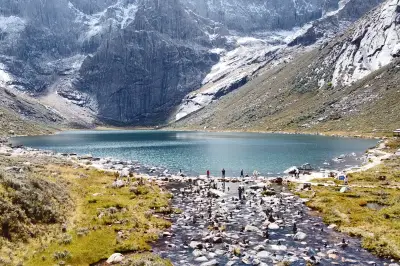
Long Lake is like the mother lake of all lakes in Jiuzhaigou. Due to its high altitude and location at the foot of a snow mountain, its water volume is stable year-round, supplying other lakes. Standing on the viewing platform looking down, a pure blue greeted my eyes. Though the sky was blue, the lake didn't reflect it but absorbed the blue deeply into itself. Through the ripples blown by the breeze, it playfully teased the visitors' eyes. The white snow mountain stood at the far end of Long Lake, selflessly offering its love and guardianship. If Long Lake is the mother, then the distant snow mountain is like the father. Beside the viewing platform below Long Lake, there is a magical pine tree with branches growing in one direction, like an old butler silently welcoming distant guests. The boardwalk from Long Lake to Five Color Pond is the steepest in Jiuzhaigou. My calves and right knee started aching—maybe from too much walking these days, or from exposure to cold. This section was also a bit tough. Just as Guo Feng's altitude sickness disappeared, my knee started acting up. Alas, visual enjoyment still comes at a price.
Coming down from Long Lake, we reached the second gem of Jiuzhaigou—Five Color Pond. Jiuzhaigou's Five Color Pond is different from Huanglong's. It's a single pond, smaller, but has another color that other lakes lack. Besides the crystal-clear green, there's a special fluorescent green, maybe due to light refraction or unique minerals in the pond. This interplay of deep and light, movement and stillness, creates a breathtaking beauty. Because it's small, the pond was even more crowded, making it hard to get close. I managed to take a full picture using a selfie stick, but it was filled with others' phone screens. It seems everyone shares the same aesthetic for great beauty.
Leaving Five Color Pond, we took a sightseeing bus directly out of the ravine. Arriving at Nuorilang Visitor Center, it was already 3:30 p.m. The guide had set the meeting time at 5:30, leaving us only two hours. The Shuzheng Ravine, leading to the exit, was still unvisited, so we boarded a bus without resting. Fortunately, the essence of Jiuzhaigou was already deeply imprinted in our minds. We made brief stops at Rhinoceros Lake, Spark Lake, and Bonsai Shoal before leaving the scenic area. This time, we came out early, arriving at the bus at 5 p.m. The sky in Jiuzhaigou was already starting to darken. It was a tiring day, but also a happy fatigue. Interestingly, the young couple sitting next to me had a quarrel. The woman looked very angry; no matter how the man tried to appease her, she rejected his touch. The scene was awkward but also a bit funny. Before this, they had been chattering nonstop on the bus. Now they were completely silent. I didn't pay much attention and soon dozed off. When I opened my eyes, the bus was empty. For a moment, I thought I was dreaming or that something supernatural had happened. Though slightly panicked, I knew staying calm was the key, so I remained seated. Then Guo Feng came to call me—apparently, an hour had passed since we boarded. It was now one of the guide's activities: visiting a Tibetan household. Everyone else had gotten off, but I was asleep and hadn't heard the bus stop or the guide's voice. In such noise, I still slept—I was impressed with myself! However, I was too tired, so I asked Guo Feng to go alone while I rested in the car. I waited for an hour before they returned, ending the day's itinerary.
On the 27th, we still got up at 5 a.m. and left at 6:30. Since it was the last day back to Chengdu, I couldn't help feeling reluctant. Despite being the last day, we visited three attractions in the morning that were ostensibly about ethnic minority culture but were actually shopping spots: one silver jewelry store, one specialty supermarket, and one silk products store. Although tinged with commerce, they still taught us a lot about minority customs and culture—a different kind of gain.
After leaving the silver shop and getting on the bus, I noticed the young couple next to me had made up and resumed their usual chatter. The woman now had a silver bracelet on her wrist. Indeed, shopping is the best way to appease women! At 2 p.m., we departed from the silk culture center in Chuanzhusi and began the eight-hour return journey. The bus first had to cross a snow mountain over 4200 meters high before leaving the mountains. Since it was daytime, we could enjoy the snow mountain scenery up close. I desperately wanted to sleep but couldn't bear to close my eyes. Despite my reluctance, the blue sky, white clouds, and towering mountains gradually receded from my view. The bus spiraled upward; Chuanzhusi at the foot grew smaller and smaller. When we reached the highest point, through the window, I saw the endless snow mountains stretching before me. Unlike previous views where the snow mountains seemed lofty and untouchable, now they appeared almost within arm's reach. This sense of shock from a level gaze was incomparable to looking up. I suddenly had the illusion that the bus would break through the cliff railing and drive straight into the snow mountain. I wondered if there were bronze doors and Zhang Qiling inside? The majestic snow mountains were incredibly beautiful and spectacular! I didn't expect to enjoy such scenery on the last day—truly worth it! Unfortunately, I was on the bus and didn't take a photo. After descending the snow mountain, the scenery became ordinary, like returning from heaven to earth. I finally allowed myself to sleep. The drive out of the mountains felt endless without any expectation to hold onto. Every time I drifted off, I woke up just a few minutes later—time crawled. The only consolation was that I didn't feel car sick, perhaps because I had gotten used to the swaying ride. I won't dwell on the tedious details. After six hours of bumpy ride, cityscapes began to appear outside. Finally, we had driven out of the mountains! The bus stopped at Jinniu Ba Road on Chengdu's Third Ring Road, marking the end of our group tour. Our guide had many shortcomings, especially during Guo Feng's altitude sickness night, but she had been diligent in her duties overall, so I was still grateful. After getting off, we planned to take a taxi to the booked hotel, but the road near the hotel was blocked. We had to book a hotel near the drop-off point. After checking in, it was past 11 p.m., and we were so hungry that we went to McDonald's for a burger, not getting to bed until 12:30 a.m.
That night, I slept very well. When the alarm went off at 7 a.m. the next day, I thought I was dreaming. Since the last day's itinerary was to Chongqing, with a 10:50 a.m. bullet train ticket, I didn't dare sleep longer. After washing up, I hurried out. At 10 a.m., we collected our tickets at Chengdu East Station. Looking back at the city of Chengdu, I plunged into the waiting room. On the train, I kept recalling the journey's moments, not even enjoying the scenery, until we arrived at the mountain city—Chongqing. The reputation of 'Mountain City' was well-deserved. From the taxi window, I could see skyscrapers like mountains everywhere. The roads were winding and narrow; every two steps, the car climbed a slope, often very steep. Even in the city center, one could see low hills, so the greenery was extensive. Mountain City—mountain first, city later. The mountain didn't yield to urban development; rather, the city accommodated the mountain's stubbornness. The taxi driver recommended a highly-rated pea and noodle restaurant near Jiefangbei in Chongqing, which had appeared on many TV shows. Since it was close to Hongyadong, we dropped by to try it. To be honest, it was okay. For some reason, from the moment I stepped off the train, I felt a strange dislike for this city—not even half the fondness I had for Chengdu. Perhaps because I found Chongqing people relatively indifferent. After eating, we wandered around with our luggage, unsure where to head. Sightseeing with luggage is not a wise choice—it's awkward in crowds. So, upon reaching the entrance of Hongyadong, I decided to stay and watch the luggage. Guo Feng didn't find it fun to go alone, and she was feeling a bit unwell, so she came out shortly.
The taxi driver had warned that due to narrow roads and many one-way streets, rush hour traffic jams are severe. To avoid traffic, we took a taxi to Beichuan Airport at 4 p.m., arriving at 5 p.m. for an 8:30 p.m. flight. We spent the last three hours of the trip at a buffet restaurant. At 10:30 p.m., the plane landed at Guangzhou Baiyun Airport, marking the true end of our journey.
This trip had hardships and surprises, but overall, it was very worthwhile. This spontaneous journey started in Chengdu and ended in Chongqing, allowing me to appreciate nature's craftsmanship and experience the different characters of each city. If I have a regret, it's not spending more time at Five Flower Lake. But regrets are the motivation for next time. Jiuzhaigou's beauty is such that it can't be seen enough even in a thousand views. Next time, I must fly directly to Jiuhuang Airport and spare myself the eight hours of bumpy misery.