Spring Outing to Jiuzhaigou, Capturing Scenic Beauty Like a Painting
Jiuzhaigou is located in Jiuzhaigou County, Aba Tibetan and Qiang Autonomous Prefecture, Sichuan Province. It is known as a 'fairy-tale world, paradise on earth.' From various magazine photos, it's clear that golden autumn is the best time to visit Jiuzhaigou, with vibrant and rich colors. The colorful forests and snow-capped peaks complement each other, and the plank roads wind through the colors into a romantic scene. The passionate waterfalls and the dazzling lakes make everyone who comes to Jiuzhaigou fall into a trance in the autumn scenery like a dressed-up maiden. Worries and nostalgia drift away, and inner peace arises spontaneously.
I came to Chengdu from Shanghai in advance and rested for a day in Chengdu. Since airfare from Shanghai to Chengdu during Golden Week was expensive and the discounted flights had inconvenient schedules, I chose to take the D2206 bullet train, departing at 06:39. The journey took about 15 hours, costing 606 RMB. It started from Hongqiao Railway Station and ended at Chengdu East Station. Bringing a book on the trip made it less boring. There are no direct flights from Shanghai to Huanglong; all require transfers, so spending time in Chengdu to play or rest was a good choice. I stayed at the Jiaoliao Humanistic Boutique Hotel near Kuanzhai Alley. The hotel is right in Kuanzhai Alley, surrounded by many snacks. After leaving the hotel, I could have grilled skewers, pig trotters, wontons (in red oil), and various noodle dishes. On Hongwasi Street, two specialty shops are Huaxi Beef Noodles and Zizhong Rabbit Noodles. Near the legendary north gate of Sichuan University, you can find ice jelly (three-delicious type without glutinous rice balls), guokui (pork-filled), and danhonggao (weird flavor). Near Gonghe Village, in the basement of a commercial building, there are old spicy wontons (order extra-spicy), bobo chicken (skewers), and Li Hua Dumplings. Near Jiuyanqiao Bridge is a bar street; those who love nightlife can have fun, and late-night snacks can be had at Zishi Grilled Fish. You can also go to Xidajie New City Square to eat Tan Tofu Pudding and Jiang Pig Trotters, and don't forget to order a serving of sweet noodle water and Zhong Dumplings—they're super delicious! Don't ask why you must go there; just go. As for scenic spots in Chengdu, the Jinsha Site and Sanxingdui Site are must-visits; Wuhou Temple is standard, Du Fu Thatched Cottage has no value for money, and the Sichuan Museum has few good collections. Jinli and Kuanzhai Alley are commercialized. These are just personal opinions.
Chengdu Jiaoliao Humanistic Boutique Hotel
Honestly, I didn't know how to read 'Jiaoliao' at first glance. Seeing the introduction that it might be a hotel, and since I hadn't found a place to stay yet, I decided to check it out.
When the door opened, the long corridor in front of me deeply caught my attention.
'A winding path leads to a secluded spot, and the meditation room is hidden among flowers. The mountain light delights the birds, and the pool shadows empty the mind.' Although it's not a meditation room, it's even better. Though there are no high mountains or deep pools, there are flowers, trees, water, and birds, creating a very poetic atmosphere.
Chengdu Jiaoliao Humanistic Boutique Hotel
After stepping in and experiencing everything about Jiaoliao, I immediately decided to stay. Staying there brought me even more surprises, like a secluded retreat hidden in a bustling city.
The hotel is small, with only 10 rooms, but each room is nearly 100 square meters. The entire hotel has excellent privacy, with attentive butler service that can arrange everything, big or small. Each room also has a unique feature: a small window called the butler service window. For convenience, small items like takeout or room supplies can be placed inside, ensuring complete privacy, just like at home. No need to worry about outside noise; you can enjoy your own space peacefully.
Service aside, the hotel's hardware is also very good. The room's decoration and layout give a very comfortable feeling. The style is traditional Chinese, an old cultural style that I really like.
Later, the butler told me that the hotel is core-themed on Zhuangzi's culture. Every corner reflects Zhuangzi's cultural atmosphere, with many antique items and artifacts, creating a rich cultural ambiance.
Although I stayed for only one day, I deeply felt the charm of Jiaoliao. The hotel is small but exquisite, free and comfortable. The environment, atmosphere, and service are all impressive. If I come to Chengdu again, I will surely stay here again to experience the charm of Jiaoliao.
Day 1 (October 7, 2015): Chengdu to Jiuzhaigou Entrance
At 7:00 AM, I gathered at the south gate of Chengdu Baihuatan Park and took the Jiantu Westbound bus to the Jiuzhaigou entrance. The one-way ticket was 110 RMB/person, bookable on Ctrip. The journey took about 10 hours. The drop-off point was at the Dream Jiuzhai Parking Lot, about 5 km from the scenic area entrance. Due to a landslide in Mao County, we detoured through Mianyang, adding an extra 60 RMB/person. Alternatively, you can take a long-distance bus from Chadianzi or Xinnanmen Bus Station, with a 141 RMB/person fare. Xinnanmen has more frequent departures, but tickets can only be bought 7 days in advance. The group lunch cost 25 RMB/person.
Day 2 (October 8, 2015): Jiuzhaigou – Zechawa Gully Long Lake Section
Jiuzhaigou gets its name from nine Tibetan villages, including Shuzheng, Heye, and Zechawa. The developed scenic area is shaped like a Y, combining walking and bus rides. The scenic area implements staggered visiting times. When you board the eco-friendly bus, you don't know which spot you'll go to first, which may disrupt your plans.
'After visiting the Five Sacred Mountains, one sees no mountains; after returning from Huangshan, one sees no other mountains. The scenery of Guilin is unmatched in the world, and Jiuzhaigou's beauty surpasses Guilin. Coming to Jiuzhaigou is for the water; after Jiuzhaigou, one sees no other water.' Jiuzhaigou is beautiful because of its water, spiritual because of its water, and magical because of its water. Water is the soul of Jiuzhaigou and the moving spirit of Jiuzhaigou. The water in Jiuzhaigou is pure and elegant, mysterious, light and ethereal, colorful, passionate, and peaceful. The six wonders—emerald seas, layered waterfalls, colorful forests, snow-capped peaks, Tibetan customs, and blue ice—leave the world the most precious treasures.
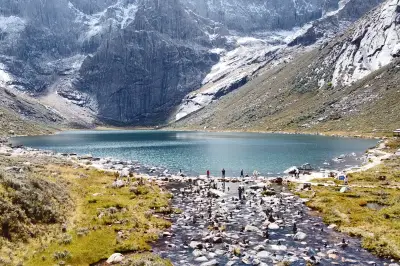
After entering the scenic area, I boarded the eco-friendly bus. It briefly stopped at Shuzheng Qunhai and then went straight to Long Lake. Long Lake is Jiuzhaigou's highest and widest lake. Its surface is dark blue, and its water comes from melted snow on high mountains. Strangely, the lake is over a hundred meters deep and shaped like an S. The surrounding forest is emerald green, and the peaks are permanently snow-capped. Long Lake has no outlet. In summer, despite rain, the water doesn't overflow. In winter and summer drought, it doesn't dry up. Hence Long Lake is called 'an unfillable, undrainable magical gourd.' Legend says that monsters sometimes appear in Long Lake; in the 1980s, someone claimed to have seen giant aquatic creatures there. Oddly, no fish live in the vast Long Lake. These mysterious things add to the lake's enigma in winter.
Walking down the wooden plank road about 1 km, you reach Five-Color Pond, the essence of Jiuzhaigou's lakes. The upper half is blue-green, the lower half orange-red; the left side is sky blue, and the right is olive green. The lake grows water plants like Spirogyra, Chara, and small ferns, as well as reeds, horsetail, and water bulbs. These aquatic communities have different chlorophyll levels, and in calcium-rich lake water, they present various colors. In the same lake, some areas are deep blue, some are light green, some are reddish yellow, some are pink-blue... endlessly changing and beautiful! In winter, the surroundings are icy, but this colorful small pond doesn't freeze—amazingly unique. Legend says Five-Color Pond is where the goddess Semo combed her hair. The god Dago fetched water for her from Long Lake every day. Over time, Dago's feet stepped 189 steps into the cliff, and the rouge from Semo's face turned into this stunning pond. Lovers believe that if they walk down the steps to the pond, make a silent wish, and then climb back up the 189 steps, they will love each other forever.
Now comes the highlight. After visiting Five-Color Pond, you have three options: 1) Take the bus from Five-Color Pond station to other spots. 2) Walk along the road or plank road down to Upper Seasonal Lake, then return to Five-Color Pond station by the same route (about 20 minutes one way). 3) Hike back to Nuorilang Center. I chose the hiking route, taking about 4 hours while sightseeing and photographing. Seasonal Lake is a lesser-known spot; you have to experience the scenery along the way yourself. Arriving at Nuorilang Center, I took the bus toward the exit and got off at Huohua Lake station, then walked along the plank road toward Reed Lake. The lake is full of reeds, with water birds flying and clear streams flowing, creating a wetland scene. In the middle of Reed Lake, a flowing water belt gracefully winds through, dividing it in half. This belt has a jade-like luster, so it's called the Jade Belt River. Legend says this beautiful river was transformed from the belt of the Jiuzhaigou mountain goddess Wornuo Semo. On the cliff beside Reed Lake, due to weathering, a profile resembling the goddess Wornuo Semo has formed.
Day 3 (October 9, 2015): Jiuzhaigou – Rize Gully Primeval Forest Section
Sunshine, rain, pine forest, and birdsong create a beauty different from Jiuzhaigou's waterscapes. The orderly, towering pines and cypresses stand like majestic warriors guarding the beautiful nature. The primeval forest is about 3 degrees cooler, so keep warm. Walking down the plank road, you'll pass by Grass Sea and Swan Sea.
Board the bus at Swan Sea and get off at Arrow Bamboo Lake, then explore down to Five-Flower Lake. Arrow bamboo is the favorite food of giant pandas. The shores of Arrow Bamboo Lake are widely covered with arrow bamboo, which is the lake's most notable feature, hence its name. The lake is wide and long, with a blue-green water surface. The reflections are so clear that it's hard to tell if the mountains are in the water or the water is on the mountains. In Arrow Bamboo Lake, many submerged trees are calcified, forming peculiar coral-like shapes. On the decaying wood, new trees grow, called deadwood regeneration or 'withered trees blooming again.' In calm weather, you can enjoy the reflections at Arrow Bamboo Lake, second only to Mirror Sea.
Panda Lake and Arrow Bamboo Lake are sister lakes. The rock textures on the lakeside cliffs are unique, reflected in the water, and together with round white stones underwater that naturally form black patterns resembling pandas, they create a delightful scene. Remember not to take the bus from Panda Lake to Five-Flower Lake; instead, walk along the road or plank road. At Tiger's Mouth, you'll see the most beautiful view of Five-Flower Lake. Ah, I forgot and missed this scene—so regrettable!
Five-Flower Lake is the pride of Jiuzhaigou. The same water area displays colors like goose yellow, dark green, deep blue, and navy blue, patchy and colorful. The bold, intense, and varied colors painted by nature are amazing. From Tiger's Mouth overlooking its whole view, it looks like a peacock with full plumage spreading its tail. Under sunlight, the lake becomes more enchanting, dazzling, and surreal, entering a fairy-tale world. The ever-changing splendor of the lake makes people fascinated. Through the clear water, you can see springs rising from the bottom, creating a dizzying effect. As mountain breezes blow, various colors intermingle, inlay, mix, and dye, making Five-Flower Lake full of life, active, and vibrant.
Take the bus to Pearl Shoal Waterfall. In a sense, it resembles the Luositan Waterfall in the Huangguoshu Waterfall group. It's not just a fall over a cliff; it has a shoal about 20-30 degrees. The waterfall first flows slowly over the shoal. Because the shoal is composed of travertine, with scale-like micro-undulations on the surface, when the thin water layer flows over, under sunlight, it looks like thousands of pearls sparkling with silver light, hence the name Pearl Shoal. Since the current is slow and the shoal fairly flat, visitors can take off shoes and socks and walk barefoot on the shoal. However, because the waterfall is formed by melted snow from the mountains, the water temperature is low. Even in midsummer, walking on Pearl Shoal feels biting cold and makes one shiver.
Continue down to Mirror Sea, where the valley slopes are steep, forests dense, and the forest color changes seasonally with rich layers. At first morning light or sunset glow, the lake is as flat as a mirror. Blue sky, white clouds, distant mountains, and nearby trees are all reflected on the bottom, with clear images, distinct lines, bright colors, and rich variation. The magical scene of 'fish swimming in the sky, birds flying under the water' makes people intoxicated. On the shore, a thick vine tightly clings to a towering tree, reaching the same height straight up. The tree gives the vine warm green shade, and the vine gives the tree beautiful and pure love. Thus, Mirror Sea has another name: Love Park.
Passing through Mirror Sea, you reach Nuorilang Waterfall. 'You carry the load, I lead the horse'—which role do you want to play? The opening scene of Journey to the West was filmed here. 'Nuorilang' is a Tibetan transliteration meaning 'male god,' symbolizing majesty. So Nuorilang Waterfall means a magnificent waterfall. The surging water comes from Nuorilang Lakes and falls from the top, like a Milky Way pouring down, thundering through the valley. The southern end has a mighty water flow, cold and misty. Under morning sunlight, rainbows often appear across the valley, adding charm to the waterfall. In autumn, the 300-meter waterfall, set against autumn colors and clouds, forms a spectacular picture.
Finally, you arrive at another major waterfall in Jiuzhaigou: Shuzheng Waterfall. The white, foamy waterfall and the ancient, sturdy trees—one dynamic, one static—form a strong contrast yet a harmonious natural picture. Some describe the magical beauty of Shuzheng Waterfall: 'The curved trunks of verdant ancient trees are half immersed in the waterfall, allowing the white spray to wash over them, like fairies with flowing hair and bare bodies playing in the holy water.' Nature's magic can sometimes make one feel as if in the Garden of Eden!
Day 4 (October 10, 2015): Huanglong Day Trip
At 7:00 AM, I took the Jiantu Westbound bus from Dream Jiuzhai Parking Lot to the Huanglong Cable Car Station. Round-trip ticket: 80 RMB/person. The journey took about 2.5 hours. We stopped at an altitude sickness explanation station to learn about altitude sickness and buy medicine, but it wasn't mandatory. The scenic area visiting time was about 6 hours. Alternatively, Jiuzhaigou Bus Station also has tickets to Huanglong for 90 RMB/person round trip, with only two departures at 7:00 and 7:30. The return departure time needs to be inquired at Huanglong.
Huanglong Scenic Area is known as 'the fairy pond on earth' because many colorful ponds change color with the surrounding scenery and sunlight angles. The main scenic area, Huanglong Gully, resembles the 'dragon' image in Chinese minds, so it's always called 'the fairy pond on earth' and 'symbol of China.' It is highly revered by local people of all ethnicities. Tibetans call it 'Dongri Seerjun,' meaning 'the eastern conch mountain (referring to Xuebao Mountain)' and 'golden haizi (referring to Huanglong Gully).'
Day 5 (October 11, 2015): Jiuzhaigou to Chengdu
At 7:00 AM, I took the Jiantu Westbound bus from Dream Jiuzhai Parking Lot back to Chengdu via Mao County. One-way ticket: 120 RMB/person. The journey took about 8 hours. Drop-off at Chengdu Chadianzi Bus Station.
Due to weather, I wasn't entirely satisfied with this Jiuhuang trip. But in life's journey, how can everything be smooth? Whether reading thousands of books, traveling thousands of miles, or meeting countless people, we continuously improve ourselves through the perception of change and realization, ultimately reaching the highest state of 'form is emptiness, emptiness is form.' Emptiness is not nothingness; it's being aware of impermanence and not clinging to things, like the moon in water, flowers in a mirror—a manifestation of great wisdom. As the Sutra of Impermanence says: 'Worldly phenomena have no form; form arises from the mind. Visible things are not things; perceptible events are not events. All things are empty—truly a hindrance of the mind. The mind of an ordinary person is everywhere a prison. Only by transforming the world can one achieve no-self. The self is the world; the world is the self.'
Notes and Suggestions:
1. Waterproof jacket and pants, waterproof hiking shoes are essential. In light rain, you don't need an umbrella or raincoat.
2. Start taking anti-altitude sickness medicine two weeks in advance. In high-altitude areas, drink plenty of water and rest.
3. Book tickets on travel websites if possible, to avoid carrying too much cash. Jiuzhaigou entrance + eco-bus: 310 RMB/person. Online pickup is convenient. Huanglong entrance + uphill cable car: 280 RMB/person. Uphill cable car is recommended to save time. I took photos for a long time, and 6 hours was a bit rushed.
4. For hiking, pack light and bring high-energy food like chocolate, Snickers, beef jerky, etc. Small spots inside Jiuzhaigou usually sell self-heating boxed meals for 25 RMB/box. Buy one as soon as you see it to replenish energy. Don't eat the set meal at Nuorilang Center—it's low value for money. Wait until you return to Chengdu for good food. At Huanglong, there is a Rhododendron Forest Service Station where things are decent and not expensive. Usually you can reach it around 13:30. Highland barley cake + fried rice + local egg are equivalent to instant noodles.
5. The advantage of entering the valley twice is ample time for sightseeing and photography. If you take the bus all the way and like early starts, you can visit the whole Jiuzhaigou in one day with proper arrangement. You can also charter a private car inside the valley for staggered visits at an additional 210 RMB/person. Highly recommended if you just want to check off the sights.
6. Restaurant prices outside Jiuzhaigou are roughly similar. The difference lies in snacks and wontons, which can be cheap or expensive. Regular grilled fish: 68–88 RMB/piece. Don't be fooled by free side dishes—they are just the garnishes in the grilled fish. Per capita about 50 RMB. For one person, I recommend egg fried rice + stir-fried wild vegetables or grilled fish.
7. Inside the scenic area, taxis or unlicensed cars charge 10–40 RMB. Negotiate the price.
8. The Mao County section is prone to landslides. Be prepared if traveling by bus. I encountered a small landslide on the return trip, which delayed me at least 6 hours. If stuck in an area without restaurants, you may go hungry and affect subsequent plans.
9. I am lazy; I entered the valley after 9:00 AM and left around 7:00 PM. I walked quite a bit, so it was still a bit rushed.
10. Some plank roads from Long Lake to Nuorilang in Jiuzhaigou are damaged. Be careful; this section is not recommended for walking.
11. Keep a good attitude. The scenery you see may not be what you imagined. Everything changes; only your mind remains unchanged.
12. Hotel prices near the entrance are highly elastic. Sometimes booking online in advance is more expensive. If there's a cheap price online, book it. I booked a standard room for 133 RMB/night. Most hotels offer pickup service. Check with your hotel. Some hotels do not provide disposable toiletries!