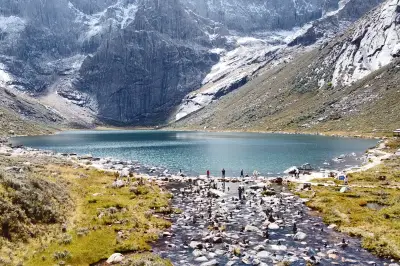
Music Festival Arrives in Jiuzhaigou, Aba Prefecture, Sichuan
The beauty of Sichuan goes without saying. For a period of time, I was crazy about Sichuan—not only for its scenery and food, but also for its culture. I have always believed that when you travel to a place, it's the local culture and customs that are its true soul!
Mid-Autumn Festival, I heard that Aba Prefecture will host the "Panda Homeland · Pure Land Aba · Jiuzhaigou World Traveler Conference." I was thrilled when I saw this news. As a rock fan for over a decade, this event hits the spot. It can be said to be a grand gathering of folk customs and culture, music and art, food and scenery! Rock people, rock souls, the autumn of Aba Prefecture is ready! This recommendation is first up!
Great news spreads far and wide—the music festival in Aba Prefecture is here! No need to worry about where to go for the Mid-Autumn break. Looking at the lineup, it feels like experiencing a live version of "The Big Band." High mountains with beautiful views, starry nights, music, beer, and hormones—just thinking about it feels amazing!
Now it's an era of rock for everyone; even kids can come and play. The organizers will set up two stages: the Jiuzhai (Ethnic) Stage and the MTA presents Mountain Spirit Stage! Tibetan cuisine, folk customs and arts—this event will showcase Aba's intangible cultural heritage in the most trendy form.
Location: Jiuzhaigou County, Aba Prefecture, Sichuan
Large-scale art installation site
This Traveler Conference is an immersive art exhibition. Artists will cross-border integrate their works with Tibetan and Qiang ethnic culture, combining human geography to create sculptures representative of Aba culture tailored for this music festival, bringing the most fashionable ways of play into nature. There will be works themed around the 100th anniversary of the founding of the Communist Party of China. Over these three days, this place is expected to become a new trending check-in spot!
Unmissable music scene
Remember those unforgettable bands from "The Big Band"? Some of them will participate in this music festival. The lineup covers rock, folk, rap, electronic, indie pop, and more!
China's most influential rock band Miserable Faith, veteran rock singer Lao Lang, rock's "Neon Sweetheart" Mosaic, and the very eyeliner-skilled Muma—just seeing the list is enough to make people scream! There are also some new forces and fusion bands with Tibetan musical elements—very, very exciting! Rock fans, are you ready?!
Speaking of Aba Prefecture, the most familiar place is Jiuzhaigou! It is a minority area mainly inhabited by Tibetans and Qiang people. Its unique geography and climate make the people here good at singing and dancing. Many singers from music shows come from here! It is also a "machine" for intangible cultural heritage! The county has a total of 90 intangible cultural heritage items, including 4 national-level, 4 provincial-level, 31 prefecture-level, and 51 county-level.
(Twelve Animal Mask Dance)
"Zhou" dance is a traditional dance of Jiuzhaigou County. "Zhou" means auspicious. This dance is a fusion of Diqiang culture and Tibetan culture, with some sacrificial rituals. Dancers wear animal masks. Early mask designs had about 100 types, later only about 30, and now only about 10! The masks are carved from wood. Being able to see this dance now is truly something to cherish.
Every year on the fifth day of the first lunar month, the Baima Tibetans hold activities to worship various gods of nature, among which the "Zhou" ritual is particularly important.
This is a unique form of self-accompanied group rap art in Jiuzhaigou, mainly using the pipa. The tune of Jiuzhaigou mainly integrates folk music elements of Tibetan, Han, and Hui ethnic groups. It is a unique local art and a national intangible cultural heritage!
The lyrics and melodies of these tunes are relatively simple, representing people's aspirations for life in a certain period and recording the social conditions of that time. Worth a listen.
In recent years, with the strong promotion of cultural tourism, local authorities have increasingly valued the inheritance of intangible cultural heritage. It would be a pity if hundreds of years of culture were lost!
(Dengga Ganzhou)
This dance is my favorite. It is themed around pandas and has strong regional representation. The dance depicts the living habits of pandas. Every year from the fifteenth to the eighteenth day of the first lunar month, as a festival to worship and commemorate pandas, the whole village, young and old, selects the youngest and most capable young men from the clan, wearing "panda masks" and pretending to be "Dengga" (panda) to perform.
This is a dance passed down through generations, making people feel the locals' love and worship of pandas. Very atmospheric. If you have a chance to visit Aba in winter, don't miss it!
This dance is a collective dance of the Baima Tibetans. Actually, during travel, many places or scenic spots perform this dance when entertaining tourists, to show respect to visitors.
But the true tradition of this dance is performed every year from the first to the fifteenth night of the first lunar month. Before the dance, teenagers in the village go to each house to collect a bundle of firewood, place it in the center of the threshing ground, light a bonfire, and dance around it.
On the seventeenth day of the first lunar month, it is the annual Tumo Festival of the Baima Tibetans. The Tumo Festival is a carnival for the Baima Tibetans. On this day, everyone gathers together and celebrates by chasing each other and smearing soot from pots.
Western Sichuan Tibetan Folk Songs
Tibetan folk songs from western Sichuan, heard on many variety shows, have a loud and penetrating voice. It's not hard to imagine that most of western Sichuan is high-altitude, where people live mainly by herding. In their spare time, this might be the simplest way to entertain themselves!
They easily sing out the beautiful scenery, social life, and religious beliefs of western Sichuan, which is reflected in the lyrics.
Summary: These folk activities are actually related and form a continuous program. Every year on the first day of the Tibetan New Year, the Baima Tibetans invite married daughters back; on the second day, they invite friends; on the third day, they start performing the "Zhou" dance. From the fifteenth to the sixteenth day of the first lunar month, they send off the gods. During the farewell, they sing antiphonally and dance around the fire.
Mani Pile (Duobang)
In Jiuzhaigou, you often see high piles of stones at crossroads, along roadsides, by lakes, and in villages. Upon closer inspection, you can see stones carved with Buddha images and Buddhist scriptures. This form is called a Mani pile, used by Tibetans for blessings.
In Tibetan Buddhist areas, stones are considered to have life and spirituality. The "Mani stones" carved with Buddha images and Buddhist scriptures have no uniform size or shape. The maker does not need to choose deliberately; they pick up any stone and carve on it. The scriptures are mostly the "Eight Syllable Mantra" and spells.
Having seen so much, the autumn of Jiuzhaigou is ready. Have you made plans for the Mid-Autumn Festival? If you miss it this year, you'll have to wait another year. Book your flights and hotels now!
Travel Diary: 1. Three Days of Mid-Autumn Rock 'n' Roll Together 2. Intangible Cultural Heritage of Aba Prefecture
Tourist Information: Hotel Index, Guide Index, Airfare Index, Website Navigation, Travel Index, Cruise Index, Corporate Travel Index, Membership Cooperation, Distribution Alliance, Friendly Links, Corporate Gift Card Purchase, Insurance Agency, Agency Cooperation, Hotel Franchise, Destination and Scenic Area Cooperation, More Membership Cooperation, About Ctrip, Ctrip Hot Topics, Contact Us, Careers, User Agreement, Privacy Policy, Business License, Security Center, Ctrip Content Center, Intellectual Property, Trip.com Group Algorithm Disclosure