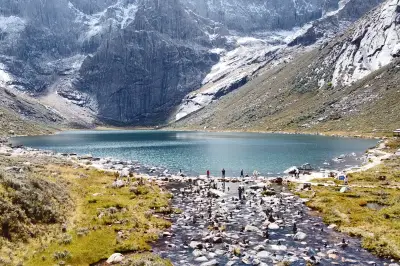
![My Daughter's Elementary School Graduation Trip Part 2 ~ 2021 Summer Self-driving Travelogue [Jiuzhaigou, Huanglong Chapter]](/img/5b5246b6d27ea12d_l.webp?src=https%3A%2F%2Fdimg04.c-ctrip.com%2Fimages%2F0102z1200090p91e14976_W_320_0_Q80.jpg)
My Daughter's Elementary School Graduation Trip Part 2 ~ 2021 Summer Self-driving Travelogue [Jiuzhaigou, Huanglong Chapter]
Since entering the mountains at Yunwu Mountain, we headed towards Jiuzhaigou. Due to the narrow and bumpy mountain roads, we drove slowly, and made an unplanned stop in Wen County for the night. For two days, we traveled along winding mountain roads in light rain. Everyone says not to drive on mountain roads in rainy weather, but once we got on this only road, there was no turning back! We were also puzzled—there were very few cars on this road, and we even wondered if we had taken a wrong turn. What a mix of emotions!
It wasn't until we were almost at Jiuzhaigou that the sky cleared, and my mood lifted with a sense of relief.
Day 5:
[July 16, 2021: Arrival at Jiuzhaigou]
Just as we entered the Jiuzhaigou area, we encountered a checkpoint. This was the only mountain road for hundreds of kilometers, and if a criminal were here, they would have no escape! I was truly impressed—how thorough our country's security measures are! Thumbs up!
Life is short, so we should live with integrity and a clear conscience!
The mountain roads were bumpy, and our two cars looked weathered. To our delight, the owner of the guesthouse had a yard where we could wash the cars. The landlady warmly prepared a long hose and laundry detergent for us. The children, after the long journey, perked up and eagerly competed to wash the cars, having a great time. One good thing about kids: as long as they can get their hands on something, everything becomes fun!
Take a look at the guesthouse we booked online. Though it's just a homestay, it pleasantly surprised us—clean, tidy, and with a nice room style!
At Zangbala BBQ, we met a helpful young woman. She and her travel companion had just finished visiting Jiuzhaigou and were heading to Huanglong next, exactly one day ahead of our itinerary. I took the chance to add her on WeChat and asked her for recommendations on must-see spots and travel tips. It was a very useful exchange—thank you for sharing!
Day 6:
[July 17, 2021: Beautiful Scenery at Jiuzhaigou]
Jiuzhaigou is located in Zhangzha Town, Jiuzhaigou County, Ngawa Tibetan and Qiang Autonomous Prefecture, Sichuan Province. It is a branch gully of the Bai River, upstream of Baishui Gully, and named after the nine Tibetan villages (also called Heyao Jiuzhai). It is China's first nature reserve primarily focused on protecting natural landscapes, a famous scenic area, and a national model scenic spot for civilized tourism. It is listed as a UNESCO World Natural Heritage site and part of the "Man and Biosphere" protection network.
Jiuzhaigou is over 2,000 meters above sea level, covered with primeval forests, and contains 108 lakes.
Jiuzhaigou lies at the northern foot of Gaerna Peak in the southern Minshan Mountains. It is a branch gully at the source of the Jialing River, part of the Yangtze River system, and a transitional zone from the Qinghai-Tibet Plateau to the Sichuan Basin, with complex geological structures. The area has significant elevation differences, diverse climates, and is known for its beautiful mountains and clear waters. The main valley of Jiuzhaigou is Y-shaped, over 50 kilometers long. The total area is 650.74 hectares, with numerous lakes, waterfall groups, and travertine shoals. Water is the main highlight of Jiuzhaigou's scenery. The crystal-clear streams weave like necklaces through forests and shoals. The colorful lakes and magnificent waterfalls are a feast for the eyes.
Jiuzhaigou is a mountain valley over 50 kilometers deep, mostly covered by forest. In 2009, Nuorilang Waterfall, with a width of 320 meters, was recognized by the China World Records Association as the widest waterfall in China.
There are two sightseeing routes inside Jiuzhaigou: one from Nuorilang Central Station towards Five-Flower Lake at the upper right of the Y-shape, and the other towards Long Lake at the upper left. Regardless of which direction you go first, the shuttle bus will take you to the next unvisited spot. However, considering the physical stamina and the need to prioritize attractions within a day, I personally recommend heading to Five-Flower Lake first, so you can enjoy the most beautiful scenery with your best energy!
Our first stop: Five-Flower Lake
Five-Flower Lake has diverse and colorful waters, earning it the title of "the essence of Jiuzhaigou."
Located in the middle section of Rize Valley, one of the three main valleys of Jiuzhaigou, and upstream of the Peacock River, Five-Flower Lake gets its name from the underwater travertine deposits, colorful algae, and reflections from the vibrant forests along the shore, creating shades of goose-yellow, navy, dark green, and sapphire blue. It is the most beloved and popular spot among all attractions in Jiuzhaigou.
The lake of Five-Flower Lake—you can feel its charm accumulated over time!
Our posed photos—how can we make the beautiful scenery stay a little longer, even longer?
At Five-Flower Lake, to divert the attention of our daughter, who was feeling down after a fall, we rented a set of ethnic costumes for her. She took a set of beautiful photos, and this joy added a lot to our Jiuzhaigou trip! It's experiences like these that make the journey more exciting!
Beautiful scenery, matched with such a lovely child, makes it even more beautiful!
It felt like we were transported to another time and space...
—There are many photos, but I don't want to miss any of them! Dear friends, enjoy them slowly~
Pearl Shoal Waterfall
Located between Mirror Lake and Jinling Lake, Pearl Shoal Waterfall has fresh air and dense forests at its base. The plank road on the left side of the rapid flow is the best spot to view the waterfall. It is the largest travertine waterfall in Jiuzhaigou, with an altitude of 2,443 meters, a height of 21 meters, and a width of 162 meters. The water comes from melted snow in the mountains.
Pearl Shoal Waterfall is covered with pits and holes. When the rapids crash into them, the splashing water looks like pearls under sunlight, hence the name "Pearl Shoal."
After viewing the waterfall, walking to the parking lot, you'll pass by the 8.8 Earthquake Stone. This stone rolled down from a mountain hundreds of meters high during the 7.0-magnitude Jiuzhaigou earthquake on August 8, 2017, at 9:19 PM, witnessing that natural disaster.
Our second stop: Long Lake
Long Lake is the longest lake in Jiuzhaigou, over four kilometers long, with a dark blue color and an S-shape. The dense forests along the shore, the mirror-like water, and the towering snowy peaks against the blue sky and white clouds create a magnificent and beautiful scene.
Long Lake is 3,060 meters above sea level, with a maximum elevation of 4,457 meters, and about 5 kilometers long. There is no outlet around Long Lake; its water source comes from melting snow on the mountains. Interestingly, Long Lake never dries up or overflows, so Tibetans call it a "treasure gourd that can never be filled or emptied."
On our way back, we took a short break at Shuzheng Valley and discovered different scenery!
Shuzheng Valley is the main valley of Jiuzhaigou and the gateway to its beautiful landscapes.
The valley is 14 kilometers long and contains over 40 lakes, accounting for about 40% of all lakes in Jiuzhaigou. It is known as the epitome of Jiuzhaigou, with magical lakes, colorful shoals, original millhouses, and bridges dotting the group lakes and magnificent waterfalls that leave you dazzled and in awe of nature's wonders.
Jiuzhaigou National Nature Reserve is the core area and corridor of the A population of giant pandas in the Minshan Mountains. It has a typical natural ecosystem and is one of the core areas of biodiversity conservation in China. With abundant animal and plant resources, it has great ecological protection, scientific research, and aesthetic tourism value. The area is rich in biodiversity and contains rare species. Jiuzhaigou is also renowned for its "Six Wonders": alpine lake groups, waterfalls, colorful forests, snow peaks, blue ice, and Tibetan customs. It is called a "fairy tale world" and the "king of water scenery." Jiuzhaigou is also a national geological park, primarily protecting geological relics such as travertine lakes, shoals, waterfalls, karst water systems, and forest ecosystems, with high scientific research value.
[Video] -- Jiuzhaigou Trip
Day 7:
[July 18, 2021: "Fairy Pool on Earth" - Huanglong]
Huanglong Scenic Area is located in the southern Minshan Mountains in Songpan County, Ngawa Tibetan and Qiang Autonomous Prefecture, Sichuan Province. It is a transitional zone from the eastern edge of the Qinghai-Tibet Plateau to the Sichuan Basin. The highest peak, Xuebao Peak, the main peak of Minshan, is 5,588 meters above sea level and is snow-covered year-round. It is the easternmost point of China with modern glaciers. Huanglong's elevation ranges from 1,700 to 5,588 meters, adjacent to Jiuzhaigou, only 100 kilometers away.
The road from Jiuzhaigou to Huanglong is excellent, a true scenic highway! Driving on this road is absolutely delightful!
We saw the gate of Huanglong but almost missed it—perhaps because there were so few visitors. Later we learned it was the exit gate of Huanglong. We parked our car in the parking lot there, and a few locals approached us to solicit business. They said this was the exit, far from the main entrance, and that walking was not suitable to save energy for sightseeing. They vaguely mentioned that the scenic shuttle bus required queuing and offered to take us. Several people talked at once, making us uneasy. After all, it was our first time here, the weather was hot, and we had limited time. Although the map showed only 2 kilometers away, at an altitude of 3,500 meters, walking on the mountain road was not easy. Looking at the sun-scorched asphalt between our parking spot and the exit gate, we hesitated, mainly because we didn't know what was going on there or if there were any vehicles.
We were wary and consulted the parking lot security guard, who clearly told us that there was a free shuttle bus at the exit gate to take us to the main entrance. We decided to walk over and indeed directly boarded the shuttle bus, leaving for the main entrance after a short wait. We were glad we didn't listen to those soliciting drivers; otherwise, we would have wasted money unnecessarily.
Huanglong is a veritable natural museum of travertine.
It is huge in scale: the Huanglong Gully features a continuous travertine section up to 3,600 meters long, with the longest travertine shoal reaching 1,300 meters long and 170 meters wide; over 3,400 colorful pools; rimstone dams up to 7.2 meters high; and the Zhaga travertine waterfall up to 93.2 meters high. All these are the largest in China and unmatched in the world. It is concentrated: over the extensive carbonate rock area, travertine wonders are only concentrated in four gullies—Huanglong, Zhaga, and Erdaohai—at elevations between 3,000 and 3,600 meters. It is complete in process: the Huanglong Gully, Erdaohai, and Zhaga Gully are respectively in the modern formation, decline, and end stages of travertine formation, providing a complete site for studying travertine succession. It is intricately combined: within the 3,600-meter stretch of Huanglong Gully, almost all types of travertine are grouped together, skillfully forming a golden "dragon" soaring amidst snow mountains and forests.
[Travertine] is a chemical precipitate of calcium carbonate formed when calcium bicarbonate-rich geothermal water approaches or emerges on the surface, with large amounts of carbon dioxide escaping.
The mineral composition of travertine is mainly calcite and aragonite; it is hard, dense, fine-grained, massive, hollow or solid spherical, thick or thin layered, with fibrous or concentric structures. The shapes of travertine bodies are diverse and variable, commonly forming cones, mounds, fans, stalactites, etc. Travertine is generally a low-temperature geothermal manifestation.
Experts say that travertine landscapes refer to springs, rivers, or lakes rich in calcium bicarbonate. Due to differences in calcium carbonate saturation and water depth, light absorption and emission vary, combined with different colors of algae growing in the pools, creating colorful phenomena. The formation of travertine requires strict and complex natural conditions, and the process is very slow. Travertine pools like those in Huanglong may take tens of thousands of years to form and are almost impossible to repair once damaged.
The colorful pools of Huanglong suddenly reminded me of a lotus pond nurturing an immortal fetus in a certain play!
Huanglong Scenic Area is known as the "Fairy Pool on Earth" because of its numerous colorful pools that change color with the surrounding scenery and sunlight angles. It consists of Huanglong Gully, Danyun Gorge, Mouni Gully, Xuebaoding, Xueshanliang, Hongxing Rock, and Xigou. The main scenic area, Huanglong Gully, lies at the foot of Xuebao Peak, the main peak of Minshan, facing the source of the Fujiang River, 7.5 kilometers long and 1.5 kilometers wide.
Huanglong Scenic Area is renowned for its "Four Wonders": colorful pools, snow mountains, gorges, and forests. Some also add shoals, ancient temples, and folk customs as the "Seven Wonders."
In December 1992, Huanglong Scenic Area was listed as a UNESCO World Natural Heritage site.
I think many people might share the same thought: these natural travertine colorful pools look like terraced fields built of fine sand. So are they as loose as sand? Let me tell you quietly: my daughter and I actually touched the travertine, which looked like sand, by a small stream beside the wooden plank road. To our surprise, it was very hard and dense, not soft at all. We also tasted the water, but it was not as salty as the sea, as we imagined. Of course, we didn't dare taste too much, afraid of poisoning due to ignorance!
After seeing the scenery, remember to let the scenery remember you—taking beautiful photos is a must!
[Special Reminder]: Huanglong Scenic Area, with an altitude above 3,500 meters, is one of the highest scenic spots in China. Tourists should take precautions against altitude sickness. It is recommended to start taking Rhodiola rosea 7 days before going to Huanglong, or carry fast-acting Omer oxygen-carrying tablets.
As it turned out, I actually had mild altitude sickness at Jiuzhaigou and Huanglong—just a slight headache that I didn't recognize. That evening when we arrived at Zoige, I lay down due to unbearable headaches from altitude sickness.
*** *** *** *** *** *** *** ***
Our next stop—Zoige, Zhagana, Labrang Monastery
_____________________________________________
[Thank you all for following Vicky's travelogue. Updates continue...]
![My Daughter's Elementary School Graduation Trip Part 2 ~ 2021 Summer Self-driving Travelogue [Jiuzhaigou, Huanglong Chapter] image 1](/img/cd69620c5594924a_l.webp?src=https%3A%2F%2Fdimg04.c-ctrip.com%2Fimages%2F0102z1200090p91e14976_W_640_400_Q90.jpg%3Fproc%3Dautoorient)
![My Daughter's Elementary School Graduation Trip Part 2 ~ 2021 Summer Self-driving Travelogue [Jiuzhaigou, Huanglong Chapter] image 2](/img/9a37ca4c4621d69d_l.webp?src=https%3A%2F%2Fdimg04.c-ctrip.com%2Fimages%2F010731200090tdfh3EC28_W_640_0_Q90.jpg%3Fproc%3Dautoorient)
![My Daughter's Elementary School Graduation Trip Part 2 ~ 2021 Summer Self-driving Travelogue [Jiuzhaigou, Huanglong Chapter] image 3](/img/e857e75e1a38c99b_l.webp?src=https%3A%2F%2Fdimg04.c-ctrip.com%2Fimages%2F0101e1200090oh8gp8710_W_640_0_Q90.jpg%3Fproc%3Dautoorient)
![My Daughter's Elementary School Graduation Trip Part 2 ~ 2021 Summer Self-driving Travelogue [Jiuzhaigou, Huanglong Chapter] image 4](/img/87950856928eac24_l.webp?src=https%3A%2F%2Fdimg04.c-ctrip.com%2Fimages%2F0104k1200090oh3h33825_W_640_0_Q90.jpg%3Fproc%3Dautoorient)
![My Daughter's Elementary School Graduation Trip Part 2 ~ 2021 Summer Self-driving Travelogue [Jiuzhaigou, Huanglong Chapter] image 5](/img/f47335cf4b61ea5b_l.webp?src=https%3A%2F%2Fdimg04.c-ctrip.com%2Fimages%2F010511200090ohhxr3238_W_640_0_Q90.jpg%3Fproc%3Dautoorient)
![My Daughter's Elementary School Graduation Trip Part 2 ~ 2021 Summer Self-driving Travelogue [Jiuzhaigou, Huanglong Chapter] image 6](/img/d3eaf743a26205cc_l.webp?src=https%3A%2F%2Fdimg04.c-ctrip.com%2Fimages%2F0104r1200090ohd61DD71_W_640_0_Q90.jpg%3Fproc%3Dautoorient)
![My Daughter's Elementary School Graduation Trip Part 2 ~ 2021 Summer Self-driving Travelogue [Jiuzhaigou, Huanglong Chapter] image 7](/img/7a3a72102f594d5b_l.webp?src=https%3A%2F%2Fdimg04.c-ctrip.com%2Fimages%2F010041200090oh9gr711B_W_640_0_Q90.jpg%3Fproc%3Dautoorient)
![My Daughter's Elementary School Graduation Trip Part 2 ~ 2021 Summer Self-driving Travelogue [Jiuzhaigou, Huanglong Chapter] image 8](/img/6d425ce49682a798_l.webp?src=https%3A%2F%2Fdimg04.c-ctrip.com%2Fimages%2F010021200090ohdr9D034_W_640_0_Q90.jpg%3Fproc%3Dautoorient)
![My Daughter's Elementary School Graduation Trip Part 2 ~ 2021 Summer Self-driving Travelogue [Jiuzhaigou, Huanglong Chapter] image 9](/img/cf277021889ccf12_l.webp?src=https%3A%2F%2Fdimg04.c-ctrip.com%2Fimages%2F010311200090ohfys04CD_W_640_0_Q90.jpg%3Fproc%3Dautoorient)
![My Daughter's Elementary School Graduation Trip Part 2 ~ 2021 Summer Self-driving Travelogue [Jiuzhaigou, Huanglong Chapter] image 10](/img/5efcb311cdc1778c_l.webp?src=https%3A%2F%2Fdimg04.c-ctrip.com%2Fimages%2F010371200090oh8gz3F00_W_640_0_Q90.jpg%3Fproc%3Dautoorient)
![My Daughter's Elementary School Graduation Trip Part 2 ~ 2021 Summer Self-driving Travelogue [Jiuzhaigou, Huanglong Chapter] image 11](/img/5599987dfc6b5021_l.webp?src=https%3A%2F%2Fdimg04.c-ctrip.com%2Fimages%2F010011200090ohbqz89EF_W_640_0_Q90.jpg%3Fproc%3Dautoorient)
![My Daughter's Elementary School Graduation Trip Part 2 ~ 2021 Summer Self-driving Travelogue [Jiuzhaigou, Huanglong Chapter] image 12](/img/b50608870bb319a2_l.webp?src=https%3A%2F%2Fdimg04.c-ctrip.com%2Fimages%2F0106v1200090ohb164E45_W_640_0_Q90.jpg%3Fproc%3Dautoorient)