2021 Autumn Tour of Jiuzhaigou and Huanglong
Due to the pandemic, I hadn't traveled for two years. When I heard that Jiuzhaigou fully reopened on September 29, I was tempted. Plus, the golden October is the most beautiful season in Jiuzhaigou. I mentioned it to my friend Cailian, and to my surprise, we were immediately on the same page. Action speaks louder than words, so we—two retired aunties—immediately booked a five-day tour of Jiuzhaigou and Huanglong online, from October 11 to 15. Let me introduce Cailian. She was my colleague and neighbor back in Jiangxi thirty years ago, and also my card-playing buddy in the game of Tractor. After going our separate ways for twenty years, she, like me, retired and settled in Zhuhai. Every time I introduce her as my colleague from thirty years ago, friends look at me suspiciously and say, 'Did you get the time wrong? You look so young!' Haha, we love hearing that. It's not that I got the time wrong—time has been especially kind to Cailian; she looks very young. The itinerary was as follows:
Day 1: October 11, Fly from Zhuhai to Chengdu, Overnight in Chengdu
Day 2: October 12, Chengdu – Dujiangyan Panda Base – Songpan County – Jiuzhaigou Entrance, Overnight near Jiuzhaigou Entrance
Day 3: October 13, Full-day sightseeing by sightseeing bus in Jiuzhaigou, Overnight near Jiuzhaigou Entrance
Day 4: October 14, Jiuzhaigou – Huanglong – Chengdu, Overnight in Chengdu
Day 5: October 15, Fly from Chengdu Airport back to Zhuhai
We were quite lucky. Three days before departure, a typhoon hit Zhuhai, bringing heavy rain for three days, causing flooding everywhere and grounding flights. But on our departure day, the sun shone brightly. Our flight at 9 a.m. on the 11th arrived in Chengdu at 11 a.m. After the travel agency driver picked us up and took us to Chengdu Xinlante Hotel to check in, we took a taxi straight to Wuhou Shrine. Wuhou Shrine is located in Wuhou District, Chengdu, Sichuan Province. It originated in 223 AD with the construction of Liu Bei's Huiling Mausoleum. It is the only joint temple in China dedicated to both a monarch and his ministers, and the most famous memorial site for Zhuge Liang, Liu Bei, and heroes of the Shu Han kingdom. It is also the most influential museum of the Three Kingdoms period in the country. The Chengdu Wuhou Shrine now covers 150,000 square meters, consisting of the Three Kingdoms Historical Relics Area (cultural relics section), the West Area (Three Kingdoms cultural experience area), and the Jinli Folk Custom Area (Jinli Street), earning the reputation of 'Holy Land of the Three Kingdoms.'
After visiting Wuhou Shrine, we came out at Jinli Street. Legend has it that Jinli was one of the oldest and most commercial streets in the Western Shu region, famous nationwide as early as the Qin-Han and Three Kingdoms periods. Now, Jinli Street is 550 meters long, styled with late Ming and early Qing dynasty Western Sichuan folk architecture, with Three Kingdoms culture and Chengdu folk customs as its content. It is an integration of tourism, shopping, leisure, and entertainment. Known as the Chengdu version of 'Along the River During the Qingming Festival,' Jinli is a spiritual station for romantic relaxation and a charming street to experience Three Kingdoms culture and Chengdu customs.
Although there were many snacks at Jinli, we decided not to eat there for the sake of our stomachs—just strolled and took photos. Finally, we found a hotpot restaurant nearby and had hotpot: lamb, kidney slices, fried crispy pork, various vegetables, and also ordered a bowl of dangdang noodles. Cailian even suggested a bottle of beer, but I gave it up for the sake of my blood sugar. With high blood sugar, I always have to control my mouth and keep moving. While eating hotpot, we watched a performance featuring face-changing, tea art, rolling lanterns, and Sichuan opera. The hotpot was delicious, and the show was wonderful. I couldn't help but admire how comfortable life is for Chengdu people—so envious!
The next day, a small car picked us up at the hotel at 5:45 a.m. to take us to the coach. Two fellow hotel guests were late. The driver called to ask if they could come down in two minutes; the answer was no. The driver immediately said he couldn't wait, sent them the address, and told them to take a taxi to the meeting point. We arrived at the coach meeting point, and at 7 a.m. we set off on time. Miss Xiaogu was our guide. Along the way, she explained Qiang culture, Sanxingdui culture, and more. The drive from Chengdu to Jiuzhaigou was really long—nearly 8 hours. The journey was quite tiring, but fortunately the coach seats were spacious, making it relatively comfortable, and hot water was available on board. An hour later, we arrived at Dujiangyan Panda Paradise. Here we learned that the red panda is not the baby of the giant panda.
Lunch was a special 'Panda Feast' at a designated restaurant in Dujiangyan—tasty.
After lunch, we passed through Wenchuan and Maoxian counties, and drove through Songpan Ancient City. Apart from spending 1 yuan several times to use the restroom, the journey went smoothly. We arrived at Jiuzhaigou entrance at 8 p.m. and stayed at a hotel there. We had a group dinner at the hotel. During the pandemic, the table companions didn't use serving chopsticks, so we placed serving chopsticks in each dish. But several companions still didn't use them. We didn't dare to eat from those dishes again. As a result, we only ate half full. Cailian went to buy chicken legs to eat, while I, poor thing, controlled my blood sugar and didn't dare to eat more.
Day 3: Staying at the entrance turned out to be convenient—we could sleep well and enjoy a nice hotel buffet breakfast. At 8 a.m., as soon as the scenic area gate opened, we walked in. We began a full day of touring Jiuzhaigou. Jiuzhaigou is a branch valley of the Baihe River upstream of Baishui Gully, named after nine Tibetan villages. Its altitude ranges from 2,000 to 3,000 meters. It is famous worldwide for its 'Five Wonders': emerald lakes (alpine lakes), layered waterfalls, colorful forests, snow-capped mountains, and Tibetan customs. It is known as 'Dreamland' and 'Fairy Tale World.' Jiuzhaigou is mainly composed of three valleys in a 'Y' shape within the Minshan Mountains: Rize Valley, Zechawa Valley, and Shuzheng Valley. The main scenic spots are distributed in these three valleys, which can be divided into five scenic areas: Shuzheng Scenic Area, Rize Scenic Area, Changhai Scenic Area, Baojingya Scenic Area, and Primitive Forest Ecological Scenic Area. 'After visiting Jiuzhaigou, you won't care about any other water.' Water is the soul of Jiuzhaigou—lakes, springs, waterfalls, and shoals are linked together, combining motion and stillness, strength and gentleness.
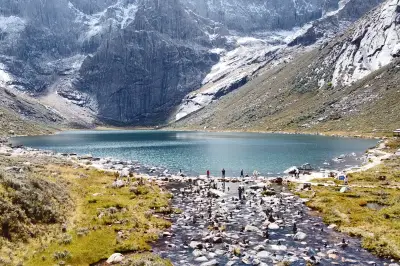
We took the scenic area shuttle bus first to Long Lake (Changhai). Long Lake is the highest and widest lake in Jiuzhaigou, with a dark blue surface, fed by melting snow from high mountains. Strangely, there is no outlet around Long Lake, but it doesn't overflow during the summer rainy season, nor does it dry up during the dry winter and spring. Therefore, locals call it a 'treasure gourd that can never be filled or drained.' There was an ancient tree whose branches only grew to one side, with the other side bare. When we arrived, heavy fog blocked the distant view. We took a few photos and then took the shuttle bus to the next spot: Five-Color Pond.
Five-Color Pond is like a huge sapphire hidden in the dense forest—it is the smallest and most colorful pond in Jiuzhaigou. One kilometer downstream from Long Lake is Five-Color Pond. Photos really cannot capture its brilliant colors.
With that, we finished the Zechawa Valley attractions. We took the bus to Nuorilang Transfer Center. Tired and hungry, we sat down on the steps to eat the dry food from our backpacks, converting the weight into energy! We saw many tourists carrying self-heating meals that looked enticingly hot. After a snack, we took the bus to Rize Valley and got off at Arrow Bamboo Lake. Arrow bamboo is a favorite food of giant pandas, and the shores of Arrow Bamboo Lake are covered with it—hence the name. The lake is wide and long, with clear blue water and perfect reflections, making it hard to tell whether the mountains are in the water or the water is on the mountains. In the lake, there are many calcified dead trees forming strange coral-like structures, and new trees grow on the decaying wood—a phenomenon called 'decay renewal' or 'withered trees thriving again.'
From Arrow Bamboo Lake to Panda Lake, we were glad we took the wooden plank path; otherwise, we would have missed Arrow Bamboo Lake Waterfall. The waterfall has a large span and a small drop, forming an arc-shaped fall. So beautiful! I'll let the photos speak for themselves.
Reluctantly leaving Arrow Bamboo Lake Waterfall, we arrived at Panda Lake.
A walk of over 900 meters from Panda Lake brought us to Five-Flower Lake (Wuhua Hai). Five-Flower Lake is praised as 'a unique wonder of Jiuzhaigou' and 'the essence of Jiuzhaigou.' It is so beautiful that I can't describe it in words—again, please refer to the photos.
Walking down the plank path from Pearl Shoal, we soon reached Pearl Shoal Waterfall, at an altitude of 2,445 meters, 21 meters high and 162 meters wide. This is where the four characters from the Journey to the West opening scene—the master and his disciples leading the horse—waded through the water!
Earthquake Stone of August 8: This 522-ton rock broke off from the mountain at an altitude of 2,654 meters during the 2017 Jiuzhaigou earthquake and rolled down to the valley, destroying all vegetation along the way.
Nuorilang Waterfall: With a drop of 20 meters and a width of 300 meters, it is the widest of all the waterfalls in Jiuzhaigou. Cailian had knee pain and found going down steps difficult, so we only took a few photos from above and didn't go down for a close look.
Shuzheng Waterfall is the smallest of Jiuzhaigou's four major waterfalls.
Shuzheng Group Lakes consist of 19 lakes of varying sizes arranged like terraces. Unlike other lakes, these are all small, with clusters of trees growing between them, giving a forest-in-water appearance.
It was almost 4 p.m. The scenic area shuttles stop at 5:30 p.m., and we wanted to see Reed Lake (Luhai). Reed Lake has a different landscape from other lakes. However, there is no stop at Reed Lake; we had to take the bus to Spark Lake, then hike to Reed Lake, and then walk to Bonsai Shoal to catch a bus to the exit. That would be over 4 kilometers—time was tight. So we skipped Spark Lake and Double Dragon Lake and rushed toward Reed Lake. Reed Lake is at an altitude of 2,140 meters, 2.2 kilometers long, and is a semi-swamp lake. A graceful water ribbon winds through the middle of the reeds, dividing the lake into two halves. This ribbon has the luster and color of fine jade, so it is called Jade Ribbon River. Legend has it that this beautiful river was transformed from the sash of the mountain goddess Wono Semo of Jiuzhaigou.
We walked to Bonsai Shoal to catch the bus, quickly snapping some photos.
We left the scenic area gate at 5:40 p.m., with fewer tourists around. I took a quick photo of the gate. Thus ended our one-day tour of Jiuzhaigou. 'After visiting Jiuzhaigou, you won't care about any other water'—it's truly no exaggeration. Jiuzhaigou's water is breathtakingly beautiful. I thought I had seen some pretty waters, but Jiuzhaigou's beauty stunned me. We had the same group dinner as the day before. After dinner, I accompanied Cailian to find knee pads. She was really struggling today—her knee hurt so much that she had to move sideways step by step down the steps. Several shops had no sports knee pads for sale, so we returned to the hotel. Cailian dug out two quick-dry T-shirts and tied them around her legs, saying, 'Now I have knee pads for tomorrow!' Haha, so resourceful! After showering and massaging our legs, we hoped our legs wouldn't hurt tomorrow. We walked 32,000 steps today—very tired, but I have to admire our stamina.
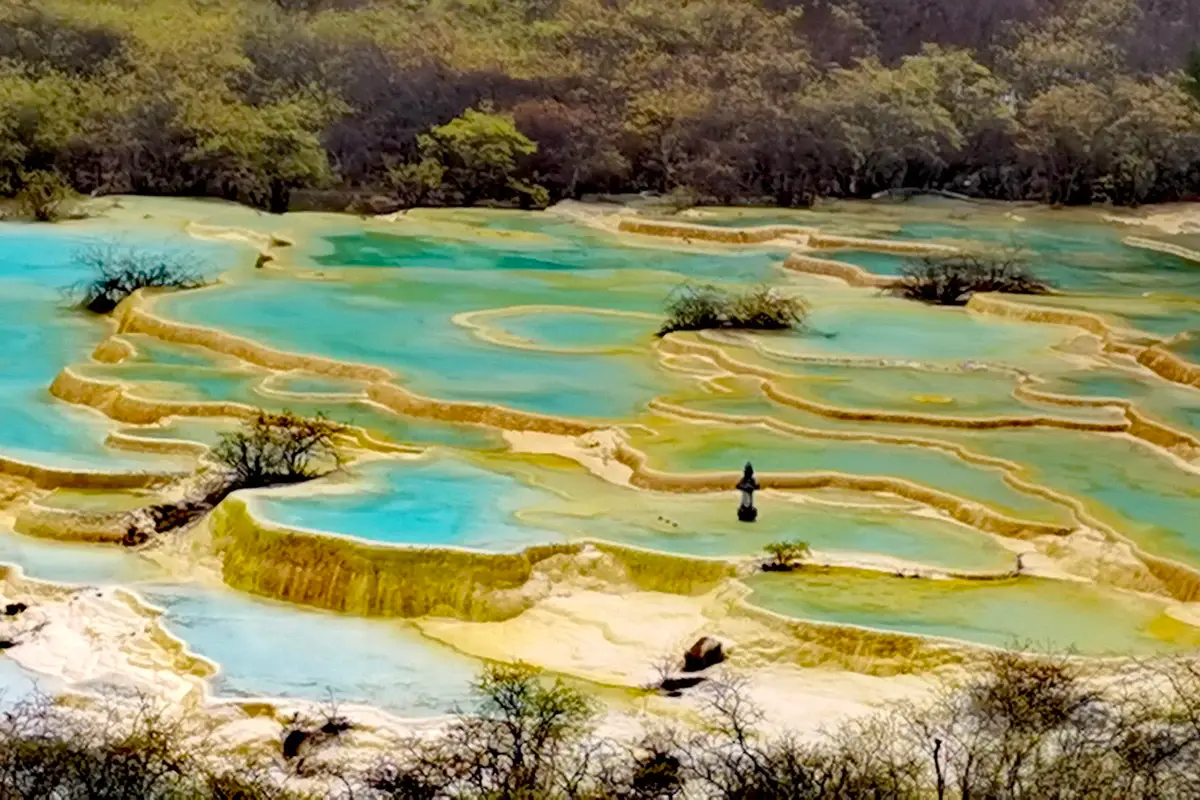
Day 4: We slept well and picked up breakfast at 5:20 a.m. to head for Huanglong. Huanglong is famous worldwide for its 'Four Wonders': colorful pools, snow-capped mountains, canyons, and forests. Together with beach streams, ancient temples, and folk customs, it's known as the 'Seven Wonders.' It is the only well-preserved high-altitude wetland in China, 100 kilometers from Jiuzhaigou, with altitudes ranging from 1,700 to 5,588 meters. We arrived at Huanglong at 8 a.m. Cailian bought a walking stick. The plan was to take the cable car up and walk down. Guide Gu said that those with physical strength and no altitude sickness could walk 2.5 kilometers from the upper cable car station to Five-Color Pond; those weak or with altitude sickness could go down and view the Competing Color Pools. Hearing that from the upper cable car station to Five-Color Pond was 2.5 kilometers (5 km round trip), Cailian was worried about her knees and decided not to go to Five-Color Pond. She would slowly descend and wait for me at the Competing Color Pools. I had to go alone. The Huanglong scenic area is simple—just follow the plank paths; you can't go wrong. From the upper cable car station, climb another 2.5 kilometers to reach Five-Color Pond. Five-Color Pond is at an altitude of 3,576 meters, the highest point in Huanglong. It is a group of calcified travertine pools at the top of Huanglong, consisting of 693 pools, like colorful pearls set in the primeval forest, known as 'Heavenly Pond on Earth.' The weather was great today—blue sky, white clouds, green mountains. The main peak of the Minshan Mountains, Xuebaoding, standing 5,588 meters high, loomed in front of us. Strolling along the pools, countless pools of various sizes and shapes looked like a palette filled with colorful paints—blue-green, ocean blue, light blue, etc.—vivid and extraordinary. They seemed like jade scattered among the mountains by immortals, mysterious and fantastic, known as the 'eyes of Huanglong.' This is the essence of the Huanglong Gully scenic area. No photography skills needed; every shot is a masterpiece. I'll let the photos do the talking.
After taking panoramic shots, I went down for a close look—the colors appeared different up close. Truly, the view differs from far and near, high and low. I couldn't help but marvel at nature's ingenuity.
Reluctantly leaving Five-Color Pond, I headed toward Competing Color Pools. On the way down the Huanglong plank path, I met an ordinary porter. I chatted with him briefly and learned that on this plateau over 3,500 meters above sea level, he carries over 100 jin (about 50 kg) of goods each trip, walking 4 kilometers one way (8 km round trip), earning only 80 yuan per trip, and doing 5 trips a day. I felt great respect and sincerely hoped that a more modern transportation method would be found soon!
The descent was full of beautiful sights.
Two kilometers down from Five-Color Pond lies Competing Color Pools (Zhengyan Chi). Covering an area of 20,000 square meters and consisting of 658 pools, it is the second-largest group of travertine pools in Huanglong, at an altitude of 3,454 meters. These pools have the richest and most graceful forms.
Suoluo Yingcai Pool (Rhododendron Reflection Pool): Covers 6,840 square meters, with over 400 pools, at an altitude of 3,415 meters. It is 311 meters above Competing Color Pools and 119 meters below Mingjing Daoying Pool (Mirror Reflection Pool). 'Suoluo' refers to rhododendrons. The pools are surrounded by colorful rhododendrons, which bloom in spring and summer. The emerald pool water, golden travertine walls, and the sky, light, and rhododendrons reflect each other, creating a picturesque scene.
Mirror Reflection Pool (Mingjing Daoying Chi): The pool surface is as smooth as a mirror, with clear, emerald water. The reflections of sky, clouds, snowy peaks, and dense forests are so clear that photographers often can't tell which is right side up when they look at the photos.
From Mirror Reflection Pool to Xishen Cave, there is a travertine flow about 1,500 meters long and 70-120 meters wide, called 'Golden Sand Spread on the Ground.' On the right is Bonsai Pool, consisting of nearly 100 pools nested within each other. The pool bottoms are yellow, white, brown, or gray, and the surfaces are crystal clear. Trees and flowers grow around and inside the pools, forming natural bonsais.
Beautiful sights along the way that I can't name.
As one of the eight wonders of Huanglong, the colorful travertine pools—whether the brilliantly colored Five-Color Pond, the varied Competing Color Pools, or the clear Mirror Reflection Pool—each has its own characteristics and beauty. Seen from different angles and in different seasons, the pools show different postures. They are ever-changing and incomparable—a true 'Heavenly Pond on Earth'!
After visiting Huanglong, we had a meat pot cooked with big bones at a Tibetan chieftain's house for lunch and then returned to Chengdu.
We arrived back in Chengdu around 8 p.m. and stayed at a hotel near Wuhou Shrine. We had dinner at a restaurant next to the hotel: sliced pork with garlic sauce, mapo tofu, pumpkin tips, and dangdang noodles. It was delicious—unfortunately, I forgot to take photos. We walked 22,000 steps today. Cailian had a harder time, moving sideways step by step with her walking stick down the stairs, but she also managed 19,000 steps.
Day 5: We woke up naturally, enjoyed the hotel's buffet breakfast—it was great, with a wide variety. It was the best breakfast of this trip. Our plan for the day was to visit the Chengdu Museum. There happened to be a free guided tour, so we followed the guide and learned about Chengdu's history, customs, the development of shadow puppetry, etc. For lunch, we had mouth-watering chicken, dry-fried pork intestines, and braised pork. Completely satisfied.
At 5:40 p.m., we flew back to Zhuhai. Thus ended our Jiuzhaigou and Huanglong tour successfully.